
seungwonpark/RandWireNN
seungwonpark/RandWireNN has 684 GitHub stars and 134 forks. GitHot measured 0 stars in 24 hours. Last checked 2026-11-19 11:11 UTC. Last push 2019-06-26.
Crecimiento de estrellas medido
- in 24h
- 0
- in 7 days
- Recopilando historial
- in 15 days
- Recopilando historial
- in 1 month
- Recopilando historial
Cambios netos en períodos que se solapan, no totales diarios. Los datos no disponibles se dejan en blanco. Las estrellas indican interés, no calidad.
Acerca de
Implementation of: "Exploring Randomly Wired Neural Networks for Image Recognition"
Aprendizaje automáticoREADME.md
OriginalRandWireNN

Unofficial PyTorch Implementation of: Exploring Randomly Wired Neural Networks for Image Recognition.
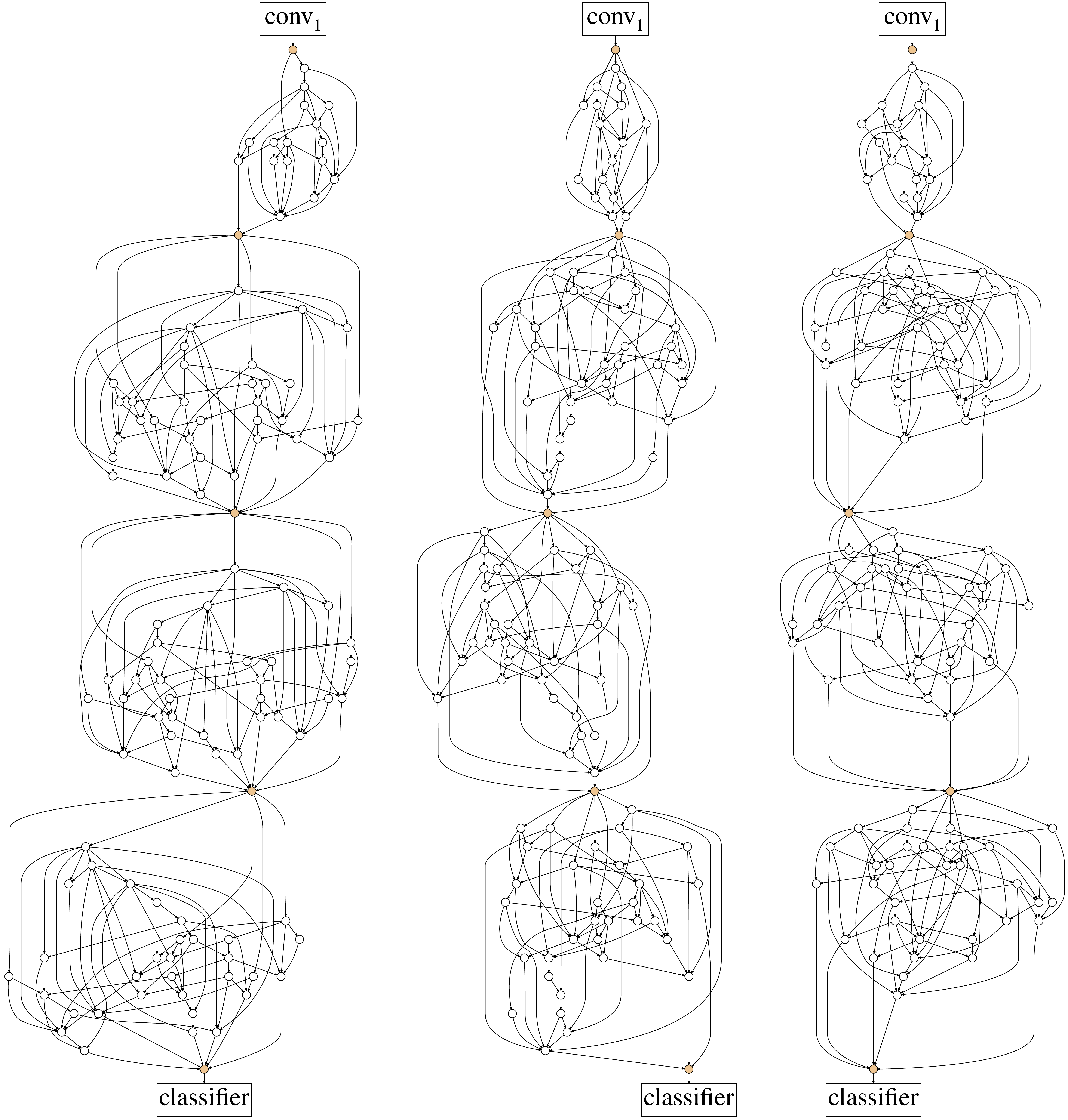
Results
Validation result on Imagenet(ILSVRC2012) dataset:
| Top 1 accuracy (%) | Paper | Here |
|---|---|---|
| RandWire-WS(4, 0.75), C=78 | 74.7 | 69.2 |
- (2019.06.26) 69.2%: 250 epoch with SGD optimizer, lr 0.1, momentum 0.9, weight decay 5e-5, cosine annealing lr schedule (no label smoothing applied, see loss curve below)
- (2019.04.14) 62.6%: 396k steps with SGD optimizer, lr 0.1, momentum 0.9, weigth decay 5e-5, lr decay about 0.1 at 300k
- (2019.04.12) 62.6%: 416k steps with Adabound optimizer, initial lr 0.001(decayed about 0.1 at 300k), final lr 0.1, no weight decay
- (2019.04) JiaminRen's implementation reached accuarcy which is almost close to paper, using identical training strategy with paper.
- (2019.04.10) 63.0%: 450k steps with Adam optimizer, initial lr 0.001, lr decay about 0.1 for every 150k step
- (2019.04.07) 56.8%: Training took about 16 hours on AWS p3.2xlarge(NVIDIA V100). 120k steps were done in total, and Adam optimizer with
lr=0.001, batch_size=128was used with no learning rate decay.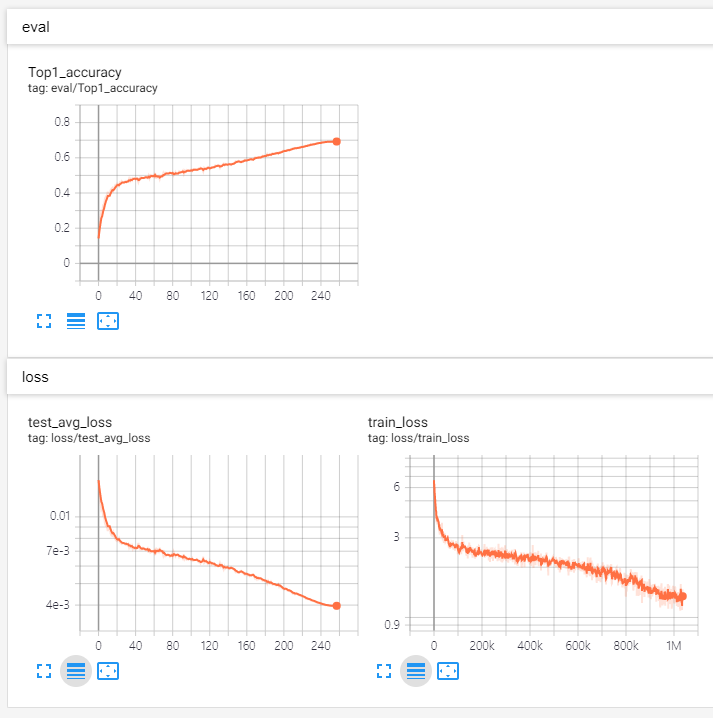
Dependencies
This code was tested on Python 3.6 with PyTorch 1.0.1. Other packages can be installed by:
pip install -r requirements.txt
Generate random DAG
cd model/graphs
python er.py -p 0.2 -o er-02.txt # Erdos-Renyi
python ba.py -m 7 -o ba-7.txt # Barbasi-Albert
python ws.py -k 4 -p 0.75 ws-4-075.txt # Watts-Strogatz
# number of nodes: -n option
All outputs from commands shown above will produce txt file like:
(number of nodes)
(number of edges)
(lines, each line representing edges)
Train RandWireNN
Download ImageNet dataset. Train/val folder should contain list of 1,000 directories, each containing list of images for corresponding category. For validation image files, this script can be useful: https://raw.githubusercontent.com/soumith/imagenetloader.torch/master/valprep.sh
Edit
config.yamlcd config cp default.yaml config.yaml vim config.yaml # specify data directory, graph txt filesTrain
Note. Validation performed here won't use entire test set, since it will consume much time. (about 3 min.)
python trainer.py -c [config yaml] -m [name]View tensorboardX
tensorboard --logdir ./logs
Validation
Run full validation:
python validation.py -c [config path] -p [checkpoint path]
This will show accuracy and average test loss of the trained model.
Author
Seungwon Park / @seungwonpark
License
Apache License 2.0