
patrick-kidger/NeuralCDE
patrick-kidger/NeuralCDE has 722 GitHub stars and 74 forks. GitHot measured -1 stars in 24 hours and -2 in 7 days. Last checked 2026-11-25 05:35 UTC. Last push 2022-10-22.
Crecimiento de estrellas medido
- in 24h
- -1
- in 7 days
- -2
- in 15 days
- Recopilando historial
- in 1 month
- Recopilando historial
Cambios netos en períodos que se solapan, no totales diarios. Los datos no disponibles se dejan en blanco. Las estrellas indican interés, no calidad.
Acerca de
Código para «Ecuaciones diferenciales controladas neuronales para series temporales irregulares» (NeurIPS 2020 Spotlight)
Aprendizaje automáticoREADME.md
Original Neural Controlled Differential Equations for Irregular Time Series
(NeurIPS 2020 Spotlight)
[arXiv, YouTube]
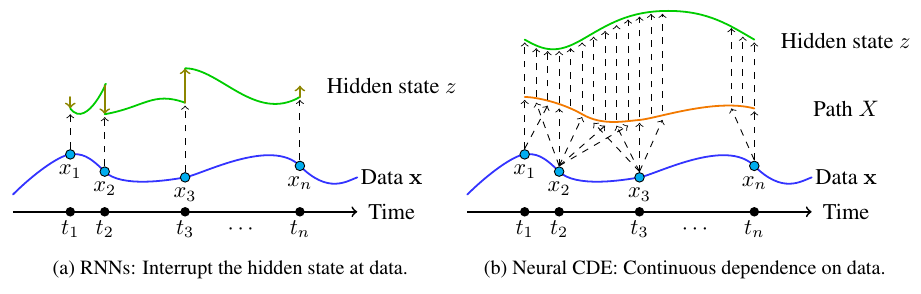
Building on the well-understood mathematical theory of controlled differential equations, we demonstrate how to construct models that:
- Act directly on irregularly-sampled partially-observed multivariate time series.
- May be trained with memory-efficient adjoint backpropagation - even across observations.
- Demonstrate state-of-the-art performance.
They are straightforward to implement and evaluate using existing tools, in particular PyTorch and the torchcde library.
Library
See torchcde.
Example
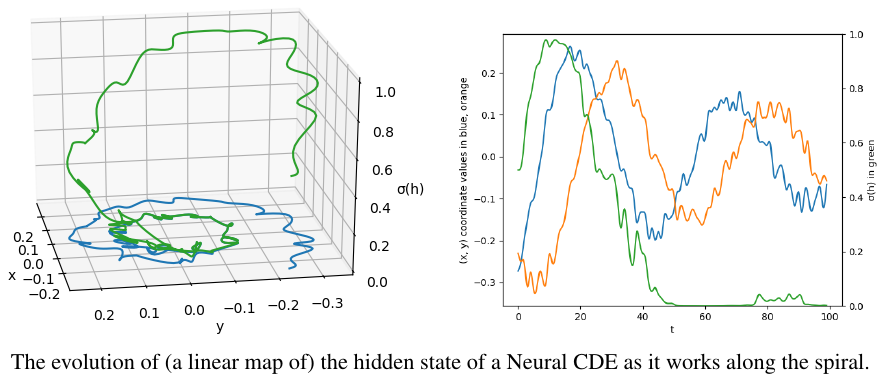
We encourage looking at example.py, which demonstrates how to use the library to train a Neural CDE model to predict the chirality of a spiral.
Also see irregular_data.py, for demonstrations on how to handle variable-length inputs, irregular sampling, or missing data, all of which can be handled easily, without changing the model.
A self contained short example:
import torch
import torchcde

# Create some data
batch, length, input_channels = 1, 10, 2
hidden_channels = 3
t = torch.linspace(0, 1, length)
t_ = t.unsqueeze(0).unsqueeze(-1).expand(batch, length, 1)
x_ = torch.rand(batch, length, input_channels - 1)
x = torch.cat([t_, x_], dim=2)  # include time as a channel

# Interpolate it
coeffs = torchcde.natural_cubic_spline_coeffs(x)
X = torchcde.NaturalCubicSpline(coeffs)

# Create the Neural CDE system
class F(torch.nn.Module):
    def __init__(self):
        super(F, self).__init__()
        self.linear = torch.nn.Linear(hidden_channels,
                                      hidden_channels * input_channels)
    def forward(self, t, z):
        return self.linear(z).view(batch, hidden_channels, input_channels)

func = F()
z0 = torch.rand(batch, hidden_channels)

# Integrate it
torchcde.cdeint(X=X, func=func, z0=z0, t=X.interval)
Reproducing experiments
Everything to reproduce the experiments of the paper can be found in the experiments folder. Check the folder for details.
Results
As an example (taken from the paper - have a look there for similar results on other datasets):

Citation
@article{kidger2020neuralcde,
    title={{N}eural {C}ontrolled {D}ifferential {E}quations for {I}rregular {T}ime {S}eries},
    author={Kidger, Patrick and Morrill, James and Foster, James and Lyons, Terry},
    journal={Advances in Neural Information Processing Systems},
    year={2020}
}
Explorar proyectos relacionados
Cargando…