
kylemath/DeepEEG
kylemath/DeepEEG has 288 GitHub stars and 62 forks. GitHot measured 0 stars in 24 hours. Last checked 2026-11-18 23:31 UTC. Last push 2022-11-21.
Crecimiento de estrellas medido
- in 24h
- 0
- in 7 days
- Recopilando historial
- in 15 days
- Recopilando historial
- in 1 month
- Recopilando historial
Cambios netos en períodos que se solapan, no totales diarios. Los datos no disponibles se dejan en blanco. Las estrellas indican interés, no calidad.
Acerca de
Deep Learning with Tensor Flow for EEG MNE Epoch Objects
Aprendizaje automáticoREADME.md
OriginalDeepEEG
MNE/Keras/Tensorflow library for classification of EEG data
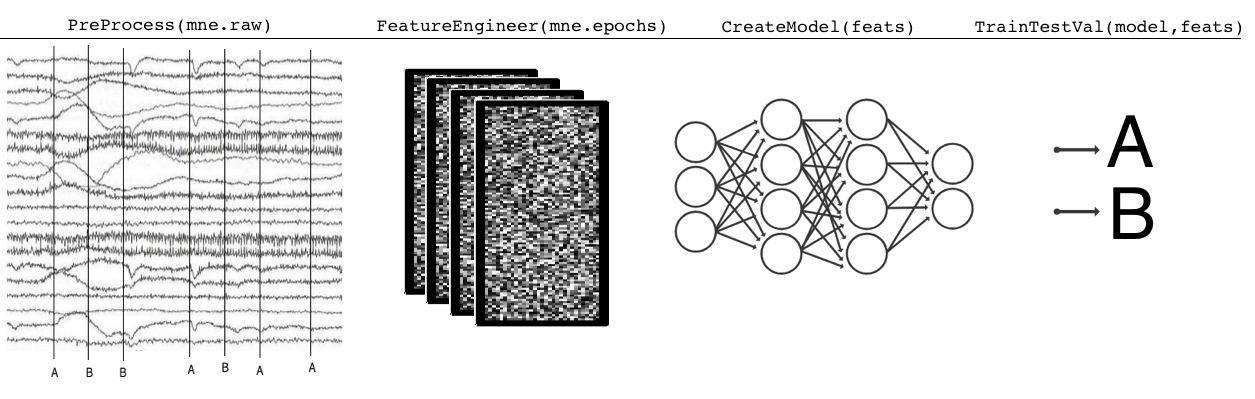
DeepEEG is a Keras/Tensorflow deep learning library that processes EEG trials or raw files from the MNE toolbox as input and predicts binary trial category as output (could scale to multiclass?).
CAN 2019 Poster presentation on DeepEEG - https://docs.google.com/presentation/d/1hO9wKwBVvfXDtUCz7kVRc0A6BsSwX-oVBsDMgrFwLlg/edit?usp=sharing
Collab notebooks for cloud compution
Colab Notebook Example with simulated data: https://colab.research.google.com/github/kylemath/DeepEEG/blob/master/notebooks/DeepEEG_Sim.ipynb
Colab Notebook Example with data from Brain Vision Recorder in google drive: https://colab.research.google.com/github/kylemath/DeepEEG/blob/master/notebooks/Deep_EEG_BV.ipynb
Colab Notebook Example with muse data from NeurotechX eeg-notebooks: https://colab.research.google.com/github/kylemath/DeepEEG/blob/master/notebooks/Deep_EEG_Muse.ipynb
Getting Started Locally:
DeepEEG is tested on macOS 10.14 with Python3. Prepare your environment the first time:
# using virtualenv
 python3 -m venv deepeeg
 source deepeeg/bin/activate
# using conda
#conda create -n deepeeg python=3
#source activate deepeeg
git clone https://github.com/kylemath/DeepEEG/
cd DeepEEG
./install.sh
git clone https://github.com/kylemath/eeg-notebooks_v0.1
You are now ready to run DeepEEG.
For example, type python and use the following:
This loads in some example data from eeg-notebooks
from utils import *
data_dir = 'visual/cueing'
subs = [101,102]
nsesh = 2
event_id = {'LeftCue': 1,'RightCue': 2}
Load muse data, preprocess into trials,prepare for model, create model, and train and test model
#Load Data
raw = LoadMuseData(subs,nsesh,data_dir)
#Pre-Process EEG Data
epochs = PreProcess(raw,event_id)
#Engineer Features for Model
feats = FeatureEngineer(epochs)
#Create Model
model,_ = CreateModel(feats)
#Train with validation, then Test
TrainTestVal(model,feats)
Tests
You can run the unittests with the following command:
python -m unittest tests
Strategy
- Load in Brain Products or Interaxon Muse files with mne as mne.raw,
- PreProcess(mne.raw) - normal ERP preprocessing to get trials by time by electrode mne.epochs
- FeatureEngineer(mne.epochs) - Either time domain or frequency domain feature extraction in DeepEEG.Feats class
- CreateModel(DeepEEG.Feats) - Customizes DeepEEG.Model for input data, pick from NN, CNN, LSTM, or AutoEncoders, splits data
- TrainTestVal(DeepEEG.Feats,DeepEEG.Model) - Train the model, validate it during training, and test it once complete, Plot loss during learning and at test
Dataset example
- Interaxon Muse - eeg-notebooks - https://github.com/kylemath/eeg-notebooks
- Brain Recorder Data
API
- Input the data directory and subject numbers of any eeg-notebook experiment (https://github.com/kylemath/eeg-notebooks)
- Load in .vhdr brain products files by filename with mne io features
- FeatureEngineer can load any mne Epoch object too - https://martinos.org/mne/stable/generated/mne.Epochs.html
Preprocessing
- To be moved to another repo eventually
- Bandpass filter
- Regression Eye movement correction (if eye channels)
- EOG Regression example: https://cbrnr.github.io/2017/10/20/removing-eog-regression/
- Original emcp paper: https://apps.dtic.mil/dtic/tr/fulltext/u2/a125699.pdf
- Generalized emcp paper: http://www.kylemathewson.com/wp-content/uploads/2010/03/MillerGrattonYee-1988-GeneralizeOcularRemoval.pdf
- 1988 Fortran, Gehring C code: http://gehringlab.org/emcp2001.zip
- Matlab implementation: https://github.com/kylemath/MathewsonMatlabTools/blob/master/EEG_analysis/gratton_emcp.m
- Epoch segmentation (time limits, baseline correction)
- Artifact rejection
LearningModels
- First try basic Neural Network (NN)
- Then try Convolution Neural Net (CNN)
- New is a 3D convolutional NN (CNN3D) in the frequency domain
- Then try Long-Short Term Memory Recurrant Neural Net (LSTM)
- Can also try using (AUTO) or (AUTODeep) to clean eeg data, or create features for other models
DataModels
- Try subject specific models
- Then pool data over all subjects
- Then try multilevel models (in the works)
Benchmarks
- Goal build models that can be integrated with https://github.com/NeuroTechX/moabb/
Code References
- https://github.com/kylemath/eeg-notebooks
- https://github.com/mne-tools/mne-python
- https://github.com/keras-team/keras/blob/master/examples/imdb_cnn_lstm.py
- https://github.com/ml4a/ml4a-guides/blob/master/notebooks/keras_classification.ipynb
- https://github.com/tevisgehr/EEG-Classification