
kosua20/herebedragons
kosua20/herebedragons has 1,795 GitHub stars and 82 forks. GitHot measured 0 stars in 24 hours, 0 in 7 days, and -1 in 15 days. Last checked 2026-11-25 03:15 UTC. Last push 2025-07-11.
Crecimiento de estrellas medido
- in 24h
- 0
- in 7 days
- 0
- in 15 days
- -1
- in 1 month
- Recopilando historial
Cambios netos en períodos que se solapan, no totales diarios. Los datos no disponibles se dejan en blanco. Las estrellas indican interés, no calidad.
Acerca de
Una escena 3D básica implementada con distintos motores, frameworks o API.
Creación y multimediaREADME.md
OriginalHere be dragons
Hic sunt dracones.
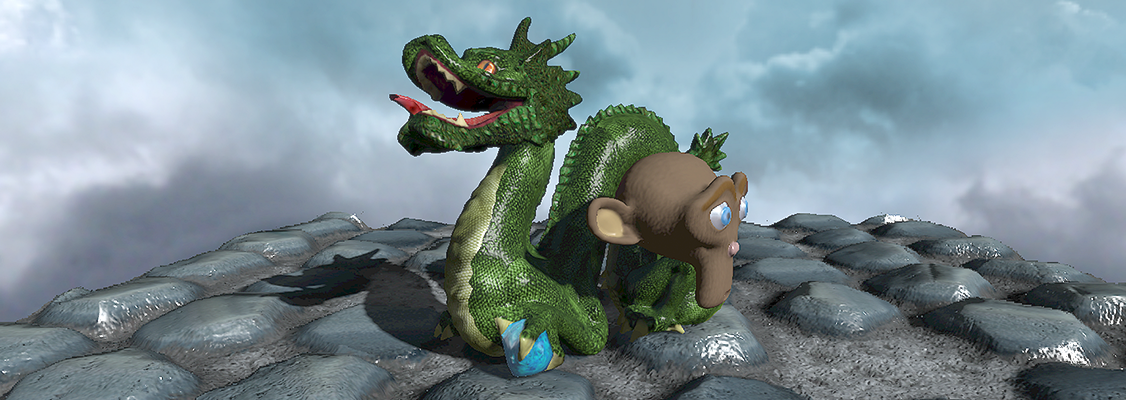
This repository contains multiple implementations of the same 3D scene, using different APIs and frameworks on various platforms. The goal is to provide a comparison between multiple rendering methods. This is inherently biased due to the variety of algorithms used and available CPU/GPU configurations, but can hopefully still provide interesting insights on 3D rendering. You can check a video of most versions runnning here (Youtube)
The following versions are currently available:
- OpenGL
- WebGL
- Vulkan
- WebGPU
- Metal
- SceneKit
- Godot
- Unity
- Unreal
- Blender Cycles
- Ptah (a custom real-time renderer, see the Github page)
- Nintendo DS
- Nintendo Game Boy Advance
- PlayStation 2
- PICO-8
- Vectrex
- Glide
- DX9
- DX11
- DX12
- Dreamcast
The following versions are (tentatively) planned:
- OpenGL ES
- other console hardwares
- other engines
- another raytracing approach
In the directory of each version, you can find the source code, the corresponding resources (as each method has its own format/quality constraints), along with a readme describing the method and a few examples.
Resources
The scene is composed of four main elements:
- a plane representing the ground, with a pavement texture.
- a dragon (the Stanford dragon).
- a monkey head ('Suzanne') rotating around its vertical axis.
- a skybox surrounding the scene, textured with a cloudy sky.
Additionally, the sun is simulated by using a directional light, and the camera should be able to rotate around the scene. Note that some versions might provide additional effects, such as soft shadow maps, parallax mapping or screen space ambient occlusion.
The initial 3D models and textures are contained in the opengl/resources directory.
Other implementations
Here you can find implementations using some of the above APIs combined with other programming languages, submitted by awesome people!
- An OpenGL + Python version, by cprogrammer1994: herebedragons-python. (see #11)
- A Vulkan version, by vazgriz: vk_dragons.
Explorar proyectos relacionados
Cargando…