
graykode/xlnet-Pytorch
graykode/xlnet-Pytorch has 580 GitHub stars and 103 forks. GitHot measured 0 in 7 days and 0 in 15 days. Last checked 2026-11-18 10:48 UTC. Last push 2019-07-03.
Crecimiento de estrellas medido
- in 24h
- Actualización retrasada
- in 7 days
- 0
- in 15 days
- 0
- in 1 month
- Recopilando historial
Cambios netos en períodos que se solapan, no totales diarios. Los datos no disponibles se dejan en blanco. Las estrellas indican interés, no calidad.
Acerca de
Simple XLNet implementation with Pytorch Wrapper
Aprendizaje automáticoREADME.md
OriginalXLNet-Pytorch arxiv:1906.08237
Simple XLNet implementation with Pytorch Wrapper!
You can see How XLNet Architecture work in pre-training with small batch size(=1) example.
To Usage
$ git clone https://github.com/graykode/xlnet-Pytorch && cd xlnet-Pytorch

# To use Sentence Piece Tokenizer(pretrained-BERT Tokenizer)
$ pip install pytorch_pretrained_bert

$ python main.py --data ./data.txt --tokenizer bert-base-uncased \
   --seq_len 512 --reuse_len 256 --perm_size 256 \
   --bi_data True --mask_alpha 6 --mask_beta 1 \
   --num_predict 85 --mem_len 384 --num_epoch 100
Also, You can run code in Google Colab easily.
- Hyperparameters for Pretraining in Paper.
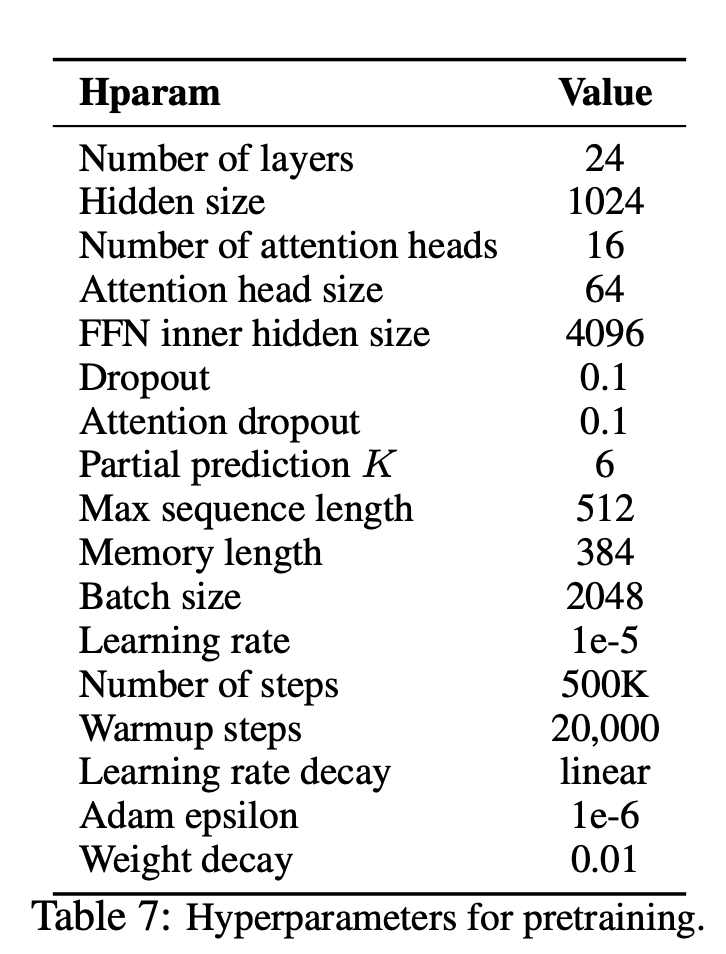
—data(String) :.txtfile to train. It doesn't matter multiline text. Also, one file will be one batch tensor. Default :data.txt—tokenizer(String) : I just used huggingface/pytorch-pretrained-BERT's Tokenizer as subword tokenizer(I'll edit it to sentence piece soon). you can choose inbert-base-uncased,bert-large-uncased,bert-base-cased,bert-large-cased. Default :bert-base-uncased—seq_len(Integer) : Sequence length. Default :512—reuse_len(Interger) : Number of token that can be reused as memory. Could be half ofseq_len. Default :256—perm_size(Interger) : the length of longest permutation. Could be set to be reuse_len. Default :256--bi_data(Boolean) : whether to create bidirectional data. Ifbi_dataisTrue,biz(batch size)should be even number. Default :False—mask_alpha(Interger) : How many tokens to form a group. Defalut :6—mask_beta(Integer) : How many tokens to mask within each group. Default :1—num_predict(Interger) : Num of tokens to predict. In Paper, it mean Partial Prediction. Default :85—mem_len(Interger) : Number of steps to cache in Transformer-XL Architecture. Default :384—num_epoch(Interger) : Number of Epoch. Default :100
What is XLNet?
XLNet is a new unsupervised language representation learning method based on a novel generalized permutation language modeling objective. Additionally, XLNet employs Transformer-XL as the backbone model, exhibiting excellent performance for language tasks involving long context.
- XLNet: Generalized Autoregressive Pretraining for Language Understanding
- Paper Author's XLNet Github
| Model | MNLI | QNLI | QQP | RTE | SST-2 | MRPC | CoLA | STS-B |
|---|---|---|---|---|---|---|---|---|
| BERT | 86.6 | 92.3 | 91.3 | 70.4 | 93.2 | 88.0 | 60.6 | 90.0 |
| XLNet | 89.8 | 93.9 | 91.8 | 83.8 | 95.6 | 89.2 | 63.6 | 91.8 |
Keyword in XLNet
How did XLNet benefit from Auto-Regression and Auto-Encoding models?
- Auto-Regression Model

- Auto-Encoding Model

- Auto-Regression Model
Permutation Language Modeling with Partial Prediction
Permutation Language Modeling
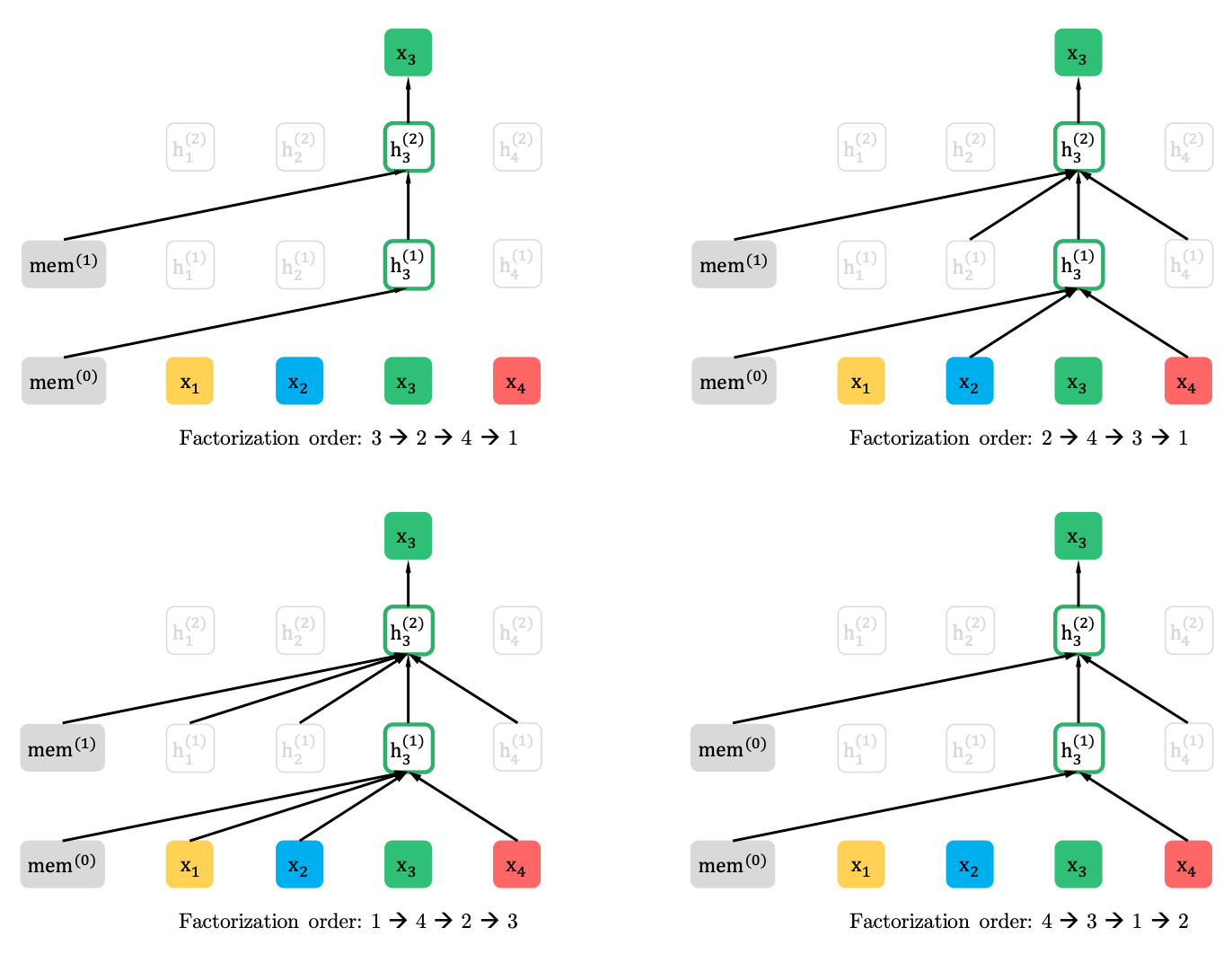
Partial Prediction

Two-Stream Self-Attention with Target-Aware Representation
Two-Stram Self-Attention
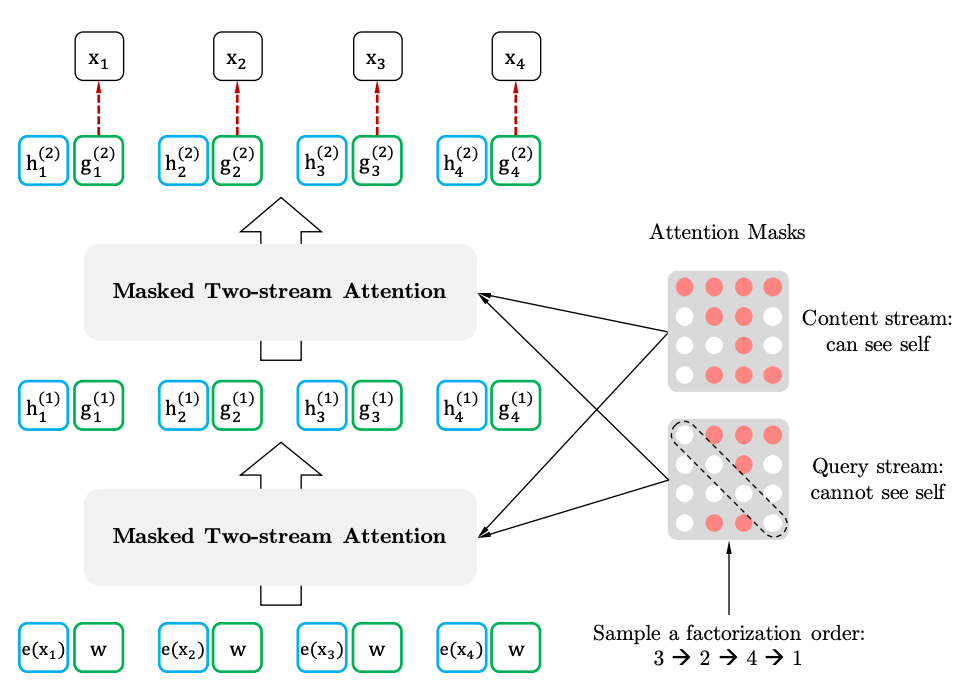
Target-Aware Representation

Author
- Because the original repository is subject to the Apache2.0 license, it is subject to the same license.
- Tae Hwan Jung(Jeff Jung) @graykode, Kyung Hee Univ CE(Undergraduate).
- Author Email : [email protected]