fkodom/fft-conv-pytorch
fkodom/fft-conv-pytorch has 524 GitHub stars and 61 forks. GitHot measured 0 stars in 24 hours and 0 in 7 days. Last checked 2026-11-21 08:04 UTC. Last push 2026-10-16.
Crecimiento de estrellas medido
- in 24h
- 0
- in 7 days
- 0
- in 15 days
- Recopilando historial
- in 1 month
- Recopilando historial
Cambios netos en períodos que se solapan, no totales diarios. Los datos no disponibles se dejan en blanco. Las estrellas indican interés, no calidad.
Acerca de
Implementation of 1D, 2D, and 3D FFT convolutions in PyTorch. Much faster than direct convolutions for large kernel sizes.
Aprendizaje automáticoREADME.md
Originalfft-conv-pytorch
Implementation of 1D, 2D, and 3D FFT convolutions in PyTorch.
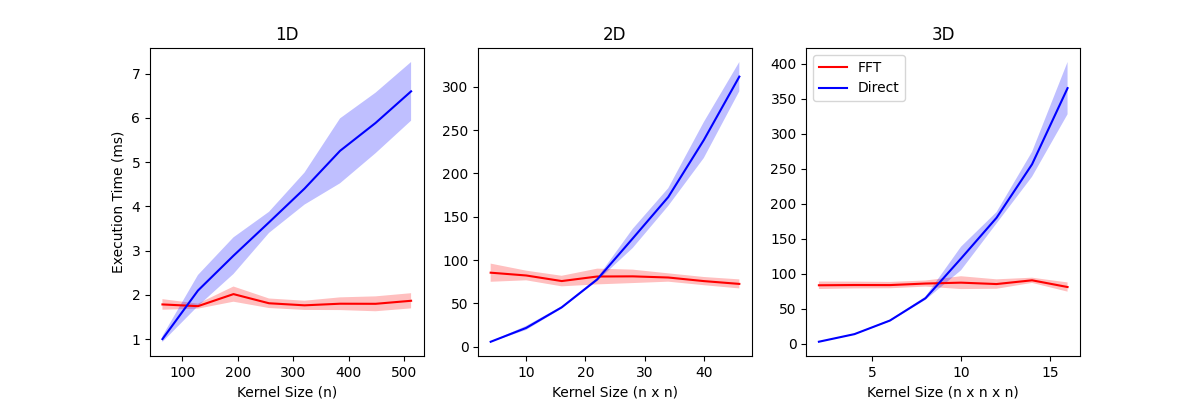
- Faster than direct convolution for large kernels.
- Much slower than direct convolution for small kernels.
- In my local tests, FFT convolution is faster when the kernel has >100 or so elements.
- Dependent on machine and PyTorch version.
- Also see benchmarks below.
For a step-by-step explanation, see my article: Fourier Convolutions in PyTorch.
Install
Using pip:
pip install fft-conv-pytorch
From source:
git clone https://github.com/fkodom/fft-conv-pytorch.git
cd fft-conv-pytorch
pip install .
Example Usage
import torch
from fft_conv_pytorch import fft_conv, FFTConv1d

# Create dummy data.
#     Data shape: (batch, channels, length)
#     Kernel shape: (out_channels, in_channels, kernel_size)
#     Bias shape: (out channels, )
# For ordinary 1D convolution, simply set batch=1.
signal = torch.randn(3, 3, 1024 * 1024)
kernel = torch.randn(2, 3, 128)
bias = torch.randn(2)

# Functional execution.  (Easiest for generic use cases.)
out = fft_conv(signal, kernel, bias=bias)

# Object-oriented execution.  (Requires some extra work, since the
# defined classes were designed for use in neural networks.)
fft_conv = FFTConv1d(3, 2, 128, bias=True)
fft_conv.weight = torch.nn.Parameter(kernel)
fft_conv.bias = torch.nn.Parameter(bias)
out = fft_conv(signal)
Benchmarks
Benchmarking FFT convolution against the direct convolution from PyTorch in 1D, 2D, and 3D. The exact times are heavily dependent on your local machine, but relative scaling with kernel size is always the same.
| Dimensions | Input Size | Input Channels | Output Channels | Bias | Padding | Stride | Dilation |
|---|---|---|---|---|---|---|---|
| 1 | (4096) | 4 | 4 | True | 0 | 1 | 1 |
| 2 | (512, 512) | 4 | 4 | True | 0 | 1 | 1 |
| 3 | (64, 64, 64) | 4 | 4 | True | 0 | 1 | 1 |