
eriklindernoren/ML-From-Scratch
eriklindernoren/ML-From-Scratch has 33,310 GitHub stars and 5,544 forks. GitHot measured +14 stars in 24 hours and +49 in 7 days. Last checked 2026-11-09 15:59 UTC. Last push 2023-10-15.
Aprendizaje automático desde cero. Implementaciones básicas en NumPy de modelos y algoritmos de aprendizaje automático, centradas en la accesibilidad. Su objetivo es abarcar desde la regresión lineal hasta el aprendizaje profundo.
Crecimiento de estrellas medido
- in 24h
- +14
- in 7 days
- +49
- in 15 days
- Recopilando historial
- in 1 month
- Recopilando historial
Cambios netos en períodos que se solapan, no totales diarios. Los datos no disponibles se dejan en blanco. Las estrellas indican interés, no calidad.
README.md
OriginalMachine Learning From Scratch
About
Python implementations of some of the fundamental Machine Learning models and algorithms from scratch.
The purpose of this project is not to produce as optimized and computationally efficient algorithms as possible but rather to present the inner workings of them in a transparent and accessible way.
Table of Contents
Installation
$ git clone https://github.com/eriklindernoren/ML-From-Scratch
$ cd ML-From-Scratch
$ python setup.py install
Examples
Polynomial Regression
$ python mlfromscratch/examples/polynomial_regression.py

Figure: Training progress of a regularized polynomial regression model fitting
temperature data measured in Linköping, Sweden 2016.
Classification With CNN
$ python mlfromscratch/examples/convolutional_neural_network.py

+---------+
| ConvNet |
+---------+
Input Shape: (1, 8, 8)
+----------------------+------------+--------------+
| Layer Type           | Parameters | Output Shape |
+----------------------+------------+--------------+
| Conv2D               | 160        | (16, 8, 8)   |
| Activation (ReLU)    | 0          | (16, 8, 8)   |
| Dropout              | 0          | (16, 8, 8)   |
| BatchNormalization   | 2048       | (16, 8, 8)   |
| Conv2D               | 4640       | (32, 8, 8)   |
| Activation (ReLU)    | 0          | (32, 8, 8)   |
| Dropout              | 0          | (32, 8, 8)   |
| BatchNormalization   | 4096       | (32, 8, 8)   |
| Flatten              | 0          | (2048,)      |
| Dense                | 524544     | (256,)       |
| Activation (ReLU)    | 0          | (256,)       |
| Dropout              | 0          | (256,)       |
| BatchNormalization   | 512        | (256,)       |
| Dense                | 2570       | (10,)        |
| Activation (Softmax) | 0          | (10,)        |
+----------------------+------------+--------------+
Total Parameters: 538570

Training: 100% [------------------------------------------------------------------------] Time: 0:01:55
Accuracy: 0.987465181058

Figure: Classification of the digit dataset using CNN.
Density-Based Clustering
$ python mlfromscratch/examples/dbscan.py

Figure: Clustering of the moons dataset using DBSCAN.
Generating Handwritten Digits
$ python mlfromscratch/unsupervised_learning/generative_adversarial_network.py

+-----------+
| Generator |
+-----------+
Input Shape: (100,)
+------------------------+------------+--------------+
| Layer Type             | Parameters | Output Shape |
+------------------------+------------+--------------+
| Dense                  | 25856      | (256,)       |
| Activation (LeakyReLU) | 0          | (256,)       |
| BatchNormalization     | 512        | (256,)       |
| Dense                  | 131584     | (512,)       |
| Activation (LeakyReLU) | 0          | (512,)       |
| BatchNormalization     | 1024       | (512,)       |
| Dense                  | 525312     | (1024,)      |
| Activation (LeakyReLU) | 0          | (1024,)      |
| BatchNormalization     | 2048       | (1024,)      |
| Dense                  | 803600     | (784,)       |
| Activation (TanH)      | 0          | (784,)       |
+------------------------+------------+--------------+
Total Parameters: 1489936

+---------------+
| Discriminator |
+---------------+
Input Shape: (784,)
+------------------------+------------+--------------+
| Layer Type             | Parameters | Output Shape |
+------------------------+------------+--------------+
| Dense                  | 401920     | (512,)       |
| Activation (LeakyReLU) | 0          | (512,)       |
| Dropout                | 0          | (512,)       |
| Dense                  | 131328     | (256,)       |
| Activation (LeakyReLU) | 0          | (256,)       |
| Dropout                | 0          | (256,)       |
| Dense                  | 514        | (2,)         |
| Activation (Softmax)   | 0          | (2,)         |
+------------------------+------------+--------------+
Total Parameters: 533762
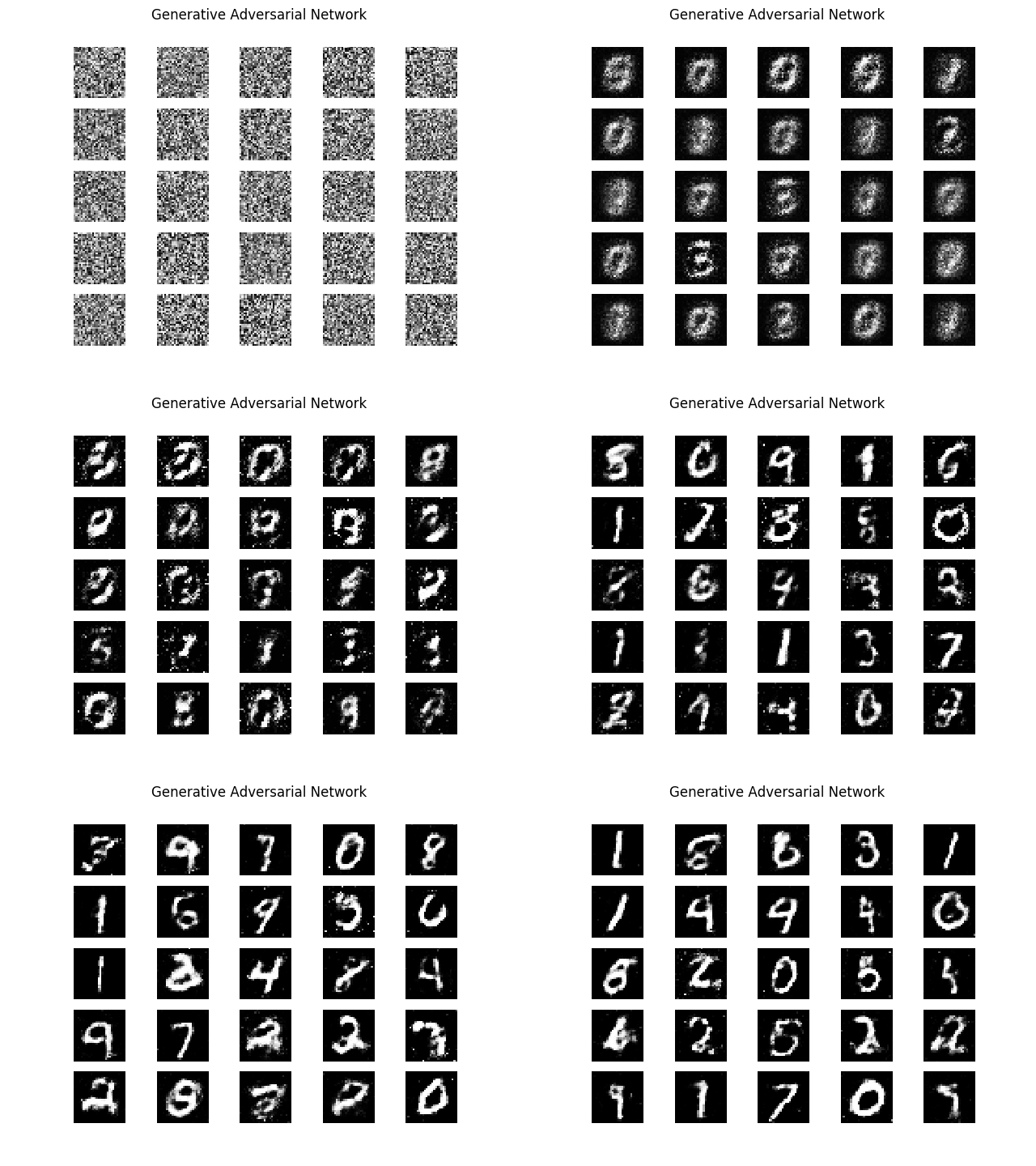
Figure: Training progress of a Generative Adversarial Network generating
handwritten digits.
Deep Reinforcement Learning
$ python mlfromscratch/examples/deep_q_network.py

+----------------+
| Deep Q-Network |
+----------------+
Input Shape: (4,)
+-------------------+------------+--------------+
| Layer Type        | Parameters | Output Shape |
+-------------------+------------+--------------+
| Dense             | 320        | (64,)        |
| Activation (ReLU) | 0          | (64,)        |
| Dense             | 130        | (2,)         |
+-------------------+------------+--------------+
Total Parameters: 450

Figure: Deep Q-Network solution to the CartPole-v1 environment in OpenAI gym.
Image Reconstruction With RBM
$ python mlfromscratch/examples/restricted_boltzmann_machine.py
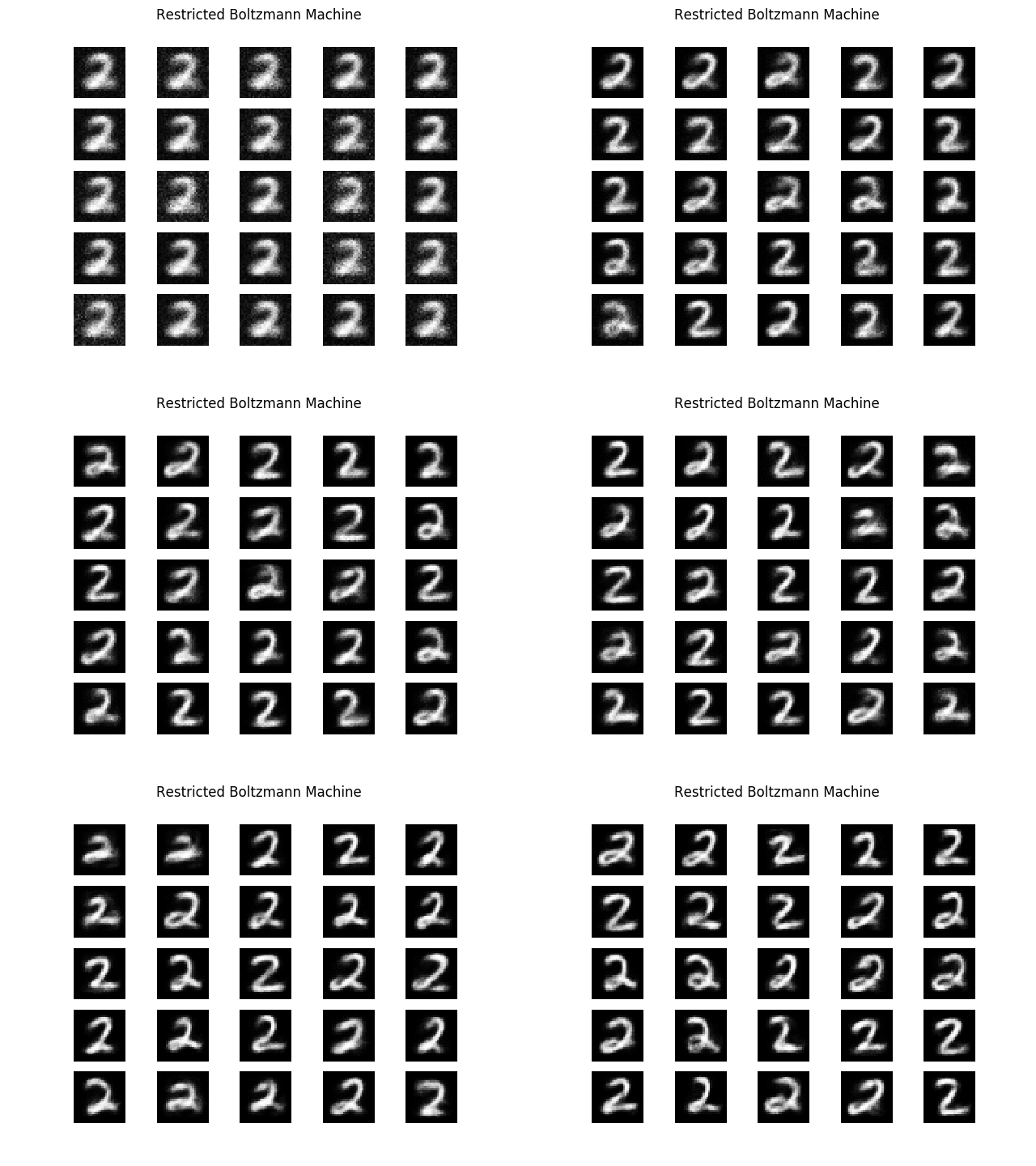
Figure: Shows how the network gets better during training at reconstructing
the digit 2 in the MNIST dataset.
Evolutionary Evolved Neural Network
$ python mlfromscratch/examples/neuroevolution.py

+---------------+
| Model Summary |
+---------------+
Input Shape: (64,)
+----------------------+------------+--------------+
| Layer Type           | Parameters | Output Shape |
+----------------------+------------+--------------+
| Dense                | 1040       | (16,)        |
| Activation (ReLU)    | 0          | (16,)        |
| Dense                | 170        | (10,)        |
| Activation (Softmax) | 0          | (10,)        |
+----------------------+------------+--------------+
Total Parameters: 1210

Population Size: 100
Generations: 3000
Mutation Rate: 0.01

[0 Best Individual - Fitness: 3.08301, Accuracy: 10.5%]
[1 Best Individual - Fitness: 3.08746, Accuracy: 12.0%]
...
[2999 Best Individual - Fitness: 94.08513, Accuracy: 98.5%]
Test set accuracy: 96.7%

Figure: Classification of the digit dataset by a neural network which has
been evolutionary evolved.
Genetic Algorithm
$ python mlfromscratch/examples/genetic_algorithm.py

+--------+
|   GA   |
+--------+
Description: Implementation of a Genetic Algorithm which aims to produce
the user specified target string. This implementation calculates each
candidate's fitness based on the alphabetical distance between the candidate
and the target. A candidate is selected as a parent with probabilities proportional
to the candidate's fitness. Reproduction is implemented as a single-point
crossover between pairs of parents. Mutation is done by randomly assigning
new characters with uniform probability.

Parameters
----------
Target String: 'Genetic Algorithm'
Population Size: 100
Mutation Rate: 0.05

[0 Closest Candidate: 'CJqlJguPlqzvpoJmb', Fitness: 0.00]
[1 Closest Candidate: 'MCxZxdr nlfiwwGEk', Fitness: 0.01]
[2 Closest Candidate: 'MCxZxdm nlfiwwGcx', Fitness: 0.01]
[3 Closest Candidate: 'SmdsAklMHn kBIwKn', Fitness: 0.01]
[4 Closest Candidate: '  lotneaJOasWfu Z', Fitness: 0.01]
...
[292 Closest Candidate: 'GeneticaAlgorithm', Fitness: 1.00]
[293 Closest Candidate: 'GeneticaAlgorithm', Fitness: 1.00]
[294 Answer: 'Genetic Algorithm']
Association Analysis
$ python mlfromscratch/examples/apriori.py
+-------------+
|   Apriori   |
+-------------+
Minimum Support: 0.25
Minimum Confidence: 0.8
Transactions:
    [1, 2, 3, 4]
    [1, 2, 4]
    [1, 2]
    [2, 3, 4]
    [2, 3]
    [3, 4]
    [2, 4]
Frequent Itemsets:
    [1, 2, 3, 4, [1, 2], [1, 4], [2, 3], [2, 4], [3, 4], [1, 2, 4], [2, 3, 4]]
Rules:
    1 -> 2 (support: 0.43, confidence: 1.0)
    4 -> 2 (support: 0.57, confidence: 0.8)
    [1, 4] -> 2 (support: 0.29, confidence: 1.0)
Implementations
Supervised Learning
- Adaboost
- Bayesian Regression
- Decision Tree
- Elastic Net
- Gradient Boosting
- K Nearest Neighbors
- Lasso Regression
- Linear Discriminant Analysis
- Linear Regression
- Logistic Regression
- Multi-class Linear Discriminant Analysis
- Multilayer Perceptron
- Naive Bayes
- Neuroevolution
- Particle Swarm Optimization of Neural Network
- Perceptron
- Polynomial Regression
- Random Forest
- Ridge Regression
- Support Vector Machine
- XGBoost
Unsupervised Learning
- Apriori
- Autoencoder
- DBSCAN
- FP-Growth
- Gaussian Mixture Model
- Generative Adversarial Network
- Genetic Algorithm
- K-Means
- Partitioning Around Medoids
- Principal Component Analysis
- Restricted Boltzmann Machine
Reinforcement Learning
Deep Learning
- Neural Network
- Layers
- Activation Layer
- Average Pooling Layer
- Batch Normalization Layer
- Constant Padding Layer
- Convolutional Layer
- Dropout Layer
- Flatten Layer
- Fully-Connected (Dense) Layer
- Fully-Connected RNN Layer
- Max Pooling Layer
- Reshape Layer
- Up Sampling Layer
- Zero Padding Layer
- Model Types
Contact
If there's some implementation you would like to see here or if you're just feeling social, feel free to email me or connect with me on LinkedIn.
Explorar proyectos relacionados
tensorflow/tensorflow
Un framework de código abierto de aprendizaje automático para todos
201,400 estrellashuggingface/transformers
🤗 Transformers: el framework de definición de modelos para modelos de aprendizaje automático de vanguardia en texto, visión, audio y multimodal, tanto para inferencia como para entrenamiento.
168,668 estrellasAUTOMATIC1111/stable-diffusion-webui
Interfaz web de Stable Diffusion
165,261 estrellasComfy-Org/ComfyUI
La GUI, la API y el backend más potentes y modulares para modelos de difusión, con una interfaz de grafos y nodos. El motor de inferencia local más rápido del mundo.
145,835 estrellas