
bshall/hubert
bshall/hubert has 411 GitHub stars and 60 forks. GitHot measured 0 stars in 24 hours. Last checked 2026-11-19 18:16 UTC. Last push 2024-10-01.
Crecimiento de estrellas medido
- in 24h
- 0
- in 7 days
- Recopilando historial
- in 15 days
- Recopilando historial
- in 1 month
- Recopilando historial
Cambios netos en períodos que se solapan, no totales diarios. Los datos no disponibles se dejan en blanco. Las estrellas indican interés, no calidad.
Acerca de
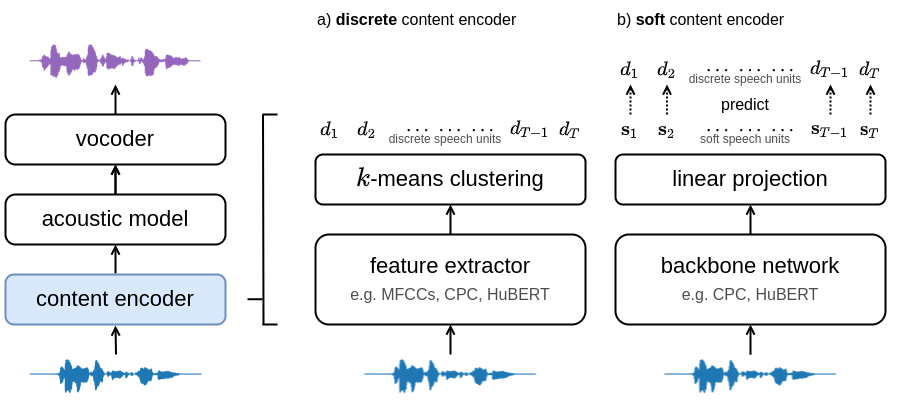
HuBERT content encoders for: A Comparison of Discrete and Soft Speech Units for Improved Voice Conversion
Aprendizaje automáticoREADME.md
OriginalHuBERT


Training and inference scripts for the HuBERT content encoders in A Comparison of Discrete and Soft Speech Units for Improved Voice Conversion. For more details see soft-vc. Audio samples can be found here. Colab demo can be found here.
Example Usage
Programmatic Usage
import torch, torchaudio

# Load checkpoint (either hubert_soft or hubert_discrete)
hubert = torch.hub.load("bshall/hubert:main", "hubert_soft", trust_repo=True).cuda()

# Load audio
wav, sr = torchaudio.load("path/to/wav")
assert sr == 16000
wav = wav.unsqueeze(0).cuda()

# Extract speech units
units = hubert.units(x)
Script-Based Usage
usage: encode.py [-h] [--extension EXTENSION] {soft,discrete} in-dir out-dir

Encode an audio dataset.

positional arguments:
  {soft,discrete}       available models (HuBERT-Soft or HuBERT-Discrete)
  in-dir                path to the dataset directory.
  out-dir               path to the output directory.

optional arguments:
  -h, --help            show this help message and exit
  --extension EXTENSION
                        extension of the audio files (defaults to .flac).
Training
Step 1: Dataset Preparation
Download and extract the LibriSpeech corpus. The training script expects the following tree structure for the dataset directory:
│   lengths.json
│
└───wavs
    ├───dev-*
    │   ├───84
    │   ├───...
    │   └───8842
    └───train-*
        ├───19
        ├───...
        └───8975
The train-* and dev-* directories should contain the training and validation splits respectively. Note that there can be multiple train and dev folders e.g., train-clean-100, train-other-500, etc. Finally, the lengths.json file should contain key-value pairs with the file path and number of samples:
{
    "dev-clean/1272/128104/1272-128104-0000": 93680,
    "dev-clean/1272/128104/1272-128104-0001": 77040,
}
Step 2: Extract Discrete Speech Units
Encode LibriSpeech using the HuBERT-Discrete model and encode.py script:
usage: encode.py [-h] [--extension EXTENSION] {soft,discrete} in-dir out-dir

Encode an audio dataset.

positional arguments:
  {soft,discrete}       available models (HuBERT-Soft or HuBERT-Discrete)
  in-dir                path to the dataset directory.
  out-dir               path to the output directory.

optional arguments:
  -h, --help            show this help message and exit
  --extension EXTENSION
                        extension of the audio files (defaults to .flac).
for example:
python encode.py discrete path/to/LibriSpeech/wavs path/to/LibriSpeech/discrete
At this point the directory tree should look like:
│   lengths.json
│
├───discrete
│   ├───...
└───wavs
    ├───...
Step 3: Train the HuBERT-Soft Content Encoder
usage: train.py [-h] [--resume RESUME] [--warmstart] [--mask] [--alpha ALPHA] dataset-dir checkpoint-dir

Train HuBERT soft content encoder.

positional arguments:
  dataset-dir      path to the data directory.
  checkpoint-dir   path to the checkpoint directory.

optional arguments:
  -h, --help       show this help message and exit
  --resume RESUME  path to the checkpoint to resume from.
  --warmstart      whether to initialize from the fairseq HuBERT checkpoint.
  --mask           whether to use input masking.
  --alpha ALPHA    weight for the masked loss.
Links
Citation
If you found this work helpful please consider citing our paper:
@inproceedings{
    soft-vc-2022,
    author={van Niekerk, Benjamin and Carbonneau, Marc-André and Zaïdi, Julian and Baas, Matthew and Seuté, Hugo and Kamper, Herman},
    booktitle={ICASSP},
    title={A Comparison of Discrete and Soft Speech Units for Improved Voice Conversion},
    year={2022}
}