
bdsaglam/torch-scae
bdsaglam/torch-scae has 38 GitHub stars and 9 forks. GitHot measured 0 stars in 24 hours and 0 in 7 days. Last checked 2026-11-20 11:42 UTC. Last push 2026-09-23.
Crecimiento de estrellas medido
- in 24h
- 0
- in 7 days
- 0
- in 15 days
- Recopilando historial
- in 1 month
- Recopilando historial
Cambios netos en períodos que se solapan, no totales diarios. Los datos no disponibles se dejan en blanco. Las estrellas indican interés, no calidad.
Acerca de
PyTorch implementation of Stacked Capsule Auto-Encoders
Aprendizaje automáticoREADME.md
Originaltorch-scae
PyTorch implementation of Stacked Capsule Auto-Encoders [1].
Ported from official implementation with TensorFlow v1. The architecture of model and hyper-parameters are kept same. However, some parts are refactored for ease of use.
Please, open an issue for bugs and inconsistencies with original implementation.
Installation
# clone project
git clone https://github.com/bdsaglam/torch-scae

# install project
cd torch-scae
pip install -e .
Train with MNIST 
It uses PyTorch Lightning for training and Hydra for configuration management.
# CPU
python -m torch_scae_experiments.mnist.train

# GPU
python -m torch_scae_experiments.mnist.train +trainer.accelerator=gpu +trainer.devices=1
You can customize model hyperparameters and training with Hydra syntax.
python -m torch_scae_experiments.mnist.train \
    data_loader.batch_size=32 \
    optimizer.learning_rate=1e-4 \
    model.n_part_caps=16 \
    trainer.max_steps=100000
Evaluate a checkpoint with linear probes and with k-means clustering plus bipartite matching, as in the paper:
python -m torch_scae_experiments.mnist.evaluate path/to/last.ckpt
Results
Unsupervised classification accuracy (%) on the 40x40 MNIST test set after
300k steps with the default configuration, which follows the reference
run_mnist.sh (40 part capsules, 32 object capsules).
| LIN-MATCH | LIN-PRED | |
|---|---|---|
| Paper [1], Table 1 (5 runs) | 98.7 (0.35) | 99.0 (0.07) |
| This implementation, seed 42 | 98.6 | 98.9 |
| This implementation, seed 43 | 98.7 | 98.8 |
LIN-MATCH fits k-means with 10 clusters on the object capsule presences of the training set and matches clusters to labels; the table reports the posterior presences. LIN-PRED is the better of the two linear probes trained alongside the model. Training takes about 4 hours on an A100.
Image reconstructions
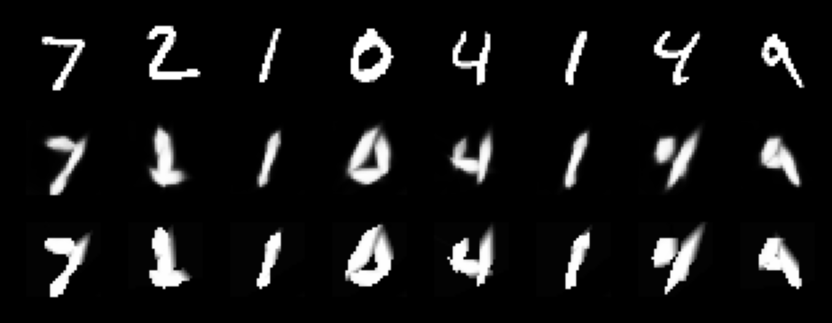
Fig 1. Rows: test images and their reconstructions
References
- Kosiorek, A. R., Sabour, S., Teh, Y. W., & Hinton, G. E. (2019). Stacked Capsule Autoencoders. NeurIPS. http://arxiv.org/abs/1906.06818