
bcicen/jstream
bcicen/jstream has 598 GitHub stars and 40 forks. GitHot measured 0 stars in 24 hours and 0 in 7 days. Last checked 2026-11-24 17:21 UTC. Last push 2023-10-23.
Crecimiento de estrellas medido
- in 24h
- 0
- in 7 days
- 0
- in 15 days
- Recopilando historial
- in 1 month
- Recopilando historial
Cambios netos en períodos que se solapan, no totales diarios. Los datos no disponibles se dejan en blanco. Las estrellas indican interés, no calidad.
Acerca de
Streaming JSON parser for Go
Herramientas de desarrolloREADME.md
Original

jstream is a streaming JSON parser and value extraction library for Go.
Unlike most JSON parsers, jstream is document position- and depth-aware -- this enables the extraction of values at a specified depth, eliminating the overhead of allocating encompassing arrays or objects; e.g:
Using the below example document:
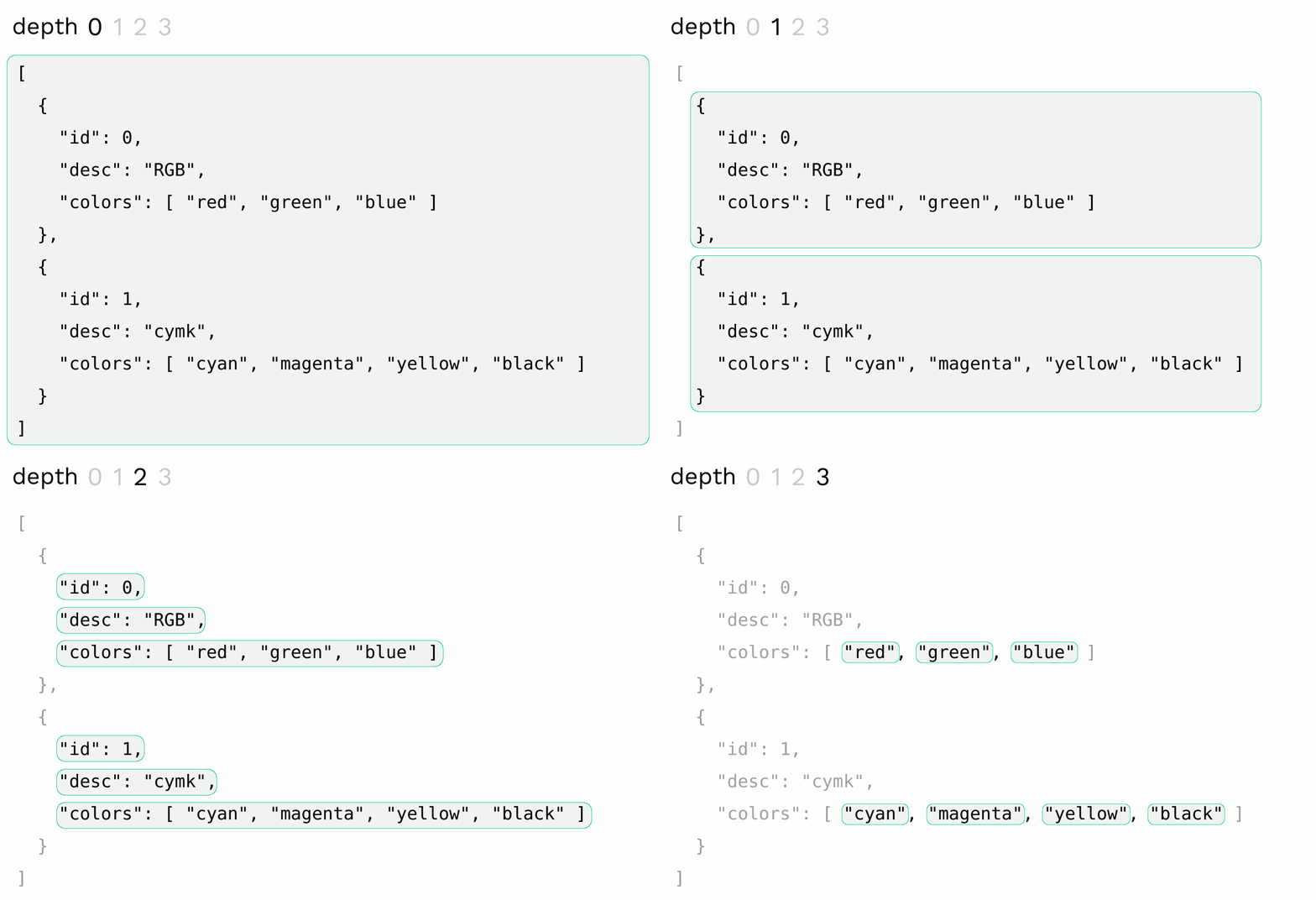
we can choose to extract and act only the objects within the top-level array:
f, _ := os.Open("input.json")
decoder := jstream.NewDecoder(f, 1) // extract JSON values at a depth level of 1
for mv := range decoder.Stream() {
  fmt.Printf("%v\n ", mv.Value)
}
output:
map[desc:RGB colors:[red green blue]]
map[desc:CMYK colors:[cyan magenta yellow black]]
likewise, increasing depth level to 3 yields:
red
green
blue
cyan
magenta
yellow
black
optionally, kev:value pairs can be emitted as an individual struct:
decoder := jstream.NewDecoder(f, 2).EmitKV() // enable KV streaming at a depth level of 2
jstream.KV{desc RGB}
jstream.KV{colors [red green blue]}
jstream.KV{desc CMYK}
jstream.KV{colors [cyan magenta yellow black]}
Installing
go get github.com/bcicen/jstream
Commandline
jstream comes with a cli tool for quick viewing of parsed values from JSON input:
jstream -d 1 < input.json
{"colors":["red","green","blue"],"desc":"RGB"}
{"colors":["cyan","magenta","yellow","black"],"desc":"CMYK"}
detailed output with -v option:
cat input.json | jstream -v -d -1

depth	start	end	type   | value
2	018	023	string | "RGB"
3	041	046	string | "red"
3	048	055	string | "green"
3	057	063	string | "blue"
2	039	065	array  | ["red","green","blue"]
1	004	069	object | {"colors":["red","green","blue"],"desc":"RGB"}
2	087	093	string | "CMYK"
3	111	117	string | "cyan"
3	119	128	string | "magenta"
3	130	138	string | "yellow"
3	140	147	string | "black"
2	109	149	array  | ["cyan","magenta","yellow","black"]
1	073	153	object | {"colors":["cyan","magenta","yellow","black"],"desc":"CMYK"}
0	000	155	array  | [{"colors":["red","green","blue"],"desc":"RGB"},{"colors":["cyan","magenta","yellow","black"],"desc":"CMYK"}]
Options
| Opt | Description |
|---|---|
| -d <n> | emit values at depth n. if n < 0, all values will be emitted |
| -kv | output inner key value pairs as newly formed objects |
| -v | output depth and offset details for each value |
| -h | display help dialog |
Benchmarks
Obligatory benchmarks performed on files with arrays of objects, where the decoded objects are to be extracted.
Two file sizes are used -- regular (1.6mb, 1000 objects) and large (128mb, 100000 objects)
| input size | lib | MB/s | Allocated |
|---|---|---|---|
| regular | standard | 97 | 3.6MB |
| regular | jstream | 175 | 2.1MB |
| large | standard | 92 | 305MB |
| large | jstream | 404 | 69MB |
In a real world scenario, including initialization and reader overhead from varying blob sizes, performance can be expected as below:

Explorar proyectos relacionados
Cargando…