
batzner/indrnn
batzner/indrnn has 513 GitHub stars and 126 forks. GitHot measured 0 stars in 24 hours. Last checked 2026-11-20 12:53 UTC. Last push 2021-08-19.
Crecimiento de estrellas medido
- in 24h
- 0
- in 7 days
- Recopilando historial
- in 15 days
- Recopilando historial
- in 1 month
- Recopilando historial
Cambios netos en períodos que se solapan, no totales diarios. Los datos no disponibles se dejan en blanco. Las estrellas indican interés, no calidad.
Acerca de
TensorFlow implementation of Independently Recurrent Neural Networks
Aprendizaje automáticoREADME.md
OriginalIndependently Recurrent Neural Networks
Simple TensorFlow implementation of Independently Recurrent Neural Network (IndRNN): Building A Longer and Deeper RNN by Shuai Li et al. The author's original implementation in Theano and Lasagne can be found in Sunnydreamrain/IndRNN_Theano_Lasagne.

Summary
In IndRNNs, neurons in recurrent layers are independent from each other. The basic RNN calculates the hidden state h with h = act(W * input + U * state + b). IndRNNs use an element-wise vector multiplication u * state meaning each neuron has a single recurrent weight connected to its last hidden state.
The IndRNN
- can be used efficiently with ReLU activation functions making it easier to stack multiple recurrent layers without saturating gradients
- allows for better interpretability, as neurons in the same layer are independent from each other
- prevents vanishing and exploding gradients by regulating each neuron's recurrent weight
Usage
Copy ind_rnn_cell.py into your project.
from ind_rnn_cell import IndRNNCell

# Regulate each neuron's recurrent weight as recommended in the paper
recurrent_max = pow(2, 1 / TIME_STEPS)

cell = MultiRNNCell([IndRNNCell(128, recurrent_max_abs=recurrent_max),
                     IndRNNCell(128, recurrent_max_abs=recurrent_max)])
output, state = tf.nn.dynamic_rnn(cell, input_data, dtype=tf.float32)
...
Experiments in the paper
Addition Problem
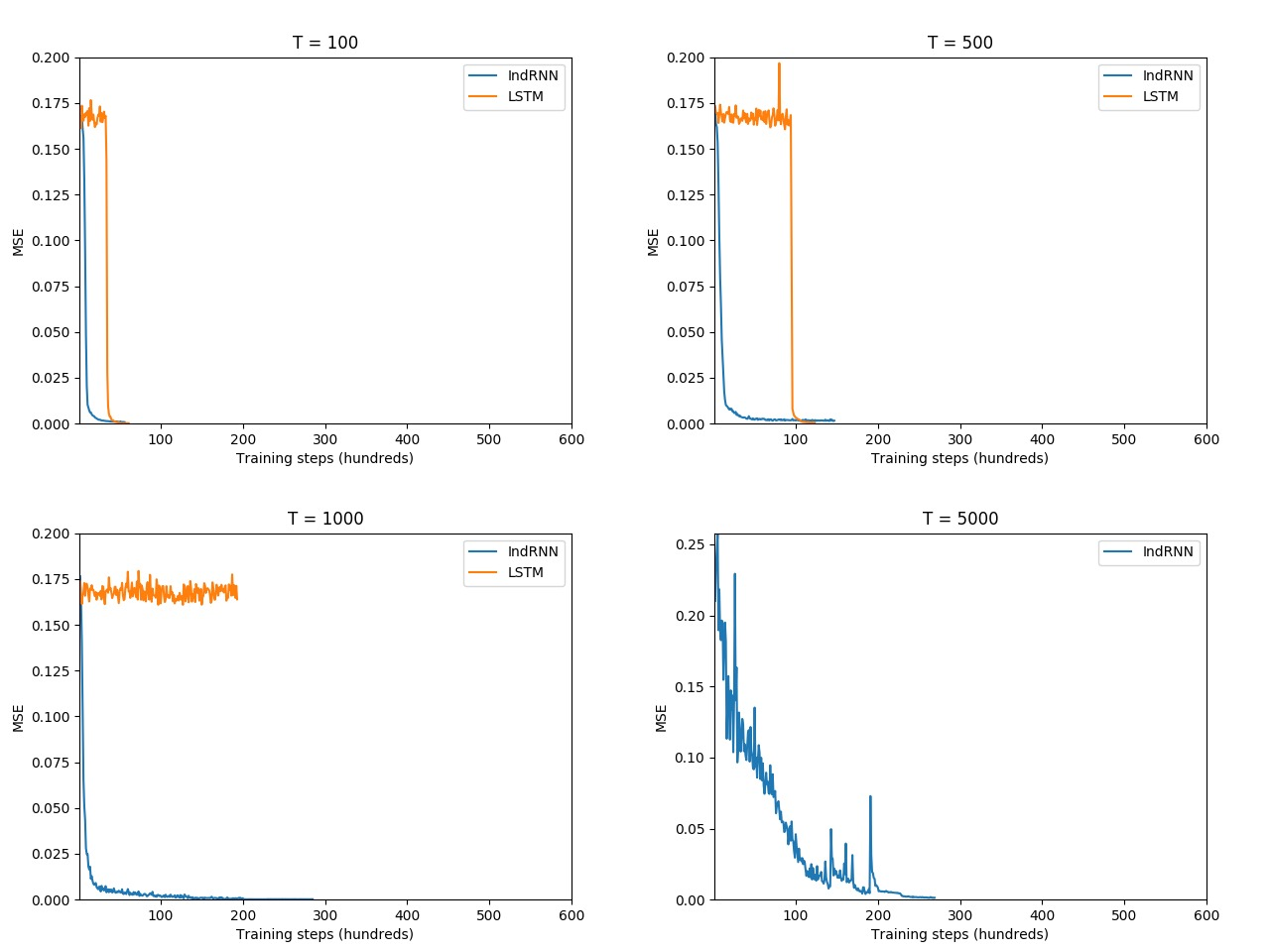
See examples/addition_rnn.py for a script reproducing the "Adding Problem" from the paper. Below are the results reproduced with the addition_rnn.py code.
Sequential MNIST
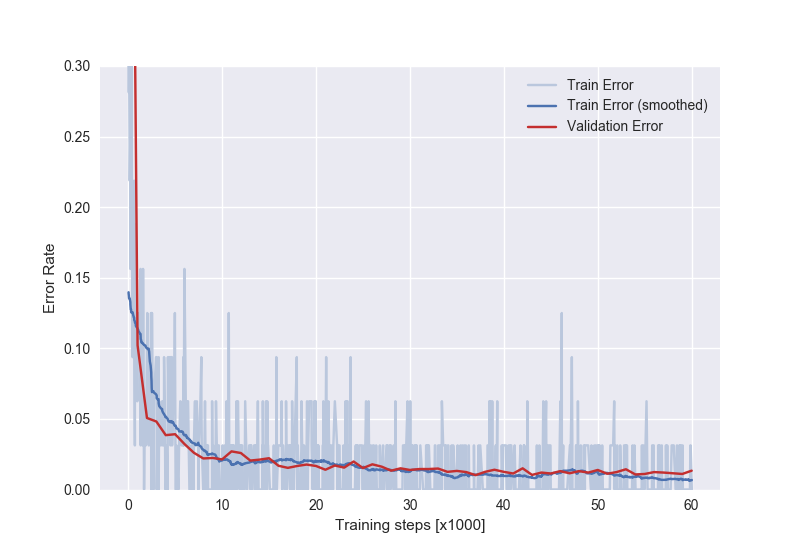
See examples/sequential_mnist.py for a script reproducing the Sequential MNIST experiment. I let it run for two days and stopped it after 60,000 training steps with a
- Training error rate of 0.7%
- Validation error rate of 1.1%
- Test error rate of 1.1%
Requirements
- Python 3.4+
- TensorFlow 1.5+