
apache/datafusion-ballista
apache/datafusion-ballista has 2,172 GitHub stars and 344 forks. GitHot measured +2 stars in 24 hours. Last checked 2026-11-08 21:58 UTC. Last push 2026-11-02.
Apache DataFusion Ballista Distributed Query Engine
Crecimiento de estrellas medido
- in 24h
- +2
- in 7 days
- Recopilando historial
- in 15 days
- Recopilando historial
- in 1 month
- Recopilando historial
Cambios netos en períodos que se solapan, no totales diarios. Los datos no disponibles se dejan en blanco. Las estrellas indican interés, no calidad.
README.md
OriginalBallista: Making DataFusion Applications Distributed


Ballista is a distributed query execution engine that enhances Apache DataFusion by enabling the parallelized execution of workloads across multiple nodes in a distributed environment.
Existing DataFusion application:
use datafusion::prelude::*;

#[tokio::main]
async fn main() -> datafusion::error::Result<()> {
    let ctx = SessionContext::new();

    // register the table
    ctx.register_csv("example", "tests/data/example.csv", CsvReadOptions::new())
        .await?;

    // create a plan to run a SQL query
    let df = ctx
        .sql("SELECT a, MIN(b) FROM example WHERE a <= b GROUP BY a LIMIT 100")
        .await?;

    // execute and print results
    df.show().await?;
    Ok(())
}
can be distributed with few lines of code changed:
[!IMPORTANT]
There is a gap between DataFusion and Ballista, which may bring incompatibilities. The community is actively working to close the gap
use ballista::prelude::*;
use datafusion::prelude::*;

#[tokio::main]
async fn main() -> datafusion::error::Result<()> {
    // create SessionContext with ballista support
    // standalone context will start all required
    // ballista infrastructure in the background as well
    let ctx = SessionContext::standalone().await?;

    // everything else remains the same

    // register the table
    ctx.register_csv("example", "tests/data/example.csv", CsvReadOptions::new())
        .await?;

    // create a plan to run a SQL query
    let df = ctx
        .sql("SELECT a, MIN(b) FROM example WHERE a <= b GROUP BY a LIMIT 100")
        .await?;

    // execute and print results
    df.show().await?;
    Ok(())
}
For documentation or more examples, please refer to the Ballista User Guide.
Who is Ballista for
Ballista serves several distinct audiences:
- DataFusion users going multi-node — you already use Apache DataFusion on a single machine and have outgrown it. Ballista runs the same SQL and DataFrame workloads across a cluster with minimal code changes and the same results.
- Spark users wanting the same execution model — you run Spark SQL or batch jobs and want a lighter, Rust-native alternative without relearning a new paradigm. Ballista keeps the familiar model: plans split into stages at shuffle boundaries, tasks over partitions, executors with vcores, and adaptive query execution (AQE).
- Library users building a specialized engine — you are building a bespoke distributed query engine and want reusable scheduler, executor, and plan-serialization building blocks with extension points, instead of writing distributed execution from scratch.
These audiences are documented in more detail, along with the guarantees each relies on, in the User Personas guide.
Architecture
A Ballista cluster consists of one or more scheduler processes and one or more executor processes. These processes can be run as native binaries and are also available as Docker Images, which can be easily deployed with Docker Compose or Kubernetes.
The following diagram shows the interaction between clients and the scheduler for submitting jobs, and the interaction between the executor(s) and the scheduler for fetching tasks and reporting task status.

See the architecture guide for more details.
Execution Modes
Ballista supports two execution modes, selected with ballista.execution.mode. Staged execution, the default, runs a job one stage at a time, the way Apache Spark does: each stage writes its output to shuffle files, and a failed task is simply re-run from them, which suits long-running jobs and busy shared clusters.
Pipelined execution (experimental) runs a job the way Trino does: every task is scheduled at once and stages stream record batches to each other over Arrow Flight, with no intermediate data written to disk, so results reach the client sooner, at the cost of a failed task failing the whole job. It suits short, latency-sensitive queries on clusters with room for the whole job. See the Pipelined Execution Guide for details.
Getting Started
The easiest way to get started is to run one of the standalone or distributed examples. After that, refer to the Getting Started Guide.
Web Terminal User Interface (Web TUI)
Ballista provides a browser-based Web TUI for monitoring a running cluster. It exposes the TUI views for jobs, executors, metrics, and scheduler information directly in a web browser.
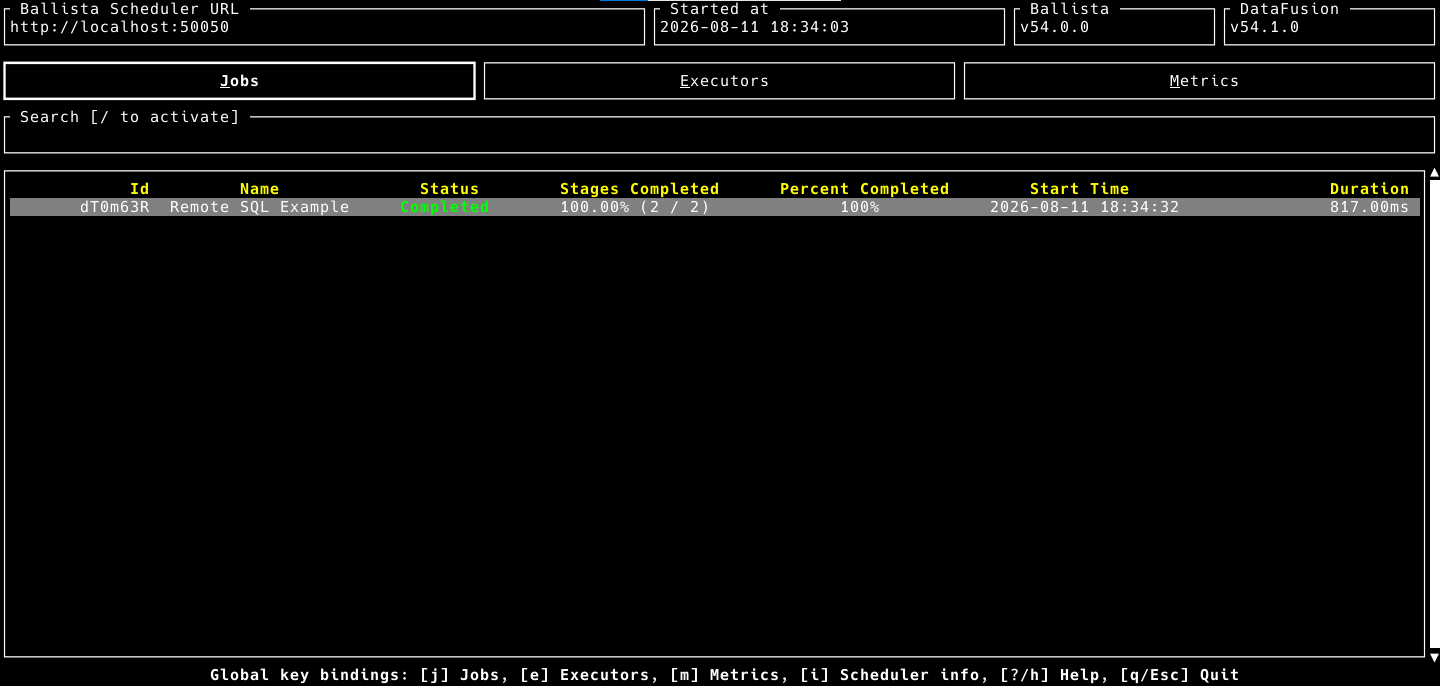
When the scheduler HTTP endpoint is available, opening the scheduler address in a browser, for example http://localhost:50050, redirects to a hosted Web TUI.
For more information, including how to run the Web TUI locally, see the Ballista CLI documentation.
Cargo Features
Ballista uses Cargo features to enable optional functionality. Below are the available features for each crate.
ballista (client)
| Feature | Default | Description |
|---|---|---|
standalone |
Yes | Enables standalone mode with in-process scheduler and executor |
ballista-core
| Feature | Default | Description |
|---|---|---|
arrow-ipc-optimizations |
Yes | Enables Arrow IPC optimizations for better shuffle performance |
build-binary |
No | Required for building binary executables (AWS S3 support, CLI parsing) |
force_hash_collisions |
No | Testing-only: forces all values to hash to same value |
utoipa |
No | Derives OpenAPI schemas for scheduler REST types; enabled by ballista-scheduler's rest-api |
ballista-scheduler
| Feature | Default | Description |
|---|---|---|
build-binary |
Yes | Builds the scheduler binary with CLI and logging |
substrait |
No | Enables Substrait plan support |
prometheus-metrics |
No | Enables Prometheus metrics collection |
graphviz-support |
No | Enables execution graph visualization |
keda-scaler |
No | Kubernetes Event Driven Autoscaling integration |
rest-api |
Yes | Enables REST API endpoints, the OpenAPI spec, and the history server |
disable-stage-plan-cache |
No | Disables caching of stage execution plans |
ballista-executor
| Feature | Default | Description |
|---|---|---|
arrow-ipc-optimizations |
Yes | Enables Arrow IPC optimizations |
build-binary |
Yes | Builds the executor binary with CLI and logging |
mimalloc |
Yes | Uses mimalloc memory allocator for better performance |
ballista-cli
| Feature | Default | Description |
|---|---|---|
cli |
Yes | Builds the ballista-cli SQL shell binary |
tui |
Yes | Enables a REST client with Terminal User Interface |
web |
No | Builds the WebAssembly Web TUI (see the Ballista CLI documentation) |

Usage Examples
# Build with standalone support (default)
cargo build -p ballista

# Build with Substrait support
cargo build -p ballista-scheduler --features substrait
Project Status
Ballista supports a wide range of SQL, including CTEs, Joins, and subqueries and can execute complex queries at scale, but still there is a gap between DataFusion and Ballista which we want to bridge in near future.
Refer to the DataFusion SQL Reference for more information on supported SQL.
Contribution Guide
Please see the Contribution Guide for information about contributing to Ballista.
Explorar proyectos relacionados
Asabeneh/30-Days-Of-Python
El reto de programación 30 Days of Python es una guía paso a paso para aprender el lenguaje de programación Python en 30 días. Este reto puede llevar más de 100 días. Sigue tu propio ritmo. Estos vídeos también pueden ayudarte: https://www.youtube.com/channel/UC7PNRuno1rzYPb1xLa4yktw
78,370 estrellasgrafana/grafana
Plataforma abierta y componible de observabilidad y visualización de datos. Visualiza métricas, registros y trazas de múltiples fuentes, como Prometheus, Loki, Elasticsearch, InfluxDB, Postgres y muchas más.
77,763 estrellasredis/redis
Para los desarrolladores que crean aplicaciones en tiempo real basadas en datos, Redis es la opción preferida, la más rápida y la de más funciones como caché, servidor de estructuras de datos y motor de consultas de documentos y vectores.
77,288 estrellasapache/superset
Apache Superset es una plataforma de visualización y exploración de datos.
75,453 estrellas