
NVlabs/GatedDeltaNet-2
NVlabs/GatedDeltaNet-2 has 366 GitHub stars and 37 forks. GitHot measured -1 stars in 24 hours. Last checked 2026-11-19 11:02 UTC. Last push 2026-10-11.
Crecimiento de estrellas medido
- in 24h
- -1
- in 7 days
- Recopilando historial
- in 15 days
- Recopilando historial
- in 1 month
- Recopilando historial
Cambios netos en períodos que se solapan, no totales diarios. Los datos no disponibles se dejan en blanco. Las estrellas indican interés, no calidad.
Acerca de
Official PyTorch Implementation of Gated DeltaNet-2: Decoupling Erase and Write in Linear Attention
Aprendizaje automáticoREADME.md
Original🔺 Gated DeltaNet-2: Decoupling Erase and Write in Linear Attention
Official PyTorch implementation of Gated DeltaNet-2: Decoupling Erase and Write in Linear Attention.

Ali Hatamizadeh, Yejin Choi, and Jan Kautz.
📢 Latest Updates
09/24/2026: 🔥🔥 Gated DeltaNet-2 has been accepted to NeurIPS 2026 ! 🎉 🎊🥂05/21/2026: 🔥 Code Release: Train your own Gated DeltaNet-2 on FineWeb-Edu- Watch this space for more exciting updates!
🌟 Why Gated DeltaNet-2?
Linear attention compresses an unbounded KV cache into a fixed-size recurrent state. The hard part is not just what to forget, but how to edit this compressed memory without scrambling existing associations. Prior delta-rule models (Gated DeltaNet, Kimi Delta Attention) tie erasing and writing to a single scalar gate — even though they act on different axes of the state.
Gated DeltaNet-2 decouples these two roles:
- ✂️ Channel-wise Erase Gate
b_t— selects which key-side coordinates of the decayed state are read and removed - ✍️ Channel-wise Write Gate
w_t— selects which value-side coordinates of the new content are committed - 🌀 Channel-wise Decay — inherited from KDA for fine-grained global forgetting
- 🔁 Strict Generalization — recovers KDA when both gates collapse to the same scalar, and Gated DeltaNet when the decay also collapses
- ⚡ Hardware-efficient Training — fast-weight WY chunkwise algorithm with gate-aware backward, fused in Triton
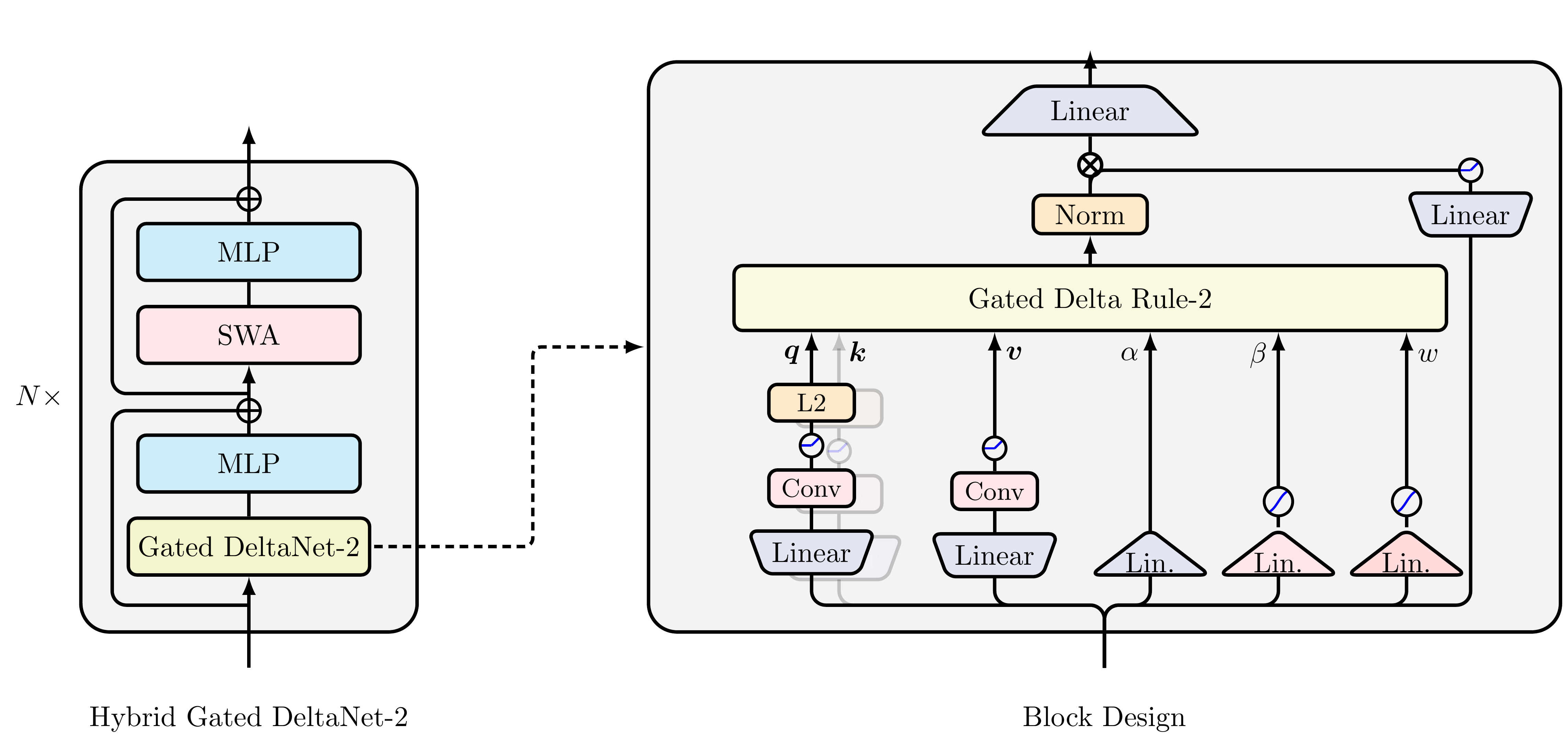
📐 The Gated Delta Rule-2
Given an erase gate b_t ∈ [0,1]^{d_k}, a write gate w_t ∈ [0,1]^{d_v}, and channel-wise decay D_t = Diag(α_t), the recurrent state evolves as:
S_t = (I − k_t (b_t ⊙ k_t)ᵀ) D_t S_{t−1} + k_t (w_t ⊙ v_t)ᵀ
Compared with KDA, the right factor of the rank-one erase becomes channel-selective on the key axis, and the write term becomes channel-selective on the value axis. The two decisions no longer share a single scalar.
📊 Results
We train all models at 1.3B parameters on 100B tokens of FineWeb-Edu, matched in recurrent state size, and compare against Mamba-2, Gated DeltaNet, KDA, and Mamba-3 (SISO and MIMO).
Language Modeling and Commonsense Reasoning
Gated DeltaNet-2 achieves the best average across both recurrent-only and hybrid settings:
| Model | Wiki ppl ↓ | LMB ppl ↓ | LMB acc ↑ | Avg. acc ↑ |
|---|---|---|---|---|
| Recurrent | ||||
| Mamba-2 | 16.79 | 12.38 | 45.24 | 51.82 |
| Gated DeltaNet | 16.40 | 11.89 | 49.62 | 52.07 |
| KDA | 16.81 | 11.68 | 48.13 | 52.28 |
| Mamba-3 (MIMO) | 16.45 | 11.66 | 47.82 | 52.39 |
| Gated DeltaNet-2 | 15.90 | 11.41 | 48.09 | 53.11 |
| Hybrid (+ SWA) | ||||
| Transformer | 19.22 | 13.72 | 48.32 | 50.86 |
| Gated DeltaNet | 16.00 | 10.82 | 48.71 | 52.25 |
| KDA | 16.01 | 10.66 | 49.21 | 52.68 |
| Mamba-3 (MIMO) | 15.81 | 10.92 | 49.82 | 52.72 |
| Gated DeltaNet-2 | 15.62 | 10.43 | 50.90 | 53.97 |
Long-context Retrieval (RULER)
Gated DeltaNet-2 is strongest where memory editing matters most — particularly the interference-heavy multi-key needle-in-a-haystack settings:
| Model | S-NIAH-2 @4K | S-NIAH-3 @2K | MK-NIAH-1 @4K |
|---|---|---|---|
| Recurrent | |||
| Gated DeltaNet | 87.2 | 54.2 | 27.8 |
| KDA | 89.0 | 63.2 | 28.0 |
| Mamba-3 (MIMO) | 64.2 | 72.4 | 18.0 |
| Gated DeltaNet-2 | 93.0 | 89.8 | 37.8 |
| Hybrid | |||
| Gated DeltaNet | 57.3 | 91.2 | 44.8 |
| KDA | 56.0 | 93.4 | 40.4 |
| Mamba-3 (MIMO) | 53.0 | 98.4 | 46.6 |
| Gated DeltaNet-2 | 57.9 | 99.0 | 48.0 |
Real-world Retrieval
Across SWDE, SQuAD, FDA, TriviaQA, NQ, and DROP, Gated DeltaNet-2 leads the recurrent and hybrid frontier:
| Setting | Mamba-2 | GDN | KDA | Mamba-3 (MIMO) | GDN-2 |
|---|---|---|---|---|---|
| Recurrent avg. | 26.84 | 28.09 | 28.67 | 28.35 | 29.88 |
| Hybrid avg. | 39.74 | 39.11 | 40.14 | 40.11 | 42.28 |
Throughput
Gated DeltaNet-2 retains near-flat scaling with sequence length on a single H100 (training, hybrid 1.3B), with only a small constant overhead over KDA for the added channel-wise gates.
🔧 What's New in the Update Rule
| Method | Decay | Erase | Write |
|---|---|---|---|
| Mamba-2 | scalar | — | scalar |
| Gated DeltaNet | scalar | scalar β_t |
scalar β_t |
| KDA | channel-wise | scalar β_t |
scalar β_t |
| Gated DeltaNet-2 | channel-wise | channel-wise b_t |
channel-wise w_t |
Ablations confirm both gates contribute, with the erase gate b_t accounting for most of the gain — consistent with its role in selectively protecting or revising key-side associations in the recurrent state.
🚀 Getting Started
Training Your Model
Launch your training with our streamlined command:
python ../pretrain.py \
--train_data_dir ${TRAIN_DATA} \
--val_data_dir ${VALIDATION_DATA} \
--output_root ${SAVE_DIR} \
--exp_name ${NAME} \
--model_name ${MODEL} \
--train_config ${CONFIG} \
--eval_iters ${EVAL_ITERS} \
--learning_rate ${LR} \
--micro_batch_size ${MICRO_BATCH_SIZE}
💡 Pro Tip: Add --interactive_job --debug for interactive debugging sessions!
Default Recipe
We train 1.3B-parameter models on 100B tokens of FineWeb-Edu with:
- AdamW, peak LR
4e-4, weight decay0.1, gradient clip1.0 - Cosine schedule with 1B-token warmup
- Global batch size
0.5Mtokens, sequence length4K - Hybrid models use a
2Ksliding-window attention size - 16 heads,
d_k = d_v = 128, matched recurrent state size against Mamba-2/3 baselines
📜 License
Copyright © 2026, NVIDIA Corporation. All rights reserved.
Licensed under the NVIDIA Source Code License-NC. See LICENSE for details.
🙏 Acknowledgements
Built on the shoulders of giants:
📖 Citation
If you find this work useful, please consider citing:
@article{hatamizadeh2026gated,
  title={Gated DeltaNet-2: Decoupling Erase and Write in Linear Attention},
  author={Hatamizadeh, Ali and Choi, Yejin and Kautz, Jan},
  journal={arXiv preprint arXiv:2605.22791},
  year={2026}
}
⭐ Support Us
If you find this work useful, please consider:
- Starring the repository
- Citing our paper
- Contributing to the codebase
Join us in pushing the boundaries of linear attention! 🚀