
Lyfxxk/Opengrep-Studio
Lyfxxk/Opengrep-Studio has 52 GitHub stars and 1 forks. GitHot measured 0 stars in 24 hours and 0 in 7 days. Last checked 2026-11-13 10:49 UTC. Last push 2026-11-02.
Crecimiento de estrellas medido
- in 24h
- 0
- in 7 days
- 0
- in 15 days
- Recopilando historial
- in 1 month
- Recopilando historial
Cambios netos en períodos que se solapan, no totales diarios. Los datos no disponibles se dejan en blanco. Las estrellas indican interés, no calidad.
Acerca de
Local-first code audit workbench for Opengrep. Scan locally, track findings across versions, verify fixes, and produce reproducible security audit reports.
SeguridadREADME.md
Original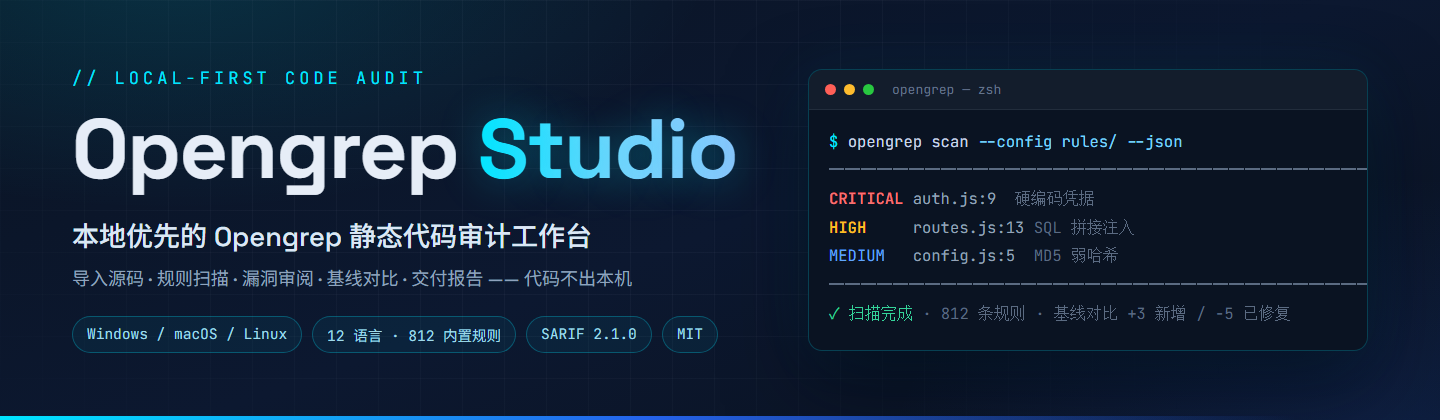
Opengrep Studio · Code Audit Workbench
Find weaknesses before attackers do.
A local-first static code-audit workbench on top of Opengrep — import source, scan with rules, triage findings one by one, diff against baselines, deliver reports — your code never leaves your machine.
简体中文 · 繁體中文 · Quick Start · Highlights · Security Model · FAQ





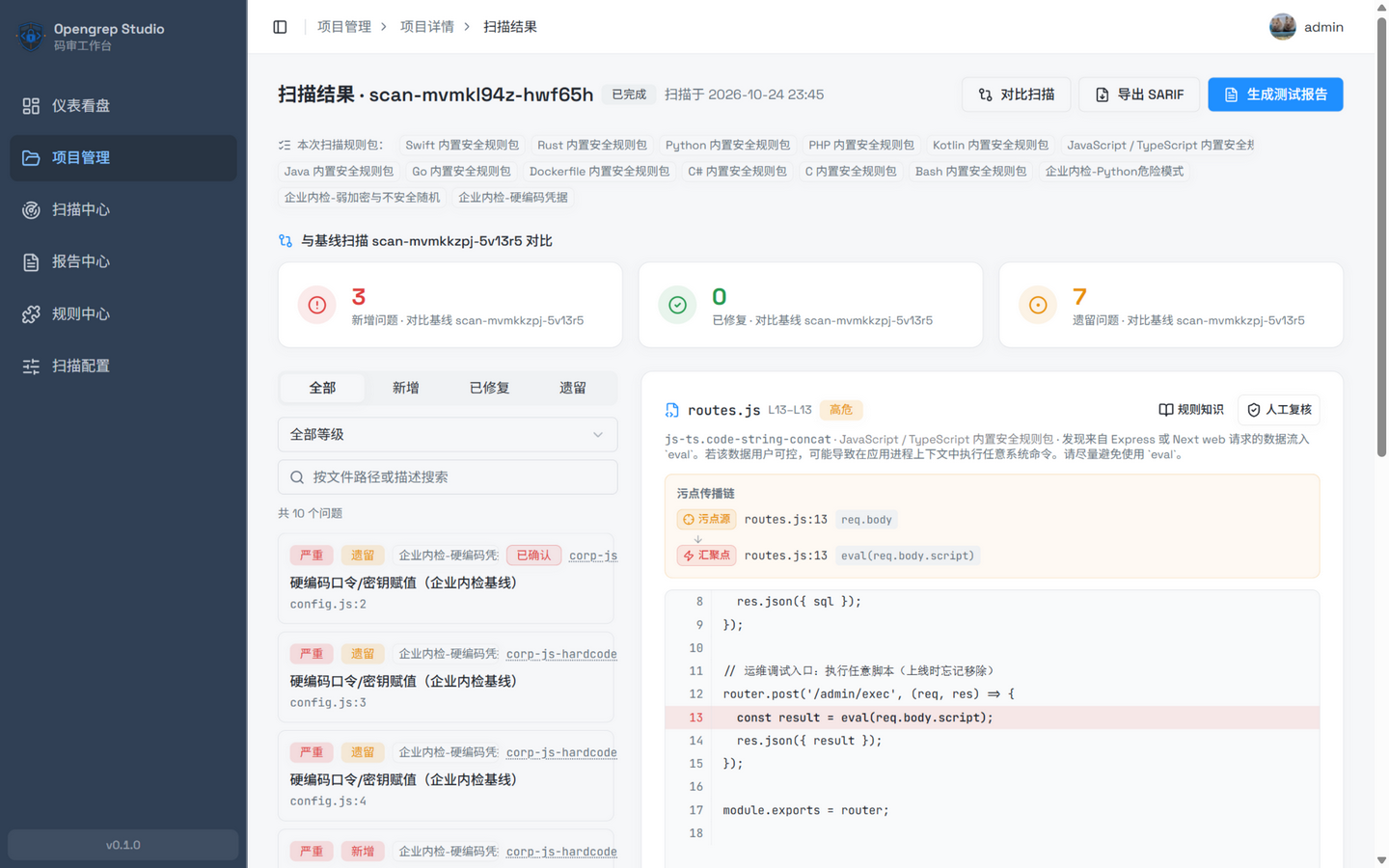
Triage view: baseline cards (new / fixed / remaining) · taint flow (source → propagation → sink) · highlighted hits · review verdicts
Why Opengrep Studio
Every codebase hides a few landmines: database passwords hardcoded in source, user input concatenated straight into SQL, debug endpoints left in after release, passwords still hashed with MD5. Static code analysis flags these problems early — without running your program and without uploading your code anywhere.
First, AI: it reads code well, but it can't carry an audit
To be fair, AI is genuinely good at reading code — business-logic flaws, authorization risks, novel patterns no rule covers: it understands intent. But using an AI chat as a code audit runs into four walls:
- AI samples; an audit must be exhaustive — a 100k-line project won't fit into any context window; of 47 SQL-concatenation sites it may flag the 5 "obvious" ones, and you'll never know it skipped the other 42. A rule engine promises that every match gets reported — only then do you dare write "all problem patterns covered by these 812 rules have been checked" in your conclusions;
- A chat is one-shot; an audit needs a ledger — AI doesn't remember what it read last month: which findings are newly introduced, which got truly fixed, which you already ruled a false positive — everything starts over;
- "AI said so" doesn't count as evidence — client delivery demands reproducibility: source hashes, engine version, full command line, so anyone can rerun and get the same result; a chat log can be neither re-verified nor attributed;
- It can't keep up with commit frequency — a full read-through costs real tokens, and the bigger the project, the costlier and leakier it gets; a local engine takes seconds to minutes at zero marginal cost — that's what plugs into CI.
Then, the engine: exhaustive scanning, but the CLI alone can't finish an audit
So this isn't either/or: rule engines provide the exhaustive safety net, AI adds semantic understanding — Semgrep itself ships AI assistance and every SAST vendor is wiring in LLMs; that's the road everyone is on. The engine behind Opengrep Studio is opengrep (the open-source community continuation of Semgrep OSS), and it scans professionally — but driving a full audit straight from its CLI still means four walls:
- The output is just JSON — what was matched and how severe it is, all read by eyeball from terminal output, with no workspace for triage;
- Rule messages are English-only — a hint like "tainted data flowing into eval" doesn't immediately tell everyone where the problem is or what to change;
- No way to tell whether a fix worked — rescan after fixing, and figuring out which findings are new and which are truly gone means manually diffing two JSON files;
- Nothing to hand to managers or clients — a risk report has to be assembled from JSON line by line, and it never looks professional.
What Studio completes is the entire pipeline after the scan
Opengrep Studio completes this pipeline: drop in code → click scan → triage findings → export a report. The engine runs locally, and your code never leaves your machine. The analysis power belongs to the upstream engine — Studio turns scan output into a reviewable, comparable, verifiable, deliverable audit workflow. In the AI era this workflow is scarcer, not obsolete: AI dumps a big pile of findings on you in one go, and someone has to dedupe them, baseline them, track them across scans, and turn them into a report — AI produces findings; Studio manages them.
Who is this for
- Security consultants / appsec engineers doing code audits — client code can't go to third-party clouds (and shouldn't be pasted into online AI chat either); delivery means a reproducible audit report;
- Small teams without a commercial SAST budget — commercial audit platforms cost a small fortune per year; this is free, open source (MIT), and runs entirely locally;
- Anyone learning application security — 812 rules with fully Chinese messages + a Chinese CWE knowledge base with fix advice + taint-flow visualization, and a rule lab that validates rules on the spot;
- Open-source authors — scan for hardcoded secrets and dangerous calls before publishing; it takes minutes.
Highlights
🗂 Multi-source import, your code never touches the cloud
Drag in a whole folder, upload ZIP / 7Z / RAR / TAR.GZ archives, or paste a Git repo URL for a shallow-clone import (respects .gitignore / .opengrepignore by default; toggle it off to dig hardcoded secrets out of .env). Language composition is analyzed automatically after upload.
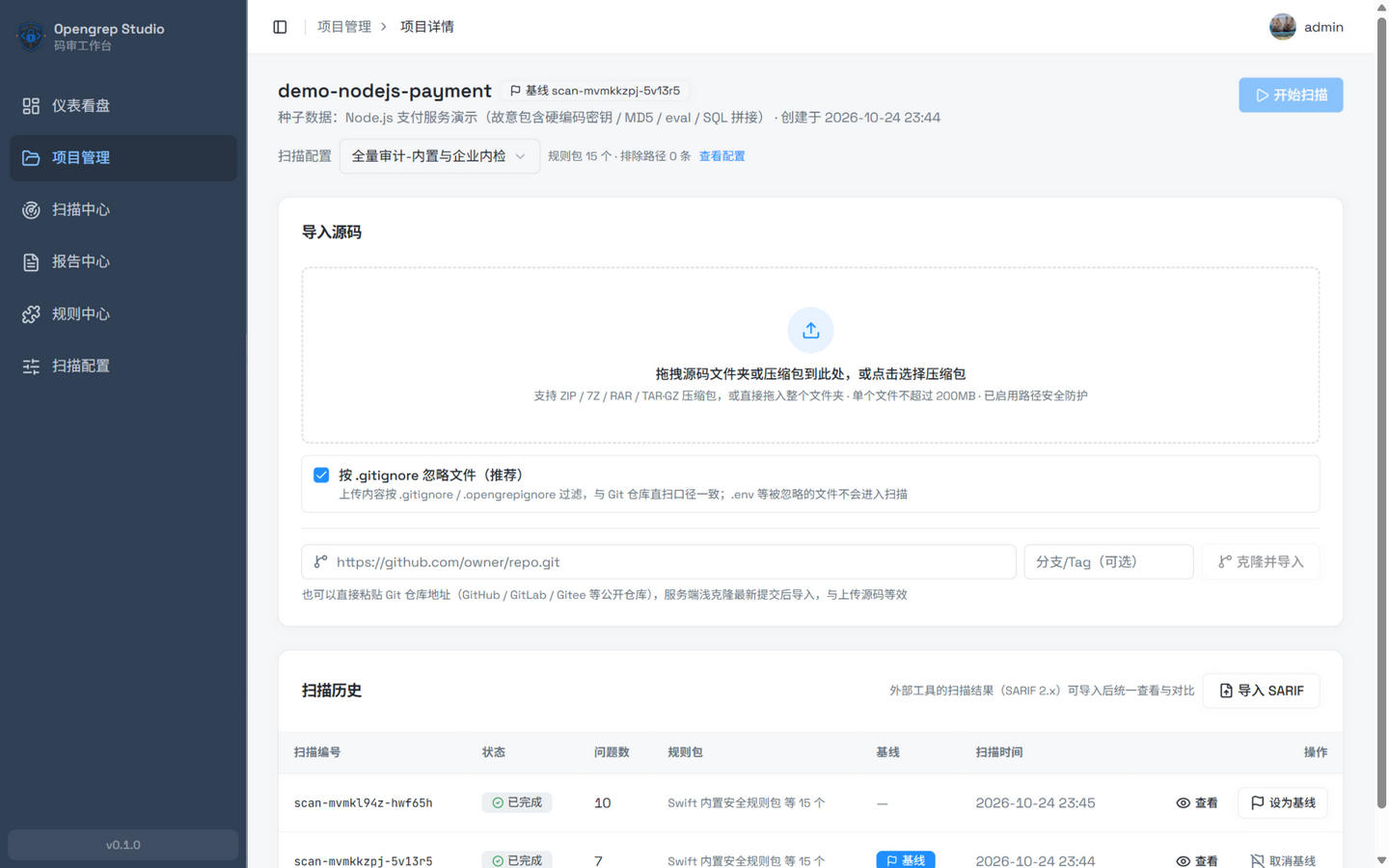
📚 812 built-in rules, 12 languages, fully Chinese messages
Curated from opengrep-rules (rules carrying CWE / OWASP metadata first, upstream provenance links kept on every rule), covering 108 CWEs; 100% of the 812 rule messages are translated into Chinese, plus 108 CWE knowledge entries in Chinese with weakness notes and fix advice. Custom rule packs support online editing, import/export, and quality checks.
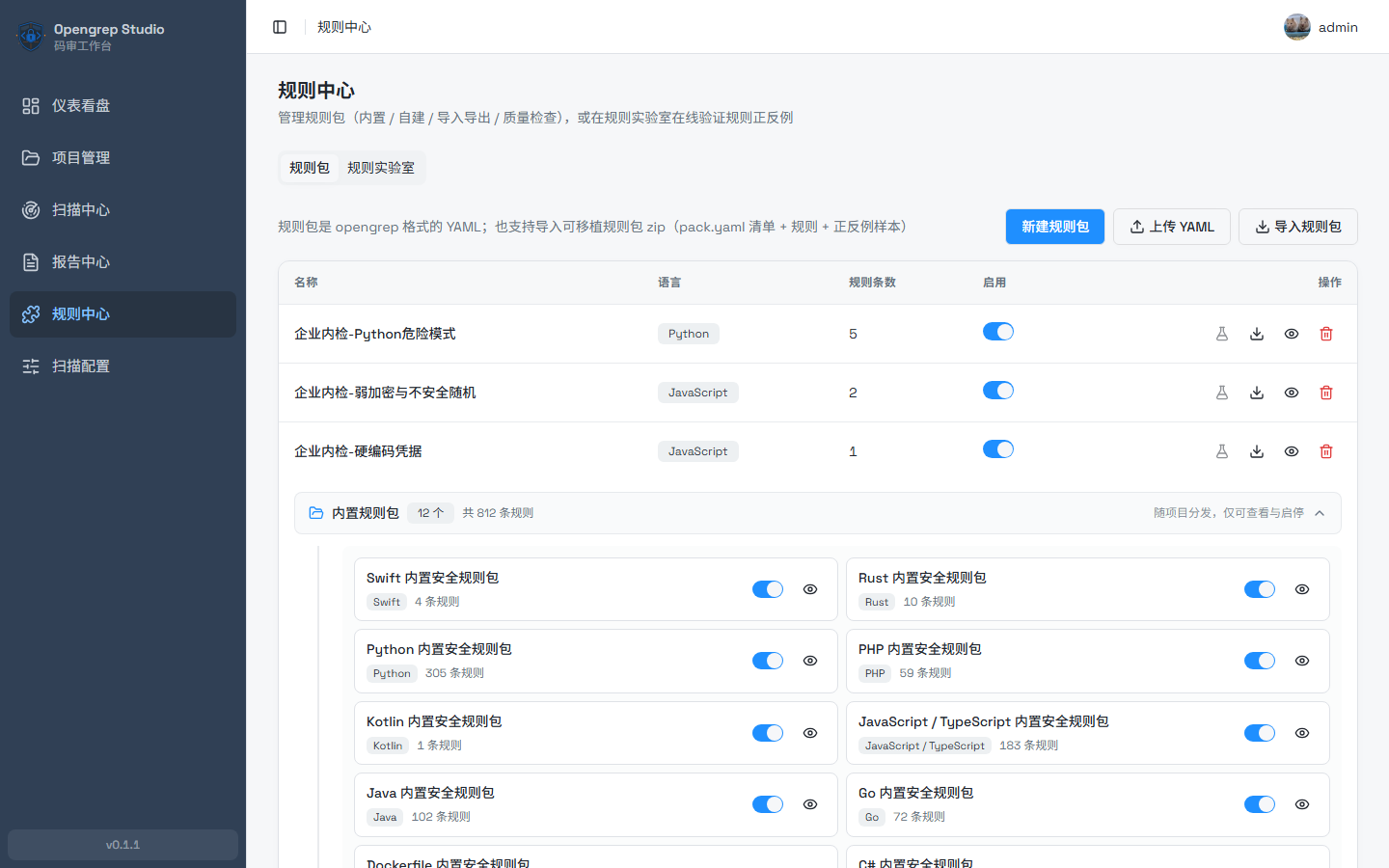
🔍 Finding-by-finding triage: code locations, taint chains, review verdicts
Every finding links straight to file and line with the hit highlighted in red; taint findings show the full source → propagation → sink chain; review verdicts (confirmed / false positive / accepted) persist across scans by finding fingerprint, building the audit evidence chain.
📊 Baseline diff & dual-snapshot compare
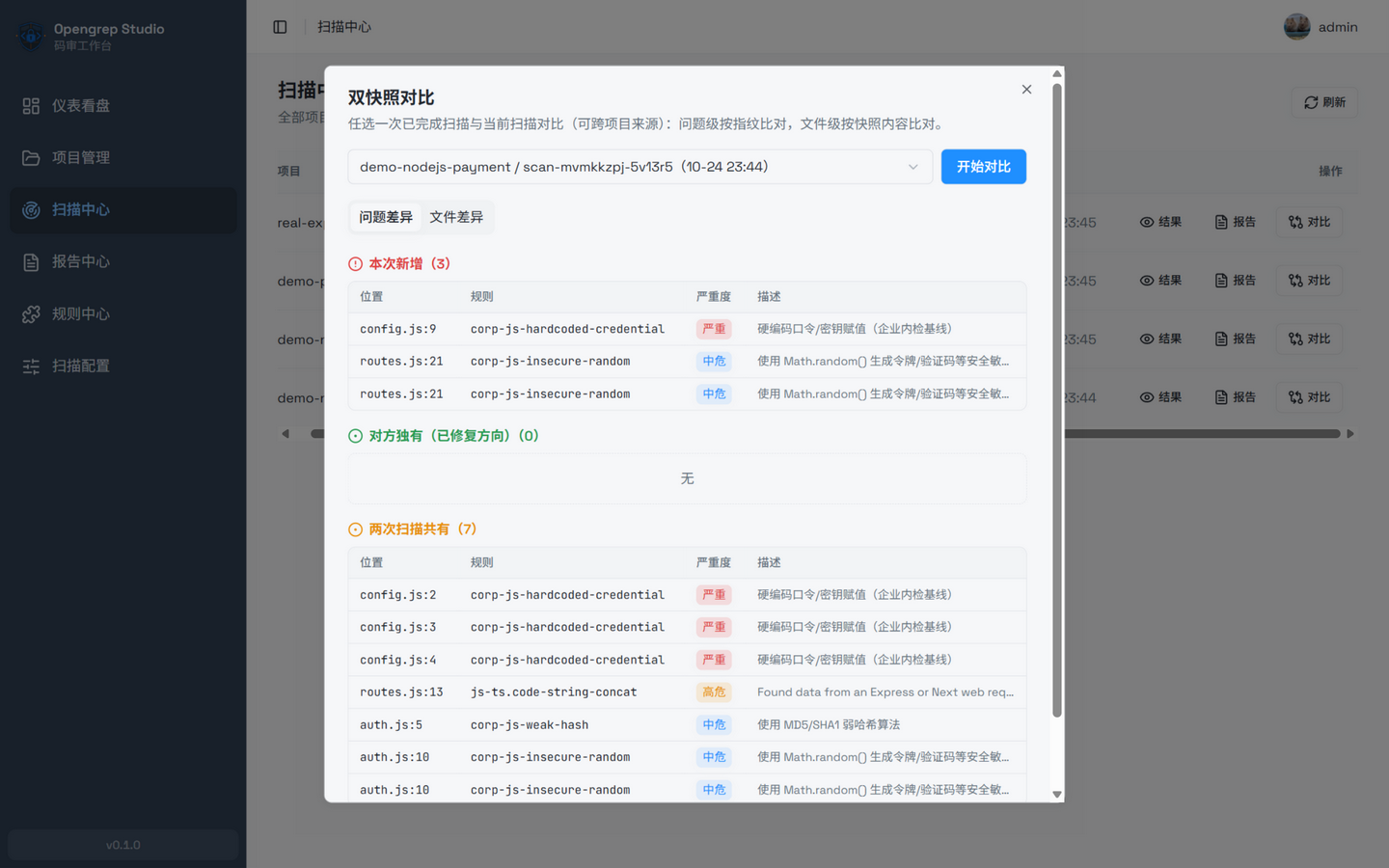
Set a baseline scan and every later scan automatically classifies findings as new / fixed / remaining; the scan center can also pick any two completed scans for a dual-snapshot compare (even across projects): issue level matched by fingerprint, file level by snapshot content.
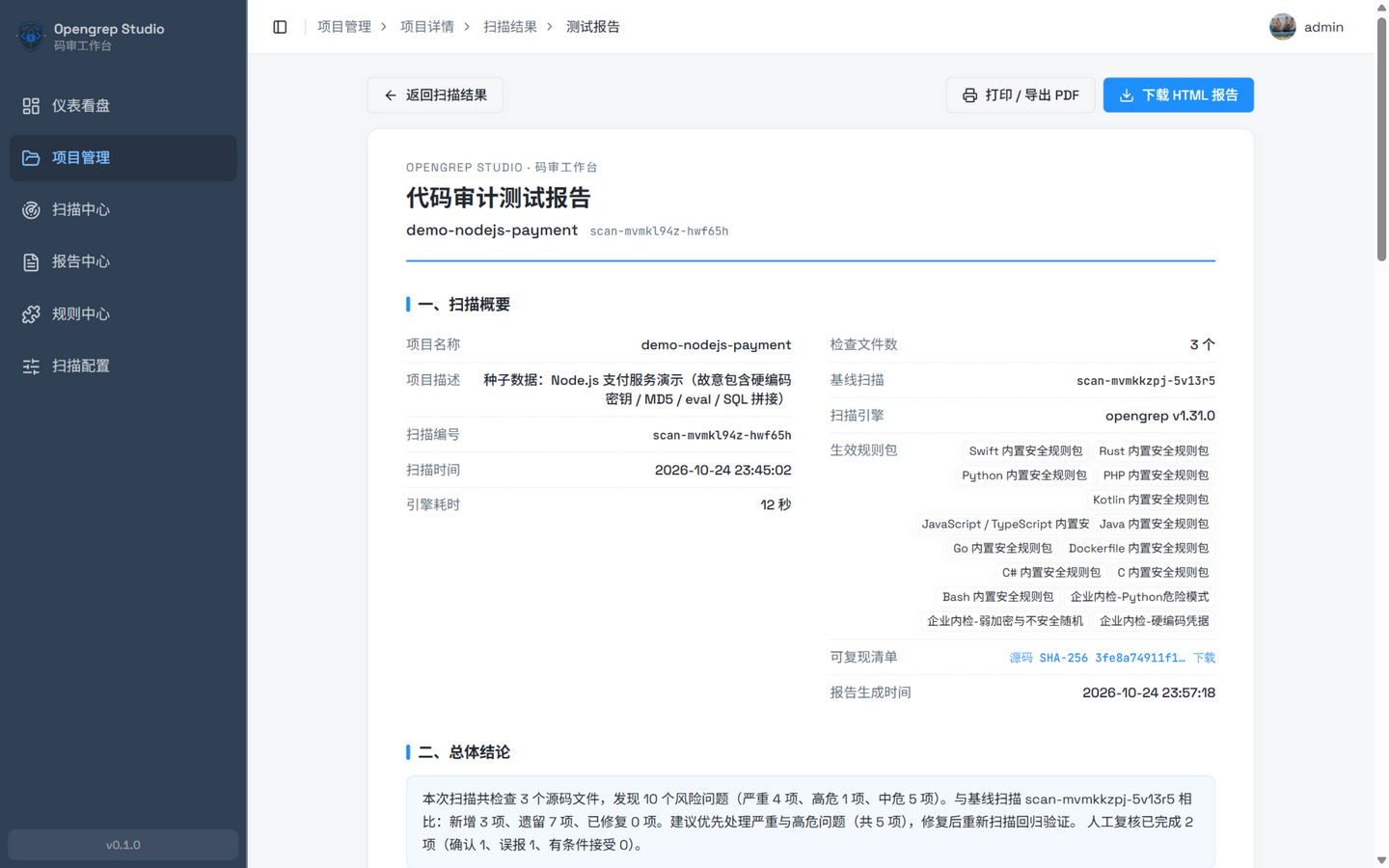
📄 Printable audit report + reproducibility manifest
One click generates a paper-styled "Code Audit Test Report": overall verdict, risk distribution, top-hit rules, hot files, finding details, triage stats — print straight to PDF or download a single-file offline HTML; every report ships with a reproducibility manifest (source SHA-256, full engine command line, rule-file hashes).
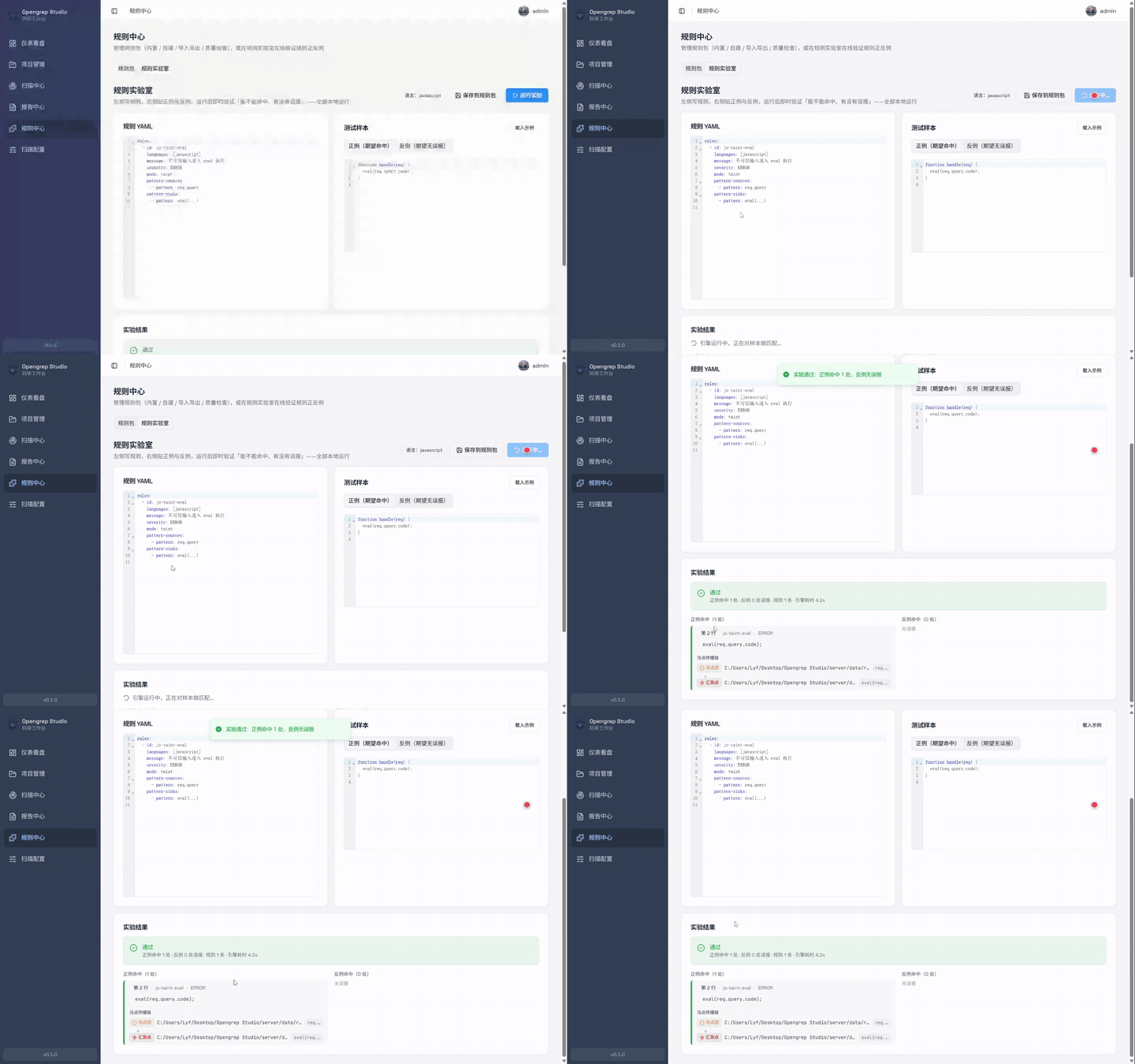
🧪 Rule Lab: verify first, commit later
Rule YAML on the left, positive and negative samples on the right, one click runs the real engine to check "does it hit, does it false-positive"; a verified rule saves together with its samples as a portable rule pack, ready for one-click regression afterwards. Drafts autosave; Ctrl+Enter runs.
🔁 SARIF interop, both ways
Export SARIF 2.1.0 for GitHub Code Scanning / DefectDojo / SonarQube to consume; or import SARIF 2.x produced by other tools as a full scan, included in your baseline and report system.
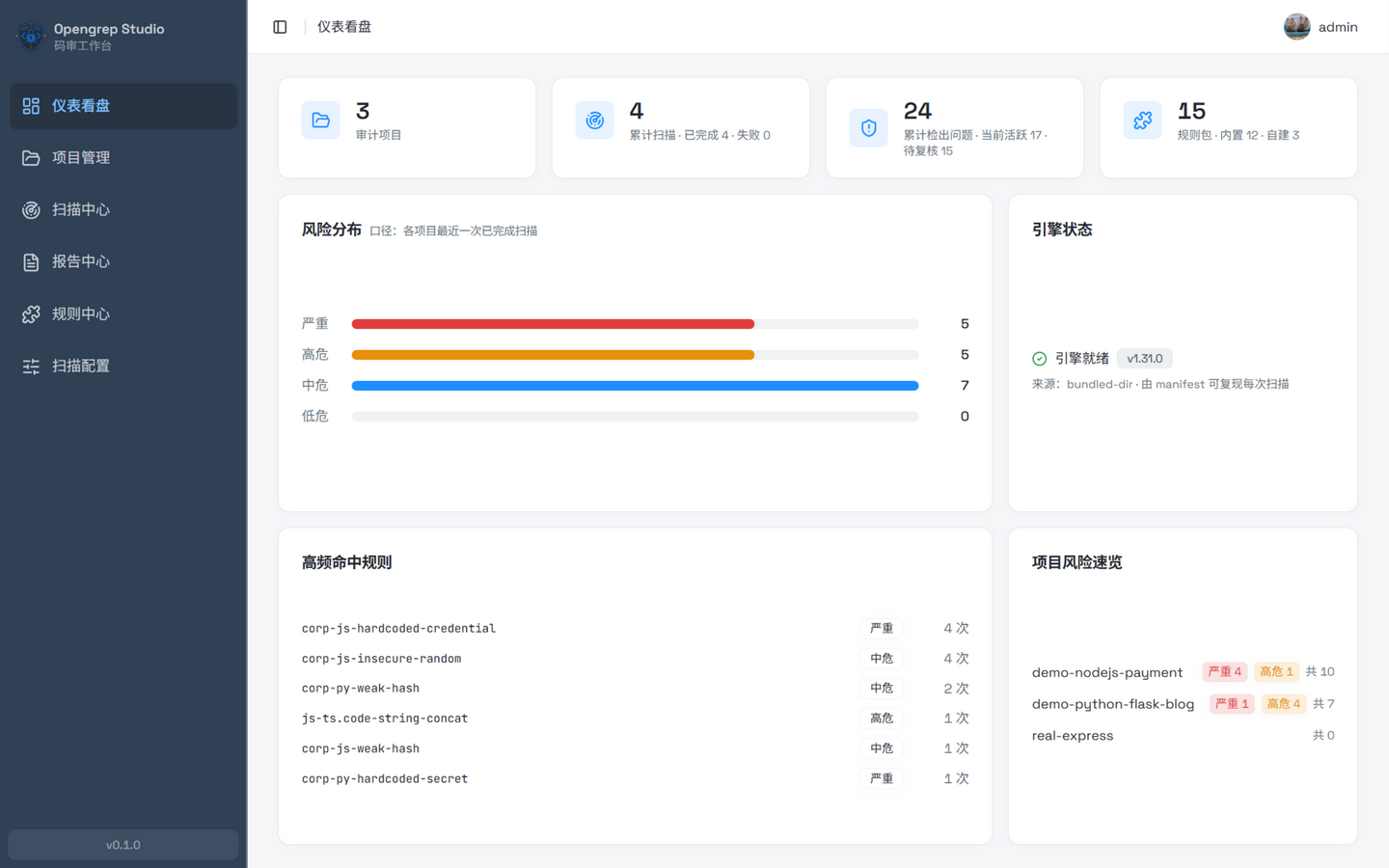
🖥 Dashboard
Projects, cumulative scans, findings and rule packs at a glance; cross-project risk distribution, top-hit rules, engine status and per-project risk overview — auto-refreshes while a scan is running.
⬆️ Engine check-update & one-click upgrade
The dashboard "Engine status" card shows the actually installed version and where it came from; click "Check for updates" to compare against the latest upstream stable and upgrade in one click:
- The upgrade is an atomic swap: download → verify SHA-256 (from the GitHub release asset digest) → run
opengrep --versionto confirm → only then replace files; if any step fails, the old engine stays untouched - Only the latest stable is offered (pre-releases are ignored); the button is disabled for users managing the engine themselves via
OPENGREP_BIN - Upgrading is disabled while a scan or the Rule Lab is running (Windows can't replace a running exe); the version-probe cache invalidates automatically after a successful upgrade
- The installed version is recorded in
opengrep-tool/installed.json; re-runningnpm run setup:enginenever downgrades an upgraded engine back to the version pinned inengines.json
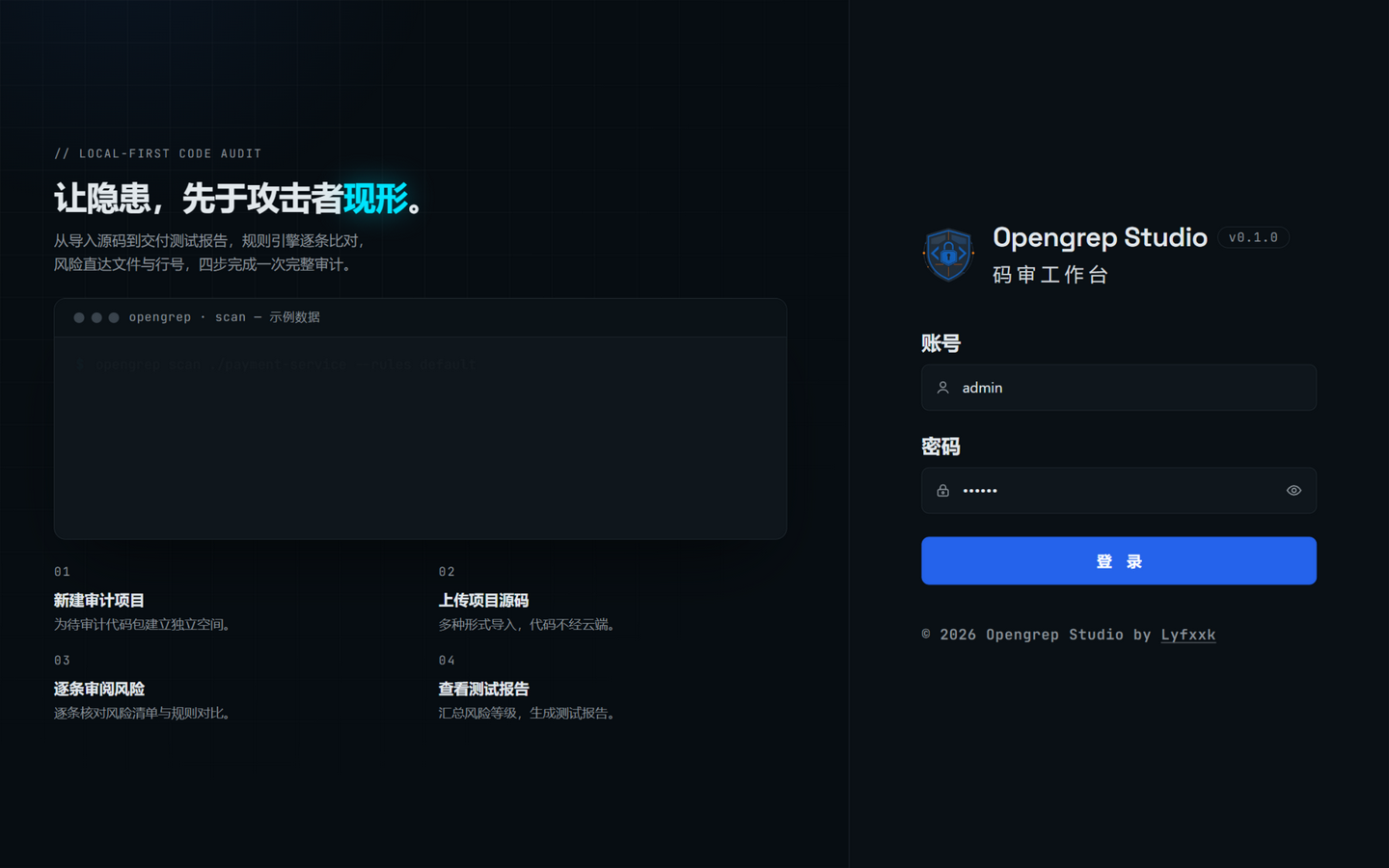
UI at a glance (login & dashboard)
 |
 |
Quick Start
Requirements
- Node.js ≥ 22.12 — built-in
node:sqliteneeds 22.5+, and Vite 8 in the frontend needs 22.12+; still no native dependencies - The scan engine is downloaded and SHA-256-verified automatically (~50 MB), nothing to preinstall; Git is only needed for repo-clone import
Option 1: One-click launch (recommended)
Double-click 一键启动(Windows).bat on Windows; on macOS / Linux run:
./一键启动(macOS/Linux).sh
The script checks your Node version, installs dependencies, downloads the engine, and opens the browser. Frontend at http://localhost:1022, backend API at http://localhost:8787.
Option 2: Three manual steps
git clone https://github.com/Lyfxxk/Opengrep-Studio.git
cd Opengrep-Studio
npm run install:all   # root + server + code dependencies in one go
npm run setup:engine  # download opengrep v1.33.1 and verify SHA-256
npm run dev           # backend (:8787) + frontend (:1022) together
Option 3: Docker
npm run docker:build
npm run docker:run    # = docker run --rm -p 8787:8787 -v ogstudio-data:/data opengrep-studio
The image ships with the engine and the built frontend — open http://localhost:8787 and you're in; data persists in the ogstudio-data volume.
One caveat on upgrades: a one-click upgrade writes to the container layer (/app/opengrep-tool), so it survives container restarts but is lost when the container is recreated (docker compose down && up), falling back to the version pinned in engines.json. For a long-term engine bump, change server/scripts/engines.json and rebuild the image.
First run
Default login: admin / 123456 (see Security Model). Suggested flow:
- Scan config — pick the rule packs to enable (optionally with exclude/include paths and engine args)
- Create a project and bind that config — or skip binding: a protected fallback config (all enabled built-in rule packs, cannot be deleted) is bound automatically on the first scan
- Import source (drag a folder / upload an archive / Git clone)
- Run a scan, then triage findings one by one
- Set a baseline, rescan, and watch new / fixed / remaining; when it's time to deliver, generate the test report
Want to see it before touching your own code? npm run seed seeds three demo projects (with baseline diffs and review records) in one go.
Troubleshooting
- Engine download slow/blocked: downloads fall back automatically (
OPENGREP_DOWNLOAD_BASEmirror → github.com → api.github.com), so a blocked github.com usually needs no manual step; if all channels fail, set a mirror (set OPENGREP_DOWNLOAD_BASE=<mirror-url>, useexporton macOS/Linux) or download from opengrep Releases and pointOPENGREP_BINat it - "Check for updates" reports GitHub API rate limit: anonymous calls are capped at 60/hour and results are cached for 30 minutes; retry later — scanning is unaffected
- macOS Gatekeeper:
xattr -d com.apple.quarantine <engine-path> - Ports busy:
node server/scripts/kill-port.mjs 8787 1022 - Other env vars:
PORT/HOST/DATA_DIR/CUSTOM_RULES_DIR/OPENGREP_BIN/OPENGREP_DOWNLOAD_BASE(server); timeout overrides take seconds:CLONE_TIMEOUT_SECONDS/SEVEN_Z_TIMEOUT_SECONDS/RULE_LAB_TIMEOUT_SECONDS. The dev server honoursAPI_TARGETfor the/apiproxy. Custom rule pack files keep landing inserver/rules/customwhen onlyDATA_DIRis set — relocate both together, otherwise the database and the rule files drift apart (the backend prints both directories at startup and warns about any mismatch)
Raw CLI vs. Opengrep Studio
| Capability | opengrep scan straight |
Opengrep Studio |
|---|---|---|
| Result form | terminal JSON / text | interactive triage: code highlights, taint chains, filtering & search |
| Localization | English-only messages | all 812 rule messages in Chinese (simplified + traditional) + Chinese CWE knowledge base |
| Baseline management | none | auto new / fixed / remaining classification; verdicts persist across scans |
| Version diffing | none | dual-snapshot compare (issue level + file level, cross-project) |
| Report delivery | hand-assembled | one-click paper-styled report (print / offline HTML) + reproducibility manifest |
| Rule debugging | edit, rerun, hope | Rule Lab: instant positive/negative validation, sample regression |
| Toolchain interop | DIY | SARIF 2.1.0 import / export |
How It Works
flowchart LR
    U["Browser UI<br/>React 19 + Vite"] -->|"REST /api"| S["Express backend<br/>:8787"]
    S -->|"child process<br/>--json --dataflow-traces"| E["opengrep engine<br/>v1.33.1"]
    S --> DB[("SQLite<br/>server/data/studio.db")]
    S --> FS[("immutable source snapshots<br/>data/workspace/")]
- Single-process deployment: the backend also serves the built frontend (in production, port 8787 is all you need); binds
127.0.0.1only, by default - Every scan runs against an immutable source snapshot; the snapshot hash and the full command line are archived, so every report is reproducible
- SQLite stores projects / scans / findings / reviews / configs — no external service dependencies; all data lives in
server/data/ - Up to 2 scans run concurrently (extra ones are queued automatically) to make use of local resources; the Rule Lab and scans are mutually exclusive
Security Model
Honest disclosure — please read:
- Local single-machine tool: binds
127.0.0.1only by default; code and results never leave the machine, no telemetry - The login gate is a frontend-only guard against mis-clicks (fixed account
admin/123456); the backend API has no authentication — do not expose the service to the public internet; if you truly need it on the LAN, setHOSTyourself and add access control - Docker mode defaults to
HOST=0.0.0.0; use it only inside an intranet / behind protection - Upload & unzip are hardened against Zip-Slip / symlinks / size & file-count bombs; Git clone is https-only with credential interaction disabled
FAQ
Which languages and platforms are supported?
Built-in rules cover Python, JS/TS, Java, Go, C, C#, PHP, Bash, Kotlin, Swift, Rust and Dockerfile — 12 languages in total; Studio itself runs on Windows (x64) / macOS (x64 / arm64) / Linux (x64 / arm64) and in Docker.
What's the relationship to Semgrep?
Opengrep is the open-source engine continued by the community from Semgrep OSS (LGPL-2.1); Studio orchestrates its official binary, and rules are curated from opengrep-rules. Studio is not affiliated with Semgrep Inc.
Will my code be uploaded anywhere?
No. Scanning, storage and report generation all happen locally; the service binds to the local loopback address only, by default.
Where is data stored? Does deleting a project leave anything behind?
Everything lives in server/data/ (SQLite + source snapshots) and the custom rule-pack directory. Deleting a project cascades to its scans, findings, review records and snapshot directory.
How do I wire this into GitHub Code Scanning?
Click "Export SARIF" on the scan result page and upload the artifact to code-scanning per GitHub's docs; fingerprints use a stable dedupe format that supports incremental reporting.
Can I import scan results from other tools?
SARIF 2.x is supported: click "Import SARIF" on the project detail page and the results become a full scan — set it as a baseline, generate reports.
Roadmap
- Chinese localization of all 812 rule messages + CWE knowledge base
- Baseline & two-snapshot diffing, review evidence chain
- SARIF 2.1.0 import/export, reproducibility manifest
- Rule Lab & portable rule packs with sample regression
- Docker image & one-click launch on 3 platforms
- Engine check-update & one-click upgrade (multi-channel download fallback)
- UI i18n (English / Simplified Chinese / Traditional Chinese)
- Scan queue & parallel scheduling
- Rule-pack import from URL & community index
- GitHub Action workflow template (scan in CI, upload SARIF back)
- Customizable report templates (branding / header & footer)
Thanks
- opengrep/opengrep — the scan engine (LGPL-2.1); this repo does not vendor its binary, it is downloaded and verified by script
- opengrep/opengrep-rules — source of the built-in rules; thanks to all upstream rule authors
- shadcn/ui / Radix UI / Tailwind CSS / CodeMirror / Vite / React — all the good stuff the interface is made of
License
This repository's code is released under MIT.
Two third-party license notes:
- The scan engine: opengrep is released under LGPL-2.1; this repo contains no engine binary —
npm run setup:enginedownloads it from the official Releases and verifies it by SHA-256 - Built-in rules: curated from opengrep-rules (LGPL 2.1 + Commons Clause) — free to use and redistribute with attribution kept, but the rules themselves must not be sold as a paid product
Explorar proyectos relacionados
trimstray/the-book-of-secret-knowledge
Una colección de listas inspiradoras, manuales, chuletas, blogs, trucos, comandos de una línea, herramientas de CLI y web, y más.
258,188 estrellasHack-with-Github/Awesome-Hacking
Una colección de diversas listas awesome para hackers, pentesters e investigadores de seguridad.
125,360 estrellasswisskyrepo/PayloadsAllTheThings
Una lista de payloads y métodos de bypass útiles para la seguridad de aplicaciones web y para pentesting/CTF.
82,649 estrellascaddyserver/caddy
Servidor web HTTP/1-2-3 rápido, extensible y multiplataforma con HTTPS automático
79,038 estrellas