
Acerca de
❴ ● ❵ GSS — GPU Style Sheets. A CSS-like language for 3D scenes: selectors, the cascade, nesting, keyframes and transitions, compiled into one raymarching shader for WebGPU and WebGL2. No Three.js, no meshes. Playground, VS Code extension, and a <gss-scene> tag for any page.
Creación y multimediaWhat you can do
- Selectors and the cascade: classes, ids, combinators, :hover, :has(), :nth-child(), nesting.
- Shapes: cube, sphere, torus, cylinder, cone, capsule, path, prism, lathe and more.
- Materials: matte(), metal(), glass(), jelly(), emissive(), iridescent(), and textures.
- Motion: @keyframes, transition, scroll-driven animations, offset-path.
Crecimiento de estrellas medido
- in 24h
- 0
- in 7 days
- +4
- in 15 days
- +13
- in 1 month
- +21
Cambios netos en períodos que se solapan, no totales diarios. Los datos no disponibles se dejan en blanco. Las estrellas indican interés, no calidad.
README.md
Original

Style sheets for the GPU.
3D scenes written in CSS, compiled into a single shader for WebGL2 and WebGPU.
Website · Playground · Reference

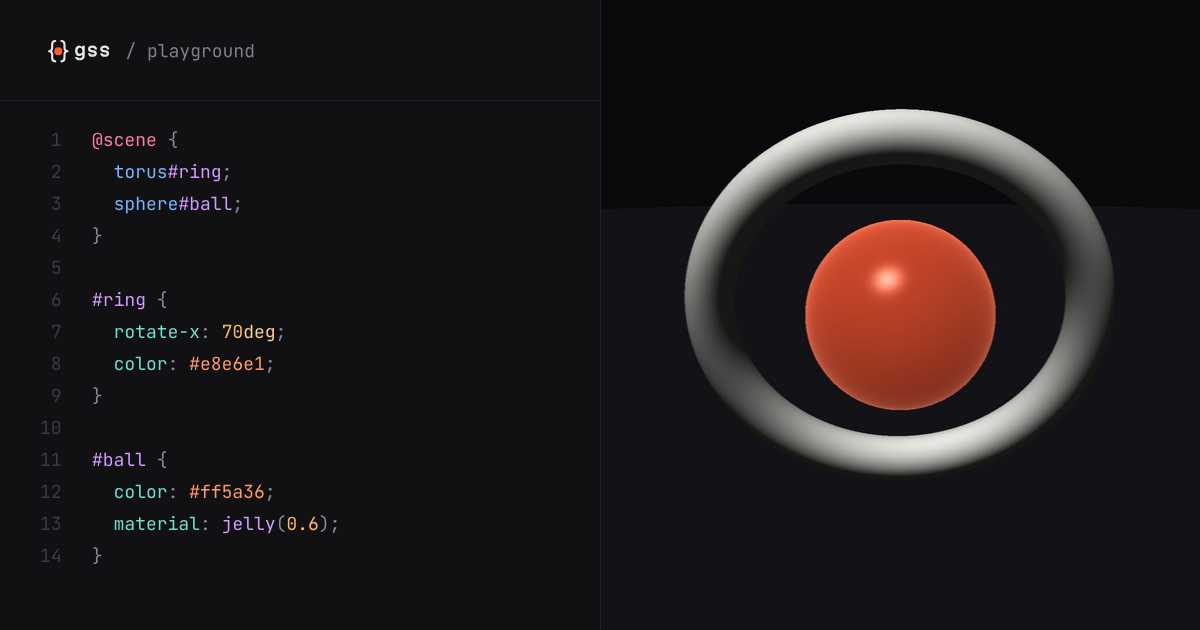
GSS (GPU Style Sheets) is a 3D language for people who already speak CSS. Declare shapes in a
@scene, style them with selectors, and the compiler turns it all into one raymarched shader.
No Three.js, no meshes.
@scene {
  torus#ring;
  sphere#ball;
}

#ring {
  translate: 0 1.2 0;
  rotate-x: 70deg;
  radius: 1.1;
  thickness: 0.14;
  color: #e8e6e1;
}

#ball {
  translate: 0 1.2 0;
  radius: 0.55;
  color: #ff5a36;
  material: jelly(0.6);
  animation: float 2s ease-in-out alternate;
}

@keyframes float {
  from { translate: 0 1.2 0; }
  to   { translate: 0 1.5 0; }
}
Documentation
- Getting started: why GSS, and your first scene.
- Installation: a tag, npm or Vite; WebGPU, TypeScript and the editor.
- Every page: each at-rule, selector, shape, property and function, with examples.
The same pages, with every example to edit live: gss-lang.dev/docs.
What it can do
- Selectors and the cascade: classes, ids, combinators,
:hover,:has(),:nth-child(), nesting. - Shapes:
cube,sphere,torus,cylinder,cone,capsule,path,prism,latheand more. - Materials:
matte(),metal(),glass(),jelly(),emissive(),iridescent(), and textures. - Motion:
@keyframes,transition, scroll-driven animations,offset-path. - Values:
calc(),var(),@property,random()and the CSS color functions. - Effects: gradients, noise, masks, blur, bloom and grain.
- The scene: floor, background, lights, fog, shadows and an orbit camera.
- Responsive:
@media,light-dark()andif().
Install
A tag, no build step:
<script type="module" src="https://cdn.jsdelivr.net/npm/[email protected]/lib/embed.js"></script>
<gss-scene src="logo.gss"></gss-scene>
npm:
npm install [email protected]
import { mount } from "gss-lang";
mount(canvas, "@scene { sphere; }");
Vite, compiled at build time:
// vite.config.ts
import gss from "gss-lang/vite";
export default { plugins: [gss()] };

// main.ts
import { mount } from "gss-lang/runtime";
import logo from "./logo.gss";
mount(canvas, logo);
WebGPU, TypeScript and the editor: see Installation.
Tools
- Playground: a live editor, errors under their line, the generated GLSL and WGSL, export to Shadertoy.
- Reference: searchable, one live example per entry.
- VS Code: highlighting, formatting and snippets.
code --install-extension lukyvj.gss-language
Status
0.0.7, early: the syntax may still change. See the changelog.
Contribute
Bugs and ideas: issues or @GSS_lang. Pull requests are welcome.
npm install
npm run dev   # the site, the playground and the reference
npm test
Before a pull request, read the contributing guide: where things live, and which branch to start from.
Credits
- Signed distance functions, smooth blending and soft shadows adapted from Inigo Quilez (MIT).
- Hash functions from Hash without Sine by David Hoskins (MIT).
- Gradient noise after Ken Perlin's Improved Noise.
- Color conversions from the CSS Color 4 sample code and Björn Ottosson's OKLab.
- Editor built on CodeMirror (MIT).
- Fonts: Martian Mono, Geist and JetBrains Mono (SIL OFL 1.1).
- Zdog studies after models by Dave DeSandro; Earth and Moon maps by NASA.
texture-mapping: spherecontributed by Yoshihiro Hasegawa.
License
Explorar proyectos relacionados
Cargando…