
KevinMusgrave/pytorch-metric-learning
KevinMusgrave/pytorch-metric-learning has 6,343 GitHub stars and 663 forks. GitHot measured +1 stars in 24 hours, +2 in 7 days, and 0 in 15 days. Last checked 2026-11-11 19:11 UTC. Last push 2026-11-01.
Entrena y evalúa embeddings para búsquedas por similitud con PyTorch. Incluye pérdidas contrastivas, minería de ejemplos difíciles, muestreadores y métricas de recuperación.
Crecimiento de estrellas medido
- in 24h
- +1
- in 7 days
- +2
- in 15 days
- 0
- in 1 month
- Recopilando historial
Cambios netos en períodos que se solapan, no totales diarios. Los datos no disponibles se dejan en blanco. Las estrellas indican interés, no calidad.
README.md
Original
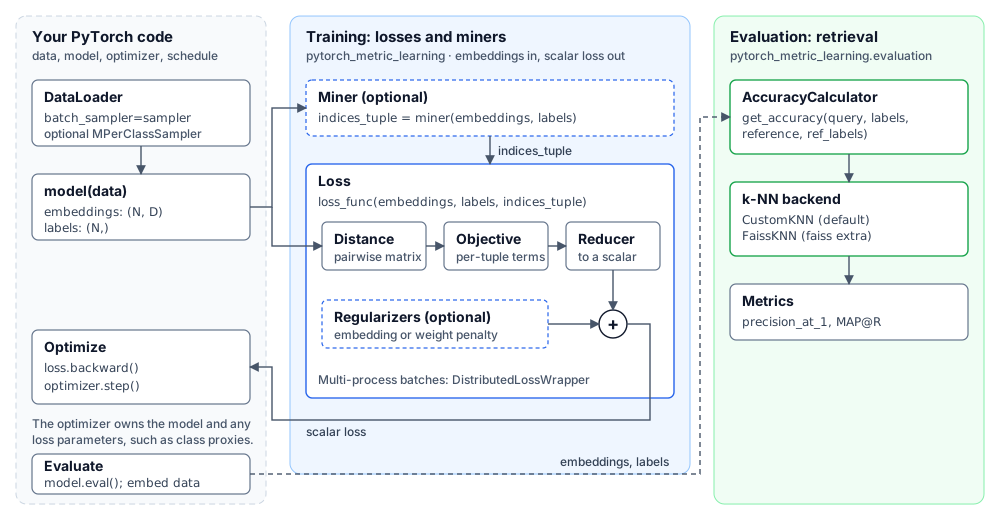
Train embedding models with composable PyTorch losses, hard-example miners, distances, reducers, and regularizers. Use them in your own training loop for retrieval, clustering, recognition, or learning from pairs and triplets.
Docs for humans · Documentation source
Install
Install from PyPI with uv or pip:
uv pip install pytorch-metric-learning
pip install pytorch-metric-learning
The core package needs only PyTorch and NumPy. Optional extras add the Faiss
retrieval backend, pytorch-metric-learning[faiss], and scikit-learn for the
NMI/AMI clustering metrics, pytorch-metric-learning[clustering].
Version 3 requires Python 3.12 or newer, PyTorch 2.14.0 or newer, and NumPy 2.5.3 or newer. Upgrading from version 2? Read the release notes and look up old names in the migration guide. The version 2 documentation remains available.
A minimal training step
Your model produces one embedding per input. Equal labels identify positive pairs; different labels identify negatives. Here a contrastive loss pulls positive pairs together and pushes negatives apart:
import torch
from pytorch_metric_learning import losses

torch.manual_seed(17)
model = torch.nn.Linear(8, 4)
optimizer = torch.optim.SGD(model.parameters(), lr=0.1)
data = torch.randn(12, 8)
labels = torch.arange(4).repeat_interleave(3)
loss_func = losses.ContrastiveLoss(neg_margin=1.4)

optimizer.zero_grad(set_to_none=True)
loss = loss_func(model(data), labels)
loss.backward()
optimizer.step()
The model returns embeddings shaped (12, 4) and labels have shape (12,).
This loss L2-normalizes embeddings by default. It averages active positive and
negative pair penalties separately, then adds them. See the
contrastive-loss contract for distances,
margins, and reduction options.
Learn more
The documentation starts with a task index and a concepts overview of embeddings, tuples, distances, loss terms, and reducers. Every component page states its signature, defaults, tensor contract, and paper, and the recipes show complete training and evaluation code.
Contributing
See CONTRIBUTING.md. Thanks to all contributors, upstream projects, and supporters.
Citing this library
If you use this library in your research, please cite the PyTorch Metric Learning paper:
@article{Musgrave2020PyTorchML,
  title={PyTorch Metric Learning},
  author={Kevin Musgrave and Serge J. Belongie and Ser-Nam Lim},
  journal={ArXiv},
  year={2020},
  volume={abs/2008.09164}
}
Explorar proyectos relacionados
tensorflow/tensorflow
Un framework de código abierto de aprendizaje automático para todos
201,505 estrellashuggingface/transformers
🤗 Transformers: el framework de definición de modelos para modelos de aprendizaje automático de vanguardia en texto, visión, audio y multimodal, tanto para inferencia como para entrenamiento.
168,815 estrellasAUTOMATIC1111/stable-diffusion-webui
Interfaz web de Stable Diffusion
165,289 estrellasComfy-Org/ComfyUI
La GUI, la API y el backend más potentes y modulares para modelos de difusión, con una interfaz de grafos y nodos. El motor de inferencia local más rápido del mundo.
146,271 estrellas