
JulesBelveze/time-series-autoencoder
JulesBelveze/time-series-autoencoder has 715 GitHub stars and 69 forks. GitHot measured 0 stars in 24 hours. Last checked 2026-11-19 20:01 UTC. Last push 2025-11-11.
What you can do
- handles multivariate time series
- attention mechanisms
- denoising autoencoder
- sparse autoencoder
Crecimiento de estrellas medido
- in 24h
- 0
- in 7 days
- Recopilando historial
- in 15 days
- Recopilando historial
- in 1 month
- Recopilando historial
Cambios netos en períodos que se solapan, no totales diarios. Los datos no disponibles se dejan en blanco. Las estrellas indican interés, no calidad.
Acerca de
PyTorch Dual-Attention LSTM-Autoencoder For Multivariate Time Series
Aprendizaje automáticoREADME.md
OriginalLSTM-autoencoder with attentions for multivariate time series


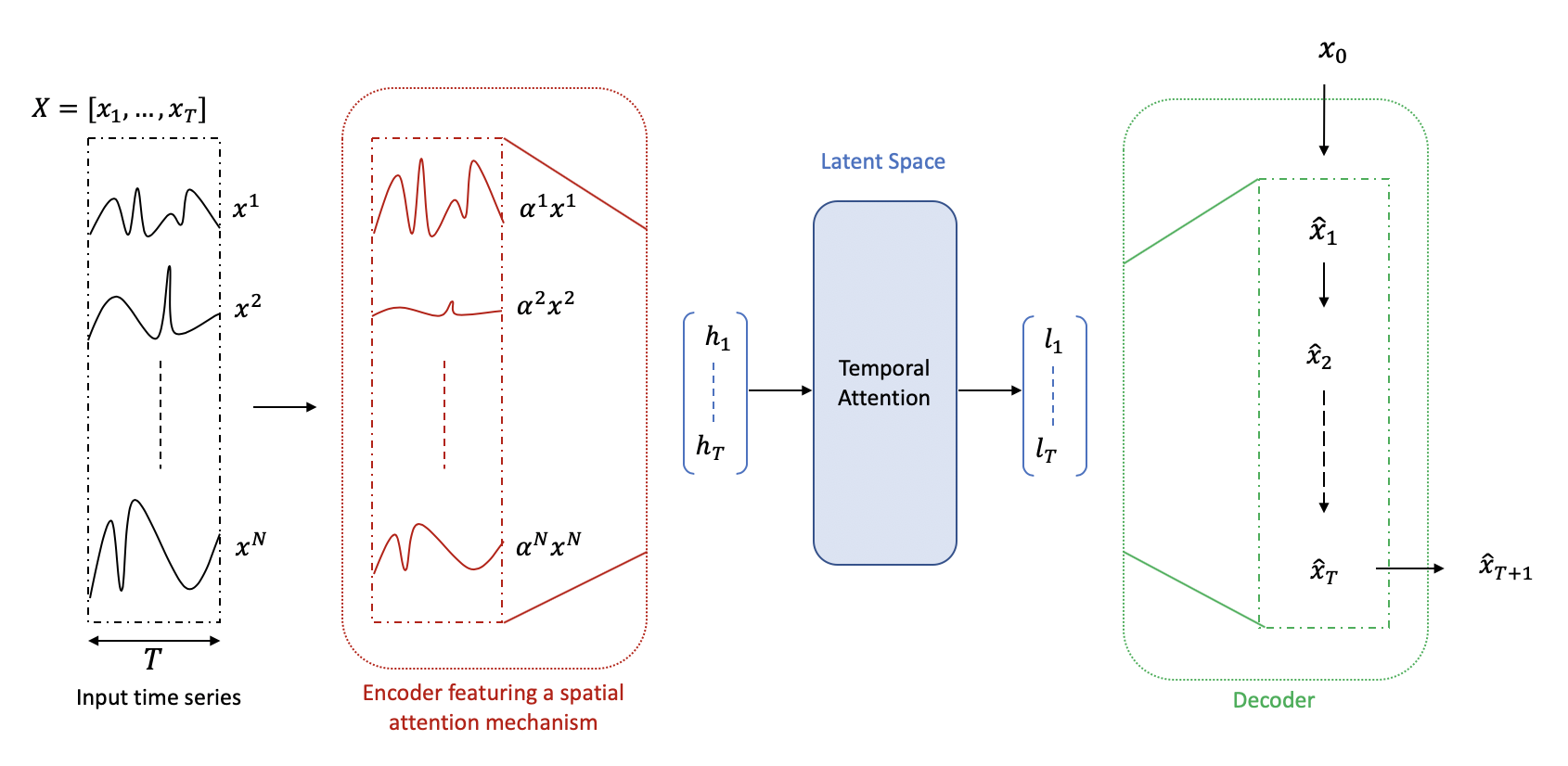
This repository contains an autoencoder for multivariate time series forecasting. It features two attention mechanisms described in A Dual-Stage Attention-Based Recurrent Neural Network for Time Series Prediction and was inspired by Seanny123's repository.
Download and dependencies
To clone the repository please run:
git clone https://github.com/JulesBelveze/time-series-autoencoder.git
Use uv
Then install uv
# install uv
curl -LsSf https://astral.sh/uv/install.sh | sh  # linux/mac
# or
brew install uv  # mac with homebrew
setup environment and install dependencies
cd time-series-autoencoder
uv venv
uv pip sync pyproject.toml
Install directly from requirements.txt
pip install -r requirements.txt
Usage
The project uses Hydra as a configuration parser. You can simply change the parameters
directly within your .yaml file or you can override/set parameter using flags (for a complete guide please refer to
the docs).
python3 main.py -cn=[PATH_TO_FOLDER_CONFIG] -cp=[CONFIG_NAME]
Optional arguments:
  -h, --help            show this help message and exit
  --batch-size BATCH_SIZE
                        batch size
  --output-size OUTPUT_SIZE
                        size of the ouput: default value to 1 for forecasting
  --label-col LABEL_COL
                        name of the target column
  --input-att INPUT_ATT
                        whether or not activate the input attention mechanism
  --temporal-att TEMPORAL_ATT
                        whether or not activate the temporal attention
                        mechanism
  --seq-len SEQ_LEN     window length to use for forecasting
  --hidden-size-encoder HIDDEN_SIZE_ENCODER
                        size of the encoder's hidden states
  --hidden-size-decoder HIDDEN_SIZE_DECODER
                        size of the decoder's hidden states
  --reg-factor1 REG_FACTOR1
                        contribution factor of the L1 regularization if using
                        a sparse autoencoder
  --reg-factor2 REG_FACTOR2
                        contribution factor of the L2 regularization if using
                        a sparse autoencoder
  --reg1 REG1           activate/deactivate L1 regularization
  --reg2 REG2           activate/deactivate L2 regularization
  --denoising DENOISING
                        whether or not to use a denoising autoencoder
  --do-train DO_TRAIN   whether or not to train the model
  --do-eval DO_EVAL     whether or not evaluating the mode
  --data-path DATA_PATH
                        path to data file
  --output-dir OUTPUT_DIR
                        name of folder to output files
  --ckpt CKPT           checkpoint path for evaluation
Features
- handles multivariate time series
- attention mechanisms
- denoising autoencoder
- sparse autoencoder
Examples
You can find under the examples scripts to train the model in both cases: