
Jingong-Chen/Any3R has 57 GitHub stars and 5 forks. GitHot measured +2 stars in 24 hours and +8 in 7 days. Last checked 2026-11-12 10:48 UTC. Last push 2026-11-02.
Any3R: Feedforward 3D Reconstruction from Any Camera Type — pinhole, fisheye beyond 180°, 360° panoramas, or any mix, in one forward pass
What you can do
- One model for every central camera. Thirteen camera models are built in (pinhole, Brown–Conrady, Kannala–Brandt, equidistant, equisolid, stereographic, FOV, MEI, double sphere, EUCM, cylindrical, equirectangular and equirectangular windows), and any other central camera works through its ray field.
- Mixed cameras in one scene. Views from different cameras, with different sizes and fields of view, are reconstructed together into one consistent point cloud.
- Calibrations as you have them. COLMAP models, OpenCV calibrations, a JSON file, or just "a 190° fisheye".
- Fast. 32 views at 512 × 512 in 1.1 s and 128 views in 9 s (17.7 GB) on one RTX 5090.
Crecimiento de estrellas medido
- in 24h
- +2
- in 7 days
- +8
- in 15 days
- Actualización retrasada
- in 1 month
- Actualización retrasada
Cambios netos en períodos que se solapan, no totales diarios. Los datos no disponibles se dejan en blanco. Las estrellas indican interés, no calidad.
README.md
OriginalAny3R: Feedforward 3D Reconstruction from Any Camera Type
Jingong Chen1,2 · Qingwen Zhang3† · Youming Deng4† · Chulwoo Pack1 · Olaf Wysocki5 · Boris Jutzi6 · Kwanghee Won1* · Kyle Gao2
1South Dakota State University 2Aalto University 3KTH Royal Institute of Technology
4Cornell University 5University of Cambridge 6Karlsruhe Institute of Technology
†Equal contribution *Corresponding author




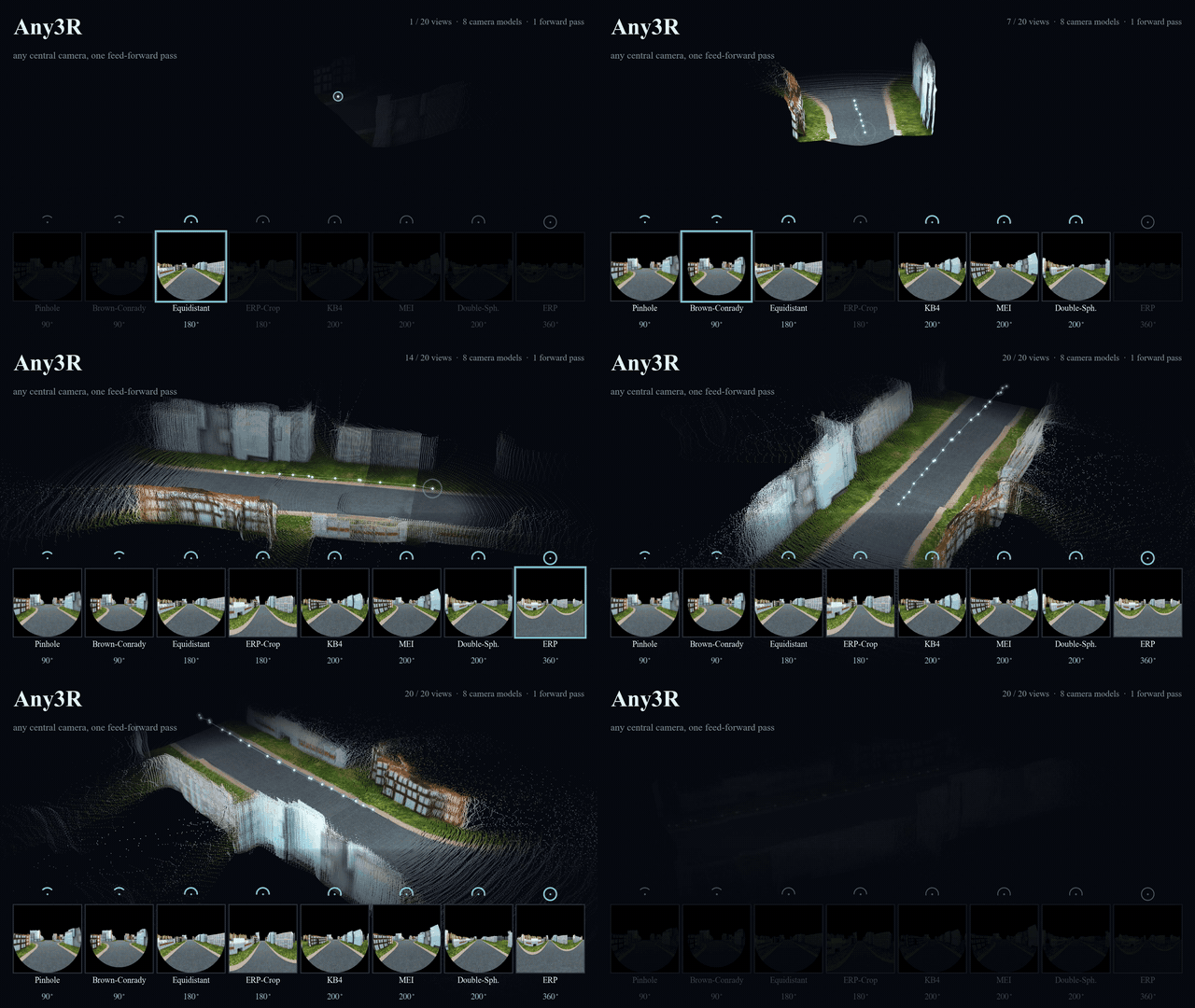
Any3R reconstructs a scene from images taken with any central camera, in a single forward pass: pinhole and distorted lenses, fisheyes beyond 180°, 360° panoramas, and any mix of them in one scene. Each view is described by its ray field, the direction of every pixel, instead of a lens type, so one set of weights covers every lens with no undistortion and no retraining. Any3R predicts per-view depth along each ray, camera poses and a fused point cloud.
News
- 2026-10-31 · Inference code, model weights, interactive demo and evaluation code are released.
Contents
Highlights · Installation · Quick start · Cameras · Demos · Model · Results · Evaluation · Limitations · Citation
Highlights
- One model for every central camera. Thirteen camera models are built in (pinhole, Brown–Conrady, Kannala–Brandt, equidistant, equisolid, stereographic, FOV, MEI, double sphere, EUCM, cylindrical, equirectangular and equirectangular windows), and any other central camera works through its ray field.
- Mixed cameras in one scene. Views from different cameras, with different sizes and fields of view, are reconstructed together into one consistent point cloud.
- Calibrations as you have them. COLMAP models, OpenCV calibrations, a JSON file, or just "a 190° fisheye".
- Fast. 32 views at 512 × 512 in 1.1 s and 128 views in 9 s (17.7 GB) on one RTX 5090.
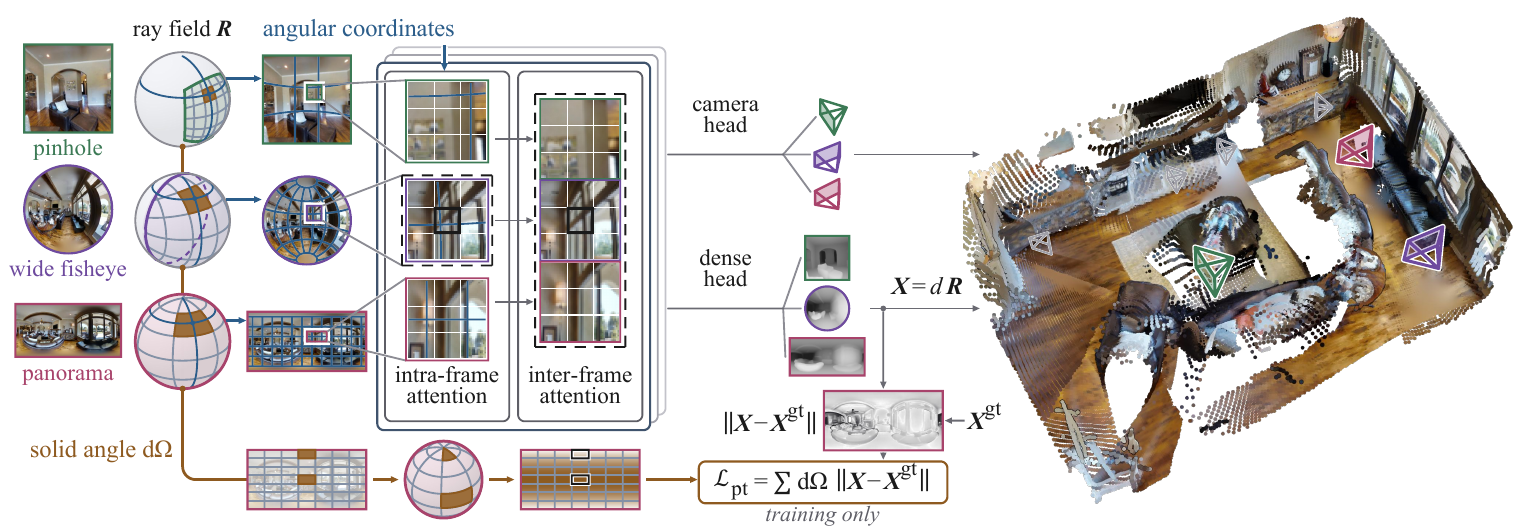
The ray field enters the network in two places. Angular coordinates give the rotary position embedding the measured elevation and azimuth of every patch, per view, in place of its row and column; solid-angle weighting scales the training loss by the area each pixel covers on the sphere. Neither depends on the lens.
Installation
git clone https://github.com/Jingong-Chen/Any3R.git
cd Any3R
conda create -n any3r python=3.11 -y && conda activate any3r
pip install torch torchvision --index-url https://download.pytorch.org/whl/cu128   # pick the build for your CUDA
pip install -e .              # the any3r package
pip install -e ".[demo]"      # optional: Gradio demo and GLB export
The weights (4.6 GB) are downloaded from Hugging Face on first use. A GPU with bfloat16 support is recommended; inference also runs in float16 on older GPUs and on the CPU.
Quick start
import torch
from any3r import Any3R, cameras
from any3r.io import prepare_views

model = Any3R.from_pretrained("Jingong/Any3R").to("cuda").eval()

images = ["phone.jpg", "fisheye.jpg", "panorama.jpg"]
cams = [
    cameras.from_fov("pinhole", 4032, 3024, fov_deg=55),                 # any calibration works, see below
    cameras.from_colmap("OPENCV_FISHEYE", 1920, 1920, [fx, fy, cx, cy, k1, k2, k3, k4]),
    cameras.ERP(),                                                        # equirectangular 360° panorama
]
views = prepare_views(images, cams, size=512)    # resize, compute ray maps, put the views on one canvas

pred = model.infer(views.images, views.rays)     # bfloat16 autocast inside
pred["depth"]          # (S, H, W, 1)  distance along each pixel's ray
pred["depth_conf"]     # (S, H, W)     confidence
pred["camera_poses"]   # (S, 4, 4)     camera-to-world, in the frame of the first view
pred["world_points"]   # (S, H, W, 3)  fused points; the scale is arbitrary
model.infer takes the images (S, 3, H, W) in [0, 1] and the ray maps (S, H, W, 3), so you can also pass ray fields computed by your own code. any3r.export.save_predictions(out_dir, pred, views) writes a PLY point cloud, a GLB scene with the cameras, the poses as JSON and the depth maps.
Describing cameras
Any3R needs the ray field of every view, which any3r.cameras computes from a calibration:
| You have | Use |
|---|---|
| a COLMAP sparse model | cameras.read_colmap_cameras("sparse/0") or demo.py --colmap sparse/0 |
| an OpenCV calibration | cameras.from_opencv(K, dist, W, H), with fisheye=True for cv2.fisheye |
| model parameters | cameras.KB4(fx, fy, cx, cy, k1, k2, k3, k4), cameras.DoubleSphere(...), ... |
| only the lens type and field of view | cameras.from_fov("equidistant", W, H, fov_deg=190) |
| an equirectangular panorama | cameras.ERP() |
| your own ray directions | pass them to model.infer directly |
Conventions, the JSON format used by the demos and the parameters of every model are in docs/cameras.md.
Demos
Command line. Three example scenes ship with the code:
# 20 views of a street through 8 different camera models (pinhole to 360°)
python demo.py --images examples/street_mixed/images --cameras examples/street_mixed/cameras.json --out outputs/street

# a real 214° fisheye with its COLMAP calibration (FIORD)
python demo.py --images examples/fiord_meetingroom/images --cameras examples/fiord_meetingroom/cameras.json --out outputs/fiord

# eight equirectangular panoramas
python demo.py --images examples/panocity_erp/images --camera erp --out outputs/panos

# your own data
python demo.py --images my_scene/images --colmap my_scene/sparse/0
python demo.py --images my_fisheye_folder --camera equidistant --fov 190
Each run writes points.ply, scene.glb (points and cameras), cameras.json (poses and calibrations) and depth.npz.
Interactive. python demo_gradio.py opens a browser app: upload images, pick a camera model or upload a calibration, and inspect the point cloud, cameras and depth maps. The examples load with one click.
Model
| Model | Parameters | Input | Weights |
|---|---|---|---|
| Any3R | 1.15 B | any number of views from any central cameras, mixed freely | 🤗 Jingong/Any3R |
Any3R is fine-tuned from VGGT-Omega for 40 epochs on Matterport3D, Stanford2D3DS, Structured3D, PanoCity and DL3DV videos. Half of the panoramic training samples are native panoramas and half are views resampled through a random camera, drawn from eight central models (pinhole, Brown–Conrady, equidistant, Kannala–Brandt, MEI, double sphere, equirectangular and cropped equirectangular) with fields of view from 30° to 360°. All test scenes are held out.
Results
All numbers are from the paper. The benchmark images every scene of three datasets through the same views with each camera model, and every method fuses its points with its own predicted camera poses. Acc (m, lower is better) is the mean distance from a reconstructed point to the ground truth; AUC@15° / AUC@30° (%, higher is better) is the area under the pairwise pose-error curve. In each table, the best value of a column is in bold and the second best underlined. The five held-out camera models are in the paper's appendix and in eval/README.md.
Eight camera models, seven methods
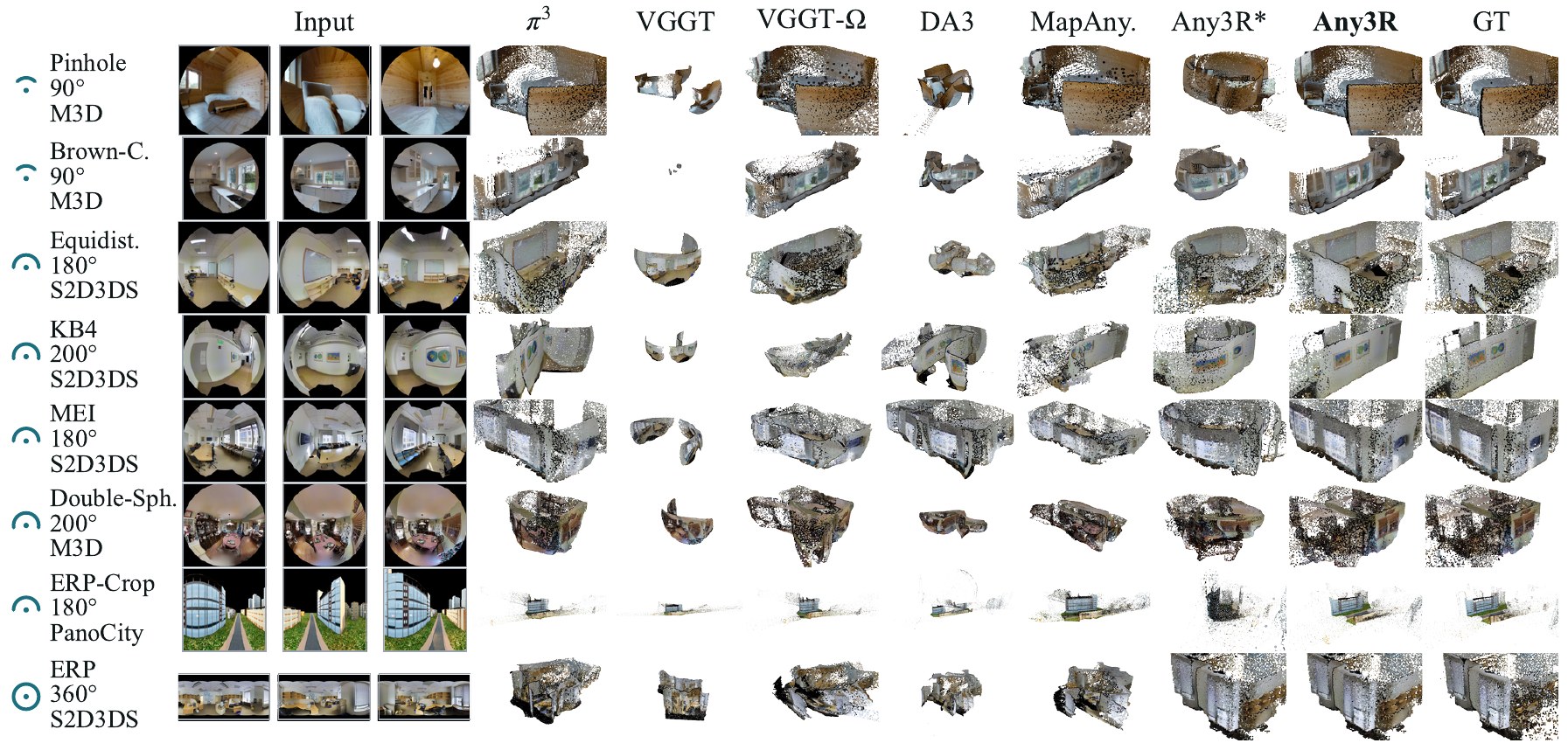
One scene per row, each imaged by three views through one camera model. Every method fuses the same three views with its own predicted poses and is placed in the ground-truth frame by one similarity transform; the highest 30% of each indoor cloud is removed so the room can be seen from above. MapAny. is MapAnything and Any3R* is Any3R without its ray map. The same data can be explored in 3D on the project page.
Methods built for other cameras
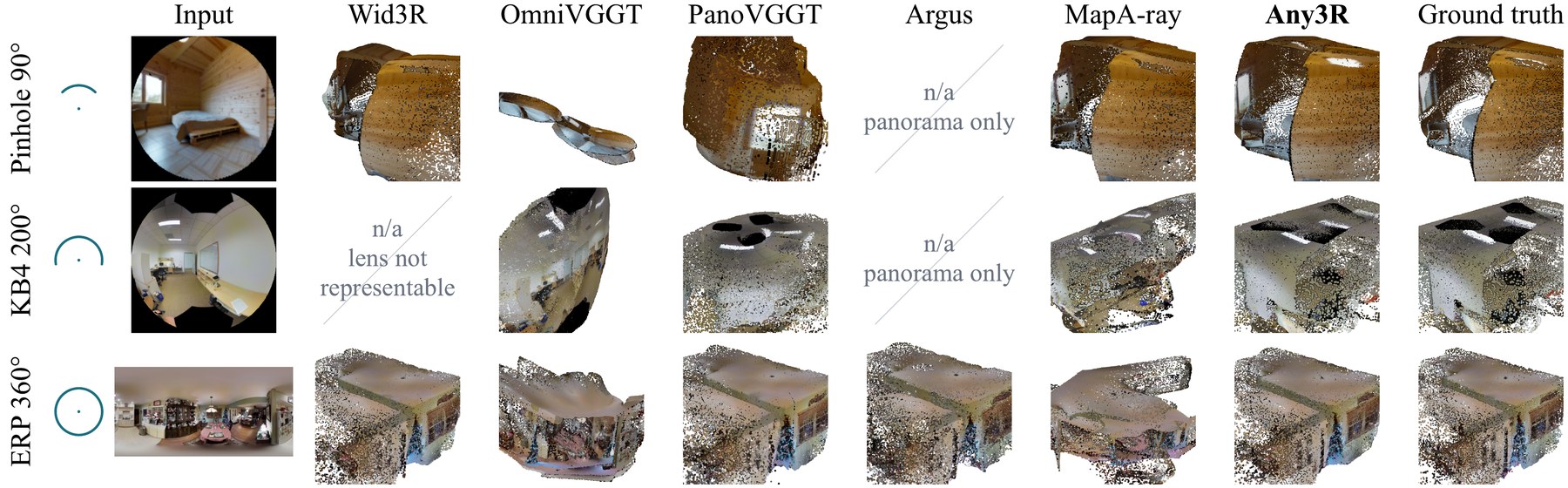
One scene per row and camera model. Wid3R receives the true ray field, Argus takes panoramas only, and n/a marks cameras a method cannot take.
Real fisheye lenses, zero-shot
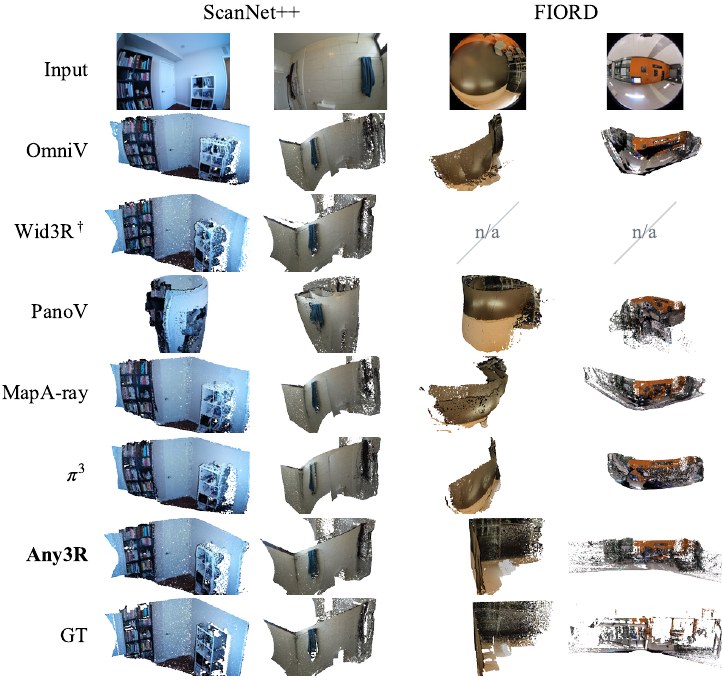
ScanNet++ (DSLR fisheye) and FIORD (200° lens), neither in Any3R's training data. The samples shown are those on which Any3R leads the most; the averages over all samples are in the zero-shot table below.
Benchmark tables
Comparison with methods built for other cameras. Wid3R receives the true ray field; MapA-ray is MapAnything with the true ray field fed to its ray encoder; – marks cameras a method cannot take.
Indoor (Matterport3D + Stanford2D3DS)
| Method | Pin. 90° | B–C 90° | Equi. 180° | ERP-C 180° | MEI 180° | KB4 200° | DS 200° | ERP 360° |
|---|---|---|---|---|---|---|---|---|
| Acc ↓ (m) | ||||||||
| OmniVGGT | 0.250 | 0.201 | 0.326 | 0.318 | 0.329 | 0.355 | 0.350 | 0.406 |
| Wid3R | 0.144 | – | 0.141 | – | 0.146 | – | – | 0.101 |
| PanoVGGT | 0.282 | 0.272 | 0.259 | 0.348 | 0.265 | 0.251 | 0.265 | 0.072 |
| Argus | – | – | – | – | – | – | – | 0.094 |
| MapA-ray | 0.092 | 0.146 | 0.277 | 0.254 | 0.239 | 0.274 | 0.258 | 0.405 |
| Any3R | 0.076 | 0.091 | 0.058 | 0.052 | 0.059 | 0.056 | 0.060 | 0.054 |
| AUC@15° ↑ (%) | ||||||||
| OmniVGGT | 6.3 | 1.8 | 1.9 | 12.1 | 0.6 | 0.9 | 2.9 | 0.7 |
| Wid3R | 46.4 | – | 59.4 | – | 59.5 | – | – | 85.3 |
| PanoVGGT | 2.2 | 2.5 | 21.7 | 21.5 | 23.6 | 36.2 | 46.9 | 89.2 |
| Argus | – | – | – | – | – | – | – | 88.4 |
| MapA-ray | 53.6 | 31.2 | 10.4 | 6.5 | 15.5 | 12.4 | 12.0 | 4.1 |
| Any3R | 74.8 | 64.8 | 90.6 | 86.0 | 90.5 | 81.2 | 80.5 | 94.5 |
| AUC@30° ↑ (%) | ||||||||
| OmniVGGT | 13.9 | 5.4 | 6.6 | 26.2 | 5.4 | 4.8 | 7.0 | 4.1 |
| Wid3R | 67.0 | – | 76.4 | – | 76.4 | – | – | 89.0 |
| PanoVGGT | 10.1 | 11.8 | 50.1 | 42.6 | 52.2 | 63.5 | 69.7 | 93.2 |
| Argus | – | – | – | – | – | – | – | 91.3 |
| MapA-ray | 72.8 | 55.5 | 25.5 | 19.7 | 34.9 | 30.2 | 32.8 | 14.1 |
| Any3R | 85.0 | 78.3 | 93.9 | 91.6 | 94.6 | 89.6 | 88.5 | 96.6 |
Outdoor (PanoCity)
| Method | Pin. 90° | B–C 90° | Equi. 180° | ERP-C 180° | MEI 180° | KB4 200° | DS 200° | ERP 360° |
|---|---|---|---|---|---|---|---|---|
| Acc ↓ (m) | ||||||||
| OmniVGGT | 2.875 | 2.676 | 3.313 | 2.804 | 3.703 | 3.941 | 3.670 | 1.479 |
| Wid3R | 2.278 | – | 2.121 | – | 2.252 | – | – | 2.330 |
| PanoVGGT | 2.256 | 2.708 | 2.498 | 3.633 | 2.433 | 2.405 | 2.473 | 0.751 |
| Argus | – | – | – | – | – | – | – | 1.517 |
| MapA-ray | 1.484 | 1.558 | 2.368 | 2.686 | 2.029 | 2.523 | 2.579 | 1.894 |
| Any3R | 1.160 | 1.243 | 0.866 | 0.811 | 0.854 | 0.863 | 0.901 | 0.663 |
| AUC@15° ↑ (%) | ||||||||
| OmniVGGT | 1.9 | 0.7 | 3.7 | 8.5 | 3.2 | 3.1 | 5.4 | 4.2 |
| Wid3R | 8.1 | – | 25.5 | – | 22.9 | – | – | 0.0 |
| PanoVGGT | 10.8 | 10.1 | 37.5 | 42.0 | 38.1 | 51.0 | 58.6 | 93.5 |
| Argus | – | – | – | – | – | – | – | 81.9 |
| MapA-ray | 56.3 | 45.0 | 17.5 | 10.0 | 27.8 | 15.1 | 20.0 | 2.1 |
| Any3R | 61.5 | 51.0 | 85.0 | 87.4 | 85.2 | 79.5 | 81.0 | 97.2 |
| AUC@30° ↑ (%) | ||||||||
| OmniVGGT | 9.6 | 4.8 | 9.0 | 19.3 | 9.3 | 10.2 | 13.2 | 6.1 |
| Wid3R | 22.8 | – | 47.9 | – | 42.6 | – | – | 0.0 |
| PanoVGGT | 25.2 | 25.9 | 61.0 | 62.7 | 62.0 | 73.9 | 78.2 | 96.8 |
| Argus | – | – | – | – | – | – | – | 90.5 |
| MapA-ray | 74.7 | 61.6 | 33.3 | 23.1 | 49.4 | 31.9 | 39.4 | 6.3 |
| Any3R | 80.7 | 74.2 | 92.5 | 93.7 | 92.6 | 89.4 | 90.5 | 98.6 |
Comparison with geometry foundation models. Any3R* is Any3R without its ray map (it then assumes an equirectangular grid) and is not ranked.
Indoor (Matterport3D + Stanford2D3DS)
| Method | Pin. 90° | B–C 90° | Equi. 180° | ERP-C 180° | MEI 180° | KB4 200° | DS 200° | ERP 360° |
|---|---|---|---|---|---|---|---|---|
| Acc ↓ (m) | ||||||||
| π³ | 0.084 | 0.119 | 0.171 | 0.287 | 0.164 | 0.189 | 0.183 | 0.414 |
| MapAnything | 0.092 | 0.149 | 0.273 | 0.269 | 0.267 | 0.283 | 0.294 | 0.386 |
| DA3 | 0.313 | 0.294 | 0.361 | 0.288 | 0.363 | 0.396 | 0.379 | 0.402 |
| VGGT | 0.270 | 0.282 | 0.361 | 0.274 | 0.379 | 0.356 | 0.374 | 0.398 |
| VGGT-Ω | 0.149 | 0.161 | 0.252 | 0.265 | 0.250 | 0.281 | 0.302 | 0.403 |
| Any3R* | 0.282 | 0.283 | 0.274 | 0.278 | 0.278 | 0.279 | 0.298 | 0.054 |
| Any3R | 0.076 | 0.091 | 0.058 | 0.052 | 0.059 | 0.056 | 0.060 | 0.054 |
| AUC@15° ↑ (%) | ||||||||
| π³ | 76.9 | 53.5 | 42.1 | 18.0 | 43.1 | 35.2 | 34.6 | 3.5 |
| MapAnything | 53.6 | 28.5 | 13.2 | 9.0 | 10.8 | 8.8 | 8.4 | 6.4 |
| DA3 | 7.8 | 2.7 | 0.9 | 22.1 | 1.2 | 0.4 | 0.7 | 7.0 |
| VGGT | 23.3 | 9.9 | 5.2 | 14.2 | 5.3 | 5.0 | 2.9 | 3.3 |
| VGGT-Ω | 63.5 | 50.4 | 31.3 | 15.0 | 29.6 | 24.0 | 19.5 | 6.9 |
| Any3R* | 24.0 | 43.8 | 48.3 | 41.7 | 48.2 | 55.0 | 58.5 | 94.5 |
| Any3R | 74.8 | 64.8 | 90.6 | 86.0 | 90.5 | 81.2 | 80.5 | 94.5 |
| AUC@30° ↑ (%) | ||||||||
| π³ | 82.7 | 66.0 | 61.9 | 37.1 | 62.7 | 56.4 | 58.9 | 14.1 |
| MapAnything | 72.8 | 52.3 | 31.3 | 23.2 | 29.6 | 27.6 | 24.8 | 16.2 |
| DA3 | 17.8 | 10.3 | 5.7 | 46.2 | 7.2 | 5.5 | 5.1 | 16.8 |
| VGGT | 50.0 | 25.6 | 18.8 | 32.2 | 16.6 | 16.4 | 13.9 | 10.6 |
| VGGT-Ω | 76.9 | 69.7 | 53.8 | 34.6 | 52.3 | 47.1 | 42.0 | 17.8 |
| Any3R* | 47.5 | 66.2 | 71.3 | 65.8 | 72.0 | 75.9 | 77.5 | 96.6 |
| Any3R | 85.0 | 78.3 | 93.9 | 91.6 | 94.6 | 89.6 | 88.5 | 96.6 |
Outdoor (PanoCity)
| Method | Pin. 90° | B–C 90° | Equi. 180° | ERP-C 180° | MEI 180° | KB4 200° | DS 200° | ERP 360° |
|---|---|---|---|---|---|---|---|---|
| Acc ↓ (m) | ||||||||
| π³ | 1.479 | 1.711 | 2.093 | 2.426 | 2.036 | 2.394 | 2.271 | 1.628 |
| MapAnything | 1.485 | 1.633 | 2.066 | 2.861 | 2.236 | 3.297 | 2.789 | 1.833 |
| DA3 | 4.360 | 5.689 | 6.656 | 2.717 | 6.844 | 6.463 | 6.477 | 3.149 |
| VGGT | 4.153 | 3.940 | 6.296 | 3.078 | 6.886 | 6.623 | 6.430 | 1.902 |
| VGGT-Ω | 1.711 | 1.572 | 2.162 | 2.455 | 2.490 | 2.680 | 2.544 | 1.876 |
| Any3R* | 2.079 | 2.525 | 2.370 | 3.324 | 2.463 | 2.420 | 2.552 | 0.663 |
| Any3R | 1.160 | 1.243 | 0.866 | 0.811 | 0.854 | 0.863 | 0.901 | 0.663 |
| AUC@15° ↑ (%) | ||||||||
| π³ | 44.6 | 34.0 | 18.8 | 15.9 | 20.0 | 14.4 | 16.0 | 2.3 |
| MapAnything | 56.5 | 20.6 | 19.6 | 10.6 | 17.1 | 16.9 | 13.8 | 0.1 |
| DA3 | 4.8 | 3.0 | 6.4 | 7.7 | 4.9 | 3.4 | 4.6 | 5.5 |
| VGGT | 15.1 | 2.6 | 3.7 | 9.5 | 6.5 | 5.5 | 7.3 | 0.9 |
| VGGT-Ω | 45.5 | 44.4 | 15.8 | 8.1 | 15.6 | 13.8 | 8.8 | 3.9 |
| Any3R* | 20.1 | 36.0 | 45.0 | 29.9 | 47.3 | 48.8 | 50.1 | 97.2 |
| Any3R | 61.5 | 51.0 | 85.0 | 87.4 | 85.2 | 79.5 | 81.0 | 97.2 |
| AUC@30° ↑ (%) | ||||||||
| π³ | 61.7 | 47.1 | 36.1 | 28.3 | 37.3 | 30.0 | 35.0 | 4.8 |
| MapAnything | 74.8 | 36.1 | 41.9 | 25.0 | 39.7 | 34.2 | 30.1 | 3.1 |
| DA3 | 13.6 | 11.5 | 14.8 | 22.1 | 10.2 | 9.8 | 10.6 | 11.3 |
| VGGT | 32.8 | 11.0 | 8.8 | 24.3 | 13.9 | 13.2 | 17.3 | 3.5 |
| VGGT-Ω | 55.3 | 54.7 | 33.8 | 23.6 | 34.8 | 31.4 | 24.4 | 8.5 |
| Any3R* | 38.9 | 58.3 | 67.7 | 53.7 | 69.6 | 72.3 | 72.2 | 98.6 |
| Any3R | 80.7 | 74.2 | 92.5 | 93.7 | 92.6 | 89.4 | 90.5 | 98.6 |
Zero-shot on real fisheye lenses: the ScanNet++ DSLR fisheye (validation split) and the 200° lens of the FIORD rig, neither in Any3R's training data. † Wid3R is trained on ScanNet++. Any3R* is not ranked.
| Method | ScanNet++ Acc ↓ | AUC@15° ↑ | AUC@30° ↑ | FIORD Acc ↓ | AUC@15° ↑ | AUC@30° ↑ |
|---|---|---|---|---|---|---|
| OmniVGGT | 0.097 | 18.6 | 41.5 | 0.363 | 18.6 | 40.3 |
| Wid3R† | 0.039 | 85.3 | 92.6 | – | – | – |
| PanoVGGT | 0.277 | 1.8 | 9.7 | 0.511 | 29.4 | 51.2 |
| MapA-ray | 0.093 | 18.5 | 43.6 | 0.396 | 19.4 | 36.5 |
| π³ | 0.086 | 20.6 | 46.6 | 0.378 | 15.7 | 36.7 |
| MapAnything | 0.099 | 19.3 | 40.2 | 0.399 | 17.7 | 37.2 |
| DA3 | 0.118 | 17.2 | 41.5 | 0.380 | 9.1 | 25.8 |
| VGGT | 0.118 | 18.0 | 41.7 | 0.442 | 15.6 | 35.3 |
| VGGT-Ω | 0.112 | 16.7 | 42.9 | 0.451 | 19.9 | 38.9 |
| Any3R* | 0.273 | 7.5 | 22.9 | 0.480 | 28.3 | 47.5 |
| Any3R | 0.055 | 62.7 | 79.7 | 0.274 | 63.8 | 78.4 |
Evaluation
eval/ reproduces the paper's benchmark end to end: it rebuilds the 936 scene files from the original datasets (every array is checked against a frozen manifest), renders each view through its camera model, runs Any3R and computes the paper's metrics (Acc, Comp, NC, and pose AUC with predicted poses).
pip install -r eval/requirements.txt
python eval/build_benchmark.py --out data/any3r_bench --m3d-root ... --s2d3ds-root ... --panocity-root ...
python eval/evaluate.py --benchmark data/any3r_bench --out results/any3r --verify
python eval/make_table.py --results results/any3r --compare-paper
On the paper's configuration (A100, PyTorch 2.5.1) the released code and weights reproduce every per-scene result of the paper exactly; on other GPUs bfloat16 kernels shift the numbers slightly (on an RTX 5090, at most 0.004 m Acc and 0.7 AUC points in the main table). The full benchmark takes about 5 minutes on one RTX 5090.
Limitations
- Central cameras. Every pixel's ray must pass through one centre. Non-central optics (rolling-shutter motion, push-broom sensors, strongly non-central catadioptric systems) are outside the model.
- A calibration is needed. Any3R uses the ray field it is given and does not estimate intrinsics. Without a calibration,
from_fovwith the nominal lens type and field of view is a reasonable start. - Scale and dynamics. Reconstructions have an arbitrary scale, and the scene is assumed static.
Citation
@article{chen2026any3r,
  title   = {Any3R: Feedforward 3D Reconstruction from Any Camera Type},
  author  = {Chen, Jingong and Zhang, Qingwen and Deng, Youming and Pack, Chulwoo and
             Wysocki, Olaf and Jutzi, Boris and Won, Kwanghee and Gao, Kyle},
  journal = {arXiv preprint arXiv:2610.36150},
  year    = {2026}
}
Acknowledgments
Any3R builds on the code and models of VGGT-Omega, VGGT and PanoVGGT, whose authors also released the PanoCity dataset. We train on Matterport3D (with the panoramas stitched by 360MonoDepth), Stanford2D3DS, Structured3D, PanoCity and DL3DV, and evaluate zero-shot on ScanNet++ and FIORD. We thank the authors of π³, MapAnything, Depth Anything 3, OmniVGGT, Wid3R and Argus for releasing the code we compare against. The evaluation uses Open3D, and the project page is adapted from Nerfies. The example scenes come from PanoCity and FIORD.
This work was supported by the U.S. National Science Foundation under Grant No. 2316400 and by the Wallenberg AI, Autonomous Systems and Software Program (WASP) funded by the Knut and Alice Wallenberg Foundation. The computations and data handling were enabled by the Arrhenius HPC resource provided by the National Academic Infrastructure for Supercomputing in Sweden, and by the South Dakota State University High Performance Computing (SDSU HPC) team.
License
The code in this repository is released under the MIT License, with one exception: the network trunk derived from VGGT-Omega (any3r/_vggt_omega/ and any3r/aggregator.py) is, together with the model weights, under the FAIR Noncommercial Research License inherited from VGGT-Omega. Running the Any3R model therefore means accepting that license (noncommercial research use), while the camera models, input and export utilities, demos and evaluation code can be reused under MIT on their own. Parts adapted from PanoVGGT are under the MIT License, and the example images keep their dataset licenses; see THIRD_PARTY_NOTICES.md.
Explorar proyectos relacionados
tensorflow/tensorflow
Un framework de código abierto de aprendizaje automático para todos
201,584 estrellashuggingface/transformers
🤗 Transformers: el framework de definición de modelos para modelos de aprendizaje automático de vanguardia en texto, visión, audio y multimodal, tanto para inferencia como para entrenamiento.
168,917 estrellasAUTOMATIC1111/stable-diffusion-webui
Interfaz web de Stable Diffusion
165,300 estrellasComfy-Org/ComfyUI
La GUI, la API y el backend más potentes y modulares para modelos de difusión, con una interfaz de grafos y nodos. El motor de inferencia local más rápido del mundo.
146,472 estrellas