
Forget-C/Jellyfish
Forget-C/Jellyfish has 7,168 GitHub stars and 1,236 forks. GitHot measured +9 stars in 24 hours and +48 in 7 days. Last checked 2026-11-11 13:38 UTC. Last push 2026-07-30.
Un espacio de trabajo integral para producir dramas cortos generados por IA. Abarca desde la introducción del guion hasta la creación de storyboards estructurados, la gestión de la coherencia, la preparación de planos, la generación de vídeo y la exportación.
What you can do
- script understanding
- shot preparation
- asset consistency
- generation execution
Crecimiento de estrellas medido
- in 24h
- +9
- in 7 days
- +48
- in 15 days
- Actualización retrasada
- in 1 month
- Actualización retrasada
Cambios netos en períodos que se solapan, no totales diarios. Los datos no disponibles se dejan en blanco. Las estrellas indican interés, no calidad.
README.md
OriginalJellyfish — AI Short Drama Studio






An end-to-end production workspace for AI-generated short dramas.
From script input to structured storyboarding, consistency management,
shot preparation, video generation, and export.
📷 Screenshots
| Project overview | Asset management |
|---|---|
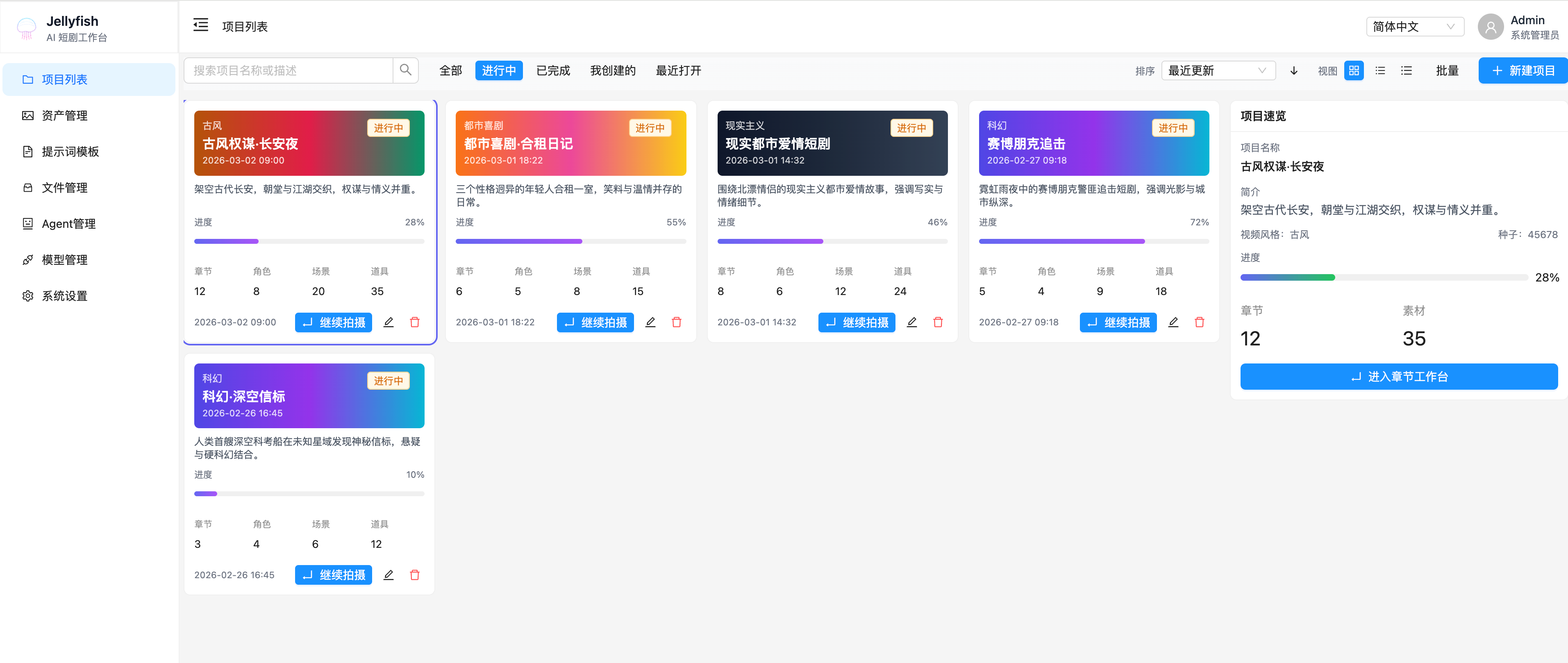 |
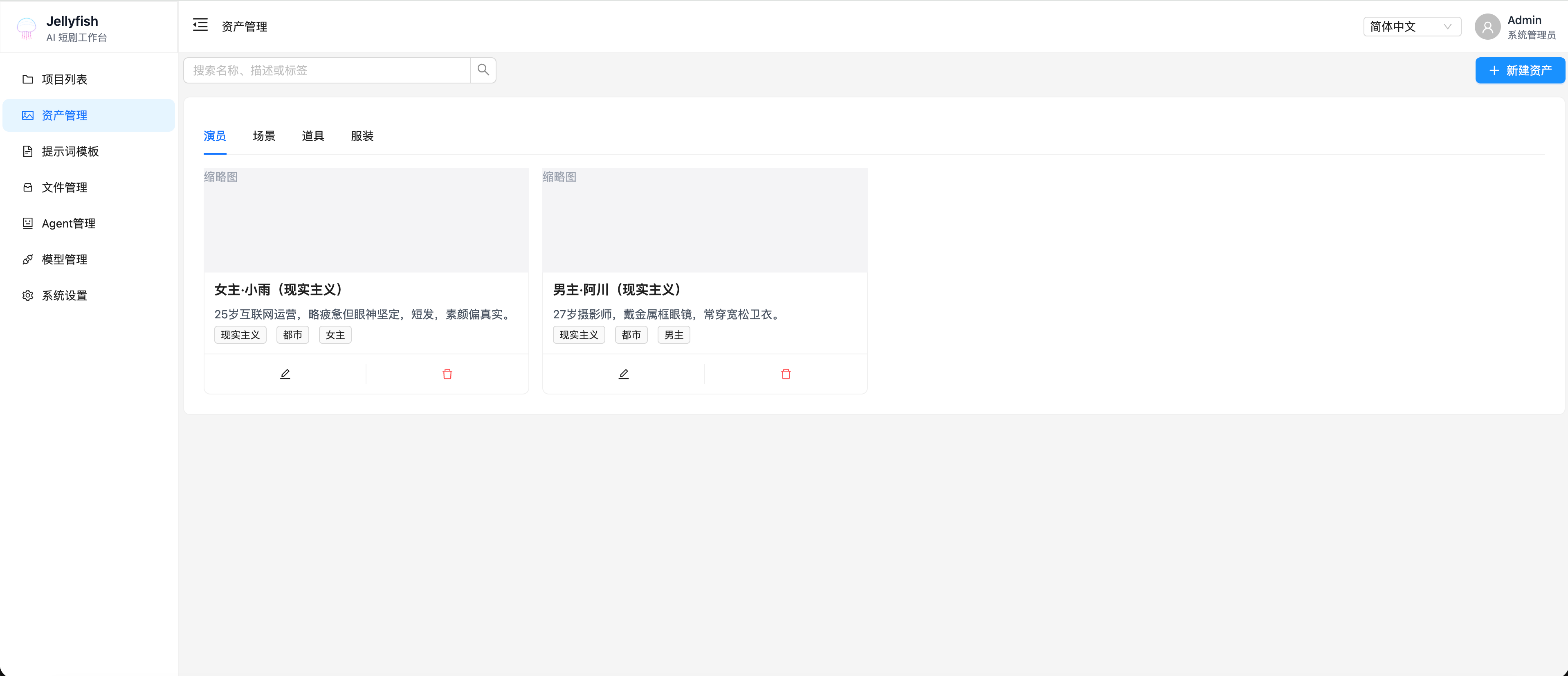 |
✨ Core Value
- Connect the full production flow: Move from script input to storyboard preparation, image/video generation, and task tracking in one place.
- Turn AI output into reusable production assets: Shots, candidate assets, dialogue, prompts, and generation tasks can all be reviewed and reused.
- Treat consistency as a first-class problem: Centralized character, scene, prop, and costume management reduces drift across shots.
- Handle long-running generation as trackable tasks: Text, image, and video jobs all go through one async task system with status, cancel, and recovery.
- Build AI capability as infrastructure: Model management, prompt templates, files, and OpenAPI-based collaboration make the system extensible.
✨ Core Capabilities
Jellyfish is not just a single “AI image/video” utility. It is a production workspace built around:
- script understanding
- shot preparation
- asset consistency
- generation execution
- task tracking
1. AI script understanding and storyboard breakdown
- Split chapter scripts into shots
- Extract characters, scenes, props, costumes, and dialogue
- Run script optimization, simplification, and consistency checks
- Support targeted analysis such as character portraits or scene details
2. Shot preparation and confirmation workflow
The main workflow is:
script breakdown → shot preparation → candidate confirmation → shot ready → generation workspace
Preparation currently supports:
- extracting and refreshing shot candidates
- accepting or ignoring asset candidates
- accepting or ignoring dialogue candidates
- linking existing characters, scenes, props, and costumes
- correcting shot-level basic information
- using a unified readiness state to decide whether a shot is prepared
3. Asset consistency and reuse
The system maintains a shared entity model across:
- characters / actors
- scenes
- props
- costumes
This supports asset reuse across shots and helps stabilize style and identity.
4. Shot-level image and video orchestration
Once a shot is ready, the generation workspace supports:
- keyframe and reference image management
- shot-level video prompt preview
- image and video generation tasks
- single-shot and batch pre-checks
- writing generation outputs back into the shot/media system
5. Unified async task center
Current task infrastructure supports:
- async text-processing tasks
- async image and video generation tasks
- unified task status, result, and elapsed-time tracking
- task cancellation
- a global task center with context-aware navigation back to project/chapter/shot
6. Model, prompt, and generation infrastructure
Supporting capabilities include:
- multi-provider / multi-model management
- default model settings by category
- prompt template management
- file and generated media management
- OpenAPI-driven frontend/backend contracts
🚀 Feature Overview
Project and chapter management
- Create and manage projects and chapters
- Use chapters as the unit for scripts, shots, and generation
- Provide dashboard-style entry points and aggregated stats
AI script processing
- Break chapter scripts into shots
- Extract characters, scenes, props, costumes, and dialogue
- Support optimization, simplification, and consistency checks
- Support focused analysis such as character portraits or scene information
Shot preparation workflow
- Edit shot title, summary, and basic information
- Refresh extracted asset and dialogue candidates
- Confirm, ignore, or link candidate items
- Use preparation state to determine shot readiness
- Keep “prepared” distinct from “currently generating”
Asset and entity management
- Manage characters, actors, scenes, props, and costumes
- Link and reuse them at shot level
- Manage entity images
- Check name existence to encourage reuse of existing assets
Shot generation workspace
- Manage keyframes, reference images, and video prompts
- Check video readiness before generation
- Launch image/video generation tasks
- Support both single-shot and batch generation workflows
Task center
- View active and recently finished tasks
- Track status, progress, elapsed time, and results
- Cancel tasks
- Jump back to the related project, chapter, or shot
Model and prompt infrastructure
- Manage providers, models, and default settings
- Manage prompt templates for images, video, and shots
- Generate frontend request helpers and types from OpenAPI
- Provide a stable base for future AI workflow expansion
File and media management
- Manage uploads and generated outputs
- Preview, link, and reuse image/video assets
- Preserve shot and entity context around generated media
🎯 Use Cases
- Short / micro-drama creators
- AI studios producing video content in batches
- Solo creators exploring vertical drama production
- Education and training teams making lesson videos
- Brands and e-commerce teams producing story-driven promos
🔁 Frontend OpenAPI client and type generation
Frontend request helpers and types are generated from the backend OpenAPI spec. Output directory:
front/src/services/generated/
Cached spec file:
front/openapi.json
With the backend dev server running at http://127.0.0.1:8000, run:
cd front
pnpm run openapi:update
🐳 Docker Compose
The repository includes a ready-to-run compose setup under
deploy/compose/.
Ports
- Frontend:
http://localhost:7788 - Backend:
http://localhost:8000(/docsfor Swagger) - MySQL:
localhost:${MYSQL_PORT:-3306} - Redis:
localhost:${REDIS_PORT:-6379} - RustFS:
http://localhost:${RUSTFS_PORT:-9000}
Start
cp deploy/compose/.env.example deploy/compose/.env
docker compose --env-file deploy/compose/.env -f deploy/compose/docker-compose.yml up --build
🧑💻 Local Development
Backend
cd backend
cp .env.example .env
uv sync
uv run uvicorn app.main:app --reload --host 0.0.0.0 --port 8000
Frontend
cd front
pnpm install
pnpm dev
📄 License
This project is licensed under Apache-2.0.
💬 Community & Feedback
Explorar proyectos relacionados
ytdl-org/youtube-dl
Programa de línea de comandos para descargar vídeos de YouTube.com y otros sitios de vídeo
141,539 estrellasexcalidraw/excalidraw
Pizarra virtual para esbozar diagramas con aspecto de dibujo a mano
135,492 estrellasgodotengine/godot
Godot Engine – Motor de videojuegos 2D y 3D multiplataforma
120,003 estrellasmrdoob/three.js
Biblioteca 3D de JavaScript.
118,122 estrellas