
AI-sandbox/iLTM has 32 GitHub stars and 1 forks. GitHot measured 0 stars in 24 hours, +1 in 7 days, and +1 in 15 days. Last checked 2026-11-22 01:42 UTC. Last push 2026-11-20.
Crecimiento de estrellas medido
- in 24h
- 0
- in 7 days
- +1
- in 15 days
- +1
- in 1 month
- Recopilando historial
Cambios netos en períodos que se solapan, no totales diarios. Los datos no disponibles se dejan en blanco. Las estrellas indican interés, no calidad.
Acerca de
iLTM: Integrated Large Tabular Model
Aprendizaje automáticoREADME.md
OriginaliLTM: Integrated Large Tabular Model





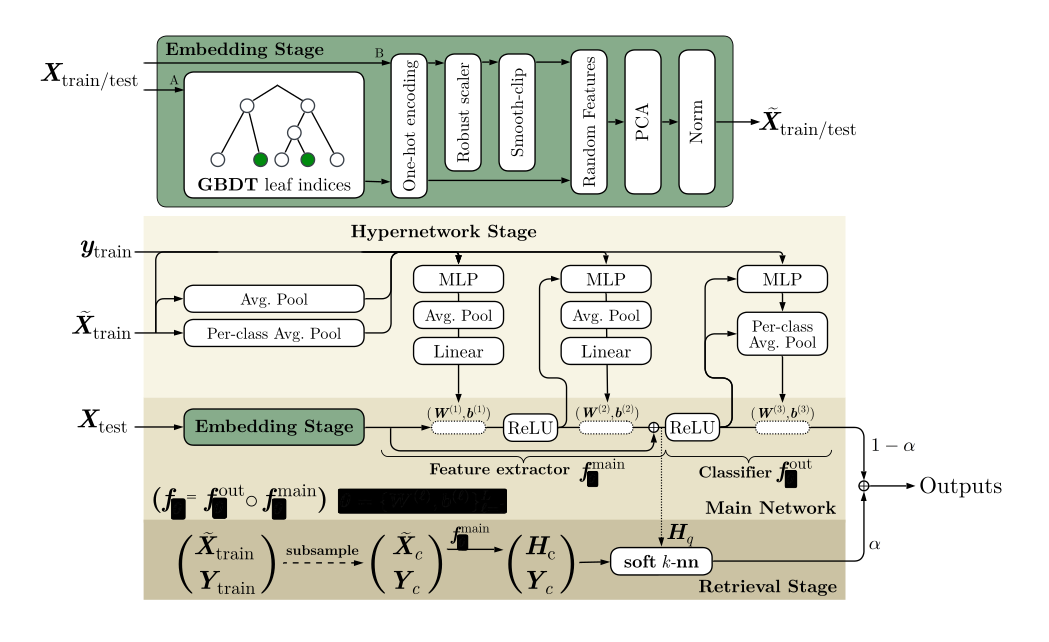
iLTM is a foundation model for tabular data that integrates tree-derived embeddings, dimensionality-agnostic representations, a meta-trained hypernetwork, multilayer perceptron (MLP) neural networks, and retrieval. iLTM automatically handles feature scaling, categorical features, and missing values.
We release open weights of pre-trained model checkpoints that consistently achieve superior performance across tabular classification and regression tasks, from small to large and high-dimensional tasks.
Install
iLTM is accessed through Python. You can install the package via pip:
pip install iltm
iLTM works on Linux, macOS and Windows, and can be executed on CPU and GPU, although GPU is highly recommended for faster execution.
Pre-trained model checkpoints are automatically downloaded from Hugging Face on first use.
By default, checkpoints are stored in platform-specific cache directories (e.g., ~/.cache/iltm on Linux, ~/Library/Caches/iltm on macOS).
You can specify where model checkpoints are stored by setting the ILTM_CKPT_DIR environment variable:
export ILTM_CKPT_DIR=/path/to/checkpoints
[!NOTE] The first call to
iLTMRegressororiLTMClassifierdownloads the selected checkpoint. Later runs reuse the cached weights fromILTM_CKPT_DIRor the default cache location.
[!TIP] For interactive work on a local machine it is often worth pointing
ILTM_CKPT_DIRto a fast local disk to avoid repeated downloads across environments.
Quick Start
iLTM is designed to be easy to use, with an API similar to scikit-learn.
from iltm import iLTMRegressor, iLTMClassifier

# Regression
reg = iLTMRegressor().fit(X_train, y_train)
y_pred = reg.predict(X_test)

# Classification
clf = iLTMClassifier().fit(X_train, y_train)
proba = clf.predict_proba(X_test)
y_hat = clf.predict(X_test)

# With time limit (returns partial ensemble if time runs out)
reg = iLTMRegressor().fit(X_train, y_train, fit_max_time=3600)  # 1 hour limit
Model Checkpoints
Available checkpoint names:
"xgbrconcat"(default): Robust preprocessing + XGBoost embeddings + concatenation"cbrconcat": Robust preprocessing + CatBoost embeddings + concatenation"r128bn": Robust preprocessing with 128-dim bottleneck"rnobn": Robust preprocessing without bottleneck"xgb": XGBoost embeddings only"catb": CatBoost embeddings only"rtr": Robust preprocessing with retrieval"rtrcb": CatBoost embeddings with retrieval
You can also provide a local path to a checkpoint file. Keep its defined filename
(for example, cbrconcat.pth): iLTM uses that name to apply the same model settings
regardless of which directory contains the file.
Common key args:
- checkpoint: checkpoint name or path to model file. Default "xgbrconcat".
- device: torch device string. Default "cuda:0".
- n_ensemble: number of generated predictors.
- batch_size: batch size for weight prediction and inference.
- preprocessing: "realmlp_td_s_v0" or "minimal" or "none".
- cat_features: list of categorical column indices.
- tree_embedding: enable GBDT leaf embeddings.
- tree_model: "XGBoost_hist" or "CatBoost".
- concat_tree_with_orig_features: concatenate original features with embeddings.
- finetuning: end to end finetuning.
- Retrieval: do_retrieval, retrieval_alpha, retrieval_temperature, retrieval_distance.
Regressor only:
- clip_predictions: clip to train target range.
- normalize_predictions: fit a fixed affine output calibration before unscaling.
Classifier only:
- voting: "soft" or "hard".
Hyperparameter Optimization
iLTM performs best when you go beyond the default hyperparameters. We recommend using the 25-config portfolio with iltm.get_hyperparameter_configs().
[!TIP] When running hyperparameter optimization with time constraints, you can use the
fit_max_timeparameter infit()to limit training time per configuration. The model will return a partial ensemble if the time limit is reached.
For random search, use iltm.sample_hyperparameters(rng) or obtain the search space with iltm.get_hyperparameter_search_space().
Development
To run the tests:
pip install -e ".[dev]"
pytest tests/
Citation
If you use iLTM in your research, please cite our paper:
@article{bonet2026iltm,
  title.  = {iLTM: Integrated Large Tabular Model},
  author. = {Bonet, David and Comajoan Cara, Marçal and Calafell, Alvaro and Mas Montserrat, Daniel and Ioannidis, Alexander G.},
  journal = {Proceedings of the 32nd ACM SIGKDD Conference on Knowledge Discovery and Data Mining V.2},
  pages   = {186–197},
  year.   = {2026},
}
License
© Contributors, 2026. Licensed under the Apache-2.0 license.
Explorar proyectos relacionados
Cargando…