
ylsung/VL_adapter
ylsung/VL_adapter has 213 GitHub stars and 17 forks. Star changes are not measured yet. Last checked 2026-11-10 22:07 UTC. Last push 2026-09-26.
So werden diese Zahlen gemessen
PyTorch code for "VL-Adapter: Parameter-Efficient Transfer Learning for Vision-and-Language Tasks" (CVPR2022)
Gemessener Sternzuwachs
- in 24h
- Aktualisierung verzögert
- in 7 days
- Aktualisierung verzögert
- in 15 days
- Aktualisierung verzögert
- in 1 month
- Aktualisierung verzögert
Nettoänderungen in überlappenden Zeiträumen, keine Tagessummen. Fehlende Messwerte bleiben leer. Sterne zeigen Interesse, nicht Qualität.
README.md
OriginalVL-Adapter
- Authors: Yi-Lin Sung, Jaemin Cho, Mohit Bansal
- Paper: "VL-Adapter: Parameter-Efficient Transfer Learning for Vision-and-Language Tasks" (CVPR 2022)
We evaluate VL-adapter in a unified multi-task setup on both image-text and video-text benchmarks. For the image-text tasks, we use four diverse V&L datasets: VQAv2, GQA, NLVR2, and MSCOCO image captioning. For video-text tasks, we use TVQA, How2QA, TVC, and YC2C.
Our results demonstrate that training the adapter with the weight-sharing technique (4.18% of total parameters for image-text tasks and 3.39% for video-text tasks) can match the performance of fine-tuning the entire model.
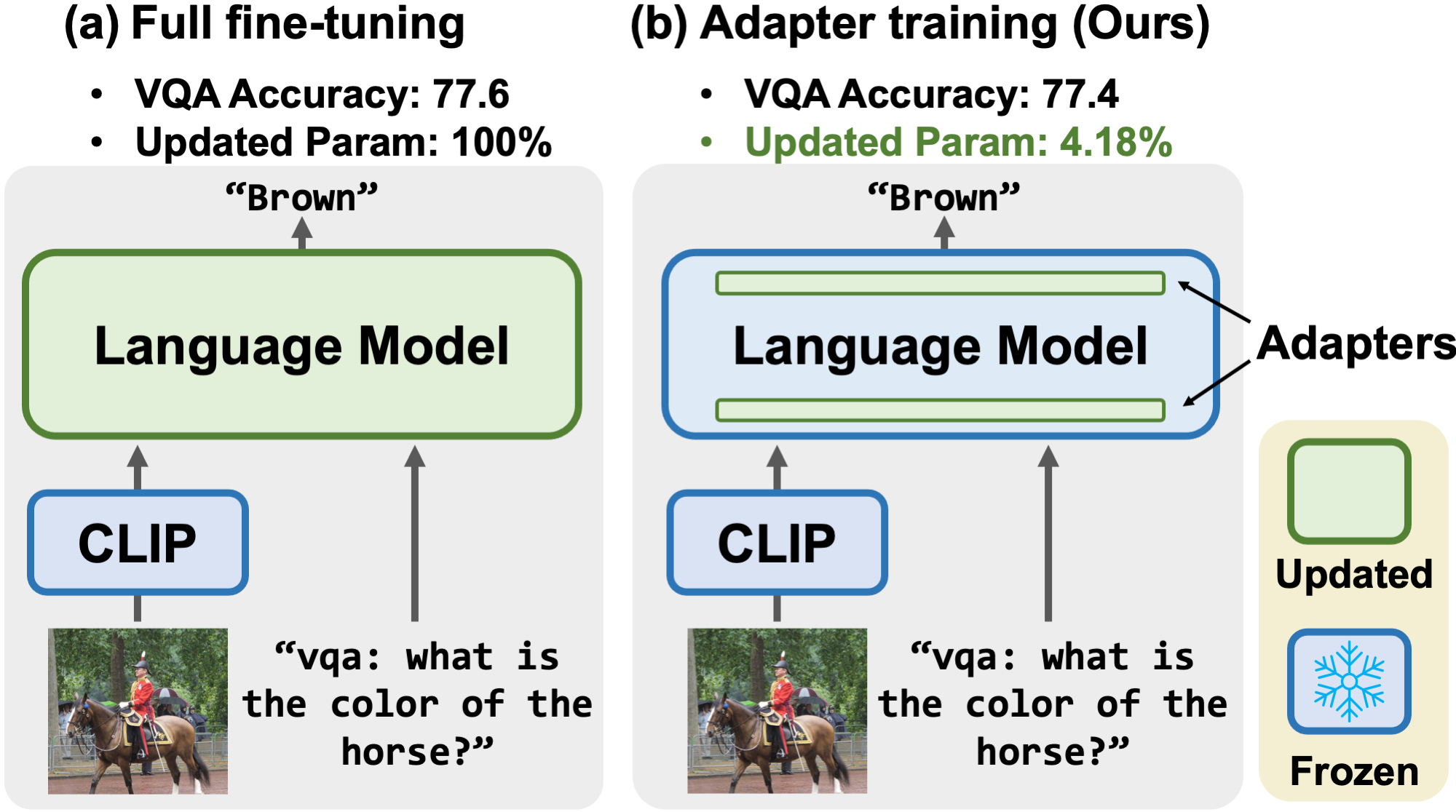
** Note ** Please go into CLIP-ViL folder and follow the README there for running the experiments of adapters on CLIP-ViL. This README is for adapters on VL-Bart.
Installation
# Create python environment (optional)
conda create -n vlt5 python=3.8
source activate vlt5

# Install python dependencies
pip install -r requirements.txt

# Download T5/BART backbone checkpoint
python download_backbones.py

# For MSCOCO captioning evaluation (optional; for captioning only)
python -c "import language_evaluation; language_evaluation.download('coco')"
Code structure
# Store images, features, and annotations
./datasets
    COCO/
        images/
        clip_featuers/
    VG/
        images/
        clip_features/
    GQA/
        images/
        clip_features/
    nlvr/
        images/
        clip_features/
    vqa/
    lxmert/

    video/
        ann/
        vis_features

# Train VL-T5 with adapters
./VL-T5/
    src/
        modeling_t5.py modeling_bart.py                       <= VL-T5/VL-BART model classes
        pretrain.py, pretrain_data.py, pretrain_model.py      <= pretraining
        vqa.py, vqa_data.py vqa_model.py ...                  <= fine-tuning on downstream tasks (ex. VQA, GQA, NLVR2)
        multitask.py, multitask_data.py multiask_model.py     <= multitask learning on 7 downstream tasks
        param.py                                              <= (argparse) configuration
        tokenization.py                                       <= custom tokenizer
        utils.py, dist_utils.py                               <= utility functions
    snap/                                                     <= store weight checkpoints
    scripts/                                                  <= bash scripts for pretraining and finetuning
Data
Image-text dataset
[!IMPORTANT] My university drive has a 15GB limit for alumni accounts, so I have moved the dataset to HuggingFace. The original Google Drive instructions are kept below, struck through, for reference — that link no longer works.
Please go to link to download the processed CLIP features. We suggest to use gdrive to download it. Unzip the downloaded file and arrange the folders following the format which is shown in the "Code Structure."
If you would like to use dgrive to download the data, please try the following command
gdrive download 1O_RU1iFh_sbItZCTkOHUrbVIQQ_89Djj
Download from HuggingFace
The processed CLIP features are now hosted on the HuggingFace Hub at ylsung/VL-Adapter-datasets.
Run the restore script from the root of this repository to rebuild datasets/ in
exactly the layout shown in "Code structure":
pip install huggingface_hub pyarrow h5py numpy

# downloads ~47 GB and expands it into ./datasets (~132 GB on disk)
python tools/restore_datasets.py --out ./datasets
The script downloads one shard at a time and deletes it right after expanding it, so it needs less than ~1 GB of scratch space on top of the final tree. It is resumable: if it is interrupted, rerun the same command and it skips whatever is already on disk.
To restore only part of the data:
# one dataset at a time: GQA needs 30.2 GB restored, nlvr 24.3 GB,
# COCO 49.9 GB, VG 22.0 GB, annotations 5.7 GB
python tools/restore_datasets.py --out ./datasets --datasets GQA --datasets nlvr
python tools/restore_datasets.py --out ./datasets --only annotations

# smoke test the download path without committing to the full tree
python tools/restore_datasets.py --out ./datasets --only features --datasets VG --limit-shards 3
To check the whole publish/restore round trip without downloading 132 GB,
tools/test_restore_roundtrip.py builds a miniature mirror of the dataset from
the original archive, pushes it to a throwaway private Hub repo, restores it with
the plain command above, compares every file against the archive, and deletes the
temp repo:
python tools/test_restore_roundtrip.py --zip VLadapter.zip --namespace <your-hf-user>
On the Hub the per-image .h5 feature files are packed into parquet shards,
because 621,783 loose files exceed the Hub's per-repository limits.
restore_datasets.py unpacks them back into the individual <img_id>.h5 files
that VL-T5/src/*_clip_data.py reads; the restored feature arrays are bit-exact.
A note on raw images
datasets/*/images/ is not needed by any script in VL-T5/scripts/image/ —
those read clip_features. Raw images are only required for the end-to-end pixel
training paths (VL-T5/src/*_raw_data.py) and for extracting your own features.
The NLVR2 photographs are not redistributed, because the NLVR2 authors do not own
their copyright. Request them from
lil-lab/nlvr and place them
in datasets/nlvr/images/. COCO, GQA and Visual Genome images are available from
COCO,
GQA and
Visual Genome.
Re-creating the Hub copy
tools/convert_zip_to_hf.py is the converter that produced the Hub dataset from
the original vlt5_dataset archive, kept here for reproducibility.
Extract your own CLIP features
Please refer to feature_extraction for more details.
Video-text dataset
Please go to VALUE to download the ViT processed data.
Run different approaches
The following scripts can run every approach with the best hyper-parameters.
Image dataset
# Full fine-tuning
cd VL-T5/
bash scripts/image/full_finetuning.sh 1

# Single Adapter
cd VL-T5/
bash scripts/image/single_adapter.sh 1

# Multiple Adapters
cd VL-T5/
bash scripts/image/multiple_adapters.sh 1

# Hyperformer
cd VL-T5/
bash scripts/image/hyperformer.sh 1

# Single Compacter
cd VL-T5/
bash scripts/image/single_compacter.sh 1

# Multiple Compacters
cd VL-T5/
bash scripts/image/multiple_compacters.sh 1

# Single LoRA
cd VL-T5/
bash scripts/image/single_lora.sh 1

# Multiple LoRA
cd VL-T5/
bash scripts/image/multiple_lora.sh 1

# Single Prompt
cd VL-T5/
bash scripts/image/single_prompt.sh 1

# Multiple Prompts
cd VL-T5/
bash scripts/image/multiple_prompts.sh 1
Video dataset
# Full fine-tuning
cd VL-T5/
bash scripts/video/full_finetuning.sh 1

# Single Adapter
cd VL-T5/
bash scripts/video/single_adapter.sh 1

# Single LoRA
cd VL-T5/
bash scripts/video/single_lora.sh 1

# Single Prompt
cd VL-T5/
bash scripts/video/single_prompt.sh 1
Acknowledgement
This repo is adapted from VLT5. I also borrow some codes from CLIP, CLIP-ViL, Compacter, Hyperformer and Prefix-tuning.
Reference
Please cite our paper if you use our models in your project.
@inproceedings{sung2022vladapter,
  title     = {VL-Adapter: Parameter-Efficient Transfer Learning for Vision-and-Language Tasks},
  author    = {Yi-Lin Sung, Jaemin Cho, Mohit Bansal},
  booktitle = {CVPR},
  year      = {2022}
}
Ähnliche Projekte entdecken
tensorflow/tensorflow
Ein Open-Source-Framework für maschinelles Lernen für alle
201,505 Sternehuggingface/transformers
🤗 Transformers: das Framework zur Modelldefinition für State-of-the-Art-Modelle des maschinellen Lernens in Text, Vision, Audio und multimodal, für Inferenz und Training.
168,815 SterneAUTOMATIC1111/stable-diffusion-webui
Web-UI für Stable Diffusion
165,289 SterneComfy-Org/ComfyUI
Die leistungsstärkste und modularste GUI, API und das Backend für Diffusionsmodelle mit einer Oberfläche aus Graphen und Knoten. Die schnellste lokale Inferenz-Engine der Welt.
146,271 Sterne