
vijayabhaskar-ev/dreamer_v4
vijayabhaskar-ev/dreamer_v4 has 40 GitHub stars and 2 forks. Star changes are not measured yet. Last checked 2026-11-11 16:08 UTC. Last push 2026-10-25.
So werden diese Zahlen gemessen
Code, results and checkpoints for the paper "Silent Pipeline Defects in World-Model RL: A Dreamer 4 Case Study": a PyTorch reimplementation of Dreamer 4, two silent defects that passed 12 checks, and three cheap checks that catch them
Gemessener Sternzuwachs
- in 24h
- Aktualisierung verzögert
- in 7 days
- Aktualisierung verzögert
- in 15 days
- Aktualisierung verzögert
- in 1 month
- Aktualisierung verzögert
Nettoänderungen in überlappenden Zeiträumen, keine Tagessummen. Fehlende Messwerte bleiben leer. Sterne zeigen Interesse, nicht Qualität.
README.md
OriginalSilent Pipeline Defects in World-Model RL: A Dreamer 4 Case Study




Code, results and checkpoints for the paper Silent Pipeline Defects in World-Model RL: A Dreamer 4 Case Study (Vijaya Bhaskar Eswaran, 2026, PDF; arXiv link to follow).
The paper reports a PyTorch reimplementation of Dreamer 4 (Hafner, Yan & Lillicrap, 2025, arXiv:2509.24527), the agent that improves a cloned policy by practicing inside a learned world model, and a test of its claim that imagination training improves on the behavior cloning (BC) policy it starts from. The test runs at small scale on one DeepMind Control task, ball_in_cup_catch, from a fixed dataset of 240 demonstrations, with every policy scored closed loop in the real environment. The first version of the pipeline had two silent defects that passed all 12 of its verification checks and produced a convincing but wrong result; the paper documents them, the corrected study (imagination training beat its BC parent in all 24 runs), and three cheap checks that catch such defects.
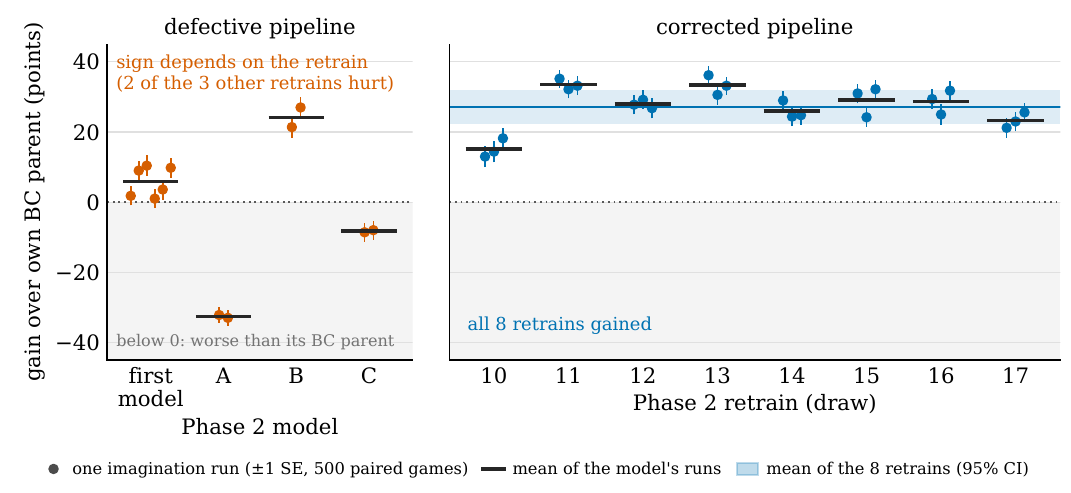
Figure 1 of the paper. Gain in catch rate of imagination training over its own BC parent, per run. Left, the defective pipeline: the sign of the gain depended on the Phase 2 retrain. Right, the corrected pipeline: all 24 runs positive, mean of the retrain means 27.15 points.
This repository holds everything behind the paper: the implementation (tokenizer, world model with shortcut forcing, Phase 2 heads, Phase 3 imagination training with PMPO), the launch scripts that produced the runs, the per game results of every evaluated policy, the analysis outputs behind every table, and a script that recomputes the paper's numbers from these files. The checkpoints are on the Hugging Face Hub.
Result
With one world model and a fixed dataset, I repeated the Phase 2 training 8 times with different seeds and trained 3 imagination policies from each retrain. Every policy played the same 500 games in the real environment, so each imagination policy is compared with its own BC parent on identical games.
| Phase 2 retrain | BC parent catch (%) | imagination catch (%), mean of 3 seeds | gain per seed (points) | retrain mean (points) |
|---|---|---|---|---|
| 10 | 55.8 | 71.0 | +13.0, +14.4, +18.2 | +15.2 |
| 11 | 53.8 | 87.3 | +35.2, +32.2, +33.2 | +33.5 |
| 12 | 51.2 | 79.1 | +27.8, +29.2, +26.8 | +27.9 |
| 13 | 54.4 | 87.7 | +36.2, +30.6, +33.2 | +33.3 |
| 14 | 56.4 | 82.5 | +29.0, +24.4, +24.8 | +26.1 |
| 15 | 54.6 | 83.7 | +31.0, +24.2, +32.2 | +29.1 |
| 16 | 53.6 | 82.3 | +29.4, +25.0, +31.8 | +28.7 |
| 17 | 56.6 | 79.9 | +21.2, +23.0, +25.6 | +23.3 |
| mean over retrains | 54.55 | 81.70 | 24/24 runs positive | 27.15 [22.20, 32.10] |
The imagination policy beat its BC parent in all 24 runs. Averaged over the 8 retrains, the catch rate rose by 27.15 percentage points (95% t interval over the retrain means 22.20 to 32.10). The spread between retrains (5.70 points, estimated with a random effects model) was about twice the spread between imagination seeds of one retrain (2.76 points), so the Phase 2 retrain is a unit of variation worth reporting.
The BC parents caught the ball in 54.55% of games, against 84.2% for the demonstrations. So the claim this evidence supports is that imagination training improves on a weak BC start. Whether it improves on a strong one is untested here.
Per game results of the 8 BC parents, the 24 imagination policies and the epoch 10 checkpoint of the first seed of each retrain are in evaluation/*-aligned-*/episodes.csv. analysis/paper_numbers_v2.py and analysis/paper_tables_v2.py are the scripts behind every number and table in the paper. They also read training side files (run summaries, timing and step size logs) that are not in this repository, so they do not run from this checkout; the table above can be recomputed from the episodes.csv files alone.
Every number is recomputable here
python analysis/recompute_from_results.py
reads only evaluation/*/episodes.csv, evaluation/*/summary.json and results_corrected/ and recomputes 55 numbers of the paper, from Table 1 and the headline interval to the defective pipeline's gains, the readout ablation, the reward calibration counts, the error by step size and the timing test, printing each next to the paper's value. All 55 match. Every number printed in the paper is also listed, with the file it comes from, in results_paper/NUMBERS.md. The two inputs it does not cover are the demonstration statistics (they need the dataset file, which is not redistributed) and the Phase 2 training curves.
Where each result of the paper comes from
| Paper | Produced by | Data |
|---|---|---|
| Table 1 (catch rate per retrain, headline interval) | make check |
results_paper/table1_results.csv, from evaluation/tmlr-aligned-*/episodes.csv and results_corrected/p3_runs.csv |
| Table 5 (every run) | analysis/paper_tables_v2.py |
results_paper/table5_every_run.csv, results_corrected/p3_runs.csv |
| Table 6 (leave one draw out) | analysis/paper_tables_v2.py, make check |
results_paper/table6_leave_one_draw_out.csv |
| Tables 2, 3, 4, 7 (settings, deviations, launches, checks) | analysis/paper_tables_v2.py |
results_paper/table_*.tex, launch/*.sh |
| Figure 1 (gain per run, both pipelines) | make figures |
evaluation/tmlr-*/episodes.csv, results_corrected/p3_runs.csv |
| Figure 2 (error by step size and signal level) | make figures |
results_corrected/evaldyn_*/ |
| Timing test (Sections 4 and 5) | results_corrected/run_timing.py, summarize.py |
results_corrected/timing_summary.csv, timing_tests*.log |
| Reward calibration and mirage counts (Section 5) | results_corrected/perstep_metrics.py |
results_corrected/perstep_metrics.csv, evaluation/*/summary.json |
| Readout ablation (Section 6) | make check |
results_corrected/readout_table.csv |
| Imagined versus real return (Section 6) | results_corrected/imagined_vs_real.py |
results_corrected/p3_runs.csv, p3_wandb_curves.csv |
| Every other number | analysis/paper_numbers_v2.py |
listed with its source file in results_paper/NUMBERS.md |
make all runs the number check, redraws both figures and runs the unit tests in a few minutes on a CPU; exact package versions are in requirements-pinned.txt. Training the models themselves takes days on a GPU (see Reproduce).
Two silent defects, and the checks that catch them
My first version of this pipeline had two defects that passed all 12 checks I used to verify it.
- Every action reached the model one step late. The dataset stores, with each frame, the action that led to it; my loader read it as the action taken at that frame. Both the world model and the BC target were affected. The standard action shuffle check passed, because it only shows that a model uses its actions, and a model trained on late actions uses them too.
- The bootstrap loss received almost no learning signal. Keeping frame 0 almost clean while its step size was drawn at random produced an enormous artifact term, and a separate normalizer for the bootstrap loss then divided the real signal by the artifact's size. The old world model's error at the shortcut steps was 76 to 109 times its error at the smallest step (13 to 24 times once the almost clean frame 0, an input never used in imagination, is left out).
With both defects present, the same evaluation gave a convincing gain on the first Phase 2 model (+5.9 points, all 6 runs positive) and then gains and losses on further retrains (-32.6, +24.2 and -8.3 points). One retrain was not enough to judge the gain.
Three checks need no further training. The first two catch the two defects, and each was validated on at least one model known to be broken and on the corrected models. The third is aimed at exploitation and is shown on the one case I observed; it is not validated beyond that case. The scripts are:
- Timing test (
analysis/phase1_timing_control.py): feed the trained model the same clips with the actions shifted in time and see which shift predicts best. Every old model preferred late actions; every corrected model preferred correct timing. It took 14 minutes for 9 models on a laptop GPU. - Step size test (
dynamics/evaluate_dynamics.py): break the prediction error down by step size and by the signal level of the input. At the shortcut steps the defective world model's error rose as the input got cleaner; the corrected model's fell. - Reward calibration (
dynamics/evaluate_env.py): let the reward head predict rewards while the policy plays real games, and compare with what the environment paid. The one exploitation case I observed came from the defective pipeline's collapsed retrain:
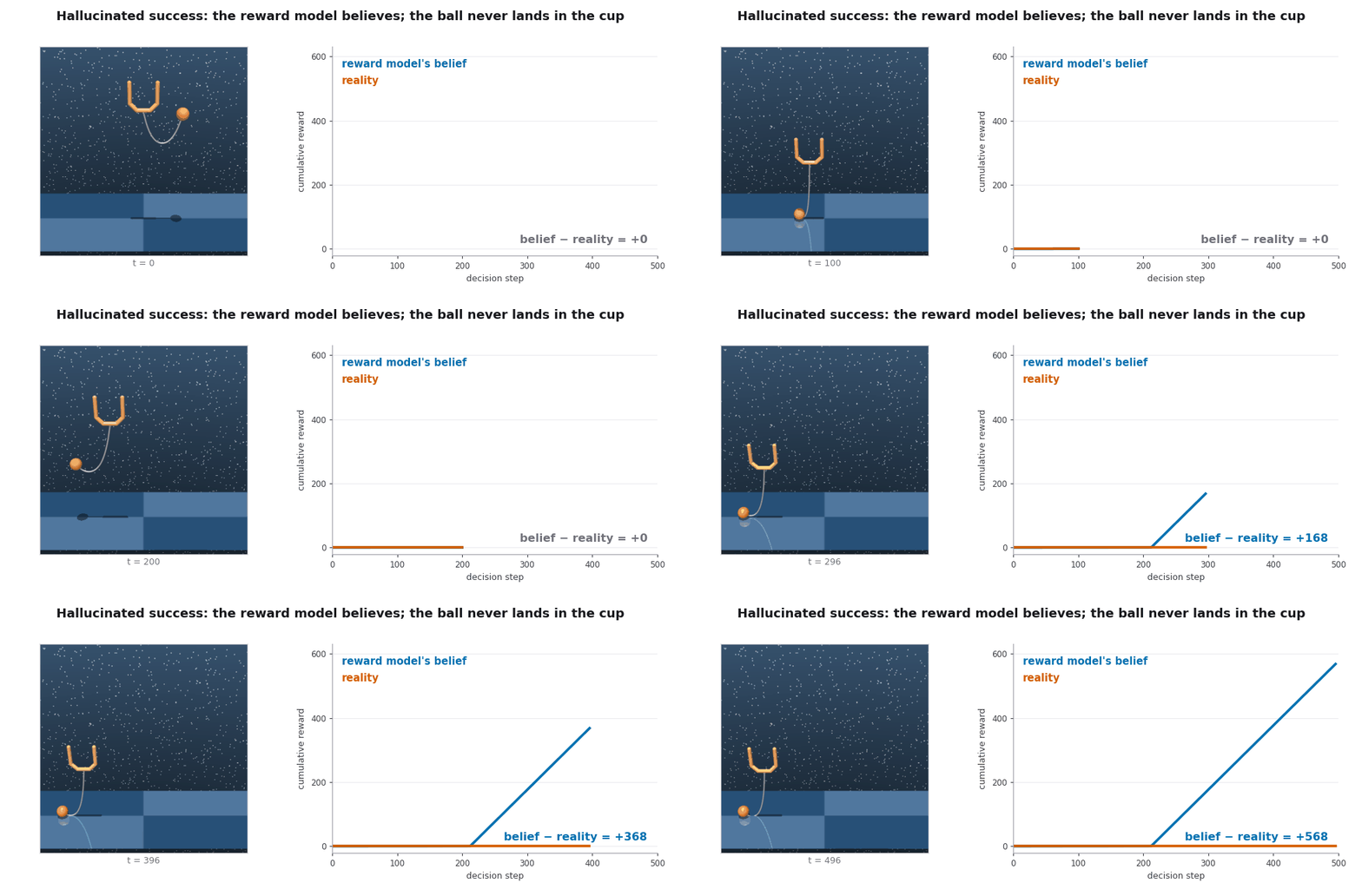
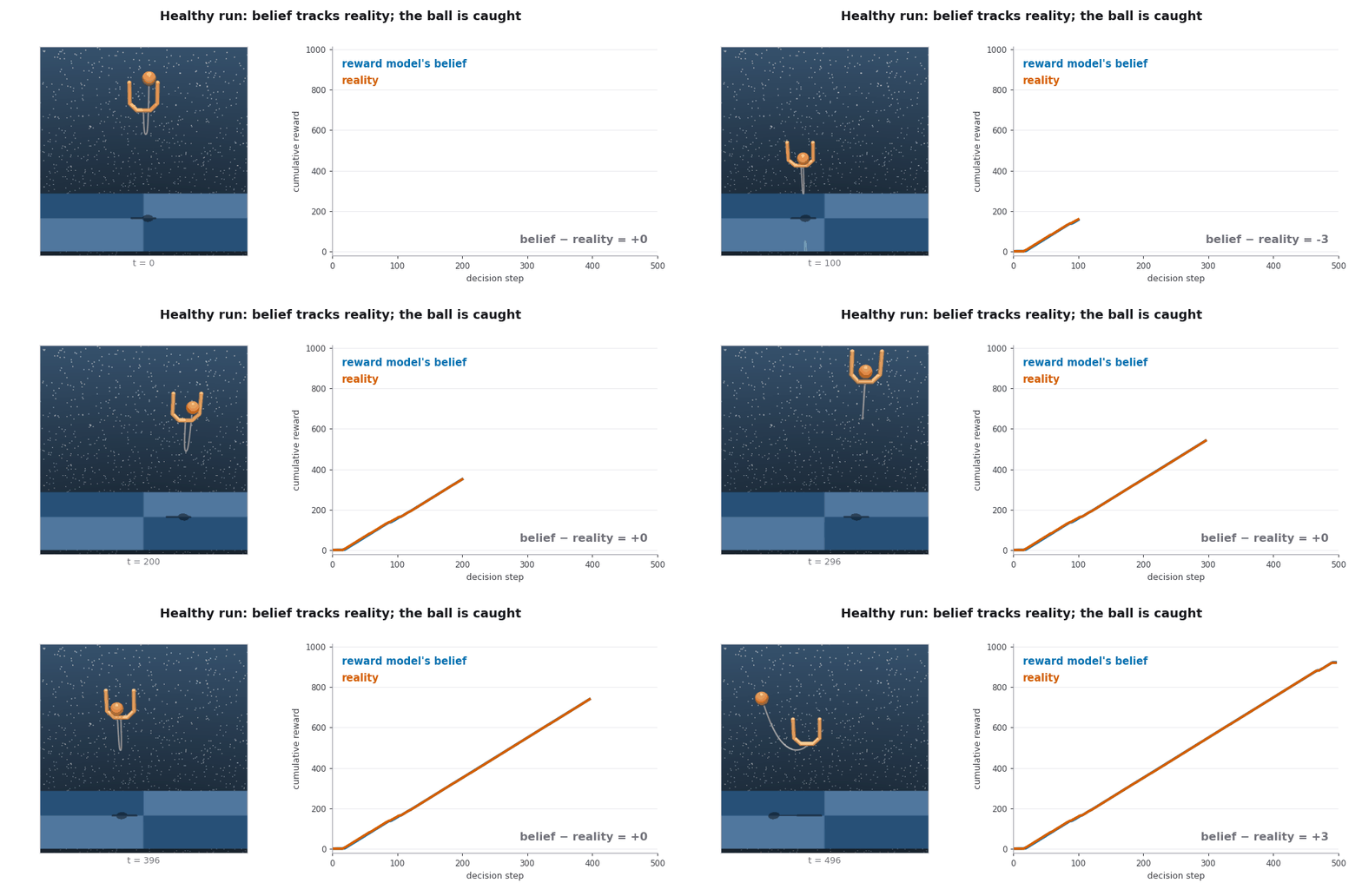
Two retrains of the defective pipeline. Top, the collapsed retrain: the frozen reward head keeps predicting reward on a game where the ball never lands in the cup. Bottom, a healthy retrain: predicted reward tracks the real one. Left is the real episode, right the cumulative predicted versus real reward.
History of this README
Earlier versions of this README reported results from the defective pipeline: a six run study with a +5.9 point gain, three Phase 2 retrains whose gains ranged from −32.6 to +24.2 points, and before that a single run with no significant gain. Those numbers were produced by the defective code and are superseded by the table above. They stay in the git history (tag v1-old-pipeline, the last commit of the defective pipeline) because the story of how they were wrong is part of the paper.
Reproduce
Each step needs the output of the one before it. The launch scripts under launch/ are the commands that produced the paper's runs; the cd /workspace/dreamer_v4 and checkpoint paths at their top are my pod layout, so set them to yours.
pip install -r requirements.txt
pip install dm_control mujoco          # closed loop evaluation
pip install lpips                      # the tokenizer loss has a 0.2 LPIPS term; without the package it is silently dropped
export MUJOCO_GL=egl                   # headless rendering
- Dataset. Download the
cup-catchdemonstrations (expert,mixed-small,mixed-large) from nicklashansen/dreamer4 intohansen_data/, thenpython convert_hansen_to_npz.py --hansen-root hansen_data --out-path ball_in_cup_catch_aligned.npz. The script shifts the stored actions one row earlier per episode (the fix of defect 1). The data are not redistributed here. - Tokenizer.
python -m tokenizer.train_tokenizer --dataset offline --dataset-path ball_in_cup_catch_aligned.npz --image-size 128 ...with the settings in the paper's hyperparameter table (--helplists every flag). - Phase 1, world model.
bash launch/phase1.shafter pointing--tokenizer-ckptand--dataset-pathat your files. - Phase 2, heads and BC policy, one retrain per seed. Set
BASE,TOKandNPZat the top oflaunch/phase2.sh, thenSEEDS="10 11 12 13 14 15 16 17" bash launch/phase2.sh. - Phase 3, imagination training and evaluation, one job per (retrain, seed):
JOBS="10:1 10:2 10:3" bash launch/phase3.sh, and so on for retrains 11 to 17. - Evaluation on its own, as recorded under
optsin thesummary.jsonof every closed loop evaluation folder (evaluation/*-aligned-*/):
(python -m dynamics.evaluate_env --phase2-ckpt <phase2.pt> --phase3-ckpt <phase3.pt> --tokenizer-ckpt <tokenizer.pt> \ --num-episodes 500 --seed-base 0 --image-size 128 --action-repeat 2 --policies phase3 --max-gifs 0 --wandb-disabled --output-dir evaluation/<name>--policies bcfor a BC parent; the script still requires a--phase3-ckpt.) It writesepisodes.csvwith one row per game. - Unit tests of the RL math:
python -m tests.test_imagination_algorithms,python -m tests.test_imagination_rollout,python -m tests.test_gradient_isolation.
Checkpoints
The corrected pipeline's checkpoints are on the Hugging Face Hub at vijayabhaskarev/dreamer-v4 under ball_in_cup/corrected/: the tokenizer, the Phase 1 world model, the 8 Phase 2 retrains and the 24 imagination policies, inference only, with a manifest of sources and checksums. analysis/release_corrected_checkpoints.py is the script that produced them. The model card gives a command that reproduces one row of the results table from them. The defective pipeline's checkpoints are kept on the same Hub repository for the record.
Repository layout
dreamer_v4/
├── tokenizer/         masked autoencoder tokenizer (model, masking, losses, trainer)
├── dynamics/          world model with shortcut forcing, Phase 2 finetune, real environment evaluation
│   ├── dynamic_model.py      transformer with register and agent tokens
│   ├── flow_matching.py      noise schedule and (signal level, step size) sampling
│   ├── trainer.py            the shortcut loss as one normalized term (defect 2 fix)
│   ├── evaluate_dynamics.py  error by step size and signal level (the step size test)
│   └── evaluate_env.py       closed loop evaluation, paired games, reward calibration
├── imagination/       Phase 3: imagined rollouts, lambda returns, PMPO, trainer
├── heads.py           reward, continue, value and policy heads (categorical and Gaussian)
├── analysis/          the timing test and the scripts behind every number and table of the paper
├── launch/            the launch scripts of the three phases
├── evaluation/        per game results of every evaluated policy
├── Makefile           make check, make figures, make tests
├── analysis/figures/  the scripts that draw Figures 1 and 2
├── results_paper/    every number and table of the paper as printed (NUMBERS.md, table_*.tex, Tables 5 and 6 as CSV)
├── results_corrected/ the analysis outputs behind the tables (per run table, timing and step size tests, reward calibration, readouts)
├── assets/            the paper's figures as PNG
├── convert_hansen_to_npz.py   builds the dataset file (defect 1 fix lives here)
├── tests/             unit tests of the imagination algebra, the rollout contract and the attention firewall
└── requirements.txt
Limitations
- One task, one dataset, one tokenizer and one Phase 1 world model. Whether the gain holds elsewhere is untested.
- The BC parents were weak compared with the demonstrations. One possible reason, untested, is that the BC head was trained on every episode, including those that never catch. The result covers a weak BC start.
- The two fixes and a fresh Phase 1 training run entered together, so the change between the two pipelines cannot be attributed to either fix alone.
- Two silent defects passed 12 checks, so a third one that these checks would also miss cannot be ruled out.
- Single GPU CUDA only; no distributed training.
References
- Hafner, Yan, Lillicrap. Training Agents Inside of Scalable World Models (Dreamer 4). arXiv:2509.24527, 2025.
- Hansen, Su, Wang. TD-MPC2: Scalable, Robust World Models for Continuous Control. ICLR 2024. The demonstrations were collected with TD-MPC2 agents and released at nicklashansen/dreamer4.
- Abdolmaleki et al. Learning from Negative Feedback, or Positive Feedback or Both (PMPO). ICLR 2025. The policy objective used in Phase 3.
Citation
@misc{eswaran2026silentdefects,
  title  = {Silent Pipeline Defects in World-Model RL: A Dreamer 4 Case Study},
  author = {Eswaran, Vijaya Bhaskar},
  year   = {2026},
  note   = {Preprint},
  url    = {https://github.com/vijayabhaskar-ev/dreamer_v4/releases/download/paper-v1/silent_pipeline_defects_dreamer4.pdf}
}
An arXiv entry will replace this when the preprint is live. Please also cite the Dreamer 4 paper for the method. For the implementation itself:
@software{eswaran2026dreamerv4,
  title  = {Dreamer V4 --- PyTorch reproduction},
  author = {Eswaran, Vijaya Bhaskar},
  year   = {2026},
  url    = {https://github.com/vijayabhaskar-ev/dreamer_v4}
}
License
MIT, see LICENSE.
Ähnliche Projekte entdecken
tensorflow/tensorflow
Ein Open-Source-Framework für maschinelles Lernen für alle
201,505 Sternehuggingface/transformers
🤗 Transformers: das Framework zur Modelldefinition für State-of-the-Art-Modelle des maschinellen Lernens in Text, Vision, Audio und multimodal, für Inferenz und Training.
168,815 SterneAUTOMATIC1111/stable-diffusion-webui
Web-UI für Stable Diffusion
165,289 SterneComfy-Org/ComfyUI
Die leistungsstärkste und modularste GUI, API und das Backend für Diffusionsmodelle mit einer Oberfläche aus Graphen und Knoten. Die schnellste lokale Inferenz-Engine der Welt.
146,271 Sterne