
tum-pbs/tadpole
tum-pbs/tadpole has 29 GitHub stars and 4 forks. Star changes are not measured yet. Last checked 2026-11-11 18:07 UTC. Last push 2026-10-30.
So werden diese Zahlen gemessen
[NeurIPS2026] Flexible scientific foundation models trained with synthetic online data generation
Gemessener Sternzuwachs
- in 24h
- Verlauf wird gesammelt
- in 7 days
- Verlauf wird gesammelt
- in 15 days
- Verlauf wird gesammelt
- in 1 month
- Verlauf wird gesammelt
Nettoänderungen in überlappenden Zeiträumen, keine Tagessummen. Fehlende Messwerte bleiben leer. Sterne zeigen Interesse, nicht Qualität.
README.md
Original

Tadpole
Autoencoders as Foundation Models for 3D PDEs with Online Learning



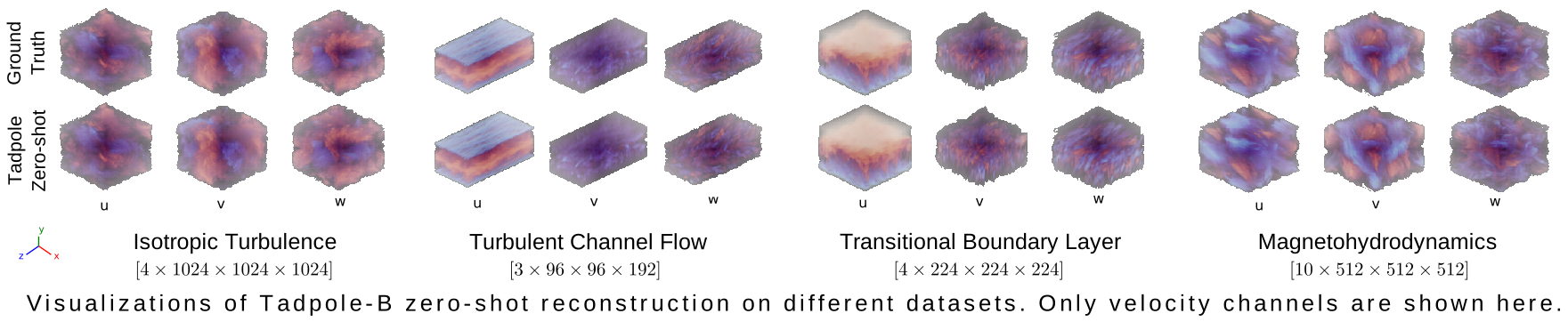
About
- What is Tadpole?
Tadpole is a foundation model for three-dimensional partial differential equations (PDEs).
- How is Tadpole different from existing PDE foundation models?
Tadpole distinguishes itself from existing PDE foundation models in three key aspects:
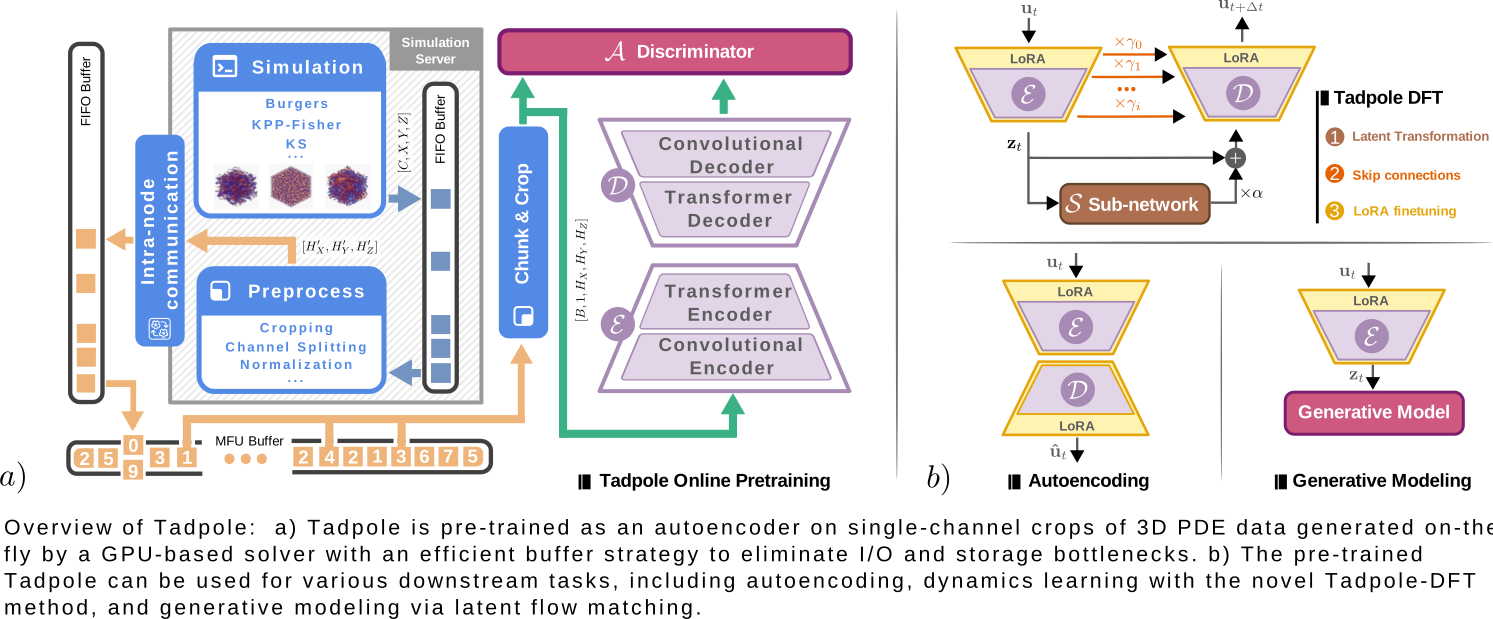
(1) Tadpole is pre-trained as an autoencoder to learn the inherent representation of PDE solutions, which is more generalizable than the traditional paradigm of training PDE foundation models directly on the dynamics evolution of PDE solutions.
(2) Tadpole is pretrained with online learning, utilizing a GPU-based solver to generate diverse data distribution without IO or storage bottlenecks induced by 3D PDE data.
(3) Tadpole is able to process multiple downstream tasks, including autoencoding, dynamics prediction, and generative modeling.
Paper Info
Tadpole: Autoencoders as Foundation Models for 3D PDEs with Online Learning
Qiang Liu, Felix Koehler, Benjamin Holzschuh, and Nils Thuerey
 Technical University of Munich
Abstract: We introduce Tadpole, a novel foundation model for three-dimensional partial differential equations (PDEs) that addresses key challenges in transferability, scalability to high dimensionality, and multi-functionality. Tadpole is pre-trained as an autoencoder on synthetic 3D PDE data generated by an efficient online data-generation framework. This enables large-scale, diverse training without storage or I/O overhead, demonstrated by scaling to an equivalent of hundreds of terabytes of training data. By autoencoding single-channel spatial crops, Tadpole learns rich and transferable representations across heterogeneous physical systems with varying numbers of state variables and spatial resolutions. Although pre-trained solely as an autoencoder, Tadpole can be efficiently applied for multiple downstream tasks beyond reconstruction, including dynamics learning and generative modeling. For dynamics learning, we propose a novel parameter-efficient fine-tuning strategy that integrates low-rank adaptation, latent-space transformations, and reintroduced skip connections, achieving accurate temporal modeling with a minimal number of trainable parameters. Tadpole demonstrates strong fine-tuning performance across various downstream tasks, highlighting its versatility and effectiveness as a foundation model for 3D PDE learning.
Read from: [Arxiv]
Cite as:
@inproceedings{liu2026tadpole,
  title     = {Tadpole: Autoencoders as Foundation Models
               for 3D PDEs with Online Learning},
  author    = {Qiang Liu and Felix Koehler and Benjamin Holzschuh and Nils Thuerey},
  booktitle = {Advances in Neural Information Processing Systems},
  year      = {2026}
}
User Guide
Installation
pip install git+https://github.com/tum-pbs/tadpole
Tutorials
- Load models and pre-trained weights
- Run online learning framework (to be added).
Additional Info
This project is part of the physics-based deep learning topic in Physics-based Simulation group at TUM.
Ähnliche Projekte entdecken
tensorflow/tensorflow
Ein Open-Source-Framework für maschinelles Lernen für alle
201,505 Sternehuggingface/transformers
🤗 Transformers: das Framework zur Modelldefinition für State-of-the-Art-Modelle des maschinellen Lernens in Text, Vision, Audio und multimodal, für Inferenz und Training.
168,815 SterneAUTOMATIC1111/stable-diffusion-webui
Web-UI für Stable Diffusion
165,289 SterneComfy-Org/ComfyUI
Die leistungsstärkste und modularste GUI, API und das Backend für Diffusionsmodelle mit einer Oberfläche aus Graphen und Knoten. Die schnellste lokale Inferenz-Engine der Welt.
146,271 Sterne