
tkipf/gae has 1,743 GitHub stars and 351 forks. GitHot measured 0 stars in 24 hours and 0 in 7 days. Last checked 2026-11-13 23:18 UTC. Last push 2020-01-03.
Gemessener Sternzuwachs
- in 24h
- 0
- in 7 days
- 0
- in 15 days
- Verlauf wird gesammelt
- in 1 month
- Verlauf wird gesammelt
Nettoänderungen in überlappenden Zeiträumen, keine Tagessummen. Fehlende Messwerte bleiben leer. Sterne zeigen Interesse, nicht Qualität.
Über uns
Implementation of Graph Auto-Encoders in TensorFlow
Maschinelles LernenREADME.md
OriginalGraph Auto-Encoders
This is a TensorFlow implementation of the (Variational) Graph Auto-Encoder model as described in our paper:
T. N. Kipf, M. Welling, Variational Graph Auto-Encoders, NIPS Workshop on Bayesian Deep Learning (2016)
Graph Auto-Encoders (GAEs) are end-to-end trainable neural network models for unsupervised learning, clustering and link prediction on graphs.
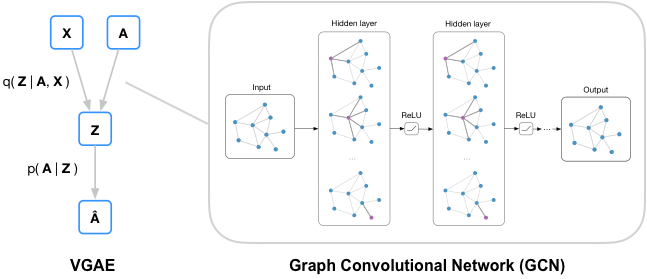
GAEs have successfully been used for:
- Link prediction in large-scale relational data: M. Schlichtkrull & T. N. Kipf et al., Modeling Relational Data with Graph Convolutional Networks (2017),
- Matrix completion / recommendation with side information: R. Berg et al., Graph Convolutional Matrix Completion (2017).
GAEs are based on Graph Convolutional Networks (GCNs), a recent class of models for end-to-end (semi-)supervised learning on graphs:
T. N. Kipf, M. Welling, Semi-Supervised Classification with Graph Convolutional Networks, ICLR (2017).
A high-level introduction is given in our blog post:
Thomas Kipf, Graph Convolutional Networks (2016)
Installation
python setup.py install
Requirements
- TensorFlow (1.0 or later)
- python 2.7
- networkx
- scikit-learn
- scipy
Run the demo
python train.py
Data
In order to use your own data, you have to provide
- an N by N adjacency matrix (N is the number of nodes), and
- an N by D feature matrix (D is the number of features per node) -- optional
Have a look at the load_data() function in input_data.py for an example.
In this example, we load citation network data (Cora, Citeseer or Pubmed). The original datasets can be found here: http://linqs.cs.umd.edu/projects/projects/lbc/ and here (in a different format): https://github.com/kimiyoung/planetoid
You can specify a dataset as follows:
python train.py --dataset citeseer
(or by editing train.py)
Models
You can choose between the following models:
gcn_ae: Graph Auto-Encoder (with GCN encoder)gcn_vae: Variational Graph Auto-Encoder (with GCN encoder)
Cite
Please cite our paper if you use this code in your own work:
@article{kipf2016variational,
  title={Variational Graph Auto-Encoders},
  author={Kipf, Thomas N and Welling, Max},
  journal={NIPS Workshop on Bayesian Deep Learning},
  year={2016}
}
Ähnliche Projekte entdecken
tensorflow/tensorflow
Ein Open-Source-Framework für maschinelles Lernen für alle
201,592 Sternehuggingface/transformers
🤗 Transformers: das Framework zur Modelldefinition für State-of-the-Art-Modelle des maschinellen Lernens in Text, Vision, Audio und multimodal, für Inferenz und Training.
168,953 SterneAUTOMATIC1111/stable-diffusion-webui
Web-UI für Stable Diffusion
165,308 SterneComfy-Org/ComfyUI
Die leistungsstärkste und modularste GUI, API und das Backend für Diffusionsmodelle mit einer Oberfläche aus Graphen und Knoten. Die schnellste lokale Inferenz-Engine der Welt.
146,714 Sterne