
timsainb/tensorflow2-generative-models
timsainb/tensorflow2-generative-models has 991 GitHub stars and 183 forks. Star changes are not measured yet. Last checked 2026-11-14 08:28 UTC. Last push 2021-07-18.
Gemessener Sternzuwachs
- in 24h
- Verlauf wird gesammelt
- in 7 days
- Verlauf wird gesammelt
- in 15 days
- Verlauf wird gesammelt
- in 1 month
- Verlauf wird gesammelt
Nettoänderungen in überlappenden Zeiträumen, keine Tagessummen. Fehlende Messwerte bleiben leer. Sterne zeigen Interesse, nicht Qualität.
Über uns
Implementations of a number of generative models in Tensorflow 2. GAN, VAE, Seq2Seq, VAEGAN, GAIA, Spectrogram Inversion. Everything is self contained in a jupyter notebook for easy export to colab.
Maschinelles LernenREADME.md
Original
Generative models in Tensorflow 2
Tim Sainburg (PhD Candidate, UCSD, Gentner Laboratory)
This is a small project to implement a number of generative models in Tensorflow 2. Layers and optimizers use Keras. The models are implemented for two datasets: fashion MNIST, and NSYNTH. Networks were written with the goal of being as simple and consistent as possible while still being readable. Because each network is self contained within the notebook, they should be easily run in a colab session.
Included models:
Autoencoder (AE) 
A simple autoencoder network.

Variational Autoencoder (VAE) (article)
The original variational autoencoder network, using tensorflow_probability

Generative Adversarial Network (GAN) (article)
GANs are a form of neural network in which two sub-networks (the encoder and decoder) are trained on opposing loss functions: an encoder that is trained to produce data which is indiscernable from the true data, and a decoder that is trained to discriminate between the data and generated data.

Wasserstein GAN with Gradient Penalty (WGAN-GP) (article)
WGAN-GP is a GAN that improves over the original loss function to improve training stability.
VAE-GAN (article)
VAE-GAN combines the VAE and GAN to autoencode over a latent representation of data in the generator to improve over the pixelwise error function used in autoencoders.
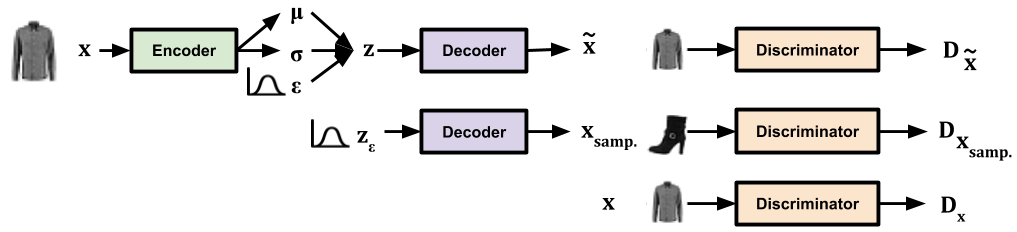
Generative adversarial interpolative autoencoder (GAIA) (article)
GAIA is an autoencoder trained to learn convex latent representations by adversarially training on interpolations in latent space projections of real data. This is an experimental modification of the original algorithm. For the original algorithm, see here: https://github.com/timsainb/gaia

Other Notebooks:
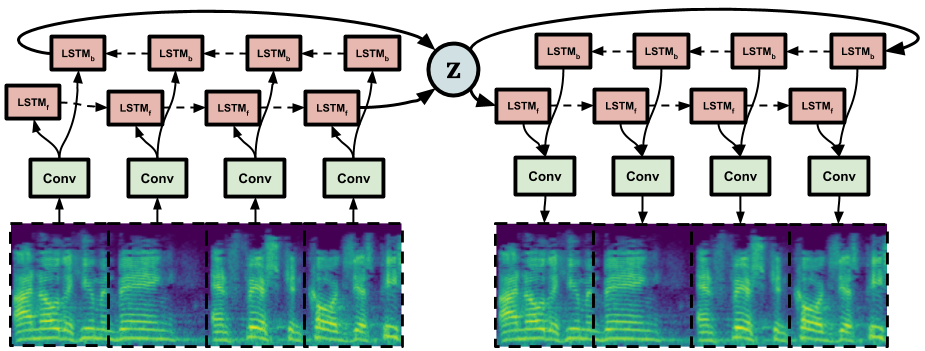
Seq2Seq Autoencoder (without attention) (Fasion MNIST: | NSYNTH: )
Seq2Seq models use recurrent neural network cells (like LSTMs) to better capture sequential organization in data. This implementation uses Convolutional Layers as input to the LSTM cells, and a single Bidirectional LSTM layer.
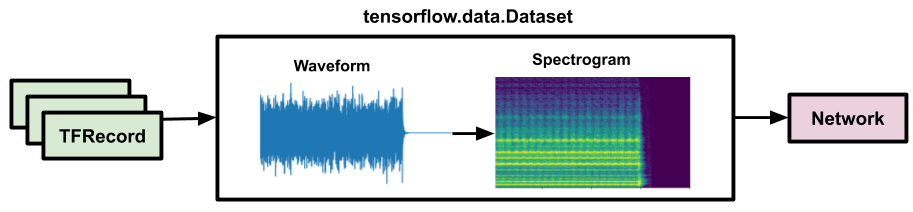
Spectrogramming, Mel Scaling, MFCCs, and Inversion in Tensorflow
Tensorflow has a signal processing package that allows us to generate spectrograms from waveforms as part of our dataset iterator, rather than pregenerating a second spectrogram dataset. This notebook can serve as a reference for how this is done. Spectrogram inversion is done using the Griffin-Lim algorithm.

Iterator for NSynth
The NSYNTH dataset is a set of thousands of musical notes saved as waveforms. To input these into a Seq2Seq model as spectrograms, I wrote a small dataset class that converts to spectrogram in tensorflow (using the code from the spectrogramming notebook).
Ähnliche Projekte entdecken
tensorflow/tensorflow
Ein Open-Source-Framework für maschinelles Lernen für alle
201,591 Sternehuggingface/transformers
🤗 Transformers: das Framework zur Modelldefinition für State-of-the-Art-Modelle des maschinellen Lernens in Text, Vision, Audio und multimodal, für Inferenz und Training.
168,957 SterneAUTOMATIC1111/stable-diffusion-webui
Web-UI für Stable Diffusion
165,310 SterneComfy-Org/ComfyUI
Die leistungsstärkste und modularste GUI, API und das Backend für Diffusionsmodelle mit einer Oberfläche aus Graphen und Knoten. Die schnellste lokale Inferenz-Engine der Welt.
146,744 Sterne