
shrubb/box-convolutions
shrubb/box-convolutions has 509 GitHub stars and 34 forks. GitHot measured 0 stars in 24 hours. Last checked 2026-11-19 06:36 UTC. Last push 2020-01-20.
Gemessener Sternzuwachs
- in 24h
- 0
- in 7 days
- Verlauf wird gesammelt
- in 15 days
- Verlauf wird gesammelt
- in 1 month
- Verlauf wird gesammelt
Nettoänderungen in überlappenden Zeiträumen, keine Tagessummen. Fehlende Messwerte bleiben leer. Sterne zeigen Interesse, nicht Qualität.
Über uns
PyTorch code for the "Deep Neural Networks with Box Convolutions" paper
Maschinelles LernenREADME.md
OriginalBox Convolution Layer for ConvNets

Single-box-conv network (from `examples/mnist.py`) learns patterns on MNIST
What This Is
This is a PyTorch implementation of the box convolution layer as introduced in the 2018 NeurIPS paper:
Burkov, E., & Lempitsky, V. (2018) Deep Neural Networks with Box Convolutions. Advances in Neural Information Processing Systems 31, 6214-6224.
How to Use
Installing
python3 -m pip install git+https://github.com/shrubb/box-convolutions.git
python3 -m box_convolution.test # if throws errors, please open a GitHub issue
To uninstall:
python3 -m pip uninstall box_convolution
Tested on Ubuntu 18.04.2, Python 3.6, PyTorch 1.0.0, GCC {4.9, 5.5, 6.5, 7.3}, CUDA 9.2. Other versions (e.g. macOS or Python 2.7 or CUDA 8 or CUDA 10) should work too, but I haven't checked. If something doesn't build, please open a Github issue.
Known issues (see this chat):
- CUDA 9/9.1 + GCC 6 isn't supported due to a bug in NVCC.
You can specify a different compiler with CC environment variable:
CC=g++-7 python3 -m pip install git+https://github.com/shrubb/box-convolutions.git
Using
import torch
from box_convolution import BoxConv2d

box_conv = BoxConv2d(16, 8, 240, 320)
help(BoxConv2d)
Also, there are usage examples in examples/.
Quick Tour of Box convolutions
You may want to see our poster.
Why reinvent the old convolution?
3×3 convolutions are too small ⮕ receptive field grows too slow ⮕ ConvNets have to be very deep.
This is especially undesirable in dense prediction tasks (segmentation, depth estimation, object detection, ...).
Today people solve this by
- dilated/deformable convolutions (can bring artifacts or degrade to
1×1conv; almost always filter high-frequency); - "global" spatial pooling layers (usually too constrained, fixed size, not "fully convolutional").
How does it work?
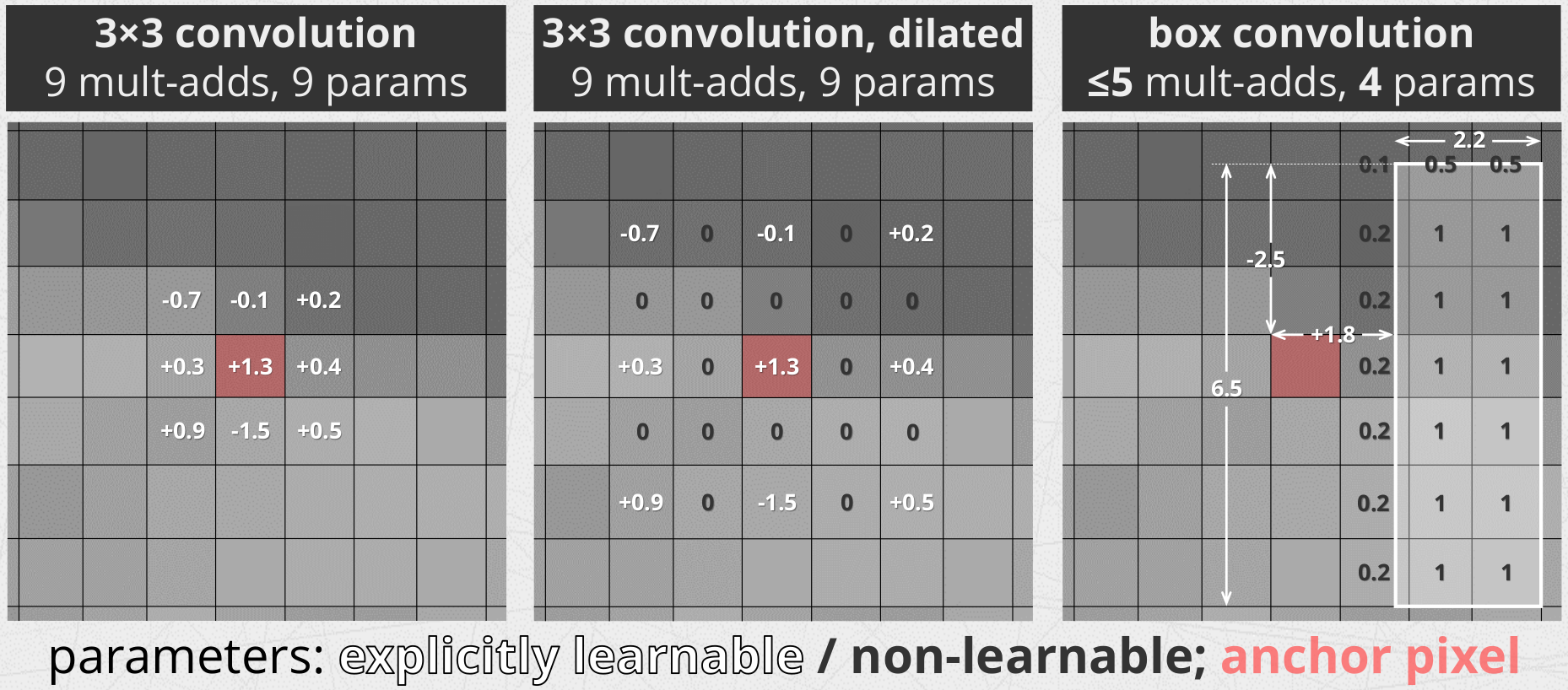
Box convolution layer is a basic depthwise convolution (i.e. Conv2d with groups=in_channels) but with special kernels called box kernels.
A box kernel is a rectangular averaging filter. That is, filter values are fixed and unit! Instead, we learn four parameters per rectangle − its size and offset:

Any success stories?
One example: there is an efficient semantic segmentation model ENet. It's a classical hourglass architecture stacked of dozens ResNet-like blocks (left image).
Let's replace some of these blocks by our "box convolution block" (right image).

First we replaced every second block with a box convolution block (BoxENet in the paper). The model became
- more accurate,
- faster,
- lighter
- without dilated convolutions.
Then, we replaced every residual block (except the down- and up-sampling ones)! The result, BoxOnlyENet, is
- a ConvNet almost without (traditional learnable weight) convolutions,
- 2 times less operations,
- 3 times less parameters,
- still more accurate than ENet!