
recho-dev/recho has 39 GitHub stars and 5 forks. Star changes are not measured yet. Last checked 2026-11-08 23:06 UTC. Last push 2026-11-04.
So werden diese Zahlen gemessen
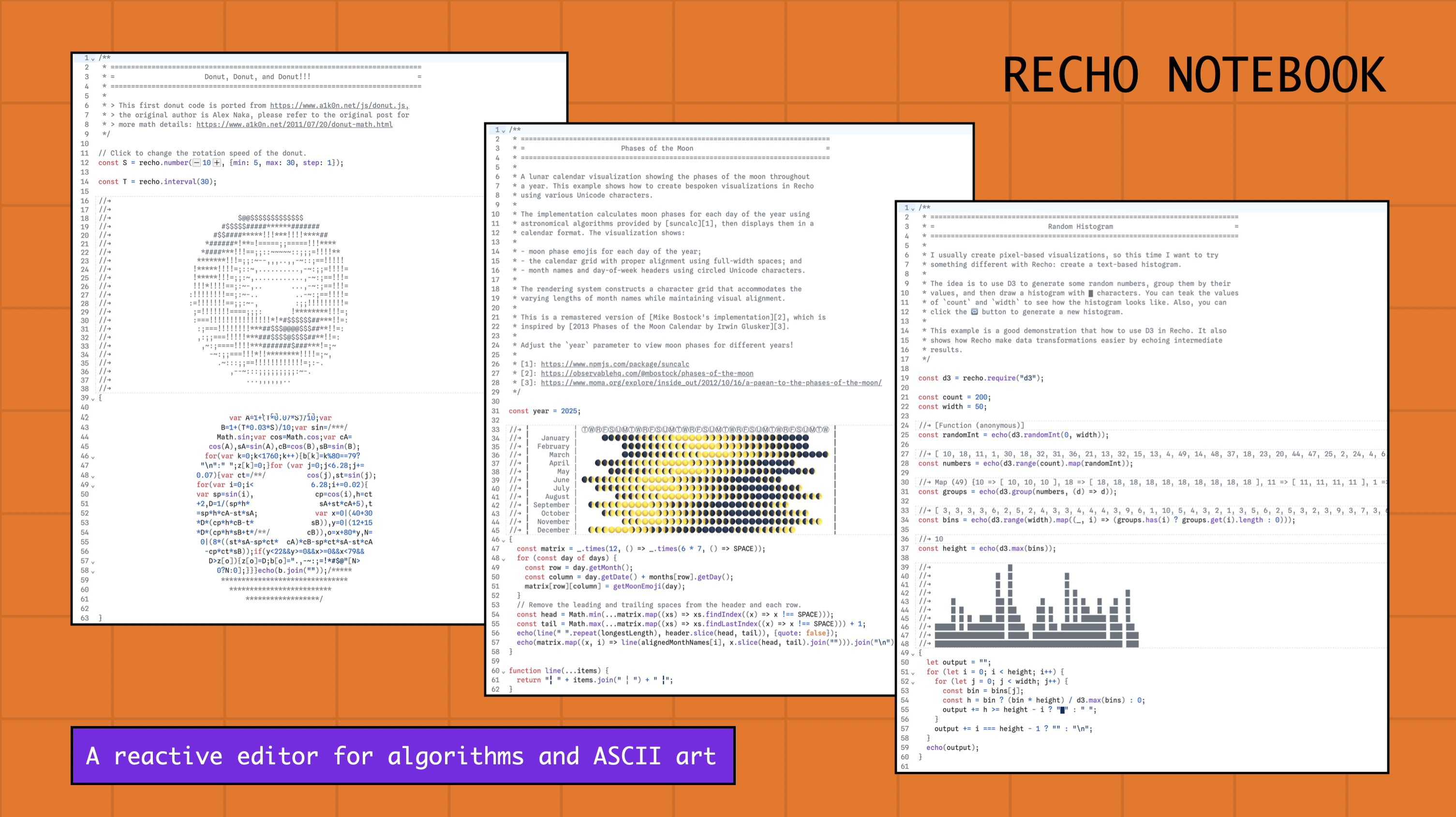
A reactive programming interface for algorithms and ASCII art. Recho Notebook introduces a plain code format for notebooks, echoing outputs inline for in-situ coding with instant feedback, built on Observable Notebook Kit.
Gemessener Sternzuwachs
- in 24h
- Aktualisierung verzögert
- in 7 days
- Aktualisierung verzögert
- in 15 days
- Aktualisierung verzögert
- in 1 month
- Aktualisierung verzögert
Nettoänderungen in überlappenden Zeiträumen, keine Tagessummen. Fehlende Messwerte bleiben leer. Sterne zeigen Interesse, nicht Qualität.
README.md
OriginalRecho
We want to live in the editor forever. — Luyu Cheng
Recho is a free, open-source, reactive editor for algorithms and ASCII art. It introduces a plain code format for notebooks — echoing output inline as comments for live, in-situ coding with instant feedback. Built on vanilla JavaScript and the reactive model of Observable Notebook Kit, Recho lets developers, artists, and learners explore algorithms and ASCII art interactively.
- Editor 📝 - The quickest way to get started with Recho.
- Announcement 📢 - Read our initial release story to discovery the vision behind Recho.
- Documentation 📚 - Learn how to use Recho with our comprehensive guides.
- Explore 🖼️ - See what you can create and draw some inspiration!
- Sharing 🎨 - Follow the instructions to open a pull request to share your sketches!
- Contributing 🙏 - We have a bunch of things that we would like you to help us build together!
Core Idea 🧠
Unlike typical notebooks (like Jupyter or Observable), Recho treats code and its output as a single, continuous document. When you write code, the output appears inline — as a comment right above your code.

If you modify the code, the echoed output updates immediately. So instead of switching between “code cells” and “output cells,” your entire notebook feels like a living text file that responds to you.
Design Philosophy 💡
The name Recho comes from “Reactive Echo” — every expression echoes its result, instantly. It’s meant to capture the feedback loop between code and creator — seeing how every small change ripples through your work.
Recho is both a tool and a statement — it imagines what happens if we strip away complex GUIs and treat code itself as the canvas.
It’s light, artistic, and reactive — blending ideas from creative coding, literate programming, and live performance.
Example Use Cases 🖼️
- Teaching/learning basic algorithms with immediate text/visual feedback.
- Creating text-based animations to experience the simplicity and clarity in ASCII art.
- Exploring code minimalism — finding beauty in code and its textual output.
Why Recho 🪶
We’ve always loved Observable Notebooks. To make notebooks more portable, we built Markdown Genji, extending Markdown with live code features. Later, Observable Framework and Observable Notebook Kit explored similar ideas, which made us wonder — could a notebook exist as a plain code file?
At the same time, we wanted to make coding more accessible and playful. Inspired by the p5.js web editor, we realized well-designed language doesn’t necessarily make coding more accessible — the environment does. So we asked — what if we focused on algorithms instead of graphics, using ASCII art when visuals are needed?
That’s how Recho began — a lighter way to code with creativity.
What's Next 🔥
Recho is in beta — and open source! 🎉 Try it out on our website or explore the code on GitHub. We’d love your thoughts, comments, or suggestions. Want to contribute? Here’s where you can help:
- Sharing Examples – text analysis, ASCII art, data viz, graphics, concrete poetry, or demos with D3, Tone, ml5… anything! One example is enough.
- Polyglot Programming – Recho is JavaScript-first but open to any language that compiles to JavaScript — Python, Rust, MLscript, wenyan‑lang… your playground.
- LLM Experiments – What if LLMs could "see" both the input and the output?
We’re also improving:
- Editing & Workflow – Reruns, formatting, smoother editing.
- Visuals – Dark theme, ANSI codes, more expressive output.
- Interactivity – Mouse, keyboard, and more input support.
License 📄
ISC © Recho
Ähnliche Projekte entdecken
sindresorhus/awesome
😎 Awesome-Listen zu allen möglichen interessanten Themen [HINWEIS: Pull Requests sind vorübergehend deaktiviert, bis ich dazu komme, die vorhandenen abzuarbeiten]
534,138 SterneEbookFoundation/free-programming-books
:books: Frei verfügbare Programmierbücher
401,364 Sternenilbuild/developer-roadmap
Interaktive Roadmaps, Leitfäden und weitere Bildungsinhalte, die Entwicklern helfen, in ihrer Karriere zu wachsen.
371,633 Sternevinta/awesome-python
Die maßgebliche Liste, die die Frage beantwortet: „Ich möchte X in Python machen – welches Tool soll ich verwenden?“
333,540 Sterne