
rasidi3112/quantum-ai-lab
rasidi3112/quantum-ai-lab has 40 GitHub stars and 1 forks. Star changes are not measured yet. Last checked 2026-11-14 02:35 UTC. Last push 2026-10-16.
Gemessener Sternzuwachs
- in 24h
- Verlauf wird gesammelt
- in 7 days
- Verlauf wird gesammelt
- in 15 days
- Verlauf wird gesammelt
- in 1 month
- Verlauf wird gesammelt
Nettoänderungen in überlappenden Zeiträumen, keine Tagessummen. Fehlende Messwerte bleiben leer. Sterne zeigen Interesse, nicht Qualität.
Über uns
Quantum computing × AI from first principles in pure NumPy: Shor, Grover, BB84/E91, QAOA, VQE, quantum ML, quantum RL and quantum chaos. Readable statevector simulations, verified against exact physics in 100+ tests.
LernenREADME.md
Original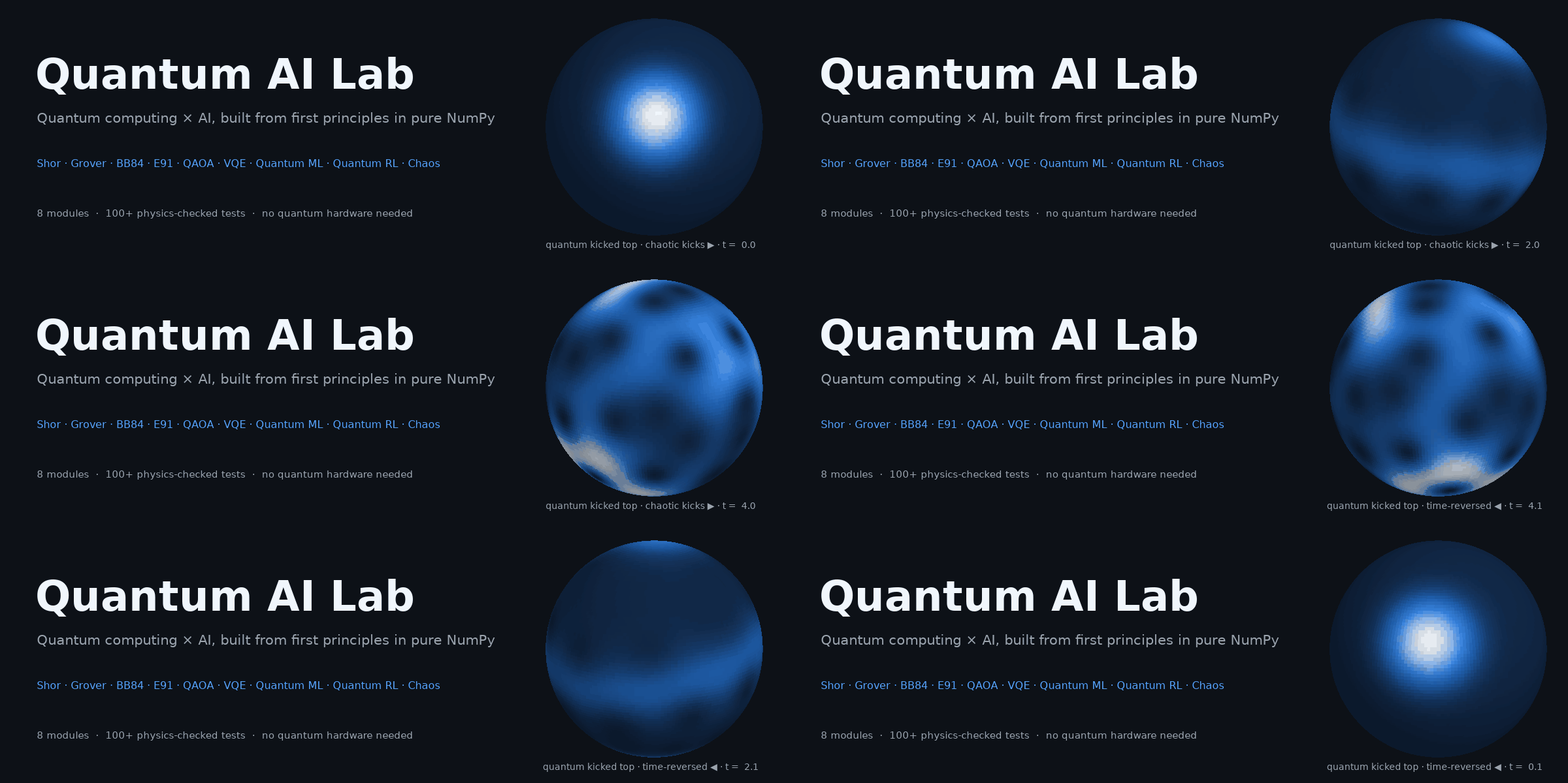
Shor, Grover, BB84, QAOA, VQE, quantum kernels, quantum RL, quantum chaos and more.
Eight modules. Every algorithm is a readable statevector simulation you can step through,
and every headline number below is checked by the test suite.





Quick start · Gallery · Modules · Verified results · Python API · Contributing
Why this repo
- No black boxes. No Qiskit, no PennyLane, no hidden simulator: gates are NumPy arrays, circuits are loops you can read and step through.
- Breadth. Algorithms, cryptography, ML, many-body physics, optimization, reinforcement learning, computer vision and quantum chaos, all behind one consistent API.
- Tested against physics. 100+ tests compare results with exact solutions: the free-fermion Ising energy, the Hubbard dimer, Tsirelson's bound, Trotter error scaling, GOE level statistics and parameter-shift gradients.
- Documented and typed. Every public module, class and function has a NumPy-style docstring with references to the original papers, and the code is fully type-annotated. Ruff and mypy enforce both in CI.
- Fast enough to play with. The whole tour runs in about 3 seconds on a laptop CPU.
Quick start
pip install git+https://github.com/rasidi3112/quantum-ai-lab.git
qailab tour
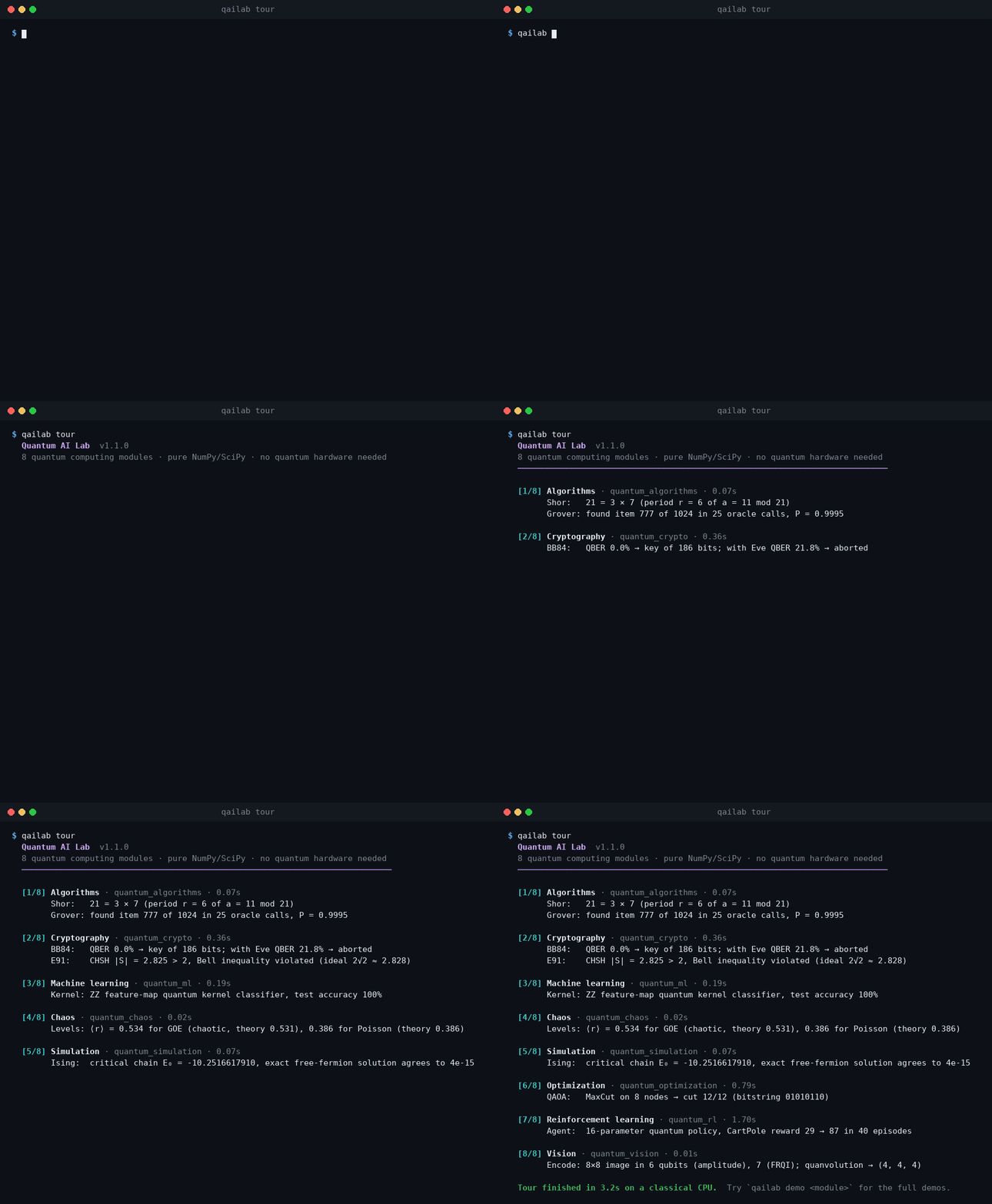
Then dive into any module:
qailab list                 # all demos
qailab demo crypto          # BB84 vs. an eavesdropper, E91 Bell test, quantum one-time pad
qailab demo optimization    # constraint-preserving QAOA for portfolio selection
qailab demo rl              # a 4-qubit policy learns to balance CartPole
Developing locally
git clone https://github.com/rasidi3112/quantum-ai-lab.git
cd quantum-ai-lab
pip install -e ".[dev]"
ruff check . && mypy        # lint, docstrings and types
pytest                      # ~20 s
python scripts/make_figures.py   # regenerate the README figures
python scripts/make_banner.py    # regenerate the animated banner
Gallery
Every image and animation is produced from the library itself by scripts/make_figures.py, make_banner.py and make_terminal_gif.py.
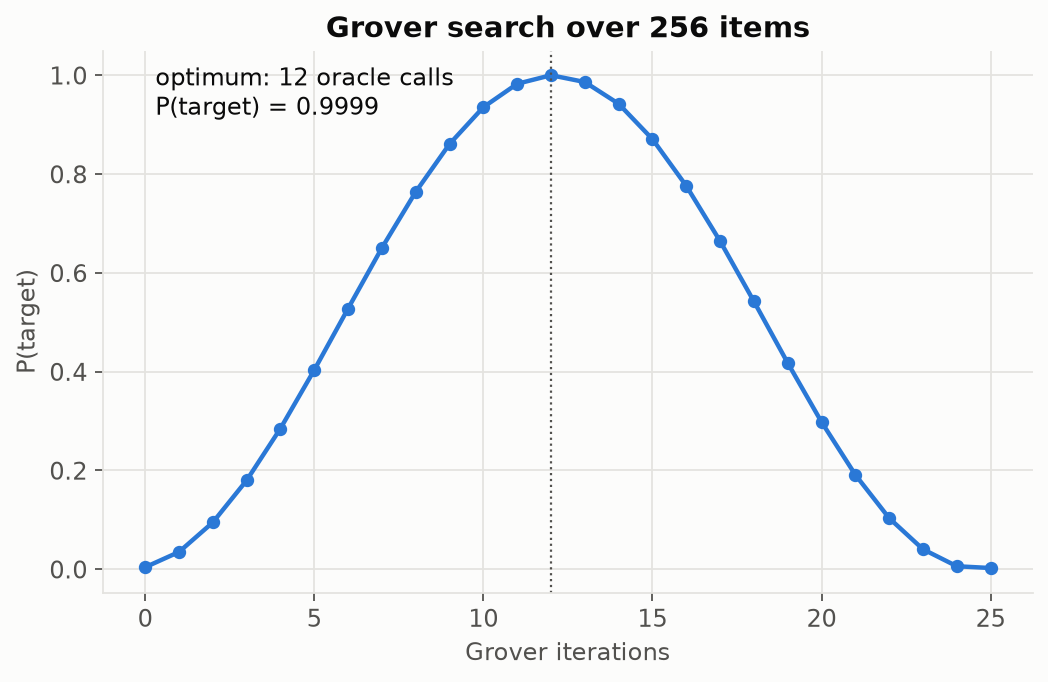 Grover search: amplitude amplification peaks at ⌊π/4·√N⌋ oracle calls. |
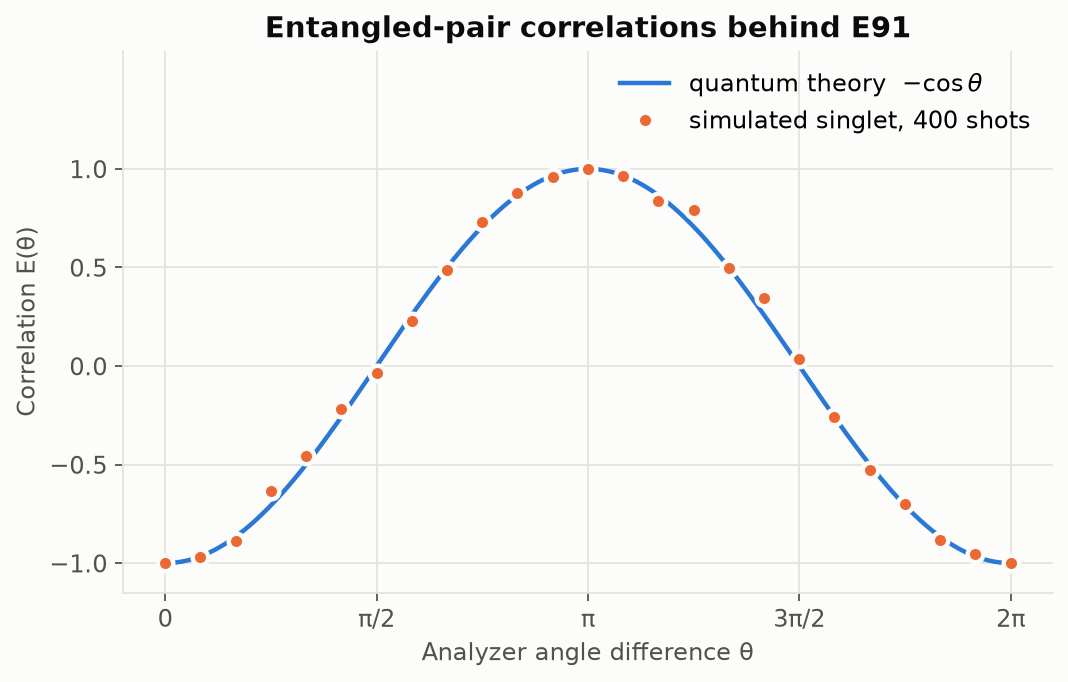 Entanglement: simulated singlet correlations follow −cos θ, the source of the CHSH violation in E91. |
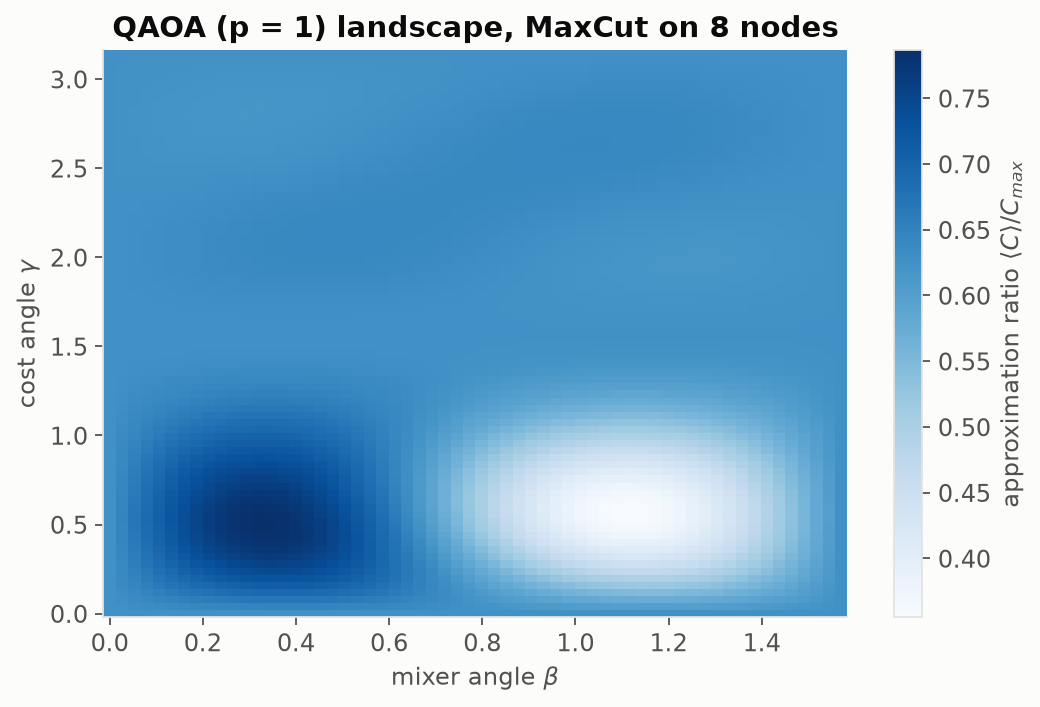 QAOA landscape: approximation ratio over (γ, β) for MaxCut on 8 nodes. |
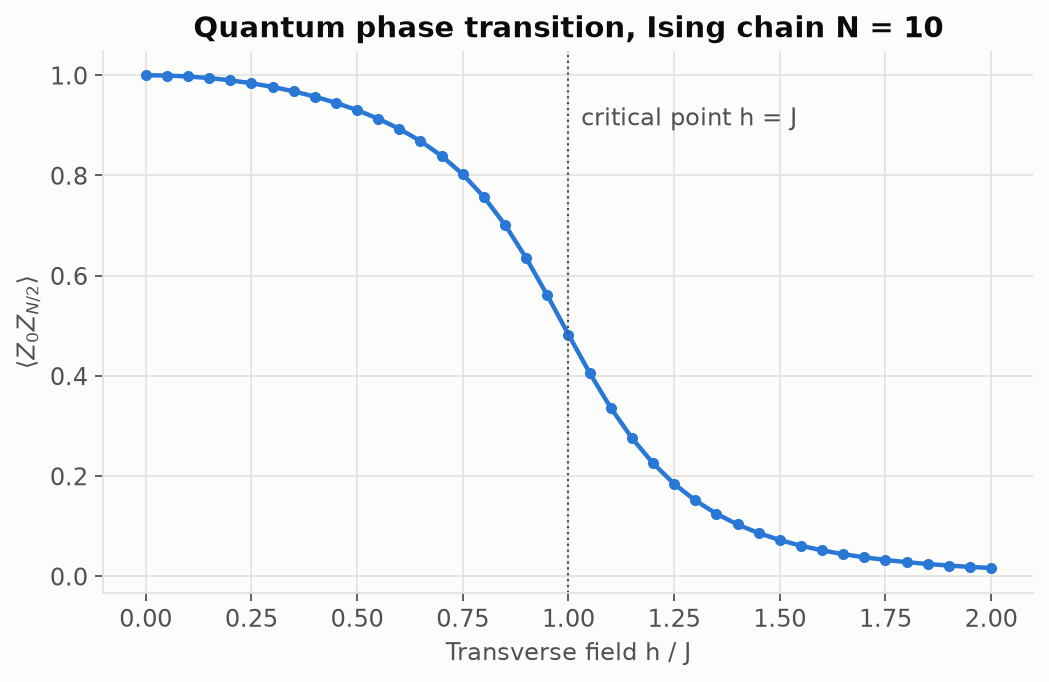 Quantum phase transition: long-range order of the transverse-field Ising chain melts at h = J. |
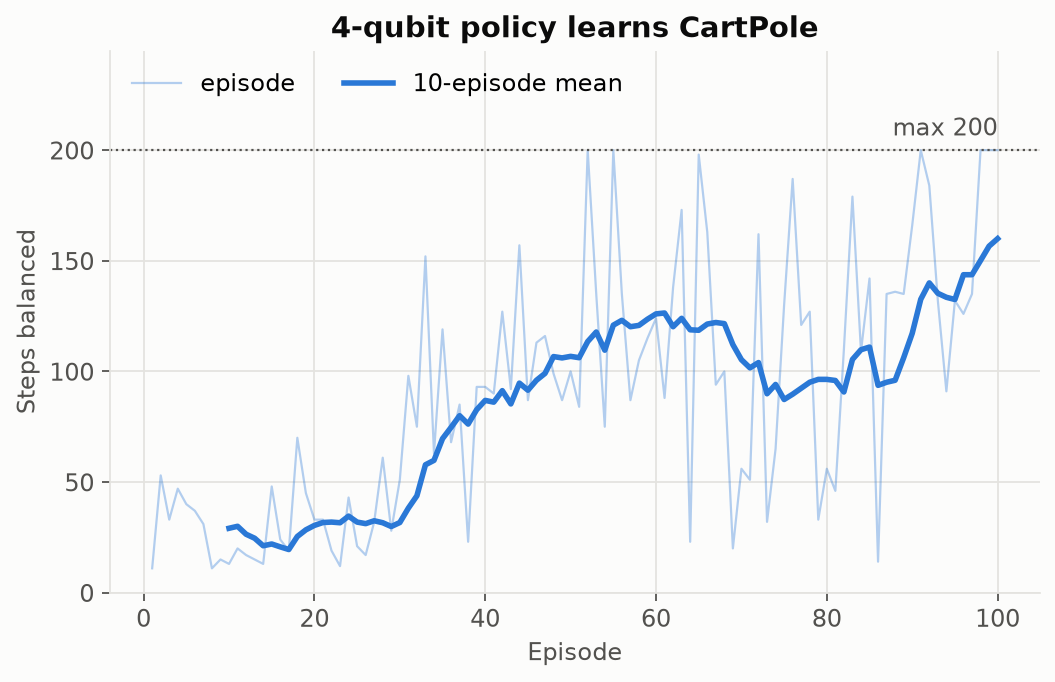 Quantum RL: a 16-parameter data-re-uploading circuit learns to balance CartPole. |
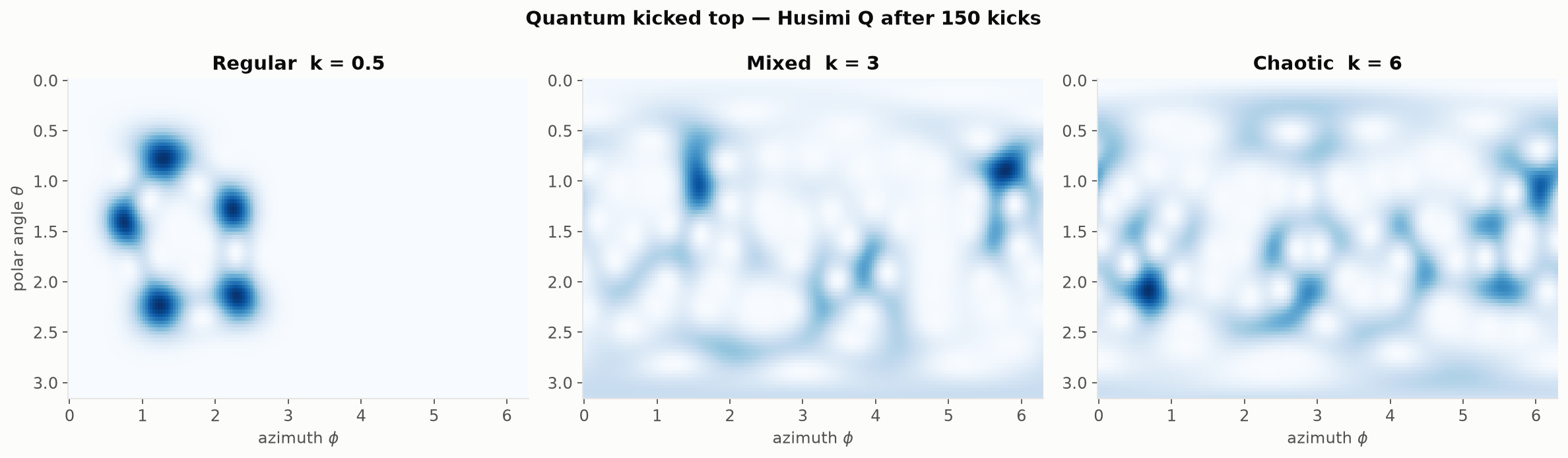 Quantum chaos: the kicked top's Husimi function stays localized when regular and fills the sphere when chaotic. The animated banner is the same simulation, run forward and then time-reversed. |
Modules
| Module | What's inside | Demo |
|---|---|---|
quantum_algorithms |
Shor (period finding + continued fractions), Grover and amplitude amplification, QFT built from gates, phase estimation, Deutsch–Jozsa | qailab demo algorithms |
quantum_crypto |
BB84 with intercept-resend attack and Toeplitz-hash privacy amplification, E91 with CHSH test, quantum one-time pad (UTF-8 safe) | qailab demo crypto |
quantum_ml |
ZZ-feature-map quantum kernels, variational quantum classifier, QNN with parameter-shift gradients | qailab demo ml |
quantum_chaos |
Quantum kicked top and Husimi functions, level-spacing statistics (Wigner–Dyson, Brody, ⟨r⟩ ratio), OTOCs and Lyapunov exponents | qailab demo chaos |
quantum_simulation |
Transverse-field Ising, Fermi–Hubbard via Jordan–Wigner, 1st/2nd/4th-order Trotter–Suzuki | qailab demo simulation |
quantum_optimization |
QAOA with X mixer and Hamming-weight-preserving XY mixer, VQE (hardware-efficient, UCCSD), MaxCut | qailab demo optimization |
quantum_rl |
Data-re-uploading quantum policy, hybrid classical–quantum REINFORCE agent, CartPole and FrozenLake | qailab demo rl |
quantum_vision |
Amplitude, angle, FRQI and NEQR image encodings, quanvolution, hybrid MLP→VQC classifier trained end-to-end with parameter shift | qailab demo vision |
Verified results
Each row is asserted in tests/, so CI fails if it ever stops being true.
| Claim | Result | Test |
|---|---|---|
| Shor factors 15, 21, 33, 35, 39, 51, 55, 77, 91 | correct factors; every quantum-found period satisfies aᴿ ≡ 1 (mod N) | test_shor_factors_semiprimes |
| Grover on N = 2ⁿ items | P(target) > 0.9 after ⌊π/4·√N⌋ iterations | test_grover_amplifies_target |
| QFT from H + controlled-phase + SWAP gates | equals the DFT matrix exactly (n ≤ 5) | test_qft_is_unitary_and_matches_circuit |
| BB84 under intercept-resend | QBER ≈ 25%, protocol aborts; clean channel gives matching keys | test_bb84_detects_intercept_resend |
| E91 CHSH value | |S| ≈ 2√2 (Tsirelson's bound) | test_e91_violates_chsh_and_keys_agree |
| Transverse-field Ising ground energy | matches the exact free-fermion solution to 1e-9 | test_ising_matches_free_fermion_solution |
| Hubbard dimer at half filling | E₀ = U/2 − √(U²/4 + 4t²) | test_hubbard_dimer_half_filling_energy |
| Trotter error | infidelity drops 4×, 16×, 256× when dt halves (orders 1, 2, 4) | test_trotter_error_scales_with_order |
| Random-matrix spectra | ⟨r⟩ = 0.531 (GOE) vs 0.386 (Poisson) | test_ratio_statistic_distinguishes_goe_from_poisson |
| VQE on 4-site Ising | reaches the exact ground energy to 1e-4 | test_vqe_reaches_ising_ground_state |
| XY-mixer QAOA | probability stays 100% inside the budget-feasible subspace | test_xy_qaoa_stays_in_feasible_subspace |
| Parameter-shift gradients | agree with finite differences (QNN and hybrid classifier) | test_qnn_parameter_shift_matches_finite_difference |
Constraint-preserving QAOA in one table
From qailab demo optimization: choosing 3 of 6 assets (20 valid portfolios out of 64).
| Ansatz (p = 4) | P(valid portfolio) | P(optimal portfolio) |
|---|---|---|
| random guess | 31.2% | 1.6% |
| QAOA, X mixer + penalty term | 43.3% | 2.9% |
| QAOA, XY mixer from a Dicke state | 100.0% | 44.1% |
Python API
from quantum_algorithms import ShorFactoring, GroverSearch
from quantum_crypto import BB84Protocol, QuantumOTP
from quantum_optimization import QAOA, MaxCutSolver
from quantum_simulation import IsingModel

result = ShorFactoring(seed=1).factor(21)
print(result.factors, result.period_found, result.method)    # (7, 3) 6 quantum period finding

key, stats = BB84Protocol(seed=0).run_protocol(n_qubits=2000, eve_present=True)
print(f"QBER={stats.qber:.1%} secure={stats.protocol_secure}")  # QBER≈25% secure=False

msg = QuantumOTP(seed=0).secure_communicate("Halo dunia, ünïcödé ok", protocol="e91")
print(msg.decrypted_text, msg.success)                        # Halo dunia, ünïcödé ok True

graph = MaxCutSolver.random_graph(8, edge_prob=0.5, seed=1)
print(MaxCutSolver(8).qaoa_solve(graph, p_layers=2, seed=0)["best_cut"])  # 12.0

E0, psi0 = IsingModel(n_sites=8, J=1.0, h=1.0).get_ground_state()
print(f"E0 = {E0:.6f}")                                        # E0 = -10.251662
Constraint-preserving QAOA on any diagonal cost function:
import numpy as np
from quantum_optimization import QAOA

costs = np.random.default_rng(0).normal(size=2**6)           # one cost per bitstring
result = QAOA(6, seed=0).optimize_hamiltonian(
    costs, p_layers=4, mixer="xy", hamming_weight=3, method="L-BFGS-B"
)
samples = QAOA.sample_solution(result["state"], n_samples=1000, seed=0)
Architecture
flowchart TB
    subgraph core["Shared foundation: NumPy statevectors · SciPy linear algebra & optimizers"]
    end
    core --> ALG["quantum_algorithms<br/>Shor · Grover · QFT · QPE · DJ"]
    core --> SIM["quantum_simulation<br/>Ising · Hubbard · Trotter"]
    core --> CHAOS["quantum_chaos<br/>kicked top · level statistics · OTOC"]
    core --> CRYPTO["quantum_crypto<br/>BB84 · E91 · OTP"]
    core --> ML["quantum_ml<br/>kernels · VQC · QNN"]
    core --> OPT["quantum_optimization<br/>QAOA · VQE · MaxCut"]
    core --> RL["quantum_rl<br/>quantum policy · hybrid agent"]
    core --> VIS["quantum_vision<br/>encoders · quanvolution · hybrid classifier"]
    CRYPTO -. keys .-> OTP["quantum one-time pad"]
    SIM -. Hamiltonians .-> OPT
    CLI["qailab CLI"] --> ALG & CRYPTO & ML & CHAOS & SIM & OPT & RL & VIS
Each package is self-contained, so you can read one module without the others. More detail in docs/architecture.md.
Under the hood
| Concept | Formula | Where |
|---|---|---|
| State vector | |ψ⟩ = Σᵢ αᵢ |i⟩ | everywhere |
| Grover iterate | G = (2|s⟩⟨s| − I)·O_f | quantum_algorithms/grover.py |
| Quantum kernel | K(x, y) = |⟨φ(x)|φ(y)⟩|² | quantum_ml/qkernel.py |
| CHSH | S = E(a,b) − E(a,b′) + E(a′,b) + E(a′,b′), |S| ≤ 2 classically | quantum_crypto/e91.py |
| Trotter–Suzuki | e^{−i(A+B)t} ≈ (e^{−iAt/2n} e^{−iBt/n} e^{−iAt/2n})ⁿ | quantum_simulation/trotter.py |
| QAOA | |γ,β⟩ = Πₖ e^{−iβₖB} e^{−iγₖC} |ψ₀⟩ | quantum_optimization/qaoa.py |
| Parameter shift | ∂⟨O⟩/∂θ = ½[⟨O⟩(θ+π/2) − ⟨O⟩(θ−π/2)] | quantum_ml, quantum_vision |
| OTOC | C(t) = ⟨[W(t), V]†[W(t), V]⟩ | quantum_chaos/lyapunov.py |
Statevector simulation scales as 2ⁿ, so the demos stay at 4–12 qubits. That is the point: small enough to inspect every amplitude.
Roadmap
- Noise models (depolarizing, amplitude damping) and error-mitigation demos
- Optional Qiskit / PennyLane backends to run the same circuits on real hardware
- Interactive notebooks for every module
- Publish to PyPI
Ideas and pull requests are welcome: see the good first issues.
Contributing
Contributions of new algorithms, demos, tests and docs are welcome. Read CONTRIBUTING.md, then run ruff check . && pytest before opening a pull request.
If this project helped you learn or teach quantum computing, consider giving it a star. It helps others find it.
Citation
If you use Quantum AI Lab in research or teaching, please cite it via the CITATION.cff file (GitHub's "Cite this repository" button).
References
- Nielsen & Chuang, Quantum Computation and Quantum Information (2010).
- Shor, Polynomial-time algorithms for prime factorization and discrete logarithms, SIAM J. Comput. 26 (1997).
- Grover, A fast quantum mechanical algorithm for database search, STOC (1996).
- Bennett & Brassard, Quantum cryptography: public key distribution and coin tossing (1984); Ekert, PRL 67, 661 (1991).
- Farhi, Goldstone & Gutmann, A quantum approximate optimization algorithm, arXiv:1411.4028 (2014).
- Hadfield et al., From the quantum approximate optimization algorithm to a quantum alternating operator ansatz, Algorithms 12, 34 (2019).
- Havlíček et al., Supervised learning with quantum-enhanced feature spaces, Nature 567, 209 (2019).
- Pérez-Salinas et al., Data re-uploading for a universal quantum classifier, Quantum 4, 226 (2020).
- Jerbi et al., Parametrized quantum policies for reinforcement learning, NeurIPS (2021).
- Henderson et al., Quanvolutional neural networks, Quantum Mach. Intell. 2, 2 (2020).
- Haake, Quantum Signatures of Chaos (2010); Atas et al., PRL 110, 084101 (2013).
License
Ähnliche Projekte entdecken
sindresorhus/awesome
😎 Awesome-Listen zu allen möglichen interessanten Themen [HINWEIS: Pull Requests sind vorübergehend deaktiviert, bis ich dazu komme, die vorhandenen abzuarbeiten]
536,488 SterneEbookFoundation/free-programming-books
:books: Frei verfügbare Programmierbücher
401,556 Sternenilbuild/developer-roadmap
Interaktive Roadmaps, Leitfäden und weitere Bildungsinhalte, die Entwicklern helfen, in ihrer Karriere zu wachsen.
371,968 Sternevinta/awesome-python
Die maßgebliche Liste, die die Frage beantwortet: „Ich möchte X in Python machen – welches Tool soll ich verwenden?“
334,587 Sterne