
pyc-team/pytorch_concepts
pyc-team/pytorch_concepts has 336 GitHub stars and 33 forks. GitHot measured +3 stars in 24 hours. Last checked 2026-11-13 04:58 UTC. Last push 2026-11-04.
So werden diese Zahlen gemessen
PyC (Pytorch Concepts) is a PyTorch-based library for designing concept-based interpretable deep learning models.
Gemessener Sternzuwachs
- in 24h
- +3
- in 7 days
- Verlauf wird gesammelt
- in 15 days
- Verlauf wird gesammelt
- in 1 month
- Verlauf wird gesammelt
Nettoänderungen in überlappenden Zeiträumen, keine Tagessummen. Fehlende Messwerte bleiben leer. Sterne zeigen Interesse, nicht Qualität.
README.md
Original



🚀 Getting Started - 📚 Documentation - 💻 User guide
[!CAUTION] Alpha software: PyC is currently under active development. Public APIs may change and be unstable between releases.
 PyC is a library built upon
 PyTorch and
 PyTorch Lightning to easily implement interpretable and causally transparent deep learning models.
The library provides primitives for annotated tensors, interpretable layers, interventions, interpretable probabilistic graphical models, and APIs for running experiments at scale.
The name of the library stands for both
- PyTorch Concepts: as concepts are essential building blocks for interpretable deep learning.
- $P(y|C)$: as the main purpose of the library is to support sound probabilistic modeling of the conditional distribution of targets $y$ given concepts $C$.
Quick Start
Install PyC from PyPI:
pip install --pre "pytorch-concepts[data]"
Use pip install --pre pytorch-concepts for core-only (no data dependencies), or see full installation options for conda setup.
Design Principles
A few basic elements let you name concepts, compute them, train them and act on them. Here is what each one lets you do:
Annotations name the concepts, with their type and size. |
Annotated tensors bind values to concept names. |
|
|
Concept layers map embeddings and/or concepts to concepts. |
Concept losses score each concept with the loss of its type. |
|
|
Interventions edit concepts inside a |
|
|
The quickstart trains a first model end to end, and the user guide covers the rest of PyC.
PyC Software Stack
The library is organized to be modular and accessible at different levels of abstraction:
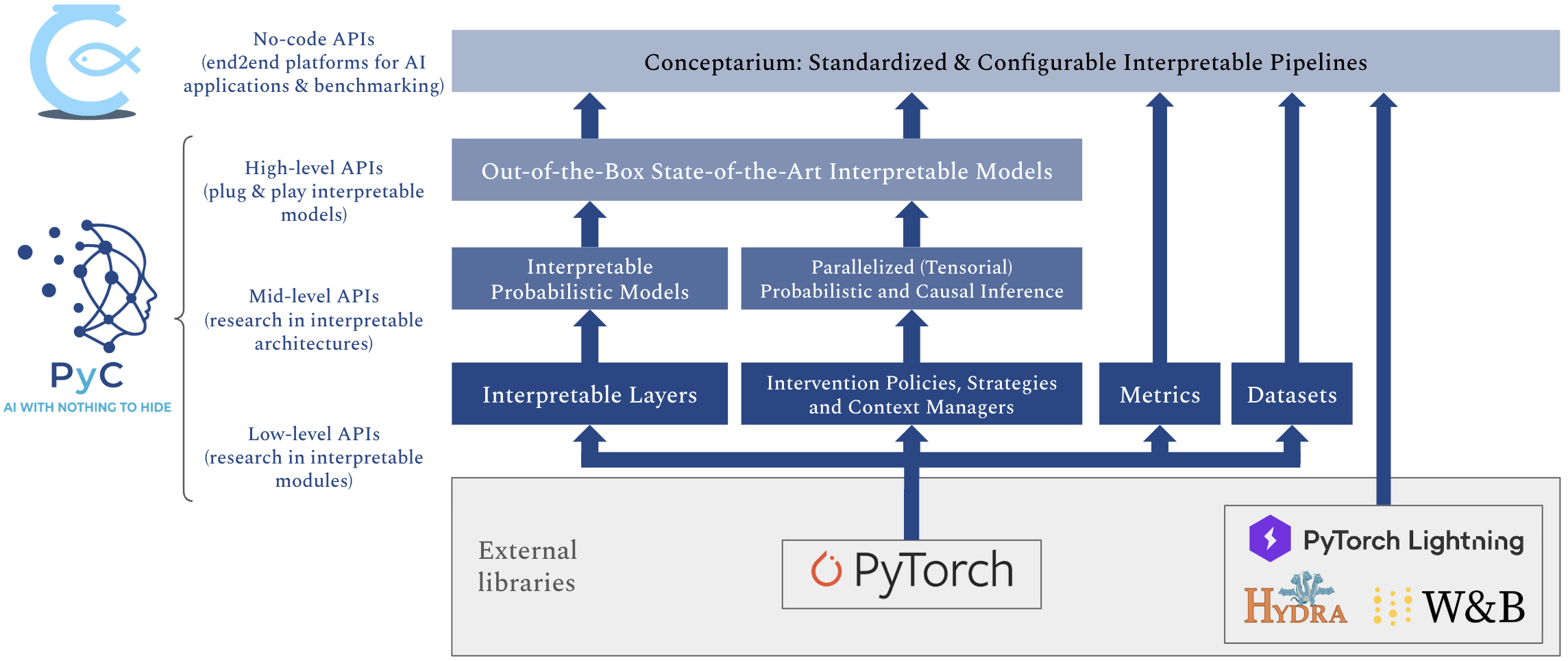
 Conceptarium (No-code API): applications and benchmarking. These APIs allow to easily run large-scale experiments by interfacing only with configuration files. Built on top of
 Hydra and
 WandB.
- High-level APIs: use out-of-the-box models. These APIs allow to instantiate models with 1 line of code. Models are available both as plain PyTorch modules (implementing
forward, allowing custom training loops) and as PyTorch Lightning modules. - Mid-level APIs: interpretable probabilistic graphical models. These APIs allow to define variables (concepts and embeddings), connect them via conditional distributions parametrized by interpretable layers, and perform probabilistic inference on the resulting graphical model.
- Low-level APIs: interpretable layers. These APIs allow to build architectures from basic interpretable layers in a plain PyTorch-like interface. These APIs also include annotated tensors, interventions, metrics, losses, and datasets.
Contributing
Contributions are welcome! Please check our contributing guidelines to get started.
Thanks to all contributors! 🧡
External Contributors
- Sonia Laguna, ETH Zurich (CH).
- Moritz Vandenhirtz, ETH Zurich (CH).
Cite this Library
If you found this library useful for your research article, blog post, or product, we would be grateful if you would cite it using the following bibtex entry:
@software{pycteam2025concept,
    author = {De Felice, Giovanni and Barbiero, Pietro and De Santis, Francesco and Gabrielli, Edoardo and Casanova Flores, Arianna and Ciravegna, Gabriele and Debot, David and Espinosa Zarlenga, Mateo and Jamnik, Mateja and Marra, Giuseppe},
    license = {Apache 2.0},
    month = {3},
    title = {{PyTorch Concepts}},
    url = {https://github.com/pyc-team/pytorch_concepts},
    year = {2025}
}
Reference authors: Giovanni De Felice, Pietro Barbiero, and Mateo Espinosa Zarlenga.
Funding
This project is supported by the following organizations:



Ähnliche Projekte entdecken
tensorflow/tensorflow
Ein Open-Source-Framework für maschinelles Lernen für alle
201,584 Sternehuggingface/transformers
🤗 Transformers: das Framework zur Modelldefinition für State-of-the-Art-Modelle des maschinellen Lernens in Text, Vision, Audio und multimodal, für Inferenz und Training.
168,943 SterneAUTOMATIC1111/stable-diffusion-webui
Web-UI für Stable Diffusion
165,303 SterneComfy-Org/ComfyUI
Die leistungsstärkste und modularste GUI, API und das Backend für Diffusionsmodelle mit einer Oberfläche aus Graphen und Knoten. Die schnellste lokale Inferenz-Engine der Welt.
146,622 Sterne