
open-data-agent-platform/awesome-odap
open-data-agent-platform/awesome-odap has 106 GitHub stars and 21 forks. Star changes are not measured yet. Last checked 2026-11-11 06:07 UTC. Last push 2026-11-07.
So werden diese Zahlen gemessen
Awesome Open Data Agent Platform resources: open data access, semantic layers, multi-agent SQL, memory, governance, and GenBI.
Gemessener Sternzuwachs
- in 24h
- Verlauf wird gesammelt
- in 7 days
- Verlauf wird gesammelt
- in 15 days
- Verlauf wird gesammelt
- in 1 month
- Verlauf wird gesammelt
Nettoänderungen in überlappenden Zeiträumen, keine Tagessummen. Fehlende Messwerte bleiben leer. Sterne zeigen Interesse, nicht Qualität.
README.md
OriginalAwesome ODAP
A curated list of tools, standards, research, and product patterns around the emerging Open Data Agent Platform category.
An Open Data Agent Platform (ODAP) is a governed AI data platform that lets people and software agents ask questions over open and enterprise data using natural language, while still preserving semantic definitions, SQL review, access control, lineage, cost awareness, and auditability.
ODAP is not a single product. It is a category that combines open data access, semantic context, agentic SQL generation, persistent memory, and governance.
Normative principles: the category's founding principles — the Five Musts (Open, Semantic, Governed, Auditable, Cost-controlled) — are defined in The ODAP Manifesto. This repository is the neutral ecosystem map built around those principles. Maintainer-affiliated reference implementation: ODAP Gateway (Apache-2.0; preview, not a declaration of production readiness or independent acceptance).
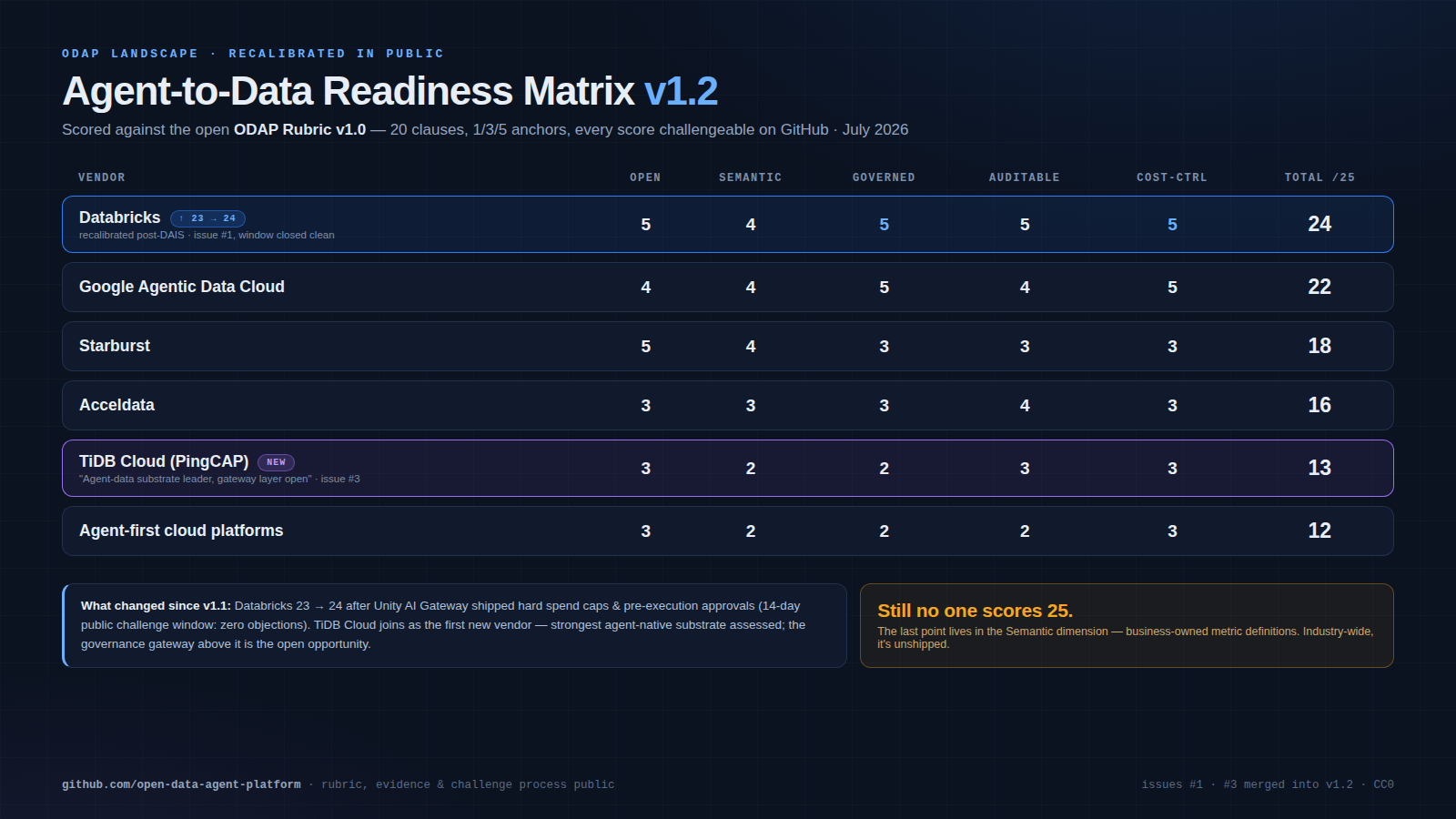
- ODAP Technical Reference v0.1
- ODAP Whitepaper v1.0 English PDF
- ODAP Whitepaper v1.0 Chinese PDF
- ODAP Landscape 2026 English Report
- ODAP Landscape 2026 Chinese Report
- ODAP data-room cover documents
- ODAP professional report page on GoogleSQL.com
Draft Design Proposals
Optional, non-normative design proposals cover human-reviewed semantic candidates, agent identity and session policy, and cost controls with audit evidence. They do not amend the Five Musts or Rubric. Parts of these directions are implemented in ODAP Gateway v0.2.0-preview.1. Its versioned release notes distinguish implemented scope from open deployment and acceptance requirements; the preview is not a production-readiness claim. The Gateway's July 2026 v0.1.0 clause mapping remains a historical assessment, not an updated evaluation of this preview.
See the November 2026 ecosystem review for official sources and historical claims requiring reassessment. Existing Landscape scores remain dated assessments pending individual review, tracked in reassessment issue #10. See this documentation update's sources and boundaries.
Adoption
- CloudSystem Association — adopted the Five Musts & Scoring Rubric v1.0 as the evaluation framework for its "Intelligent SQL Workflows Reference Architecture" program (Resolution CloudSystem-TC-2026-001; conflict-of-interest disclosure published with the resolution). Governance archive
Why This List Exists
There is no widely maintained encyclopedia entry for "Open Data Agent Platform" yet. This repository collects the ecosystem around the term in a neutral, vendor-aware way. Including adjacent and competing tools is intentional: a category becomes more useful when the landscape is mapped, not when one vendor pretends to be the only participant.
Category Definition
The category rests on two complementary artifacts:
- The Five Musts (principles) — what any agent-to-data access must be: Open, Semantic, Governed, Auditable, Cost-controlled. Defined in The ODAP Manifesto.
- The Five Layers (reference architecture) — how a platform implements those principles in practice, described below.
An ODAP should usually include five layers:
- Universal Data Gateway - connects warehouses, databases, object storage, and open table formats.
- Smart Semantic Layer - maps business language to metrics, dimensions, entities, policies, and physical schemas.
- Multi-Agent SQL Engine - plans, generates, validates, repairs, and explains SQL or analytical workflows.
- Persistent Memory - learns from user corrections, query history, preferred definitions, and organizational context.
- Governance & Observability - provides audit logs, access controls, cost controls, quality scoring, sandboxing, and lineage.
How the Five Musts map to the Five Layers
| Principle (Must) | Implementing layer(s) |
|---|---|
| Open | Universal Data Gateway |
| Semantic | Smart Semantic Layer |
| Governed | Multi-Agent SQL Engine (validator) + Governance & Observability |
| Auditable | Governance & Observability (audit logs, lineage) |
| Cost-controlled | Multi-Agent SQL Engine (dry-run estimation) + Governance & Observability (budgets, circuit-breakers) |
| — | Persistent Memory (architecture enhancement: improves accuracy over time; not an entry criterion) |
A platform that satisfies all Five Musts qualifies as an ODAP. Persistent Memory strengthens an implementation but is not required for category membership.
Reference Architecture
User or Agent
    |
Natural-language request
    |
Semantic context + policy + memory
    |
Planner agent -> SQL generator -> validator -> executor -> reviewer
    |
Open data / warehouses / lakehouse tables / APIs
    |
Answer + table + chart + confidence + audit trail
Open Table Formats
- Apache Iceberg - Open table format for large analytic datasets, with schema evolution, partition evolution, time travel, and multi-engine support.
- Delta Lake - Open source storage layer for reliable data lakes, widely used in lakehouse architectures.
- Apache Hudi - Open source data lake platform for incremental processing, transactional data lakes, and streaming ingestion.
Query Engines and Lakehouse Execution
- Trino - Distributed SQL query engine for big data and federated analytics across heterogeneous sources.
- PrestoDB - Distributed SQL query engine originally developed at Facebook and now governed by the Presto Foundation.
- DuckDB - In-process analytical database often used for local analytics, data apps, and agent sandboxes.
- Apache Spark - Large-scale data processing engine used across lakehouse, ETL, and analytical workloads.
- ClickHouse - Fast columnar database for analytical workloads.
Metadata, Catalog, and Semantic Context
- Apache Ossie (incubating) - Formerly Open Semantic Interchange (OSI); an Apache-2.0 specification for exchanging semantic models across analytics, AI and BI tools using JSON and YAML.
- NVIDIA Auto Ontology - Open-source framework for semantic context and ontology generation; a potential source of candidates for the proposed approval workflow.
- Databricks metric views
- Declarative metric definitions with natural-language-assisted YAML authoring.
- Snowflake semantic views
- Semantic modeling for Cortex Agents, including assisted generation.
These entries describe capabilities, not ODAP conformance or certification.
- OpenMetadata - Open source context layer for metadata, business semantics, lineage, collaboration, and AI agent context.
- DataHub - Open source metadata platform for data discovery, observability, and governance.
- dbt Semantic Layer
- Semantic layer for defining and querying business metrics in dbt.
- Cube - Semantic layer and agentic analytics platform for governed metrics and embedded analytics.
- MetricFlow - Semantic layer query engine used by dbt Labs.
Agent Protocols and Governed Runtimes
Adjacent layers, listed for context rather than ODAP conformance or certification. Protocol support or runtime isolation alone does not establish semantic binding, effective tenant authorization, audit completeness or budget enforcement.
- A2A Protocol - An open protocol for communication and collaboration between agents built on different frameworks.
- Model Context Protocol (MCP) - An open protocol connecting AI applications to external tools and data sources.
- NVIDIA AI Factory Operations Agent - Experimental Apache-2.0 blueprint for cluster operations, including read-only inspection and sandboxed command execution; not a semantic interchange format.
Agent Orchestration and AI Frameworks
- LangGraph - Agent orchestration framework for reliable, controllable, stateful agents.
- CrewAI - Platform and framework for building, deploying, governing, and optimizing multi-agent workflows.
- LlamaIndex - Framework for connecting LLM applications and agents to enterprise data.
- DSPy - Framework for programming and optimizing language model pipelines.
- AutoGen - Framework for multi-agent AI applications.
Vector Memory and Retrieval
- Qdrant - Vector database and similarity search engine.
- Weaviate - AI-native vector database for semantic search, RAG, and agent memory.
- Milvus - Open source vector database for scalable similarity search.
- pgvector - PostgreSQL extension for vector search.
Natural-Language Analytics and GenBI
- Wren AI - Open-source agentic GenBI platform with text-to-SQL, governed execution, semantic modeling, connectors, and memory.
- Databricks Genie Agents - Conversational analytics agents for business users on the Databricks platform.
- Looker Conversational Analytics
- Natural-language analytics experience in Looker.
- Tableau Next - Agentic analytics and AI-powered data experience from Tableau.
- Snowflake Cortex AI
- AI features inside Snowflake for natural language, analytical, and enterprise AI workflows.
- MindsHub / MindsDB - Open-source AI agents and workspace patterns for working across connected apps and data.
Governance, Observability, and Quality
- OpenTelemetry - Open observability framework for traces, metrics, and logs.
- Prometheus - Monitoring and alerting toolkit.
- Grafana - Observability dashboards and visualization.
- Great Expectations - Data quality validation and documentation.
- Soda - Data quality monitoring and testing.
- OpenLineage - Open standard for data lineage.
Reference Products and Implementations
(maintainer-affiliated) GoogleSQL.com - Project site for ODAP materials and the hosted Gateway preview.
(maintainer-affiliated) ODAP Gateway - Apache-2.0 reference implementation; the v0.2.0-preview.1 release describes semantic review, scoped approval contracts and receipt workflows, with independent integration and pilot acceptance still open.
Wren AI - A strong adjacent open-source GenBI implementation with context, semantic modeling, policies, memory, and governed text-to-SQL.
Databricks Genie Agents - A major commercial implementation of conversational analytics in a lakehouse environment.
The July 2026 v0.1.0 clause mapping is historical, not a certification or a reassessment of the preview. The hosted preview does not by itself configure OAuth, enroll administrators or authorize warehouse queries. See the release's explicit limitations.
Affiliation Disclosure
The maintainers are affiliated with ODAP Gateway and GoogleSQL.com; their entries are labeled above. The CloudSystem Association adoption statement has its own conflict-of-interest disclosure linked under Adoption. Inclusion, affiliation disclosure and reference-implementation status are not independent conformance assessments or endorsements of the other listed projects.
Evaluation Checklist
Full scoring standard with 1/3/5 anchors: ODAP Scoring Rubric v1.0
Use this checklist to evaluate whether a product belongs in the ODAP category. Questions are grouped by the Five Musts:
Open
- Does it connect to open data sources, warehouses, lakehouse tables, or object storage?
Semantic
- Does it preserve business semantics rather than only generating SQL from raw schema?
Governed
- Does it enforce permissions and policies in the path of the query?
- Does it separate planning, generation, validation, execution, and review?
- Does it support human review or sandbox execution before production actions?
Auditable
- Does it keep audit logs of generated queries, approvals, and executions?
- Does it expose answer confidence, lineage, or validation evidence?
Cost-controlled
- Does it estimate or control query cost before execution?
Architecture enhancement (optional)
- Does it remember corrections and user feedback across sessions?
Related Terms
- Agentic analytics
- Conversational analytics
- GenBI
- Text-to-SQL
- Semantic layer
- Metrics layer
- Data catalog
- Lakehouse
- Open table format
- Data governance
- AI data agent
Contributing
Pull requests are welcome. Please keep descriptions neutral and factual.
To add a project, include:
- Name
- Link to official website or repository
- One-sentence neutral description
- Which ODAP layer it supports
- License or commercial status when known
License
This list is released under the Creative Commons Zero v1.0 Universal license.
Ähnliche Projekte entdecken
Asabeneh/30-Days-Of-Python
Die Programmier-Challenge 30 Days of Python ist eine Schritt-für-Schritt-Anleitung, um die Programmiersprache Python in 30 Tagen zu lernen. Diese Challenge kann mehr als 100 Tage dauern. Gehe in deinem eigenen Tempo vor. Diese Videos können ebenfalls helfen: https://www.youtube.com/channel/UC7PNRuno1rzYPb1xLa4yktw
78,560 Sternegrafana/grafana
Offene und kombinierbare Plattform für Observability und Datenvisualisierung. Visualisiert Metriken, Logs und Traces aus mehreren Quellen wie Prometheus, Loki, Elasticsearch, InfluxDB, Postgres und vielen weiteren.
77,830 Sterneredis/redis
Für Entwickler, die echtzeitfähige, datengesteuerte Anwendungen erstellen, ist Redis der bevorzugte, schnellste und funktionsreichste Cache, Datenstrukturserver und die entsprechende Abfrageengine für Dokumente und Vektoren.
77,395 Sterneapache/superset
Apache Superset ist eine Plattform für Datenvisualisierung und Datenexploration.
75,473 Sterne