
m-schuetz/compute_rasterizer
Über uns
Rendering von Punktwolken mit Compute-Shadern
Kreativität und MedienWhat you can do
- Renders up to one billion points in about 8 milliseconds (hence 2 billion points in real-time, 60fps) on an RTX 3090.
- You need to make sure not to load more than your GPU memory can handle. You'll need about 1.6GB for every 100 million points, plus 1GB or 2GB overhead.
- Drag & Drop a LAS or LAZ files into the window to load it. Only RGB attributes are displayed.
- Requires Windows and NVIDIA GPUs. Pull requests for AMD support are welcome.
Gemessener Sternzuwachs
- in 24h
- 0
- in 7 days
- +1
- in 15 days
- Verlauf wird gesammelt
- in 1 month
- Verlauf wird gesammelt
Nettoänderungen in überlappenden Zeiträumen, keine Tagessummen. Fehlende Messwerte bleiben leer. Sterne zeigen Interesse, nicht Qualität.
README.md
Original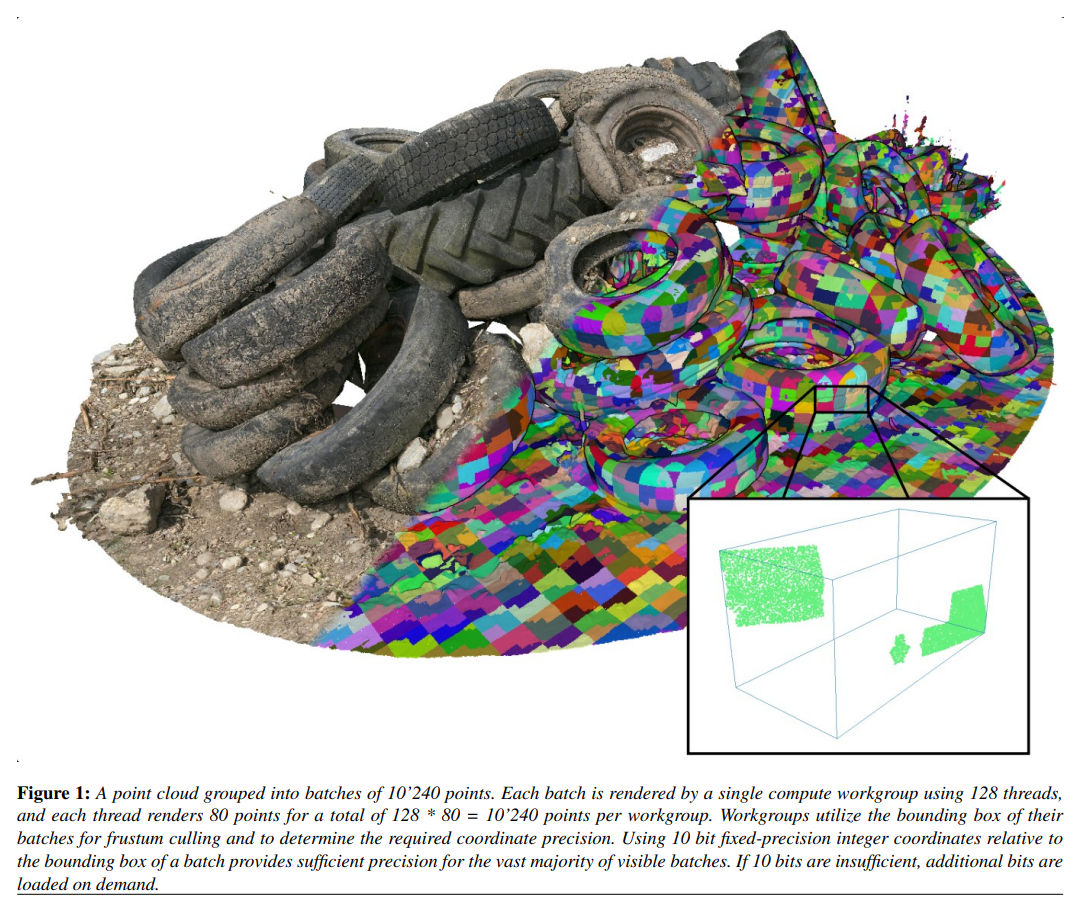
About
This repository contains the source code for our papers about real-time software rasterization of point clouds, which can be 10 to 100 times faster than GL_POINTS. This is possible because GL_POINTS is built upon the triangle-oriented rendering pipeline that is not optimal for pixel-sized points.
The basic idea is to spawn a compute shader that transforms points to screen space, encodes depth and color into a single 64 bit integer, and uses atomicMin to compute the closest point for each pixel. The color value is then extracted from the interleaved depth+color buffer and converted into a regular OpenGL texture for display.
The latest improvement also groups about 10k points into batches, and each compute workgroup(128 threads) renders a batch(10k points), i.e., each thread renders about 80 points. This allows several batch-level optimizations such as frustum culling, LOD rendering, and adaptive precision. Adaptive precision picks a sufficient coordinate precision (typically just 10 bit per axis) depending on the projected batch size, which boosts brute-force performance due to lower memory bandwidth requirements.
The main branch is a slightly more user friendly version that allows loading LAS files via drag&drop. Other branches contain snapshots of the code made after evaluations for specific paper submissions:
"Software Rasterization of 2 Billion Points in Real-Time"
In branch compute_rasterizer_2022
paper - video"Rendering Point Clouds with Compute Shaders and Vertex Order Optimization"
In branch compute_rasterizer_2021
Features and Limitations
- Renders up to one billion points in about 8 milliseconds (hence 2 billion points in real-time, 60fps) on an RTX 3090.
- You need to make sure not to load more than your GPU memory can handle. You'll need about 1.6GB for every 100 million points, plus 1GB or 2GB overhead.
- Drag & Drop a LAS or LAZ files into the window to load it. Only RGB attributes are displayed.
- Requires Windows and NVIDIA GPUs. Pull requests for AMD support are welcome.
Building
- Clone the repository
- Compile build/ComputeRasterizer.sln with Visual Studio 2022.
- Run (ctrl + f5)
| Method | Location | |
|---|---|---|
| basic | ./modules/compute_loop_las | |
| prefetch | ./modules/compute_loop_las2 | fastest, each thread fetches 4 points at a time |
| hqs | ./modules/compute_loop_las_hqs | High-Quality Shading |
| LOD | ./modules/compute_loop_nodes | Support for the Potree LOD format |
| LOD hqs | ./modules/compute_loop_nodes_hqs |
Citing
@article{SCHUETZ-2022-PCC,
  title =      "Software Rasterization of 2 Billion Points in Real Time",
  author =     "Markus Sch\"{u}tz and Bernhard Kerbl and Michael Wimmer",
  year =       "2022",
  month =      jul,
  journal =    "Proc. ACM Comput. Graph. Interact. Tech.",
  volume =     "5",
  pages =      "1--16",
  URL =        "https://www.cg.tuwien.ac.at/research/publications/2022/SCHUETZ-2022-PCC/",
}

@article{SCHUETZ-2021-PCC,
  title =      "Rendering Point Clouds with Compute Shaders and Vertex Order Optimization",
  author =     "Markus Sch\"{u}tz and Bernhard Kerbl and Michael Wimmer",
  year =       "2021",
  month =      jul,
  doi =        "10.1111/cgf.14345",
  journal =    "Computer Graphics Forum",
  number =     "4",
  volume =     "40",
  pages =      "115--126",
  keywords =   "point-based rendering, compute shader, real-time rendering",
  URL =        "https://www.cg.tuwien.ac.at/research/publications/2021/SCHUETZ-2021-PCC/",
}
Ähnliche Projekte entdecken
Wird geladen…