
lroy-stack/admin-os
lroy-stack/admin-os has 35 GitHub stars and 2 forks. GitHot measured -1 stars in 24 hours and +1 in 7 days. Last checked 2026-11-24 01:30 UTC. Last push 2026-11-06.
What you can do
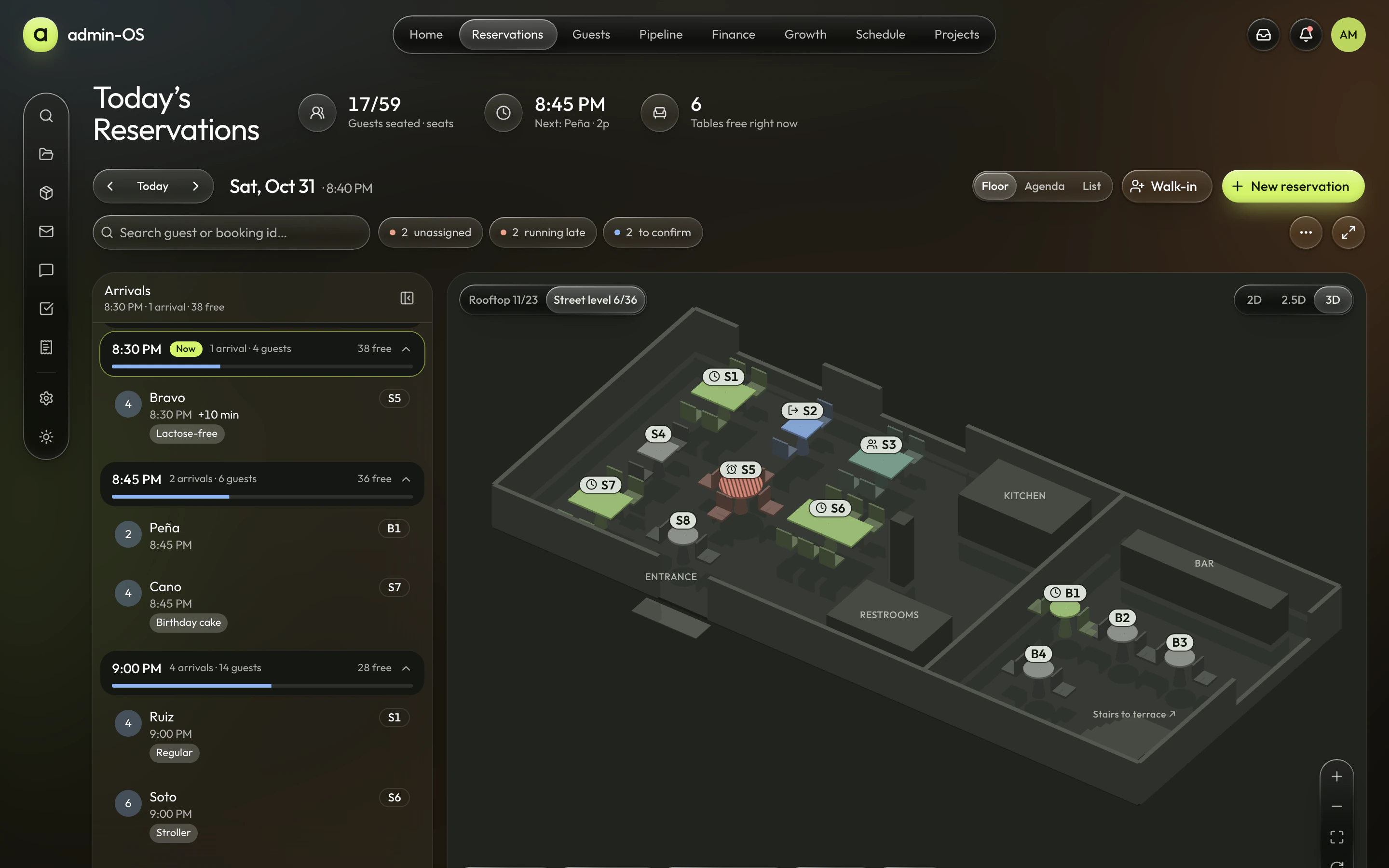
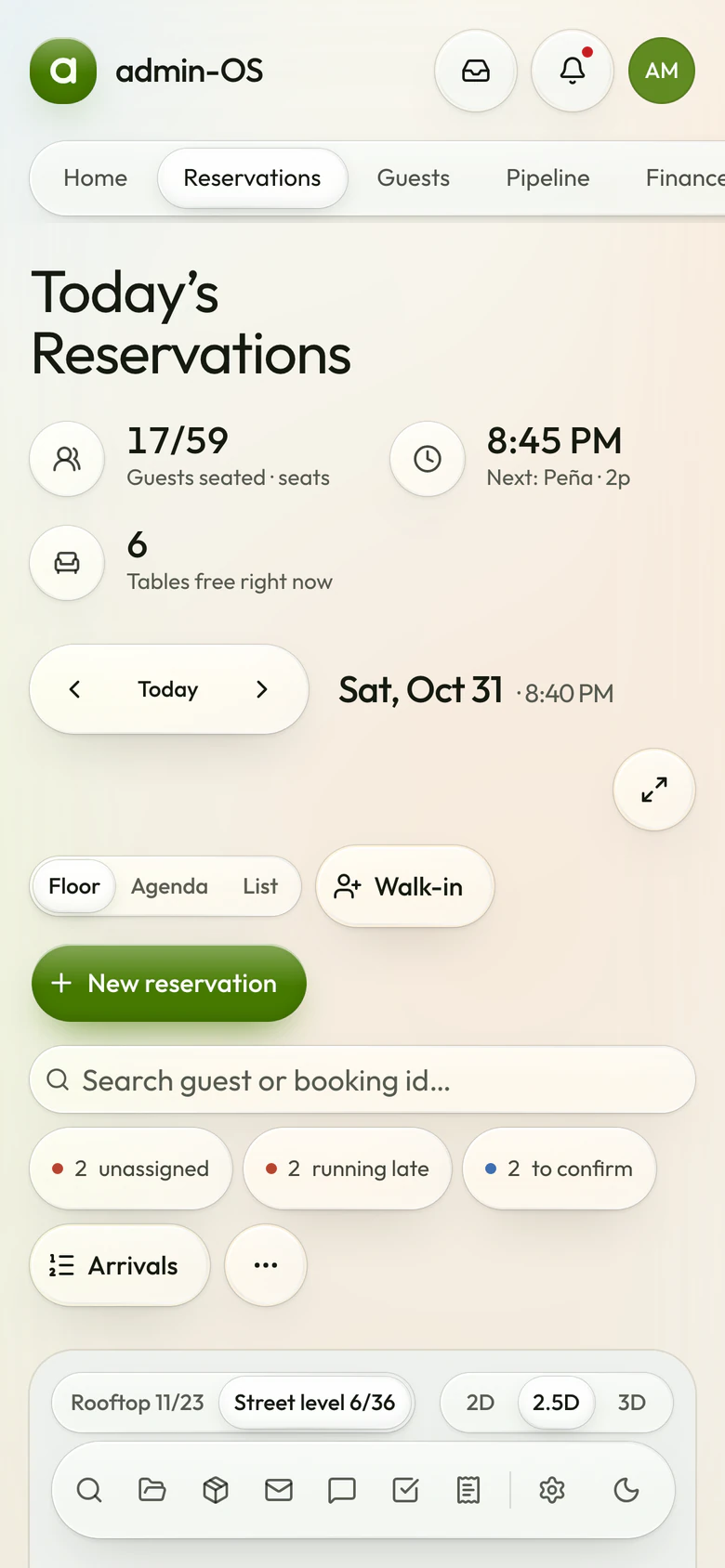
- Bookings with a live floor plan. The room in 2D, 2.5D or 3D, an arrivals rail by time slot, a room editor and a full-screen service view; status changes, walk-ins and new reservations with undo where an action can be reversed.
- Customers. A directory with search, a VIP filter, CSV export and a new-contact window that warns about a duplicate phone.
- Business settings and invoices. The owner sets the business details once in Settings; the invoice prints them, bills a client from the business's fiscal directory and starts from the catalog.
- Products by business type. The Products page, in the tools rail, shows each preset its own views: the menu and the shop for hospitality, the shop and the stock for the salon, the parts and the supplier orders for the workshop.
Gemessener Sternzuwachs
- in 24h
- -1
- in 7 days
- +1
- in 15 days
- Verlauf wird gesammelt
- in 1 month
- Verlauf wird gesammelt
Nettoänderungen in überlappenden Zeiträumen, keine Tagessummen. Fehlende Messwerte bleiben leer. Sterne zeigen Interesse, nicht Qualität.
Über uns
Open-source management dashboard template for small businesses: four languages, liquid-glass themes, a typed data seam and a native MCP server.
Web und AppsREADME.md
Originaladmin-OS
An open-source management dashboard for small businesses, built to be operated by people and by AI assistants alike.






Live demo · Documentation · MCP · Changelog
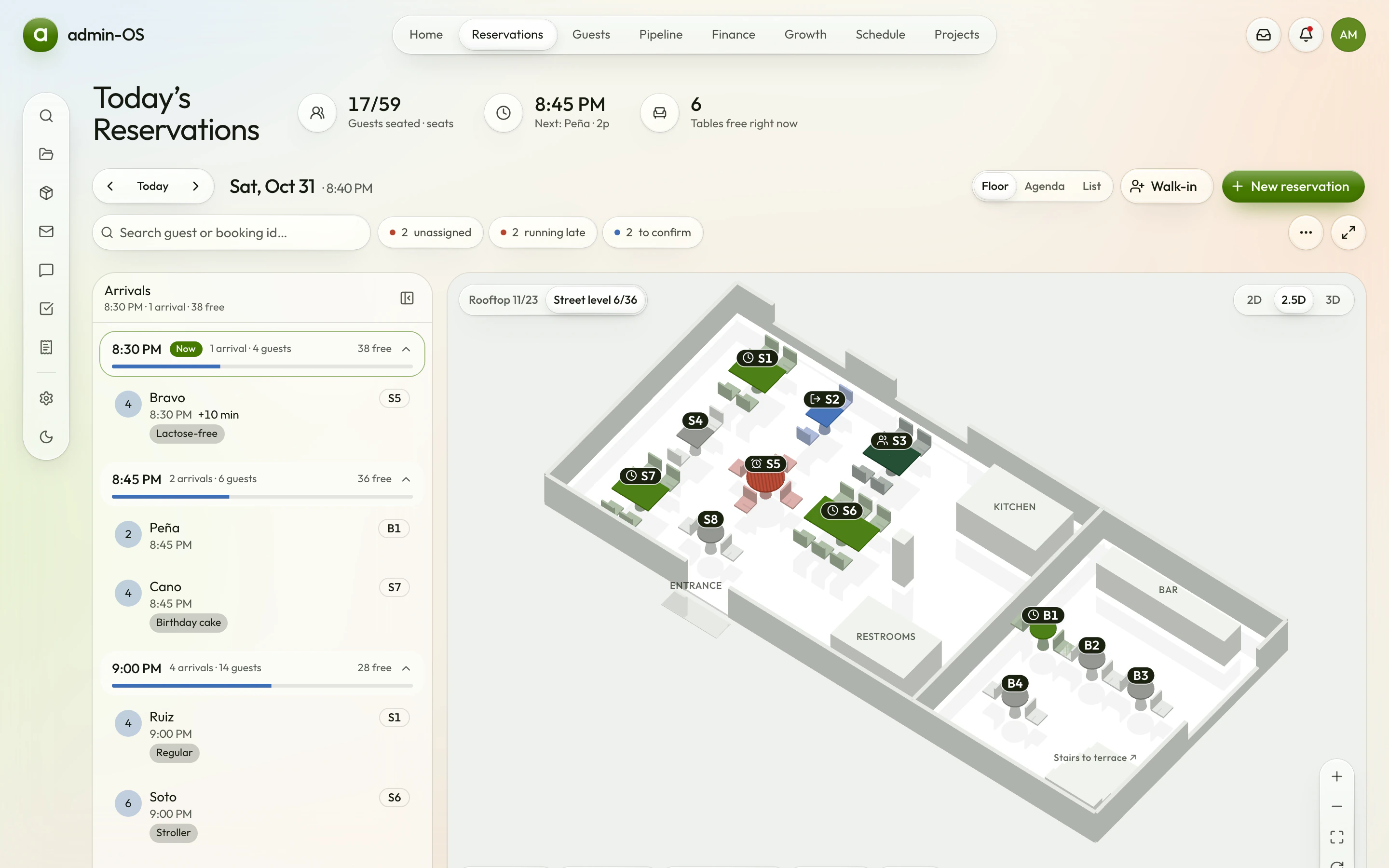
admin-OS is built for restaurants first, and a hair salon or a car repair workshop runs on the same modules through a preset. Every screen and every MCP tool reads and writes through the same typed capabilities, so an assistant works with exactly the data, permissions and approvals a person does. The live demo runs on Cloudflare Workers with seeded data of its own for each visitor.
Features
- Bookings with a live floor plan. The room in 2D, 2.5D or 3D, an arrivals rail by time slot, a room editor and a full-screen service view; status changes, walk-ins and new reservations with undo where an action can be reversed.
- Customers. A directory with search, a VIP filter, CSV export and a new-contact window that warns about a duplicate phone.
- Business settings and invoices. The owner sets the business details once in Settings; the invoice prints them, bills a client from the business's fiscal directory and starts from the catalog.
- Products by business type. The Products page, in the tools rail, shows each preset its own views: the menu and the shop for hospitality, the shop and the stock for the salon, the parts and the supplier orders for the workshop.
- Clients and suppliers. A
partiesmodule keeps who a business invoices and buys from, with a tax ID and a fiscal address, apart from the customers who book. It has no screen of its own: the invoice reads it and the MCP tools list, read, create and update it. - A module is a folder. Each module declares a manifest (capabilities, settings, seeds, references, views, bell
feeds, route slots) and
npm run generate:modulescomposes the app, the MCP server and the bell from the folders that are present, so a module can be taken out and put back. - Presets. Hospitality, salon and workshop run the same generic modules with their own vocabulary, navigation and seed data.
- Liquid-glass interface. Five themes in light and dark, checked against WCAG contrast, on desktop, tablet and phone.
- Four languages, three currencies. English, Spanish, German and French from typed dictionaries; USD, EUR or GBP.
- Roles, permissions and approvals. Owner, manager and staff; a policy holds an assistant's writes for a person to approve from the bell, which also shows the notifications each installed module feeds it.
- MCP server. Its own Worker over Streamable HTTP with OAuth and separate read and write grants, plus stdio for local clients.
- Swappable data layer. A mock adapter ships for the demo; a real backend implements one interface.
Quick start
Requires Node.js 24 and npm.
git clone https://github.com/lroy-stack/admin-os.git
cd admin-os
npm install
npm run dev
Open http://localhost:3000. The development guide covers the environment, every command, the quality gates and the Cloudflare topology.
To connect Claude Code to the live demo:
claude mcp add --transport http admin-os https://mcp.admin-os.lr0y.dev/mcp
Screenshots
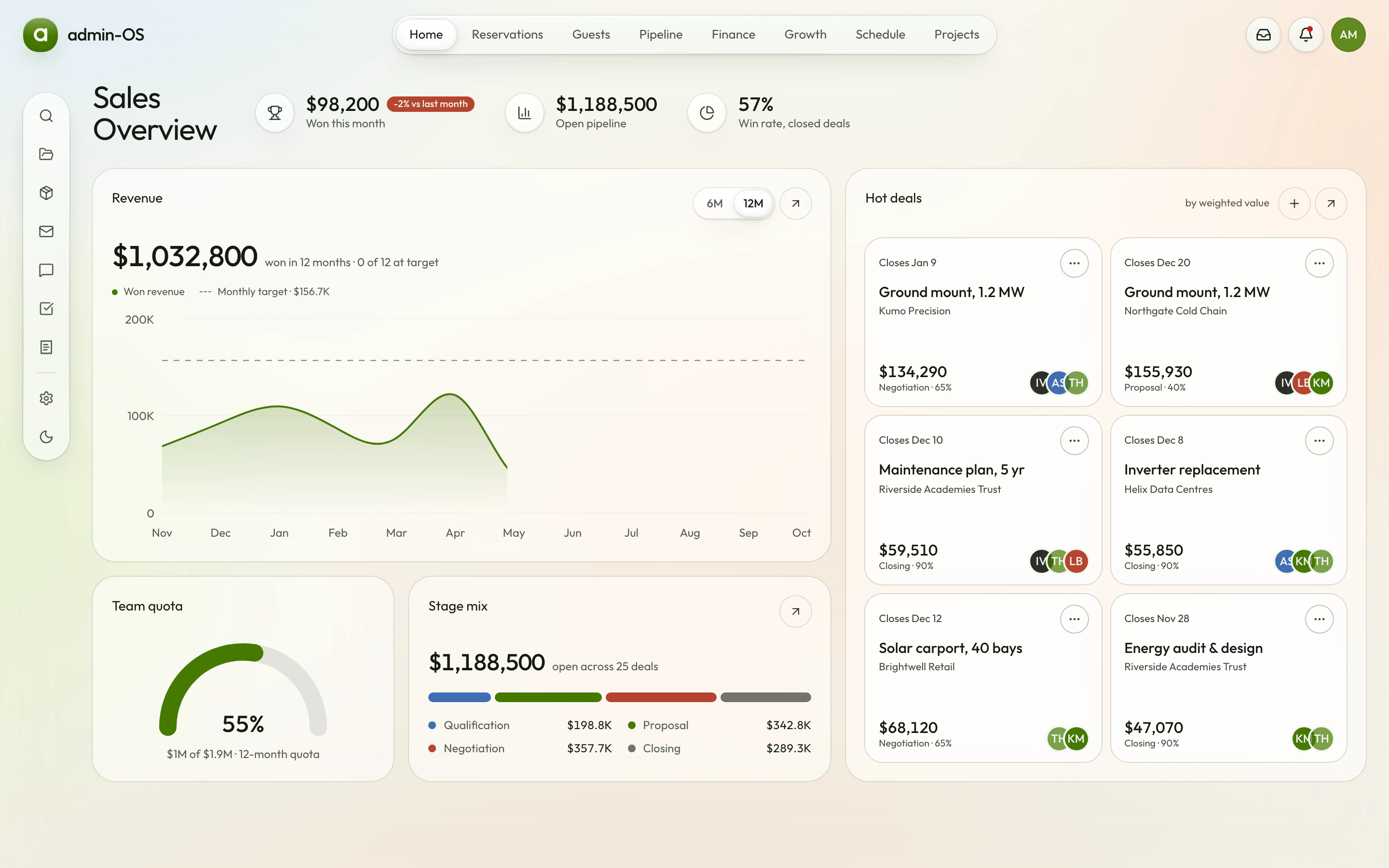
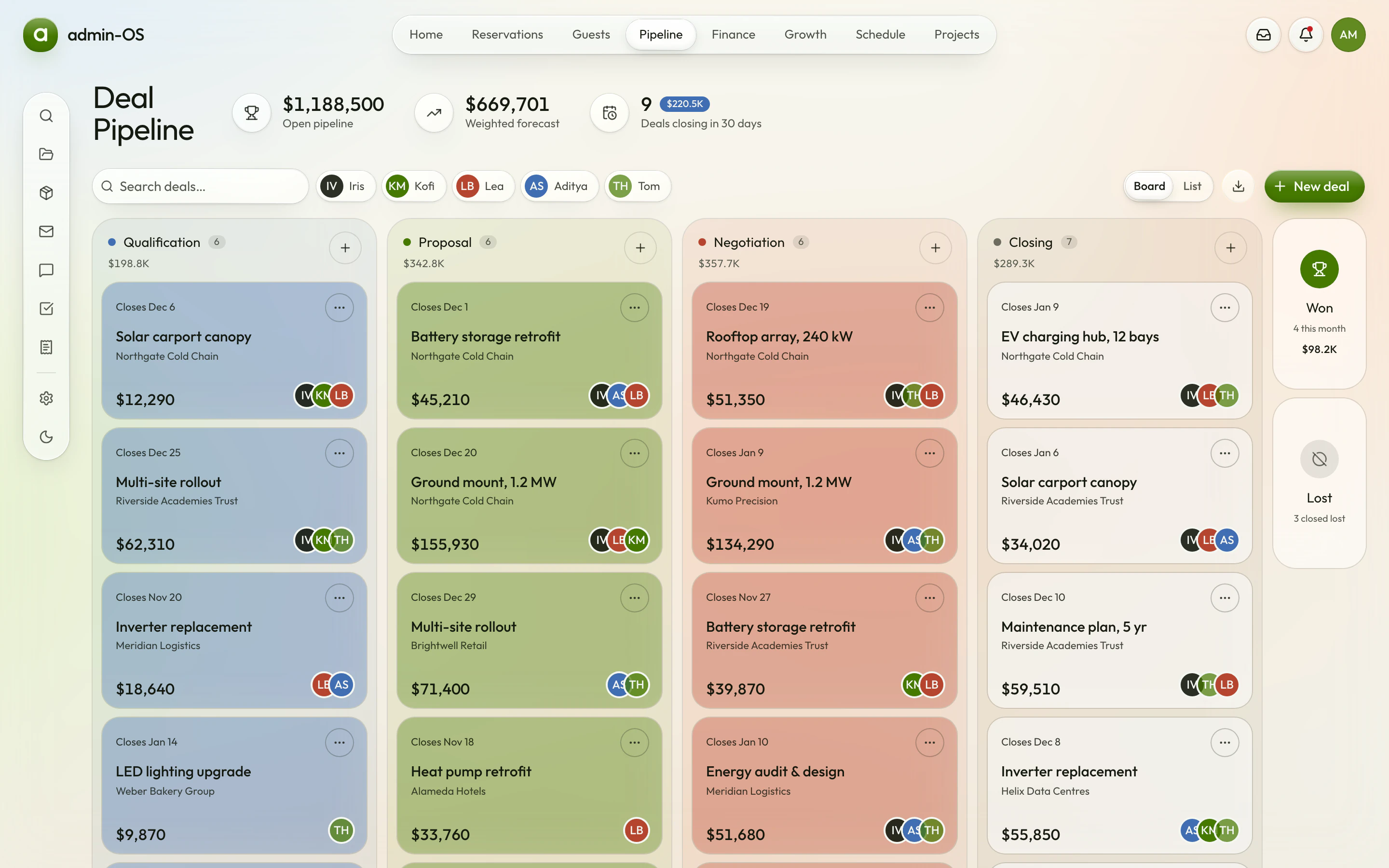
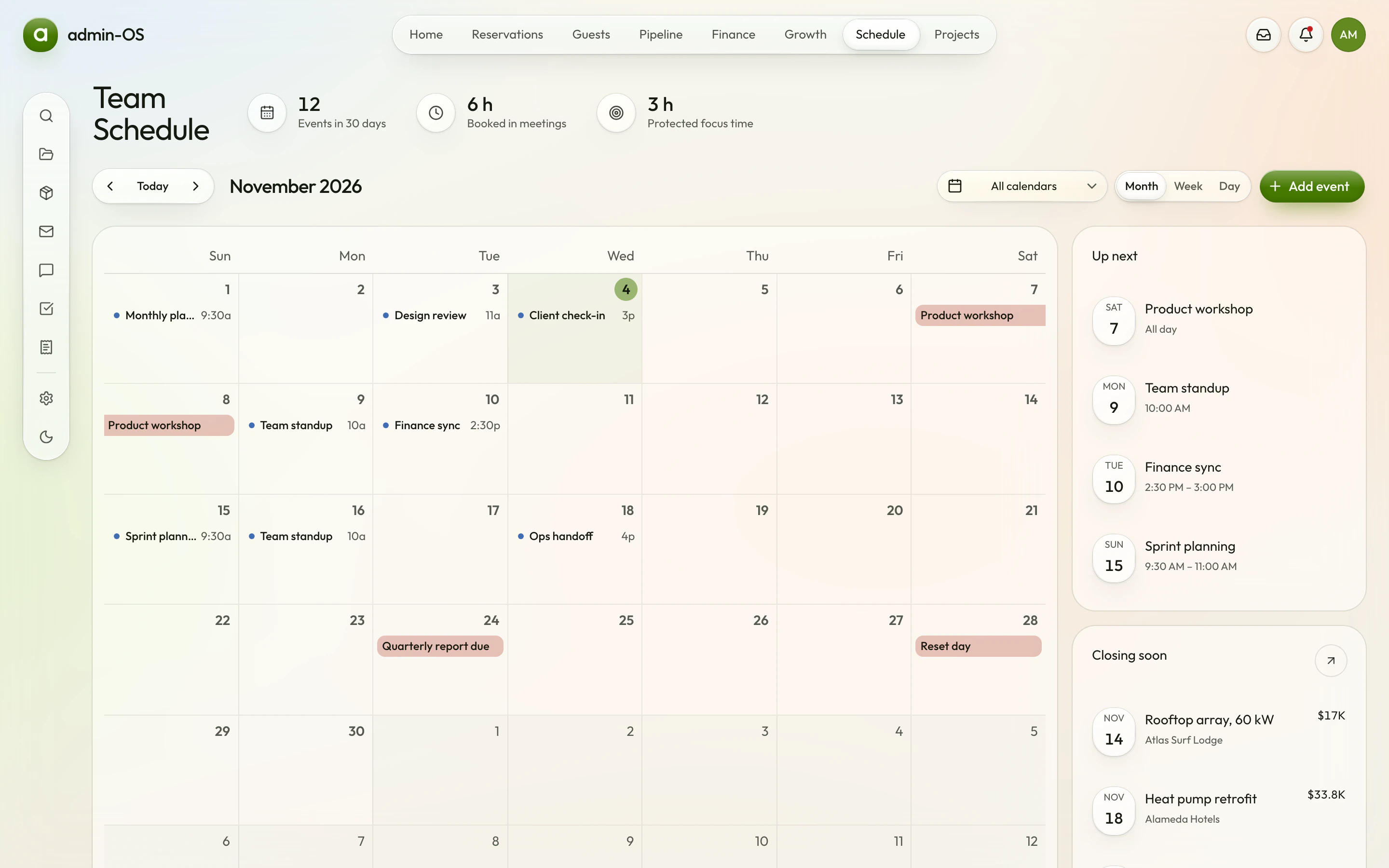
Moving around. The top bar holds the business areas, the rail the tools.
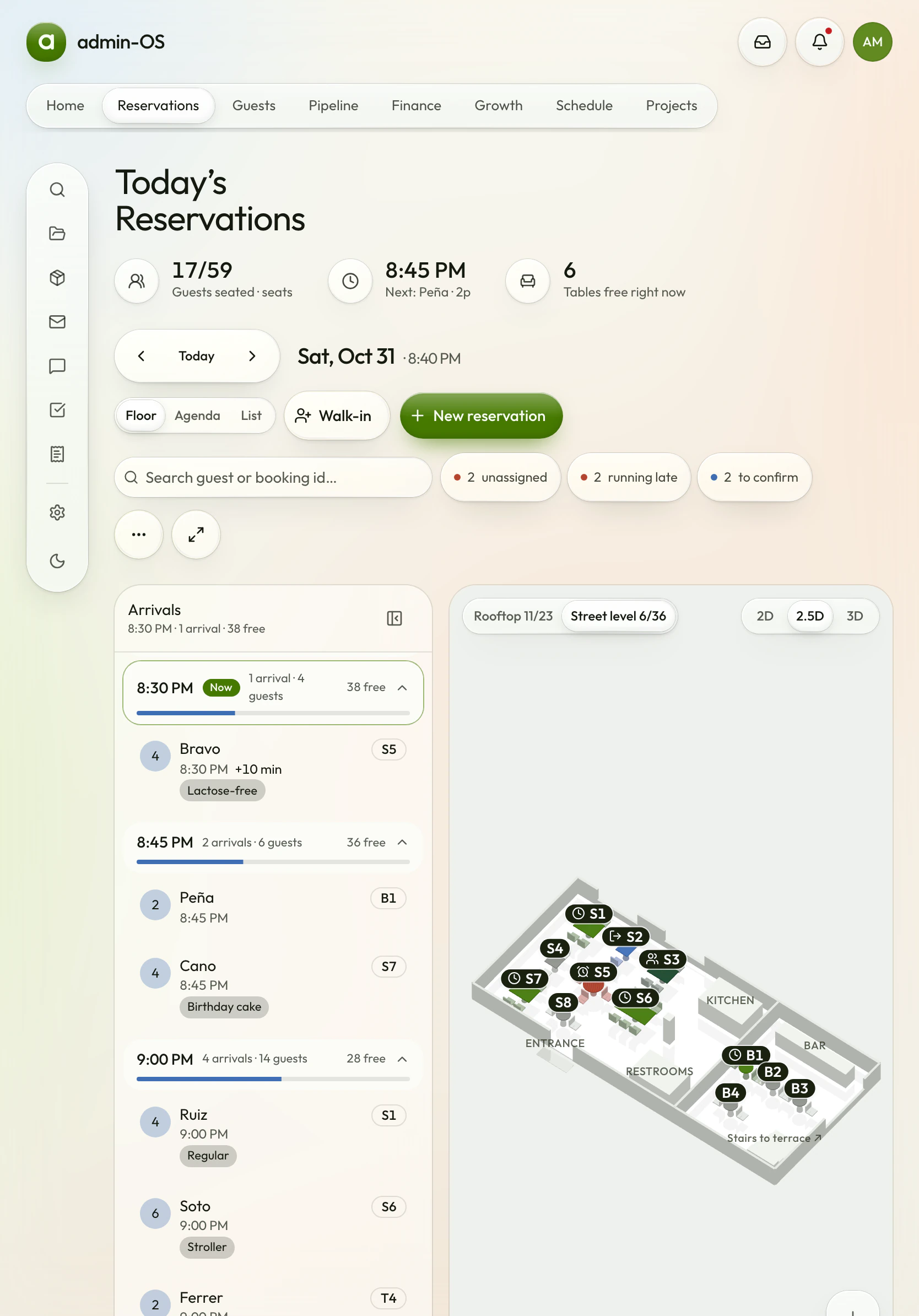
The bookings room. The floor plan switches between 2D, 2.5D and 3D; a table opens its booking, and the same service reads as an agenda or a list.
Themes, modes and languages.
More screens: desktop, tablet and phone
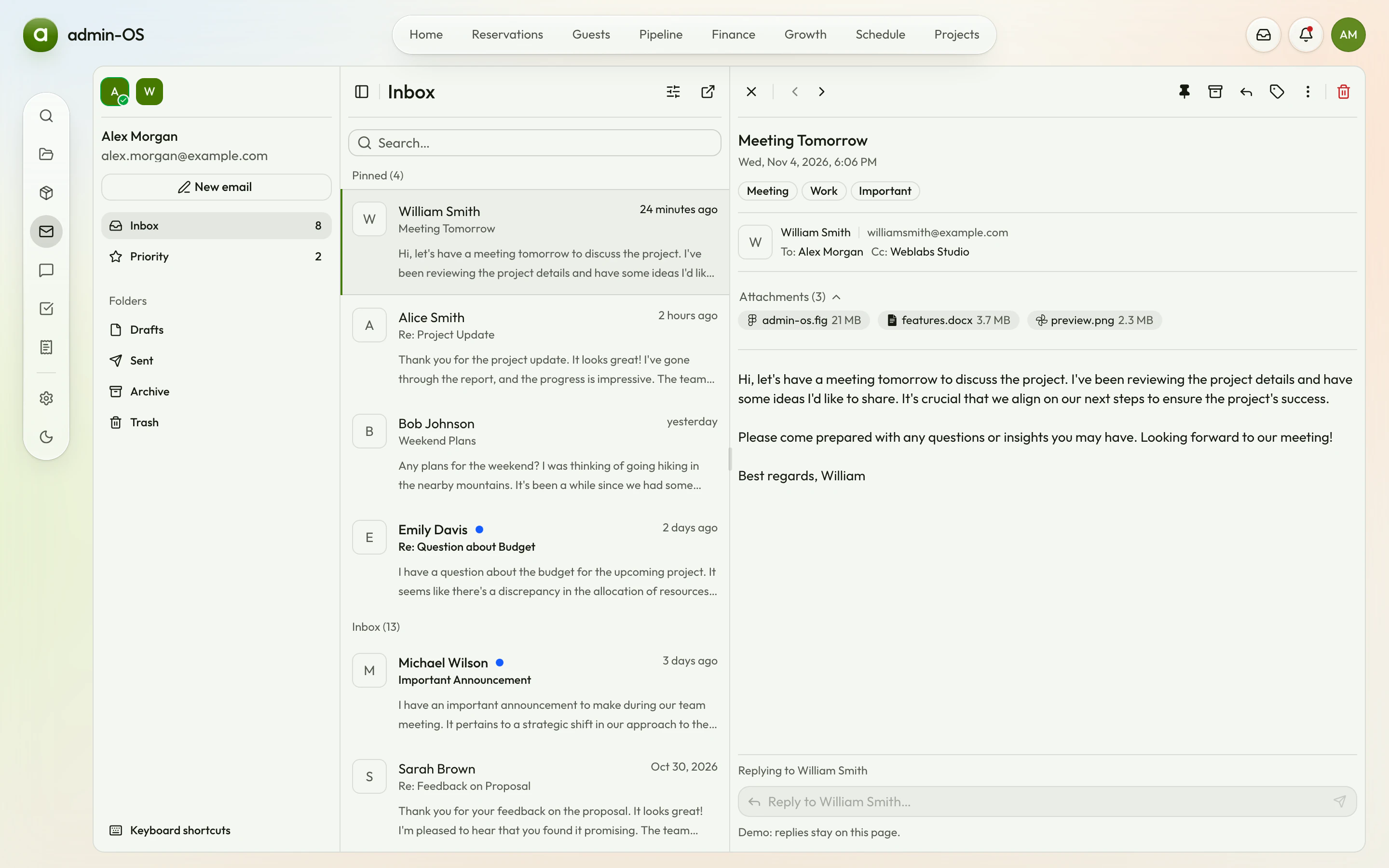
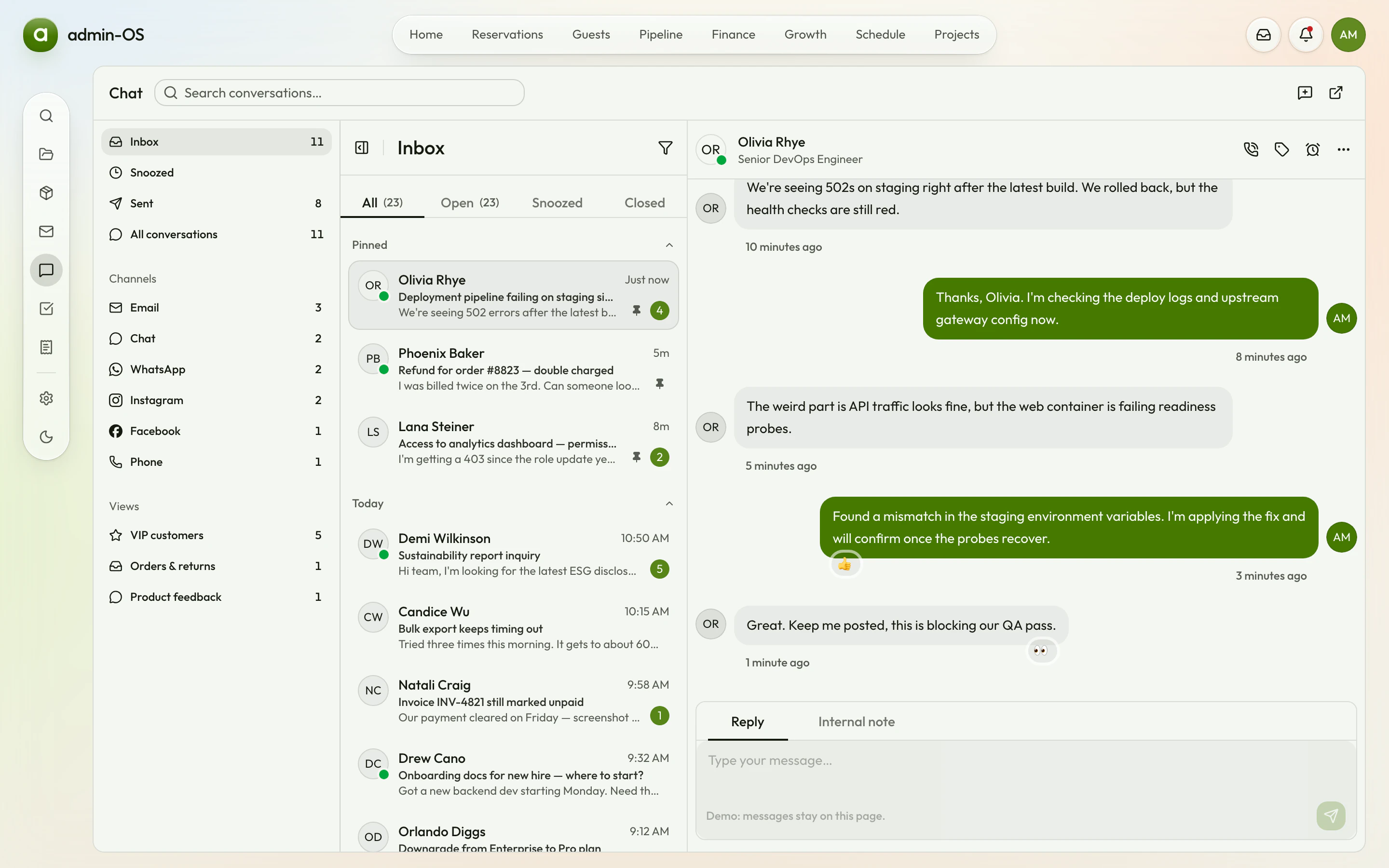
Desktop, 1440 × 900. The images follow your GitHub theme.
 |
 |
 |
 |
 |
 |
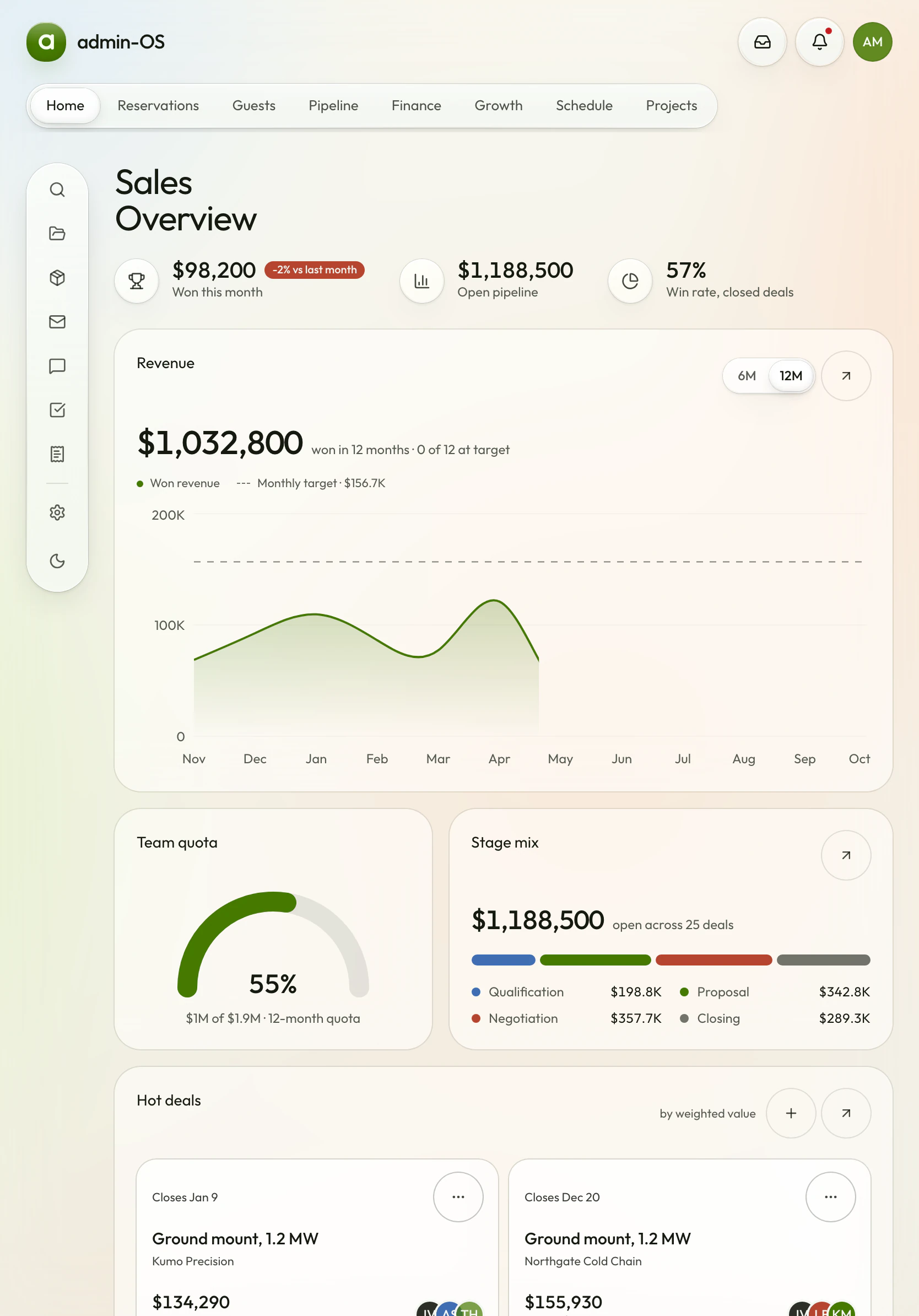
Tablet, 834 × 1194.
 |
 |
Phone, with a bottom dock and bottom sheets.
 |
 |
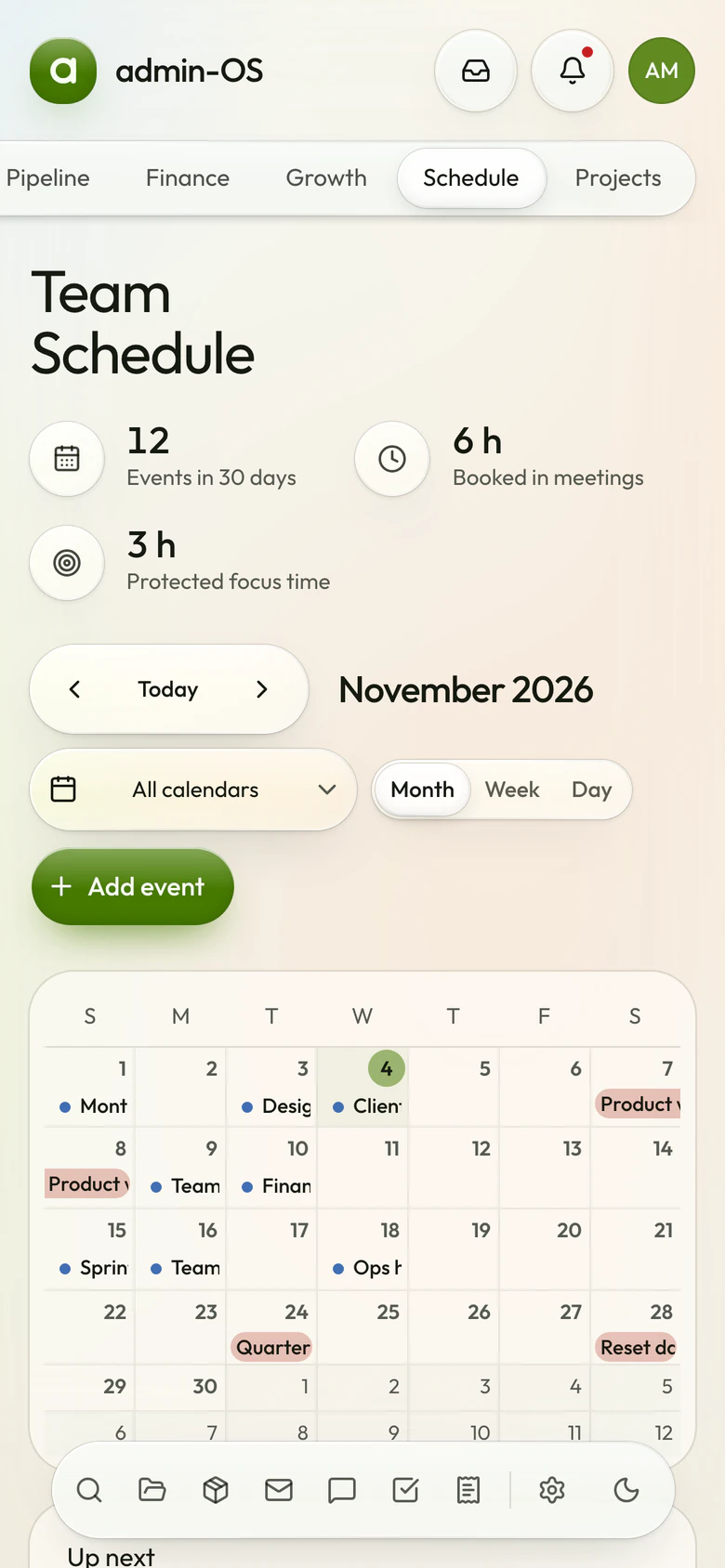 |
Every image is captured from the running app by npm run media, so it stays in step with the code.
Documentation
| Guide | Covers |
|---|---|
| Development | Setup, environment, commands, quality gates, the three Workers locally |
| Architecture | Layers, the module seam, the data seam, presets, who owns a control |
| Building on the template | Modules, presets, controls, adapters, MCP tools |
| Deployment | Deploying to Cloudflare and checking a deployment |
| MCP | Connecting assistants, access, limits, agent evals |
| MCP reference | Every tool per preset and role (generated) |
| Decision records | Why the code is the way it is |
Tech stack
Next.js 16 (App Router, React Compiler), React 19, TypeScript, Tailwind CSS v4, shadcn/ui on Radix UI and Base UI, TanStack Table, Zod, React Hook Form, Zustand, FullCalendar, dnd-kit, three.js and the official MCP TypeScript SDK. Biome, dependency-cruiser, Vitest and Playwright keep it in shape; it deploys to Cloudflare Workers through OpenNext.
Project status
The current release is v0.3.0: business settings, products by business type, the clients and suppliers directory behind the invoice, and the module seam. The changelog lists what each release brings.
Contributing
Issues and pull requests are welcome. CONTRIBUTING.md describes the workflow and the checks a
change has to pass. To report a vulnerability, follow SECURITY.md instead of opening an issue.
Credits
admin-OS started from next-shadcn-admin-dashboard by Mohammed Arham Khan (MIT), whose shell, screens and theme system it builds on.
License
Ähnliche Projekte entdecken
Wird geladen…