Projekte Auf GitHub ansehen
ksanjeevan/crnn-audio-classification
ksanjeevan/crnn-audio-classification has 392 GitHub stars and 81 forks. GitHot measured 0 stars in 24 hours, 0 in 7 days, and 0 in 15 days. Last checked 2026-11-18 19:43 UTC. Last push 2021-06-16.
What you can do
- Easily define CRNN in .cfg format
- Spectrogram computation on GPU
- Audio data augmentation: Cropping, White Noise, Time Stretching (using phase vocoder on GPU!)
Gemessener Sternzuwachs
- in 24h
- 0
- in 7 days
- 0
- in 15 days
- 0
- in 1 month
- Verlauf wird gesammelt
Nettoänderungen in überlappenden Zeiträumen, keine Tagessummen. Fehlende Messwerte bleiben leer. Sterne zeigen Interesse, nicht Qualität.
Über uns
UrbanSound classification using Convolutional Recurrent Networks in PyTorch
Maschinelles LernenREADME.md
OriginalPyTorch Audio Classification: Urban Sounds
Classification of audio with variable length using a CNN + LSTM architecture on the UrbanSound8K dataset.
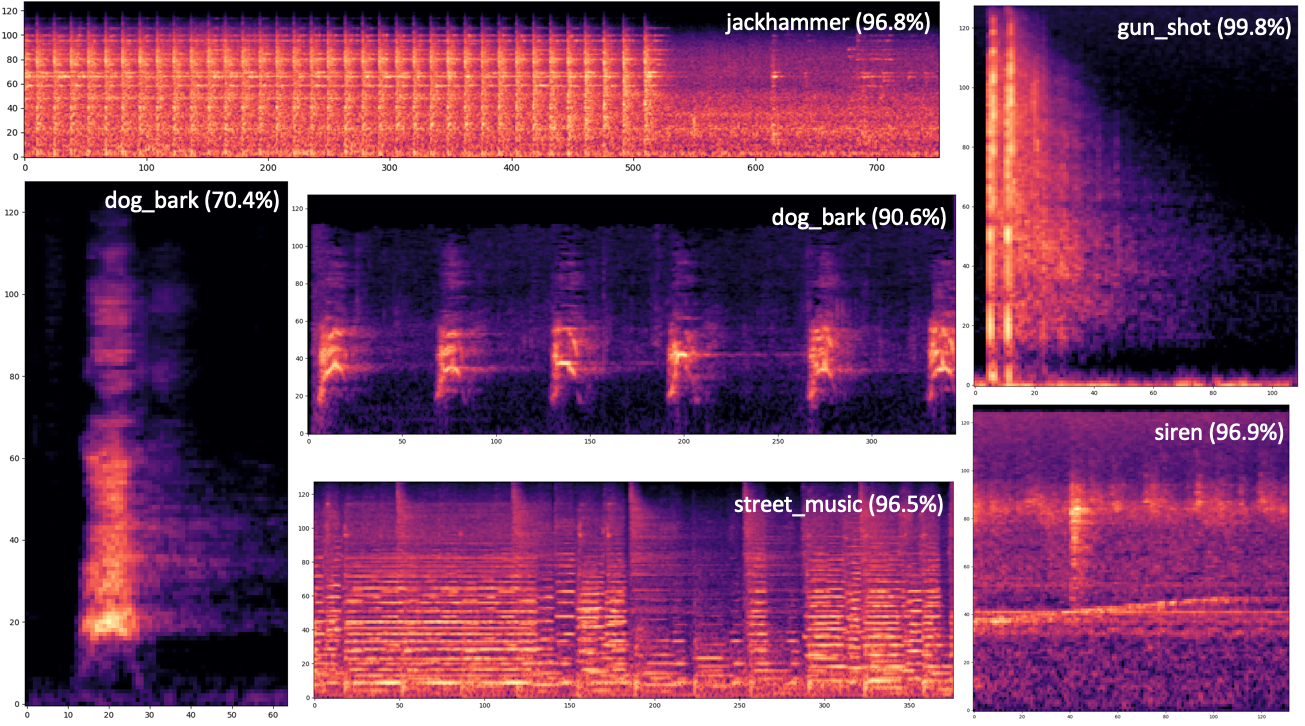
Example results:
Contents
Dependencies
- soundfile: audio loading
- torchparse: .cfg easy model definition
- pytorch/audio: Audio transforms
Features
- Easily define CRNN in .cfg format
- Spectrogram computation on GPU
- Audio data augmentation: Cropping, White Noise, Time Stretching (using phase vocoder on GPU!)
Models
CRNN architecture:
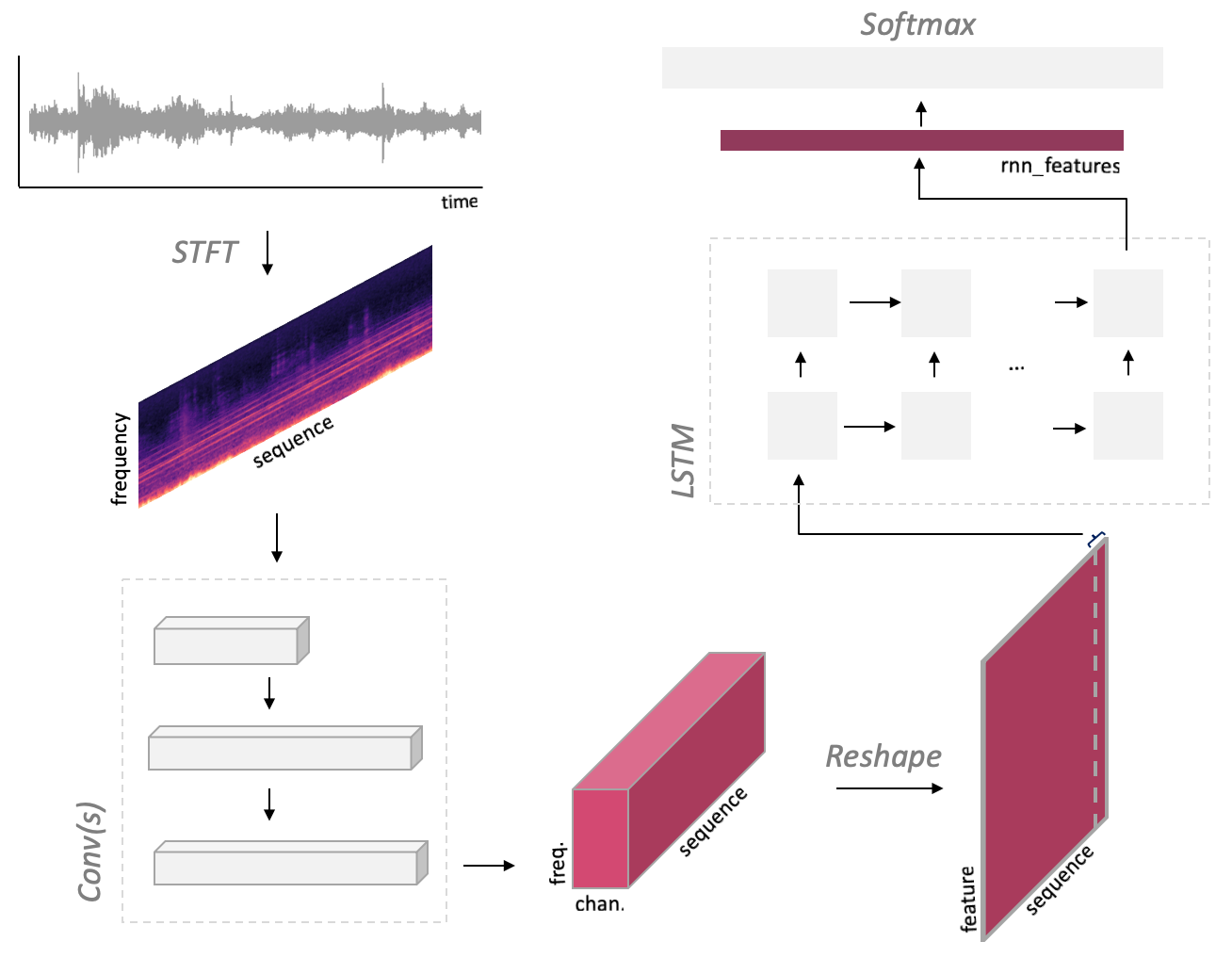
Printing model defined with torchparse:
AudioCRNN(
  (spec): MelspectrogramStretch(num_bands=128, fft_len=2048, norm=spec_whiten, stretch_param=[0.4, 0.4])
  (net): ModuleDict(
    (convs): Sequential(
      (conv2d_0): Conv2d(1, 32, kernel_size=(3, 3), stride=(1, 1), padding=[0, 0])
      (batchnorm2d_0): BatchNorm2d(32, eps=1e-05, momentum=0.1, affine=True, track_running_stats=True)
      (elu_0): ELU(alpha=1.0)
      (maxpool2d_0): MaxPool2d(kernel_size=3, stride=3, padding=0, dilation=1, ceil_mode=False)
      (dropout_0): Dropout(p=0.1)
      (conv2d_1): Conv2d(32, 64, kernel_size=(3, 3), stride=(1, 1), padding=[0, 0])
      (batchnorm2d_1): BatchNorm2d(64, eps=1e-05, momentum=0.1, affine=True, track_running_stats=True)
      (elu_1): ELU(alpha=1.0)
      (maxpool2d_1): MaxPool2d(kernel_size=4, stride=4, padding=0, dilation=1, ceil_mode=False)
      (dropout_1): Dropout(p=0.1)
      (conv2d_2): Conv2d(64, 64, kernel_size=(3, 3), stride=(1, 1), padding=[0, 0])
      (batchnorm2d_2): BatchNorm2d(64, eps=1e-05, momentum=0.1, affine=True, track_running_stats=True)
      (elu_2): ELU(alpha=1.0)
      (maxpool2d_2): MaxPool2d(kernel_size=4, stride=4, padding=0, dilation=1, ceil_mode=False)
      (dropout_2): Dropout(p=0.1)
    )
    (recur): LSTM(128, 64, num_layers=2)
    (dense): Sequential(
      (dropout_3): Dropout(p=0.3)
      (batchnorm1d_0): BatchNorm1d(64, eps=1e-05, momentum=0.1, affine=True, track_running_stats=True)
      (linear_0): Linear(in_features=64, out_features=10, bias=True)
    )
  )
)
Trainable parameters: 139786
Usage
Inference
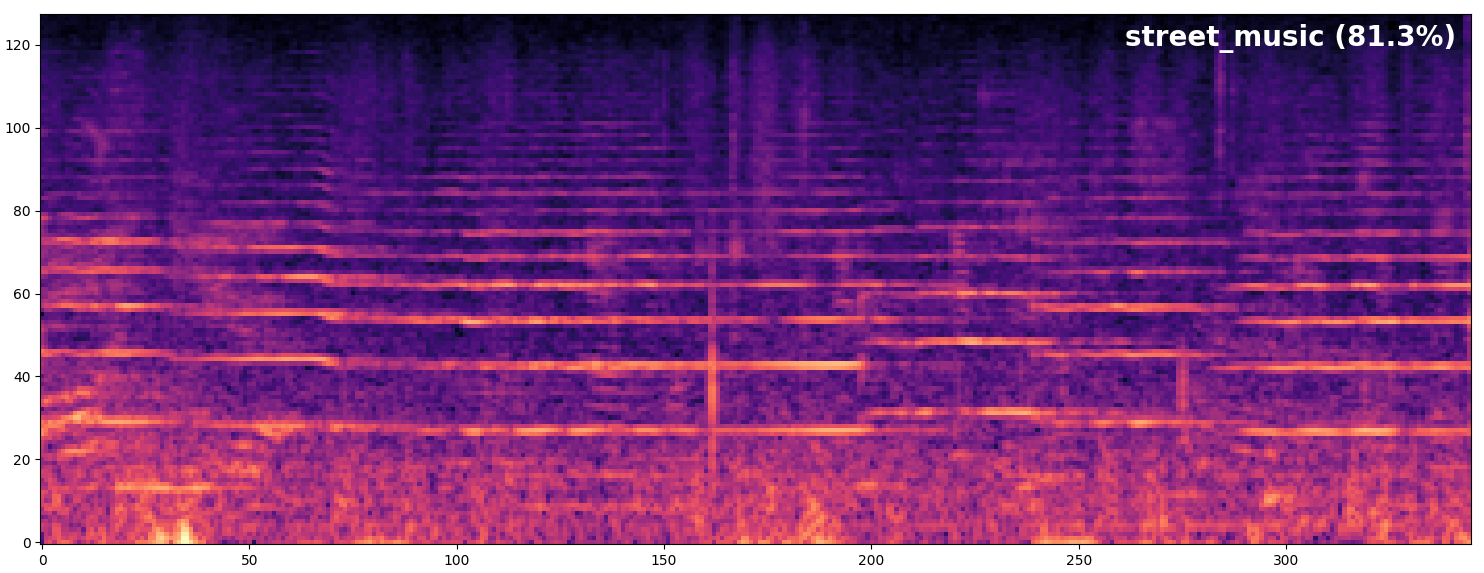
Run inference on an audio file:
./run.py /path/to/audio/file.wav -r path/to/saved/model.pth
Training
./run.py train -c config.json --cfg arch.cfg
Augmentation
Dataset transforms:
Compose(
    ProcessChannels(mode=avg)
    AdditiveNoise(prob=0.3, sig=0.001, dist_type=normal)
    RandomCropLength(prob=0.4, sig=0.25, dist_type=half)
    ToTensorAudio()
)
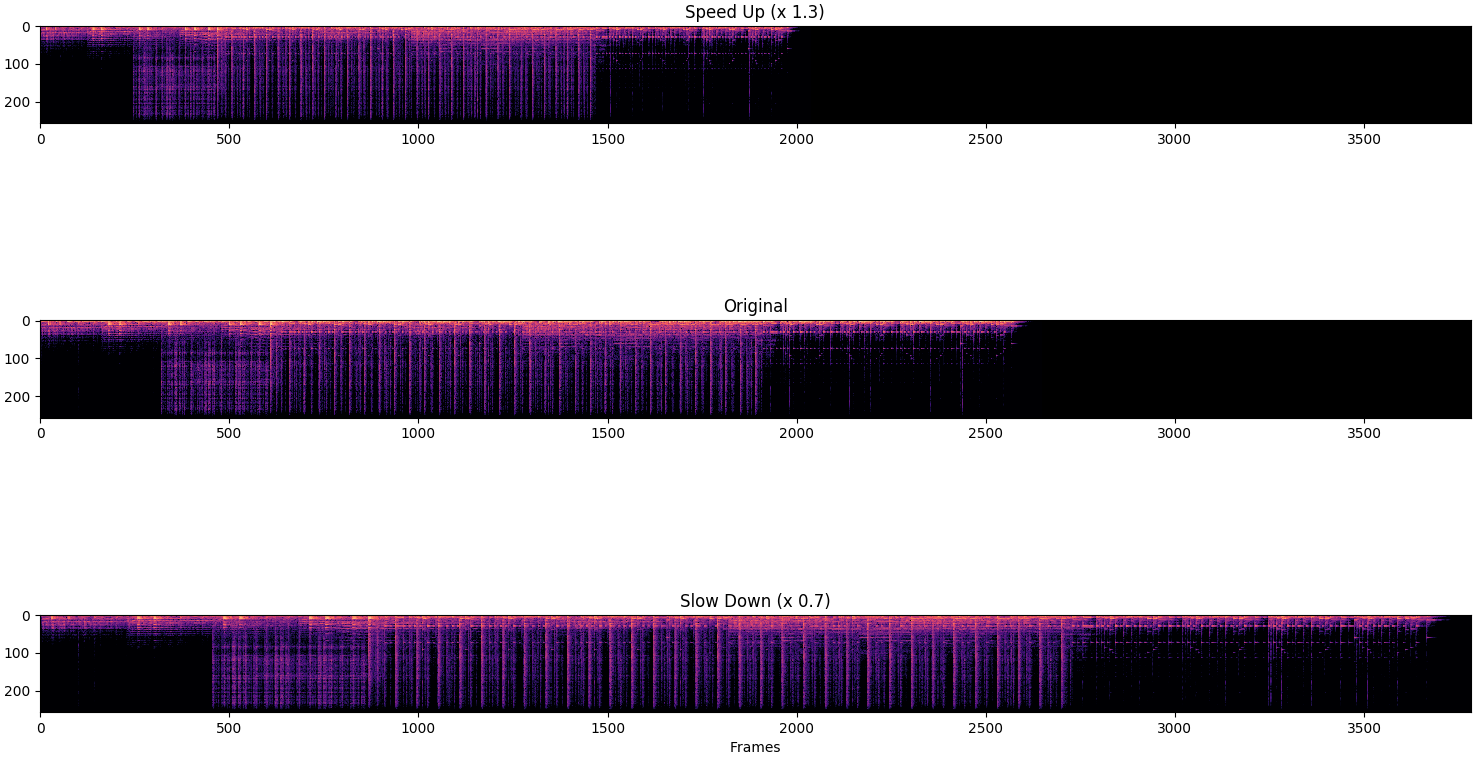
As well as time stretching:
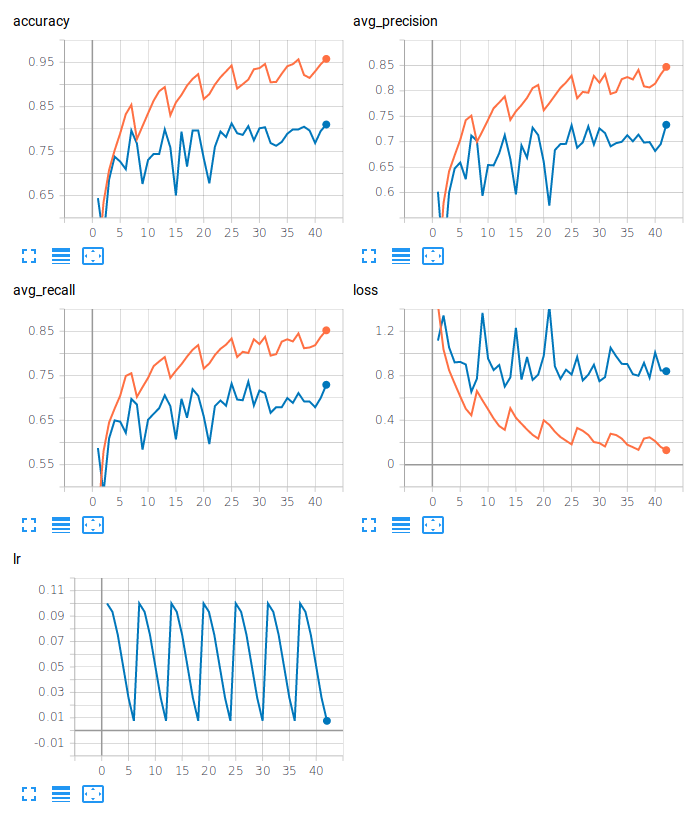
TensorboardX
Evaluation
./run.py eval -r /path/to/saved/model.pth
Then obtain defined metrics:
100%|█████████████████████████████████████████████████████████████████████████████████████████████████| 34/34 [00:03<00:00, 12.68it/s]
{'avg_precision': '0.725', 'avg_recall': '0.719', 'accuracy': '0.804'}
10-Fold Cross Validation
| Arch | Accuracy | AvgPrecision(macro) | AvgRecall(macro) |
|---|---|---|---|
| CNN | 71.0% | 63.4% | 63.5% |
| CRNN | 72.3% | 64.3% | 65.0% |
| CRNN(Bidirectional, Dropout) | 73.5% | 65.5% | 65.8% |
| CRNN(Dropout) | 73.0% | 65.5% | 65.7% |
| CRNN(Bidirectional) | 72.8% | 64.3% | 65.2% |
Per fold metrics CRNN(Bidirectional, Dropout):
| Fold | Accuracy | AvgPrecision(macro) | AvgRecall(macro) |
|---|---|---|---|
| 1 | 73.1% | 65.1% | 66.1% |
| 2 | 80.7% | 69.2% | 68.9% |
| 3 | 62.8% | 57.3% | 57.5% |
| 4 | 73.6% | 65.2% | 64.9% |
| 5 | 78.4% | 70.3% | 71.5% |
| 6 | 73.5% | 65.5% | 65.9% |
| 7 | 74.6% | 67.0% | 66.6% |
| 8 | 66.7% | 62.3% | 61.7% |
| 9 | 71.7% | 60.7% | 62.7% |
| 10 | 79.9% | 72.2% | 71.8% |
To Do
- commit jupyter notebook dataset exploration
- Switch overt to using pytorch/audio
- use torchaudio-contrib for STFT transforms
- CRNN entirely defined in .cfg
- Some bug in 'infer'
- Run 10-fold Cross Validation
- Switch over to pytorch/audio since the merge
- Comment things