
gaitco/quran-database
gaitco/quran-database has 1,946 GitHub stars and 335 forks. GitHot measured -1 stars in 24 hours. Last checked 2026-11-08 00:13 UTC. Last push 2026-08-22.
So werden diese Zahlen gemessen
A complete, structured Quran database — verses, translations and metadata, free for any project.
Gemessener Sternzuwachs
- in 24h
- -1
- in 7 days
- Verlauf wird gesammelt
- in 15 days
- Verlauf wird gesammelt
- in 1 month
- Verlauf wird gesammelt
Nettoänderungen in überlappenden Zeiträumen, keine Tagessummen. Fehlende Messwerte bleiben leer. Sterne zeigen Interesse, nicht Qualität.
README.md
Original
Quran Database
A comprehensive Quran database for MySQL, PostgreSQL, and SQLite containing the complete text with multiple translations and editions.
Contents
| File | Format | Size | Description |
|---|---|---|---|
data/quran.sql.zip |
MySQL dump | ~187 MB uncompressed | Full database dump for MySQL |
data/rukus.json |
JSON | ~92 KB | 558 sourced Ruku boundaries (Quran Foundation convention) |
quran.db.gz |
SQLite database | ~208 MB uncompressed | Full database for SQLite |
convert_to_sqlite.py |
Python script | — | Converts quran.sql to quran.db |
convert_to_postgres.py |
Python script | — | Imports quran.sql into PostgreSQL |
manifest/quran-arabic.manifest.json |
SHA-256 manifest | ~490 KB | Verse-level checksums for the Arabic text |
schema/<database>/schema.sql |
SQL | — | Generated, readable schema reference per database |
scripts/ |
Python | — | Text verification, schema export, and Ruku data export tools |
tests/ |
Python | — | Unit tests for the converters and tooling |
docs/ |
Markdown | — | architecture, provenance |
Breaking change — August 2026. In the SQLite and PostgreSQL databases,
ayahs.hizb_idis nowayahs.rub_id. It always held rubʿ al-hizb quarters (1–240), never hizbs (1–60), so the old name invited a join that silently returned wrong rows. Queries usinghizb_idnow fail loudly instead. Rename the column in your queries, or derive the real hizb withFLOOR((rub_id - 1) / 4) + 1. The MySQL dump is unchanged and still sayshizb_id. See #18.
Provenance
The Arabic text is the Tanzil Project's Uthmani transcription, manually verified
verse-by-verse against the KFGQPC Madinah Mushaf, distributed via alquran.cloud
(edition quran-uthmani) and dumped here on 2018-06-07:
KFGQPC Madinah Mushaf → Tanzil → alquran.cloud → this repository
Re-checked against a fresh Tanzil download in August 2026: 5,927 of 6,236 verses
(95.0%) are byte-identical, and the remaining 309 differ only in character
carriers (ء vs ـٔ) and word spacing — no letter and no diacritic differs.
Verify your own copy at any time:
just verify
Full details, the exact Tanzil export options, and the limits of this claim are in
docs/provenance.md.
Database Schema
Below is the enriched model the converters produce for SQLite and PostgreSQL.
The MySQL dump is the source as supplied and differs in two column names, noted
inline. Machine-readable references for all three live in
schema/ and are regenerated by just schema.
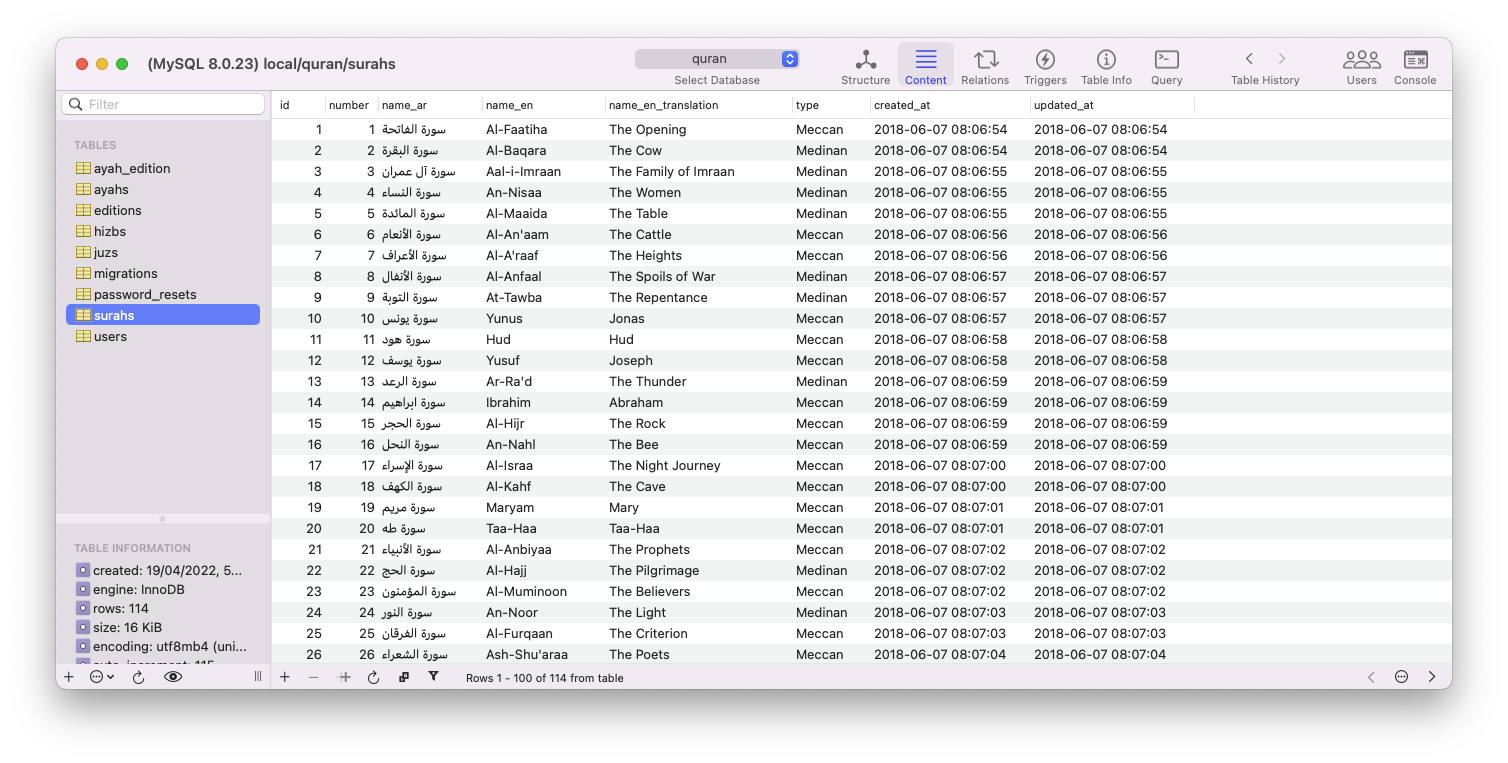
surahs
Stores metadata for all 114 surahs.
| Column | Description |
|---|---|
id |
Surah number |
number |
Surah number |
name_ar |
Surah name in Arabic (e.g. الفاتحة) |
name_en |
Surah name transliterated (e.g. Al-Fatiha) |
name_en_translation |
English meaning (e.g. The Opening) |
type |
Revelation type (Meccan / Medinan) |
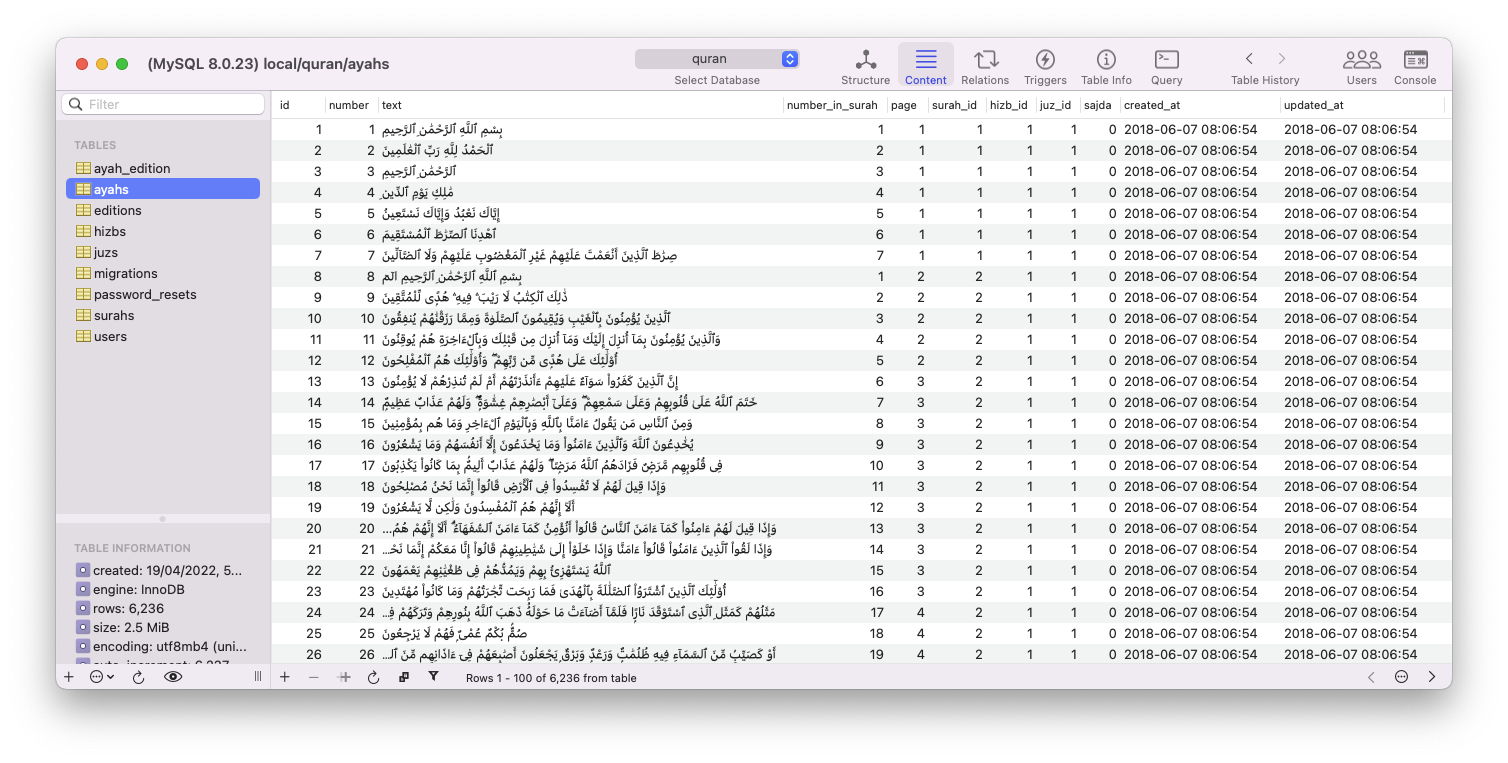
ayahs
Contains the original Arabic text of every ayah (6,236 verses).
| Column | Description |
|---|---|
id |
Unique ayah ID (1–6236) |
number |
Global ayah number |
text |
Ayah text in Arabic |
number_in_surah |
Ayah number within its surah |
page |
Mushaf page number |
surah_id |
Reference to surah |
rub_id |
Rubʿ al-hizb — quarter-hizb segment (1–240); hizb_id in the MySQL dump |
juz_id |
Reference to juz (1–30) |
sajda |
Prostration marker (0/1) — 15 ayahs |
Note on
rub_id(1–240). The Quran has 30 juz, each split into 2 hizb (60 total), and each hizb into 4 rubʿ al-hizb (quarters) — 60 × 4 = 240. The column therefore does not join to the 60-rowhizbslookup table. To derive the hizb (1–60), useFLOOR((rub_id - 1) / 4) + 1. The MySQL dump calls this columnhizb_id; the converters rename it, and enforceCHECK(rub_id BETWEEN 1 AND 240).
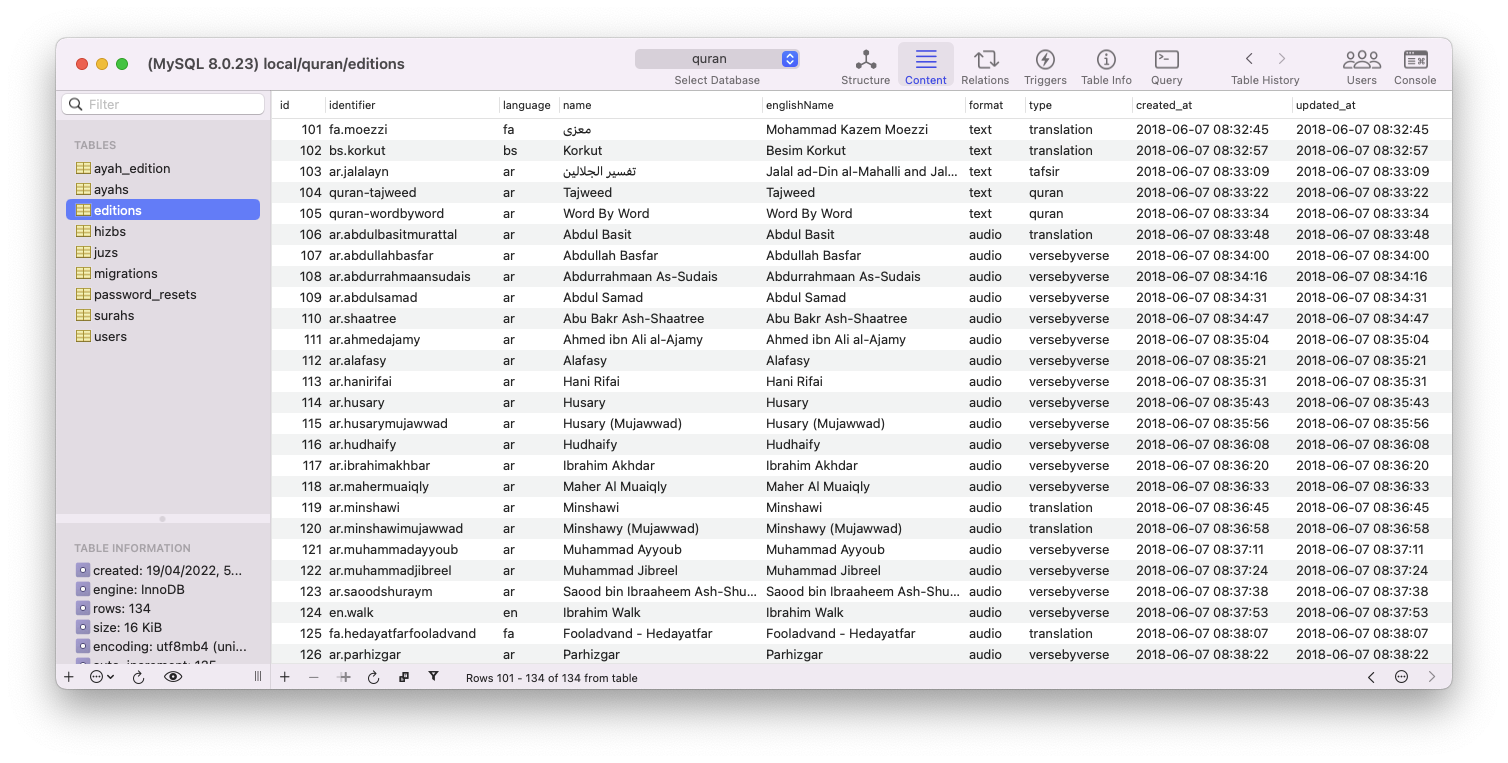
editions
Available translations and editions (134 entries).
| Column | Description |
|---|---|
id |
Unique ID |
identifier |
Unique identifier (e.g. en.sahih) |
language |
Language code |
name |
Edition name in native language |
english_name |
Edition name in English |
format |
Format (text) |
type |
Type (translation, tafsir) |
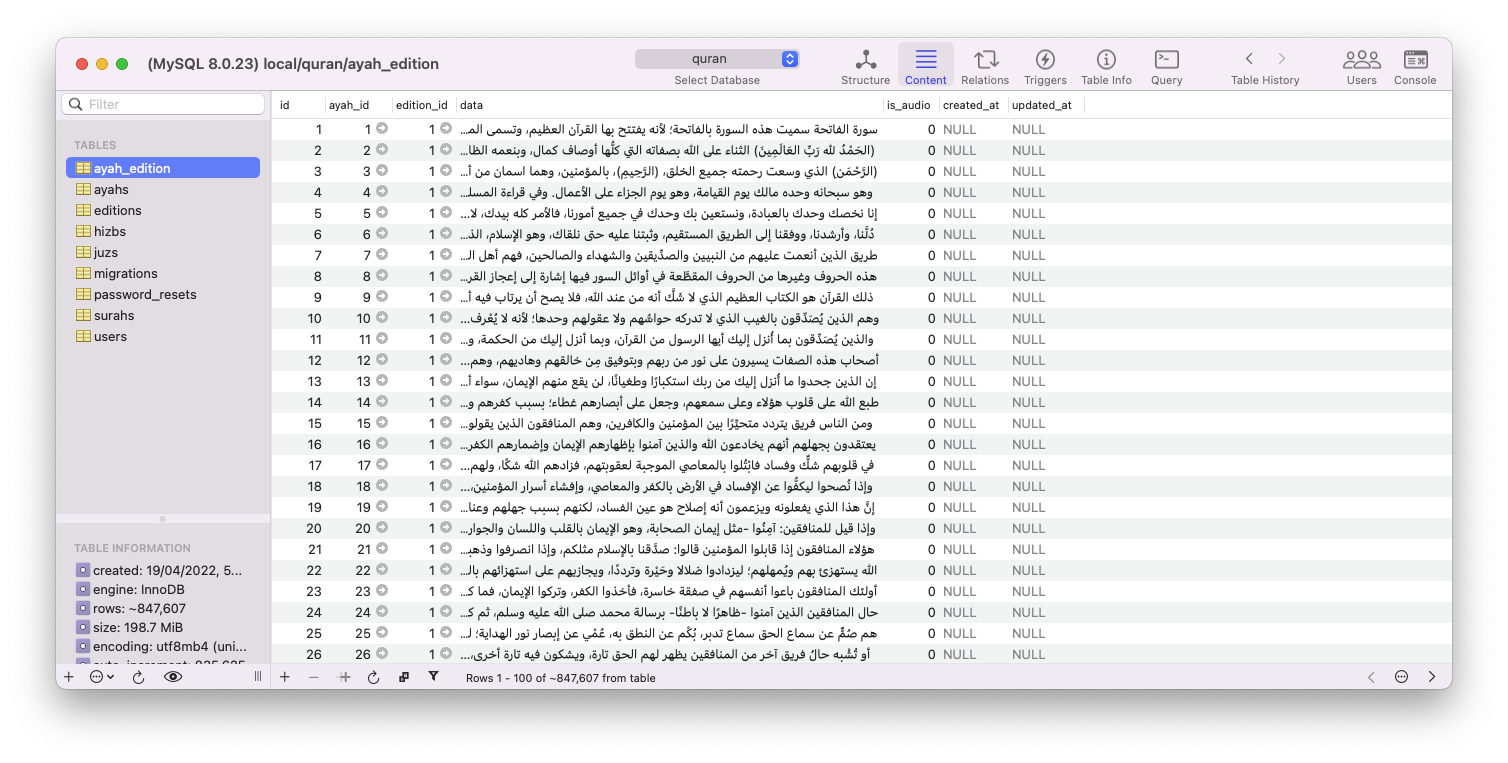
ayah_edition
Ayah-by-ayah translations (835,624 rows — 6,236 ayahs × 134 editions).
| Column | Description |
|---|---|
id |
Unique ID |
ayah_id |
Reference to ayah |
edition_id |
Reference to edition |
data |
Translated/annotated text |
is_audio |
Audio flag |
juzs (SQLite & PostgreSQL — added by the converters)
30 juz (parts) with ayah ranges.
| Column | Description |
|---|---|
id |
Juz ID (1–30) |
juz_number |
Juz number |
name_ar |
Arabic name (e.g. الجزء الأول) |
start_ayah_id |
First ayah in this juz |
end_ayah_id |
Last ayah in this juz |
hizbs (SQLite & PostgreSQL — added by the converters)
60 hizb (half-juz) with ayah ranges and juz references. Not referenced by ayahs.rub_id — see the note above.
| Column | Description |
|---|---|
id |
Hizb ID (1–60) |
hizb_number |
Hizb number |
juz_id |
Parent juz |
name_ar |
Arabic name |
start_ayah_id |
First ayah in this hizb |
end_ayah_id |
Last ayah in this hizb |
pages (SQLite & PostgreSQL — added by the converters)
The 604-page Madinah Mushaf navigation map. It is derived at import time from
the ayahs.page metadata supplied in the versioned source dump, so its ayah
boundaries stay aligned with the imported text.
| Column | Description |
|---|---|
id |
Page ID (1–604) |
page_number |
Mushaf page number (1–604) |
start_ayah_id |
First ayah assigned to the page |
end_ayah_id |
Last ayah assigned to the page |
Setup
Project commands
This repository uses just to provide a small set of consistent project commands. After installing just, run:
just
The main commands are:
just doctor   # Check required local tools
just extract  # Extract quran.sql when it is not already present
just sqlite   # Generate quran.db from the MySQL dump
just verify   # Check the Arabic text against the SHA-256 manifest
just schema   # Regenerate the readable schema references
just check    # Validate the converters and run the test suite
Text encoding
All text is UTF-8. The dump declares SET NAMES utf8mb4 and every text column is
utf8mb4_unicode_ci, so Arabic is stored with full tashkeel and no escaping. Import with a
utf8mb4 connection (mysql --default-character-set=utf8mb4) — using utf8/latin1 will
mangle the text. SQLite and PostgreSQL copies are UTF-8 as well.
MySQL
Extract the SQL file:
just extractImport into MySQL:
mysql --default-character-set=utf8mb4 -u <username> -p <database_name> < quran.sqlOptionally drop the Laravel leftovers:
The dump came from a Laravel application, so it also creates
users,password_resets, andmigrations. They are unused here —usersandpassword_resetsare empty definitions, andmigrationsholds only the eight 2018 migration filenames. No account or credential is in this repository. The SQLite and PostgreSQL converters skip all three; for a direct MySQL import:DROP TABLE IF EXISTS users, password_resets, migrations;
SQLite
Extract the database (
--keep, or you delete the archive):gunzip --keep quran.db.gzOpen with any SQLite client:
sqlite3 quran.dbOr use in Python:
import sqlite3
db = sqlite3.connect("quran.db")
# Get Surah Al-Fatiha
rows = db.execute("SELECT * FROM ayahs WHERE surah_id = 1").fetchall()
# Get ayah with translation
rows = db.execute("SELECT arabic, translation FROM ayah_with_translation WHERE surah_id = 1 AND language = 'en'").fetchall()
Check the copy you just extracted:
just verify
# OK — 6236 verses match tanzil-uthmani, root 5b58aa48fb07265a...
To regenerate from the MySQL dump:
just sqlite
Both the SQLite and PostgreSQL versions add:
- Proper foreign key constraints and CHECK constraints, including
CHECK(rub_id BETWEEN 1 AND 240) - Indexes on commonly queried columns (surah_id, juz_id, rub_id, page, number_in_surah, sajda)
- Pre-populated
juzsandhizbslookup tables with ayah ranges - Views:
surah_stats(ayat counts per surah),ayah_with_translation(joined ayah + translation) english_nameinstead of the dump'senglishName, andrub_idinstead of its misnamedhizb_idANALYZEstatistics for the query planner — plus aVACUUMed file on SQLite, which PostgreSQL cannot do inside the import transaction- None of the Laravel leftover tables (
users,password_resets,migrations)
PostgreSQL
Install the PostgreSQL driver and extract the source dump:
python3 -m pip install psycopg2-binary
just extract
Create the target database:
createdb quranRun the converter:
PGDATABASE=quran just postgres
Connection settings can be supplied through PGHOST, PGPORT, PGUSER, PGPASSWORD, and PGDATABASE. The converter validates the input before connecting, loads tables in foreign-key dependency order, and recreates the schema in one transaction so a failed import rolls back cleanly.
Docker
Build and initialize all three database targets from the tracked MySQL dump:
just docker-up
This starts MySQL 8.4 and PostgreSQL 16 with persistent named volumes and writes
the enriched SQLite database to output/quran.db. Set SQLITE_OUTPUT_DIR to
write it elsewhere. The just recipes pass your local UID/GID to the SQLite
exporter so its generated file remains writable on the host. MySQL retains the
supplied source schema; SQLite and PostgreSQL use the enriched rub_id model.
The MySQL and PostgreSQL health checks wait for all 835,624 ayah_edition
rows, so a listening server is not reported ready before its import has
finished.
The development defaults are MYSQL_ROOT_PASSWORD=quran,
POSTGRES_USER=postgres, and POSTGRES_PASSWORD=quran; override them (and the
host ports) with environment variables before exposing either service:
MYSQL_ROOT_PASSWORD=change-me POSTGRES_PASSWORD=change-me just docker-up
Useful commands:
just docker-check   # validate Compose and initialization scripts
just docker-logs    # follow imports and service logs
just docker-down    # stop services, retaining their volumes
Development
just check    # compile both converters and run the test suite
just verify   # check the Arabic text against the SHA-256 manifest
just schema   # regenerate schema/<database>/schema.sql
Or without just:
PYTHONDONTWRITEBYTECODE=1 python3 -m unittest discover -s tests -v
CI runs the suite on Python 3.10 and 3.14, lints the Markdown, tests both archives, verifies the Arabic text against the manifest, and fails if the generated schema references are out of date.
Converter notes worth knowing before changing one:
- Both load from an allow-list (
TABLE_ORDER) of four tables, so an unrecognised table in a future dump is skipped rather than imported blindly. - INSERTs name their columns, and
COLUMN_RENAMESmaps the two the enriched model changes (hizb_id→rub_id,englishName→english_name). A dump that reorders or adds a column now fails loudly instead of loading values into the wrong fields. - The SQLite converter runs
ANALYZEandVACUUMbefore finishing, so a regeneratedquran.dbcarries query planner statistics like the shipped one.
See CONTRIBUTING.md for the full workflow and
docs/architecture.md for the data flow.
Roadmap
We welcome contributions! Here's the planned roadmap for this project. Pick any item and submit a PR.
Database Improvements
- Add proper indexes for faster queries
- Add
juz(parts) table with ayah ranges - Add
hizbandrub(quarter) divisions - Add
pagestable (Mushaf page mapping) - Add word-by-word breakdown table (Arabic root, morphology)
- Add sajdah (prostration) markers
- Support PostgreSQL and SQLite exports
- Add foreign key constraints and proper normalization
- Publish a verse-level SHA-256 manifest and verify it in CI
- Document text provenance back to Tanzil and the Madinah Mushaf
- Generate readable schema references per database
Data Expansion
- Add more translations (Urdu, French, Turkish, Indonesian, etc.)
- Add Tafsir (exegesis) data — Ibn Kathir, Al-Tabari, Al-Sa'di, etc.
- Add audio recitation references (Mishary, Al-Husary, Abdul Basit, etc.)
- Add transliteration for each ayah
- Add asbab al-nuzul (reasons of revelation)
- Add hadith references related to each ayah
- Add dua (supplication) extractions from the Quran
API / Backend
- Build a RESTful API (Node.js or Python)
- GraphQL endpoint for flexible queries
- Search endpoint with full-text Arabic search
- Pagination and filtering support
- API rate limiting and authentication
- Docker setup for easy deployment
- API documentation (Swagger / OpenAPI)
Frontend / App
- Web app for browsing surahs and ayahs
- Ayah-by-ayah reader with translation toggle
- Audio player integration with reciter selection
- Search functionality (by surah, ayah, keyword)
- Bookmarking and progress tracking
- Dark mode and responsive design
- Mobile-friendly PWA support
Contributing
Contributions are welcome. CONTRIBUTING.md has the full
workflow — branching, the verification commands to run, and the rules that apply
specifically to Quranic text and metadata.
The short version:
- Never hand-edit Quranic text, translations, or generated artifacts. Change the source or the generator, regenerate, and say in the PR how you verified it.
- Cite a source, version, and licence for any data change.
- Run
just checkbefore opening a PR.
Unsure where to start? Pick an unchecked roadmap item above, or open an issue.
Screenshots
These show the MySQL source database, so they use its column names —
hizb_id rather than rub_id, englishName rather than english_name.
Related Projects
- Quran Lumen API — Laravel Lumen API
- Quran Vue
Community ports
Built from this database by the community:
- quran-database-malay — Bahasa Melayu edition, cross-checked against the official Malaysian translation, with a SQLite + WASM search page.
- quranchecksum — verse-level SHA-256 manifest for verifying an imported copy of the Quran text.
Ported or built something? Open an issue and we'll list it.
Sponsor
License
The code and packaging in this repository are MIT licensed. The Quran
text is in the public domain; individual translations remain under the terms set
by their translators and publishers — see docs/provenance.md.
data/rukus.json is derived from Quran Foundation API metadata and is subject to
their developer terms,
not the MIT license — see data/README.md.
Ähnliche Projekte entdecken
Asabeneh/30-Days-Of-Python
Die Programmier-Challenge 30 Days of Python ist eine Schritt-für-Schritt-Anleitung, um die Programmiersprache Python in 30 Tagen zu lernen. Diese Challenge kann mehr als 100 Tage dauern. Gehe in deinem eigenen Tempo vor. Diese Videos können ebenfalls helfen: https://www.youtube.com/channel/UC7PNRuno1rzYPb1xLa4yktw
78,370 Sternegrafana/grafana
Offene und kombinierbare Plattform für Observability und Datenvisualisierung. Visualisiert Metriken, Logs und Traces aus mehreren Quellen wie Prometheus, Loki, Elasticsearch, InfluxDB, Postgres und vielen weiteren.
77,752 Sterneredis/redis
Für Entwickler, die echtzeitfähige, datengesteuerte Anwendungen erstellen, ist Redis der bevorzugte, schnellste und funktionsreichste Cache, Datenstrukturserver und die entsprechende Abfrageengine für Dokumente und Vektoren.
77,288 Sterneapache/superset
Apache Superset ist eine Plattform für Datenvisualisierung und Datenexploration.
75,448 Sterne