
colinhacks/reylo has 1,580 GitHub stars and 18 forks. GitHot measured +10 stars in 24 hours and +87 in 7 days. Last checked 2026-11-11 09:32 UTC. Last push 2026-11-02.
So werden diese Zahlen gemessen
Importiere .sql-Dateien in TypeScript mit vollständiger Typinferenz und ohne Codegenerierung.
Gemessener Sternzuwachs
- in 24h
- +10
- in 7 days
- +87
- in 15 days
- Aktualisierung verzögert
- in 1 month
- Aktualisierung verzögert
Nettoänderungen in überlappenden Zeiträumen, keine Tagessummen. Fehlende Messwerte bleiben leer. Sterne zeigen Interesse, nicht Qualität.
README.md
Original
Import .sql files into your TypeScript code with full type inference


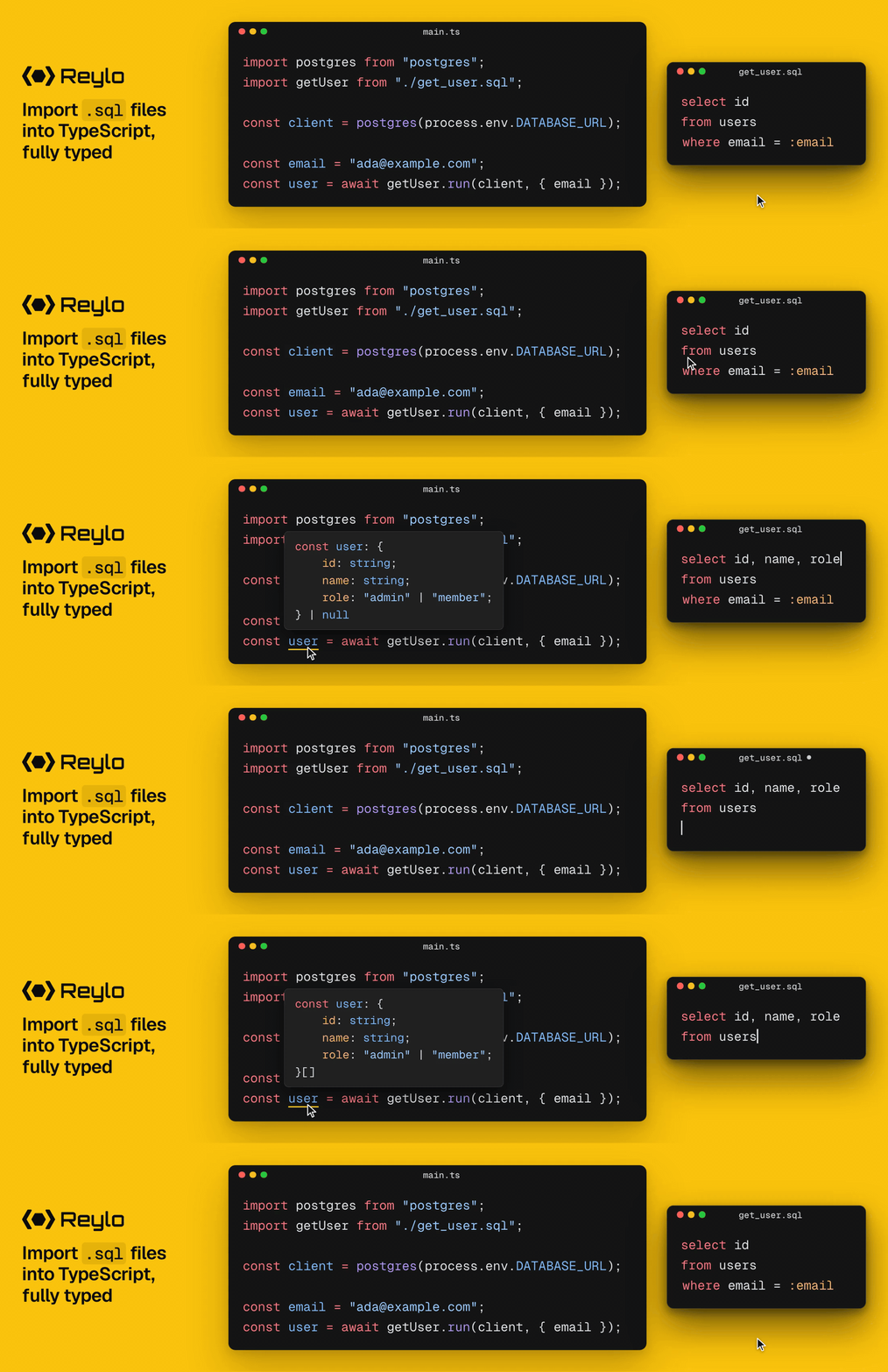
If you have a file like this:
-- get_author.sql
select u.id, u.name, count(p.id)::int as post_count
from users u
left join posts p on p.user_id = u.id
where u.id = :id::int
group by u.id
You can import it directly from a TypeScript file like this:
// main.ts
import postgres from "postgres";
import getAuthor from "./get_author.sql";

const db = postgres(process.env.DATABASE_URL);

const author = await getAuthor.run(db, { id: 1 });
// { id: number; name: string; post_count: number } | null
Reylo is powered by TypeScript content mappers, introduced in TypeScript 7.1 (currently in beta), which let you dynamically define static types for external file types and integrate them directly into TypeScript compilation.
Reylo is the perfect option for the agent era:
- 💪 The full power of SQL — any syntax, function or operator your database supports
- 🌵 DRY — no redundant hand-written types
- 🎯 Checked against your database — a misspelled column is a type error
- 🤖 Agent-friendly — DRY code is more maintainable for agents
- 🧩 Postgres, MySQL, SQLite and DuckDB (preview) — Neon, PlanetScale, Cloudflare D1, Turso and more
- 🔌 Bring your own driver —
pg, postgres.js,mysql2,better-sqlite3and more - ⚡ No codegen — no generated files, no watcher
Setup
To install Reylo, you'll need:
- TypeScript 7.1 (currently in beta). The first release with content mappers.
- Node 24 or later.
- A running dev database. Postgres, MySQL 8.0.22 or later, or a SQLite or DuckDB file: Reylo reads your current schema from it.
Install Reylo, which brings its engine for your machine, and TypeScript 7.1:
npm install reylo
npm install -D typescript@beta
Add Reylo to tsconfig.json, for .sql files and for its project file, .reylo.yaml or .reylo.yml:
// tsconfig.json
{
  "compilerOptions": { /* ... */ },
  "contentMappers": [
    { "package": "reylo", "extensions": [".sql", ".reylo.yaml", ".reylo.yml"] }
  ]
}
Then type-check with --runExternalCode, which lets tsc run content mappers:
// package.json
{
  "scripts": {
    "typecheck": "tsc --noEmit --runExternalCode"
  }
}
Point Reylo at your dev database with DATABASE_URL, in your environment or in .env. Its scheme tells Reylo which database you use:
# .env
DATABASE_URL=postgres://localhost:5432/app  # or mysql://…, file:./app.db for SQLite, duckdb:./app.duckdb for DuckDB
To make .sql imports work at run time too, load Reylo where your code runs. On Node:
node --env-file=.env --import reylo/register main.ts
For Bun, Nub, Vite, Next.js, esbuild, webpack, Rspack, Cloudflare Workers and Jest, add the plugin for your setup, or copy its complete example project. To see the types as you type, set up your editor.
To give your coding agent Reylo's rules for writing and running queries, install its skill:
npx skills add colinhacks/reylo --skill using-reylo
Usage
Write a query in a .sql file, import it, and run it with your database driver:
-- get_user.sql
select id, name, email from users where id = :id::int
import getUser from "./get_user.sql";

const user = await getUser.run(db, { id: 1 });
// { id: number; name: string; email: string | null } | null
Name each parameter with a colon, and give it a type with a cast where the query doesn't pin one down. Pass .run() your driver's client: a pool, a client, or a connection or transaction taken from one.
It resolves to the rows, shaped by how many the query can return:
| The query | Resolves to |
|---|---|
A match on a primary or unique key, or limit 1 |
Row | null |
An aggregate without group by, a one-row insert … returning |
Row |
An insert, update or delete without returning |
void |
| Anything else | Row[] |
An imported query also has .runSync(), .try(), .with(), .sql, .raw and .source (Usage). Every query Reylo runs is published on Node's tracing channel reylo:query, for a tracer or a logger to subscribe to (Tracing).
What Reylo infers
To type a query, Reylo has your dev database prepare it, without running it, and reads back the type of every column and parameter. On top of that, it infers:
- Nulls — a column is nullable unless its schema, a join or a
wheretest rules null out. - Cardinality — a match on a unique key is one row or
null, and an aggregate is exactly one row. - Unions — an enum, or a column whose check constraint lists its values, is a union of them.
- JSON — JSON the query builds, and a JSON column with a JSON Schema check, keep their shape.
Each has examples in Inference.
Supported drivers
Reylo is bring-your-own-driver. Pass .run() a client from any of these, or a Drizzle database over one:
- Postgres —
pg, postgres.js,Bun.sql, PGlite, Neon,pg-promise,slonik,@vercel/postgres - MySQL —
mysql2,mariadb, PlanetScale,Bun.sql - SQLite —
better-sqlite3,node:sqlite,Bun.sql, libSQL, Turso, Cloudflare D1 and Durable Objects,sqlite3,sqlite - DuckDB —
@duckdb/node-api, which also types DuckDB's statements
Documentation
reylo.dev covers the rest: every plugin and editor, configuration, errors, each database's data types and edge cases, and advanced examples. Agents can read it all as Markdown at reylo.dev/llms.txt. To move a Prisma project's queries to Reylo, see Migrating from Prisma.
License
Ähnliche Projekte entdecken
Asabeneh/30-Days-Of-Python
Die Programmier-Challenge 30 Days of Python ist eine Schritt-für-Schritt-Anleitung, um die Programmiersprache Python in 30 Tagen zu lernen. Diese Challenge kann mehr als 100 Tage dauern. Gehe in deinem eigenen Tempo vor. Diese Videos können ebenfalls helfen: https://www.youtube.com/channel/UC7PNRuno1rzYPb1xLa4yktw
78,560 Sternegrafana/grafana
Offene und kombinierbare Plattform für Observability und Datenvisualisierung. Visualisiert Metriken, Logs und Traces aus mehreren Quellen wie Prometheus, Loki, Elasticsearch, InfluxDB, Postgres und vielen weiteren.
77,830 Sterneredis/redis
Für Entwickler, die echtzeitfähige, datengesteuerte Anwendungen erstellen, ist Redis der bevorzugte, schnellste und funktionsreichste Cache, Datenstrukturserver und die entsprechende Abfrageengine für Dokumente und Vektoren.
77,395 Sterneapache/superset
Apache Superset ist eine Plattform für Datenvisualisierung und Datenexploration.
75,473 Sterne