
autumoswitzerland/Webduck has 55 GitHub stars and 2 forks. GitHot measured 0 stars in 24 hours, 0 in 7 days, and 0 in 15 days. Last checked 2026-11-12 23:23 UTC. Last push 2026-08-13.
So werden diese Zahlen gemessen
A self-hosted DuckDB-as-a-Service server with REST API and Web UI.
What you can do
- DuckDB storage engine with file-locking for safe concurrent access
- REST API — admin endpoints (project/DB management) + database endpoints (SQL queries)
- Web UI (NiceGUI) — dark mode with yellow/amber theme
- Dashboard — server status cards, live REST traffic monitor (queries/min, active sessions), storage overview with per-project sizes and trash totals
Gemessener Sternzuwachs
- in 24h
- 0
- in 7 days
- 0
- in 15 days
- 0
- in 1 month
- Verlauf wird gesammelt
Nettoänderungen in überlappenden Zeiträumen, keine Tagessummen. Fehlende Messwerte bleiben leer. Sterne zeigen Interesse, nicht Qualität.
README.md
Original
WebDuck
A self-hosted DuckDB-as-a-Service server with REST API and Web UI. WebDuck is designed for web hosting providers who want to offer their customers a ready-to-use administration interface for DuckDB databases and data analytics — out of the box, just like the database admin tools that come with any hosting package.


Features
- DuckDB storage engine with file-locking for safe concurrent access
- REST API — admin endpoints (project/DB management) + database endpoints (SQL queries)
- Web UI (NiceGUI) — dark mode with yellow/amber theme
- Dashboard — server status cards, live REST traffic monitor (queries/min, active sessions), storage overview with per-project sizes and trash totals
- Trash — soft-delete projects/databases with restore, permanent delete per entry, empty trash
- JWT authentication for admin API, optional project-key auth for database access
- Per-database write protection — lock a database to read-only, independent of passwords: passwords control who may access, write protection controls what may be done to the data. It protects the data only — compacting, deleting and managing passwords in the web UI keep working at any time
- bcrypt password hashing (never plaintext)
- SQL editor — multi-statement support with sequential execution, query history (Alt+Up/Alt+Down, Alt+Enter)
- SQL upload — execute multi-statement SQL scripts from files
- Database compression — reclaims space DuckDB leaves behind after updates/deletes; a hint highlights databases with high fragmentation
- Browse view — tree-based navigation of databases/tables/views with infinite scroll and cell editing
- Import/Export — CSV, Parquet and JSON import via drag & drop, export with browser download
- Project ordering — drag & drop reordering, persisted in
.projects.json - i18n — English (default), German, extensible via PO/Gettext
- Configurable logging — file rotation + console output, independently configurable
- Configurable upload size — max file size for uploads
- FK dependency hints — DROP errors include referenced tables and constraint info
- Docker support out of the box
- YAML configuration
Web UI
Dashboard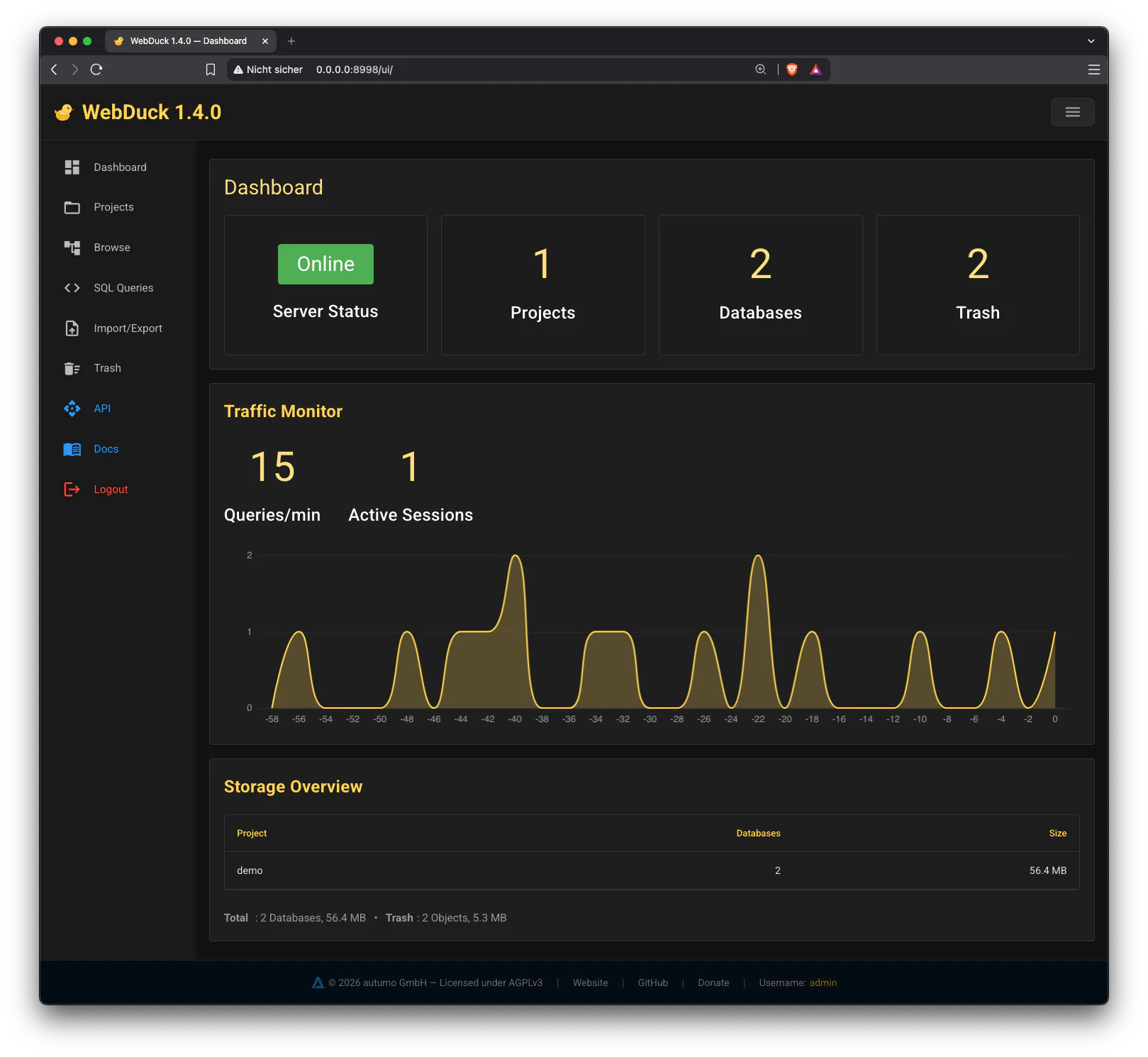 |
|
Projects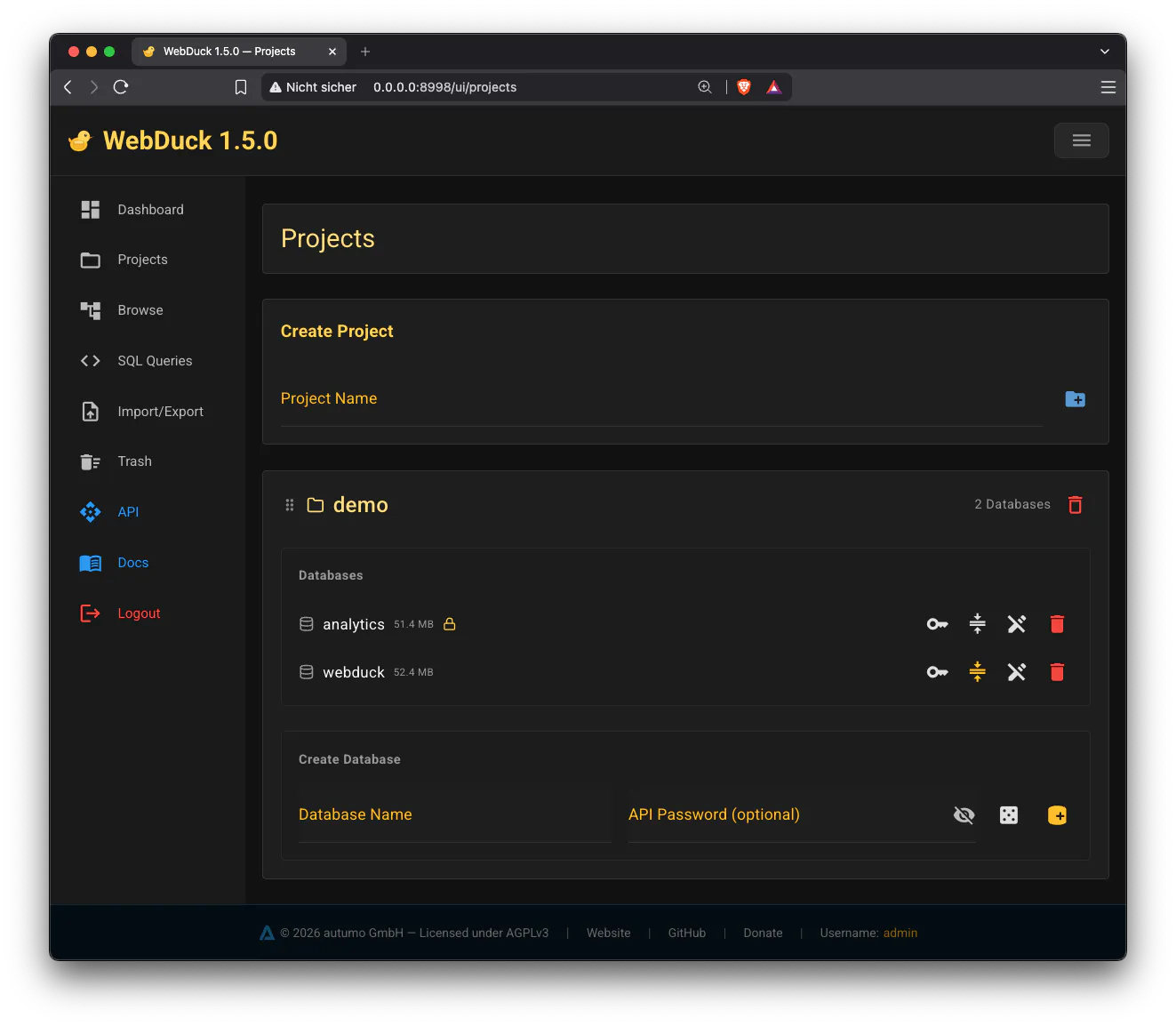 |
Browse View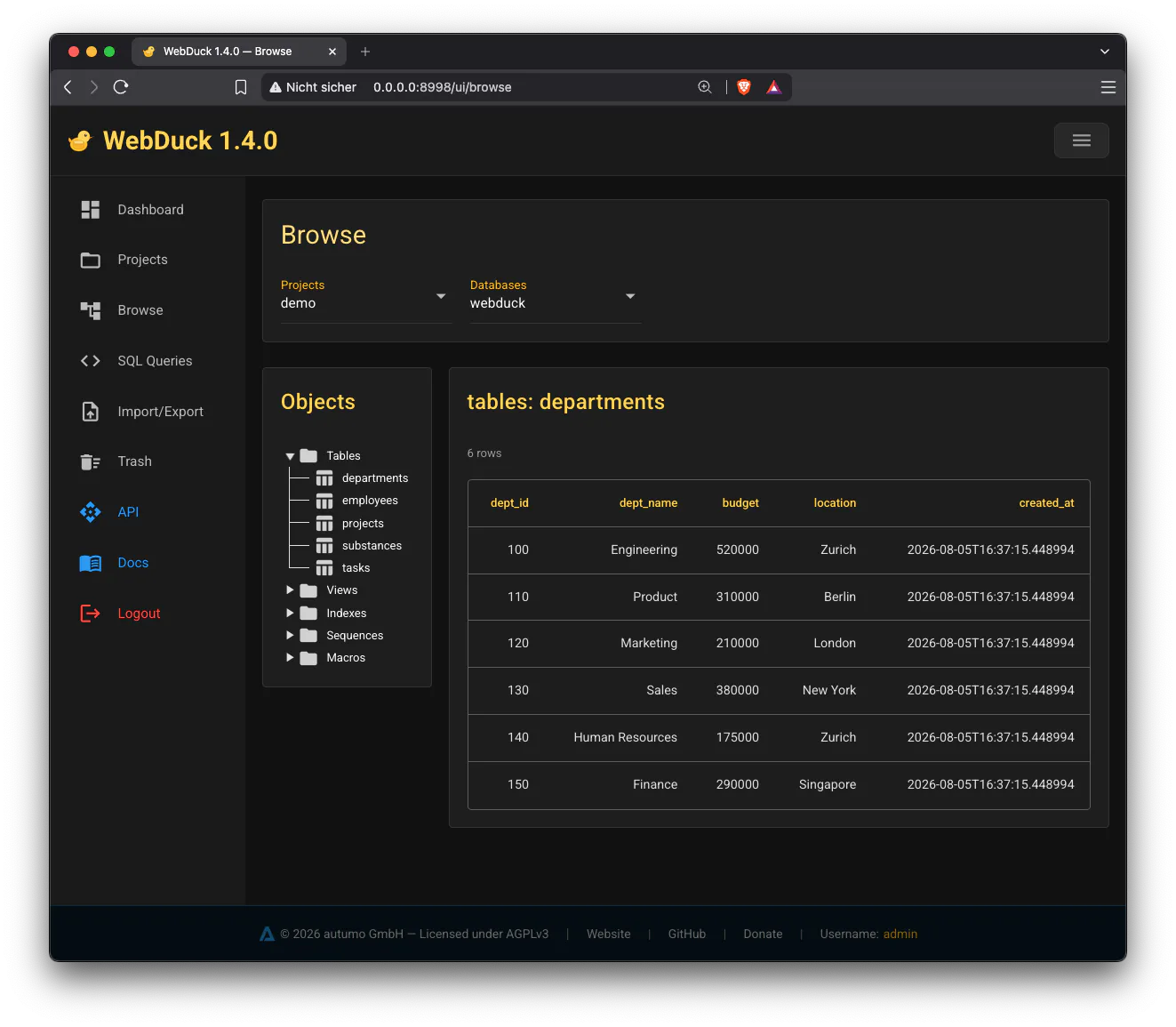 |
Installation
pip (Python)
pip install webduck
Docker
# Download docker-compose.yml
curl -O https://raw.githubusercontent.com/autumoswitzerland/Webduck/master/docker-compose.yml

# Set password
export WEBDUCK_ADMIN_PASS=mypassword

# Start - An admin user is created automatically
docker compose up -d
Quick Start
pip
# Initialize - Create an admin user
webduck init

# Create additional admin users (optional)
webduck user add anna secret

# Start server
webduck start
Docker
Docker starts automatically — UI at http://localhost:8998/ui/login.
Log in with admin and the password you set.
CLI Commands
| Command | Description |
|---|---|
webduck init |
Create admin user + default config |
webduck user add <name> <password> |
Create an additional admin user |
webduck user list |
List all admin users |
webduck user delete <name> |
Delete an admin user (removes prefs + query history) |
webduck start |
Start the server |
webduck status |
Show projects and databases |
Options:
webduck start --host 127.0.0.1 --port 8080 --config /path/to/webduck.yaml
webduck user add anna secret
webduck user add anna secret --config /path/to/webduck.yaml
Configuration
webduck.yaml (generated by webduck init):
icon: "icon.svg"
auth:
  jwt_algorithm: HS256
  jwt_expire_minutes: 60
  jwt_secret: CHANGE-ME-TO-A-SECRET-KEY-IN-PRODUCTION
logging:
  file:
    enabled: true
    level: error
    max_files: 5
    max_size_mb: 10
    query_log: false
    log_dir: log
  console:
    enabled: false
    access_log: false
    level: warning
server:
  data_dir: data
  host: 0.0.0.0
  port: 8998
  max_upload_mb: 256
Security note: Before deploying WebDuck in production, replace
jwt_secretinwebduck.yamlwith a long, random secret (e.g. generated withopenssl rand -base64 48). The placeholder valueCHANGE-ME-TO-A-SECRET-KEY-IN-PRODUCTIONmust never be used in production — anyone who knows the secret can forge admin tokens.
Web UI Pages
| Page | URL | Description |
|---|---|---|
| Login | /ui/login |
Admin login with language selection |
| Dashboard | /ui/dashboard |
Server status, live traffic monitor (queries/min, active sessions), storage overview |
| Projects | /ui/projects |
Create/delete projects, manage databases, set passwords, write protection, drag & drop reorder, database sizes + compression hint |
| Queries | /ui/query |
SQL editor (multi-statement) + SQL file upload, query history (Alt+Up/Alt+Down) |
| Browse | /ui/browse |
Tree navigation, table/view browsing with infinite scroll, cell editing |
| Import/Export | /ui/import |
CSV, Parquet and JSON import (drag & drop) and export (browser download) |
| Trash | /ui/trash |
Restore soft-deleted projects/databases, empty the trash |
REST API Reference
Admin API (JWT protected)
All admin endpoints require Authorization: Bearer <jwt_token>. Tokens are
signed with the jwt_secret from webduck.yaml — make sure you replaced the
placeholder before going to production (see the security note above).
| Method | Endpoint | Description |
|---|---|---|
POST |
/admin/login |
Login, returns JWT token |
GET |
/admin/projects |
List all projects (ordered) |
POST |
/admin/projects |
Create project |
DELETE |
/admin/projects/{project} |
Delete project + all databases |
POST |
/admin/reorder-projects |
Reorder projects |
GET |
/admin/projects/{project}/databases |
List databases in project |
POST |
/admin/projects/{project}/databases |
Create database |
DELETE |
/admin/projects/{project}/databases/{db} |
Delete database |
PUT |
/admin/projects/{project}/databases/{db}/password |
Set database password |
PUT |
/admin/projects/{project}/databases/{db}/write-protection |
Enable/disable write protection (read-only) |
GET |
/admin/users |
List admin users |
POST |
/admin/users |
Create admin user |
DELETE |
/admin/users/{username} |
Delete admin user |
Database API (project-key protected)
All database endpoints require X-Project-Key: <project>:<password>.
Databases without a password set are publicly accessible.
| Method | Endpoint | Description |
|---|---|---|
GET |
/db/projects |
List all projects (public) |
GET |
/db/projects/{project}/databases |
List databases (public) |
POST |
/db/projects/{project}/databases/{db}/query |
Execute SQL (read-only) |
POST |
/db/projects/{project}/databases/{db}/write |
Execute SQL (read-write) |
GET |
/db/projects/{project}/databases/{db}/tables |
List tables + columns |
POST |
/db/projects/{project}/databases/{db}/import/{tbl} |
Import CSV/Parquet/JSON |
GET |
/db/projects/{project}/databases/{db}/export/{tbl} |
Export table to CSV/Parquet/JSON |
Example: Login + Query
# Login
TOKEN=$(curl -s -X POST http://localhost:8998/admin/login \
  -H "Content-Type: application/json" \
  -d '{"username":"admin","password":"secret"}' | jq -r '.token')

# Create project + database
curl -X POST http://localhost:8998/admin/projects \
  -H "Authorization: Bearer $TOKEN" \
  -d '{"name":"myapp"}'

curl -X POST http://localhost:8998/admin/projects/myapp/databases \
  -H "Authorization: Bearer $TOKEN" \
  -d '{"name":"main"}'

# Execute a query via the Database API (no password yet = open)
curl -X POST http://localhost:8998/db/projects/myapp/databases/main/write \
  -H "Content-Type: application/json" \
  -d '{"sql":"CREATE TABLE users (id INT, name VARCHAR); INSERT INTO users VALUES (1, '\''Alice'\'');"}'

# Read (without password — no header needed)
curl -X POST http://localhost:8998/db/projects/myapp/databases/main/query \
  -d '{"sql":"SELECT * FROM users"}'

# Set database password (optional — without password, API is open)
curl -X PUT http://localhost:8998/admin/projects/myapp/databases/main/password \
  -H "Authorization: Bearer $TOKEN" \
  -d '{"password":"dbpass","access_level":"write"}'

# Read (with password)
curl -X POST http://localhost:8998/db/projects/myapp/databases/main/query \
  -H "X-Project-Key: myapp:dbpass" \
  -d '{"sql":"SELECT * FROM users"}'
Docker
Run WebDuck with Docker Compose:
docker compose up -d
WebDuck stores its data in /app/data inside the container. The provided Docker Compose configuration persists this data using the webduck_data volume.
Initialize with:
docker compose exec webduck webduck init
Architecture
FastAPI ──┬── /admin/*   (JWT auth)    → Project/DB management
          ├── /db/*      (project key) → SQL queries + CSV/Parquet/JSON import/export
          ├── /ui/*      (cookie)      → NiceGUI Web UI
          ├── /api/*     (session)     → Internal UI endpoints
          └── /health                  → Health check
- Storage: DuckDB files in
data/<project>/<database>.duckdb - Project order: Persisted in
data/.projects.json - Reserved name:
trashis reserved for the soft-delete trash directory — a project directory namedtrashis not listed as a project - Auth: Admin passwords in
data/.users.json(bcrypt), DB passwords indata/<project>/.project.json - Write protection: Per-database read-only flag in
data/<project>/.project.json; a protected database is always opened read-only by the engine - User preferences: Stored in
data/.user_preferences.json - Logging: Rotated log files in
log/(configurable), independent console logging - Concurrency: Per-file reader-writer locks — parallel reads, exclusive writes (DuckDB single-writer model)
Development
git clone https://github.com/autumoswitzerland/Webduck.git
cd webduck
python3.13 -m venv .venv
source .venv/bin/activate
pip install -e ".[dev]"

# Run tests
pytest tests/

# Run linter
ruff check src/ tests/
Donate
WebDuck is free and open-source. If you find it useful, consider supporting the development:

License
WebDuck is licensed under the GNU Affero General Public License v3.0 (AGPLv3) — see LICENSE for details.
Copyright © 2026 autumo GmbH
Ähnliche Projekte entdecken
Asabeneh/30-Days-Of-Python
Die Programmier-Challenge 30 Days of Python ist eine Schritt-für-Schritt-Anleitung, um die Programmiersprache Python in 30 Tagen zu lernen. Diese Challenge kann mehr als 100 Tage dauern. Gehe in deinem eigenen Tempo vor. Diese Videos können ebenfalls helfen: https://www.youtube.com/channel/UC7PNRuno1rzYPb1xLa4yktw
78,618 Sternegrafana/grafana
Offene und kombinierbare Plattform für Observability und Datenvisualisierung. Visualisiert Metriken, Logs und Traces aus mehreren Quellen wie Prometheus, Loki, Elasticsearch, InfluxDB, Postgres und vielen weiteren.
77,859 Sterneredis/redis
Für Entwickler, die echtzeitfähige, datengesteuerte Anwendungen erstellen, ist Redis der bevorzugte, schnellste und funktionsreichste Cache, Datenstrukturserver und die entsprechende Abfrageengine für Dokumente und Vektoren.
77,472 Sterneapache/superset
Apache Superset ist eine Plattform für Datenvisualisierung und Datenexploration.
75,495 Sterne