
albrateanu/multinex
albrateanu/multinex has 93 GitHub stars and 12 forks. GitHot measured +1 stars in 24 hours and +4 in 7 days. Last checked 2026-11-13 01:08 UTC. Last push 2026-10-05.
So werden diese Zahlen gemessen
[CVPR 2026] Multinex: Lightweight Low-light Image Enhancement via Multi-prior Retinex
Gemessener Sternzuwachs
- in 24h
- +1
- in 7 days
- +4
- in 15 days
- Verlauf wird gesammelt
- in 1 month
- Verlauf wird gesammelt
Nettoänderungen in überlappenden Zeiträumen, keine Tagessummen. Fehlende Messwerte bleiben leer. Sterne zeigen Interesse, nicht Qualität.
README.md
Original 
Multinex: Lightweight Low-Light Image Enhancement via Multi-prior Retinex (CVPR 2026)
Alexandru Brateanu, Tingting Mu, Codruta O. Ancuti, Cosmin Ancuti



Consider giving our repository a :star: star :star: if you find it useful!
News
- 28.07.2026: No-reference scripts and improved checkpoints (indicated in filename by
_dagger) now available! ArXiv paper also updated with the new values (indicated by $^\dagger$). Both Multinex and Multinex-Nano now clearly outperform prior work! - 20.06.2026: Clarified repository licensing and commercial-use terms. Multinex is source-available for non-commercial research and educational use under PolyForm Noncommercial 1.0.0; commercial use requires separate written permission.
- 25.04.2026: Model weights for object detection on ExDark are now available for download. Read
Detection/README.mdfor more details. - 14.04.2026 : Pre-print, code, and paper page for Multinex (accepted at CVPR 2026) are released!
Abstract: Low-light image enhancement (LLIE) aims to restore natural visibility, color fidelity, and structural detail under severe illumination degradation. State-of-the-art (SOTA) LLIE techniques often rely on large models and multi-stage training, limiting practicality for edge deployment. Moreover, their dependence on a single color space introduces instability and visible exposure or color artifacts. To address these, we propose Multinex, an ultra-lightweight structured framework that integrates multiple fine-grained representations within a principled Retinex residual formulation. It decomposes an image into illumination and color prior stacks derived from distinct analytic representations, and learns to fuse these representations into luminance and reflectance adjustments required to correct exposure. By prioritizing enhancement over reconstruction and exploiting lightweight neural operations, Multinex significantly reduces computational cost, exemplified by its lightweight (45K parameters) and nano (0.7K parameters) versions. Extensive benchmarks show that all lightweight variants significantly outperform their corresponding lightweight SOTA models, and reach comparable performance to heavy models.
Network Architecture
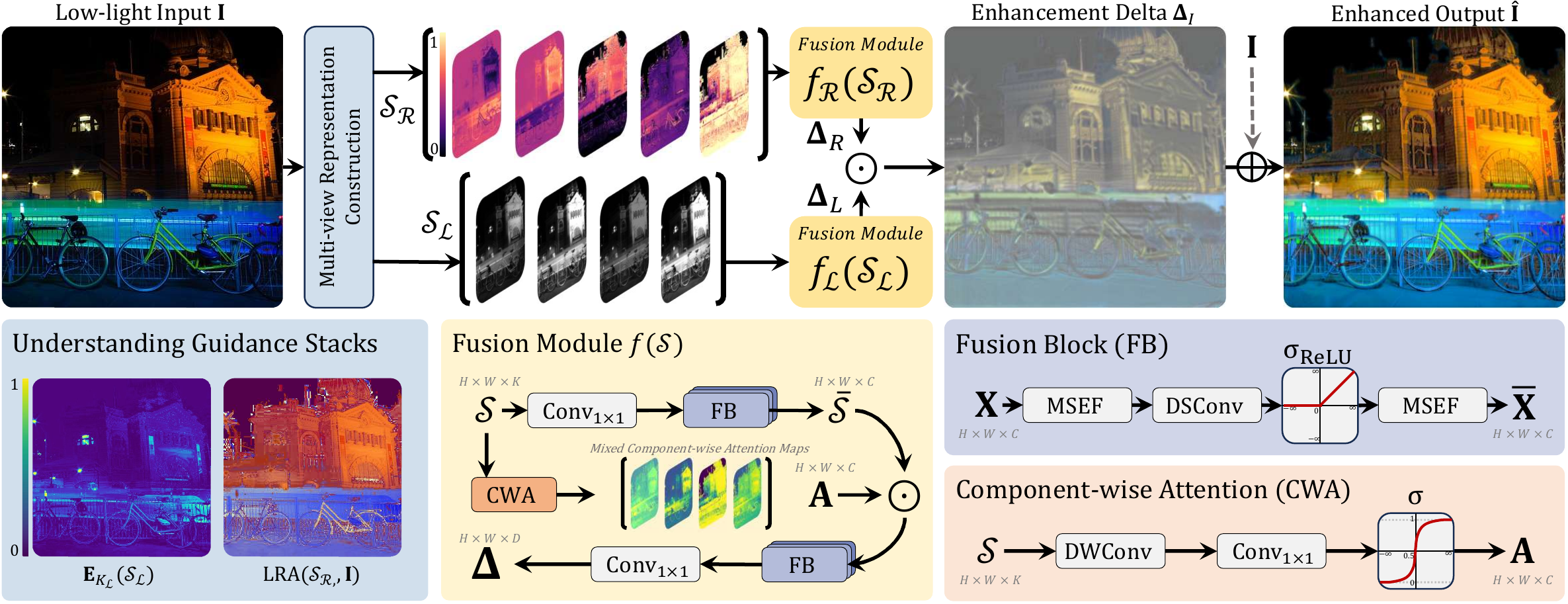
Introduction
This source-available repository contains the official implementation of Multinex for low-light image enhancement. It provides training and testing code for paired-image enhancement on standard benchmarks, together with pretrained checkpoints for direct evaluation.
Please Note: Installation and running instructions for Object Detection on ExDark are available under Detection/README.md.
Results
Quantitative results for Enhancement (LOL-v1, LOL-v2, MEF, DICM, LIME, NPE), and Detection (ExDark)
LOL Datasets (click to expand)
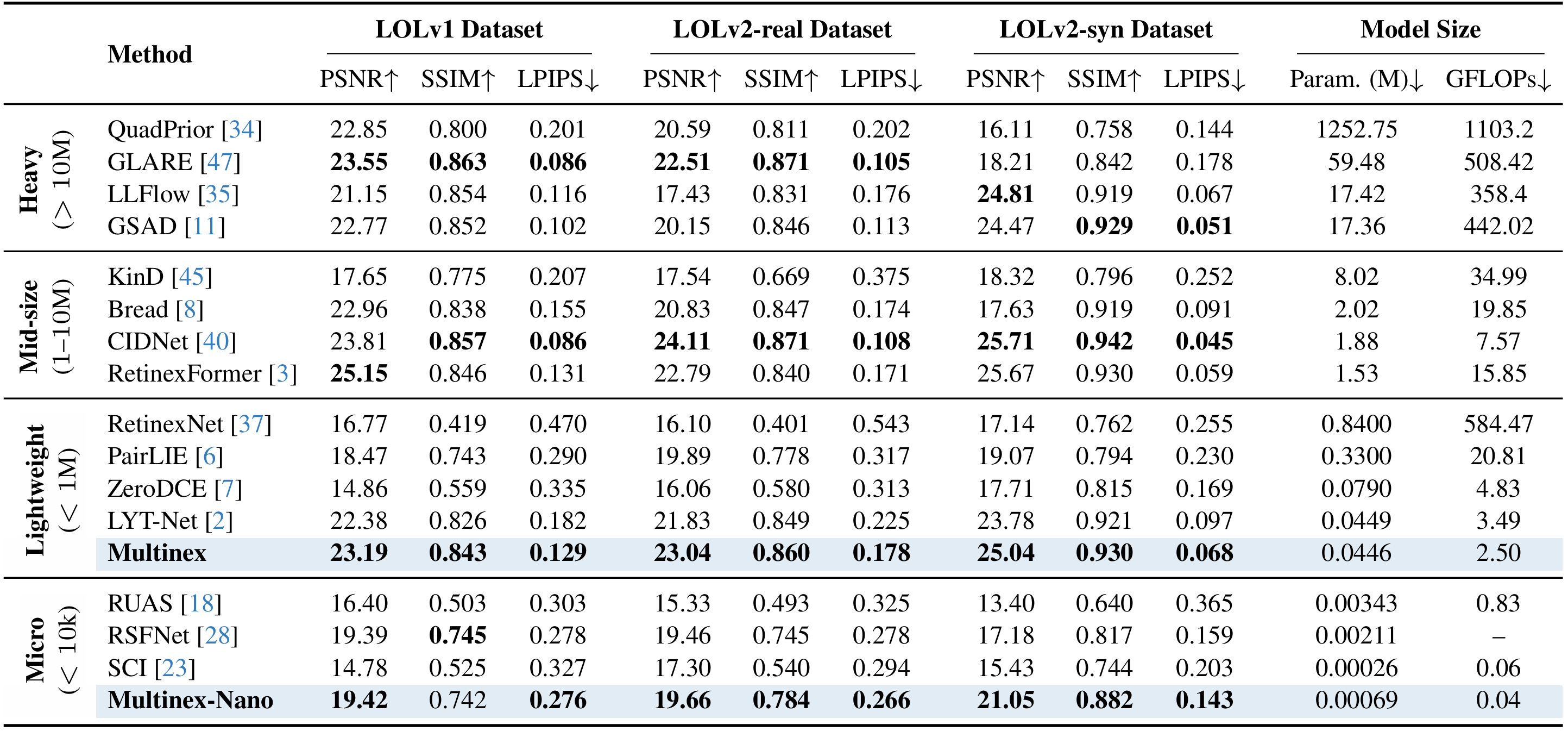
No-Reference Datasets (click to expand)

Object Detection on ExDark (click to expand)
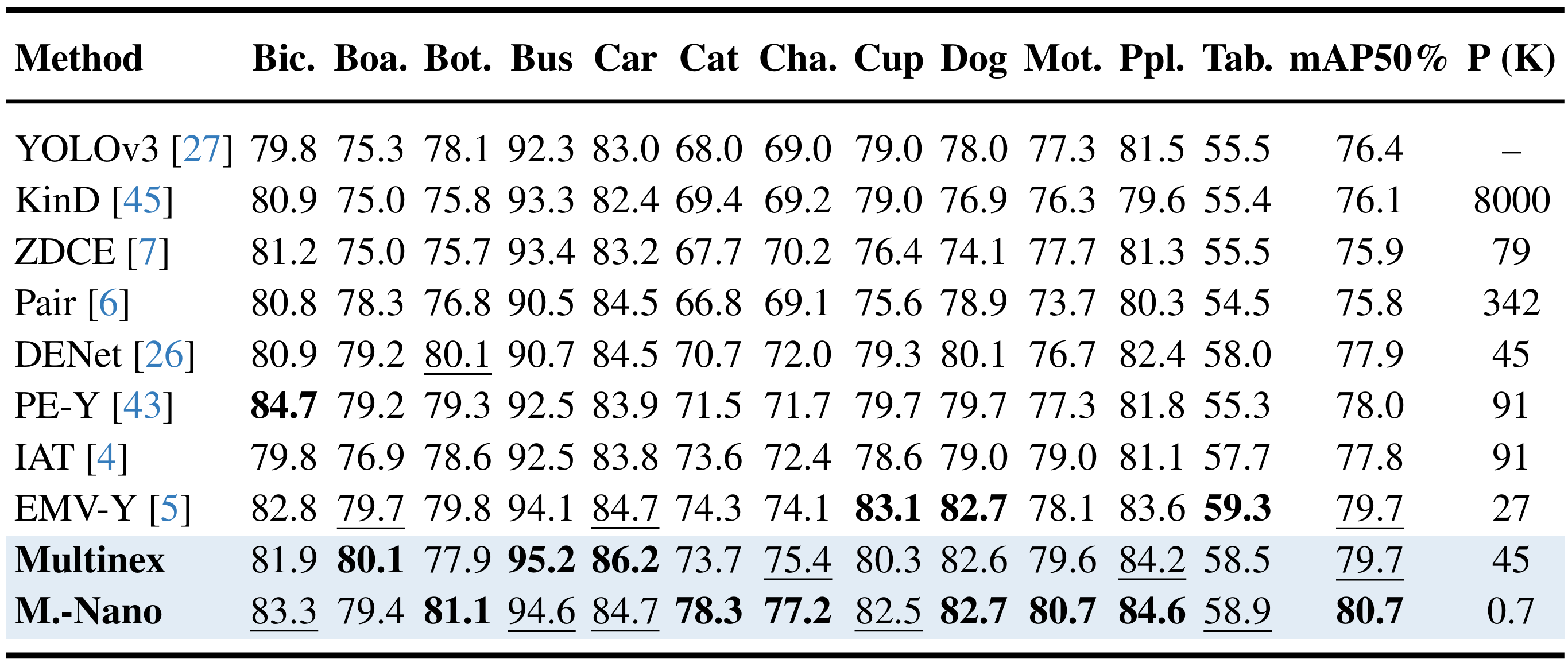
1. Create Environment
We use a PyTorch 2 environment.
1.1 Create the environment
conda create -n multinex python=3.9 -y
conda activate multinex
1.2 Install PyTorch 2
Example for CUDA 11.8:
# With Pip
pip install torch torchvision torchaudio --index-url https://download.pytorch.org/whl/cu118

# With Conda
conda install pytorch torchvision torchaudio pytorch-cuda=11.8 -c pytorch -c nvidia
Change this to accommodate your CUDA version requirements.
1.3 Install dependencies
pip install matplotlib scikit-learn scikit-image opencv-python yacs joblib natsort h5py tqdm tensorboard
pip install einops gdown addict future lmdb numpy pyyaml requests scipy yapf lpips thop timm pytorch_msssim
1.4 Install BasicSR
pip install -e .
Please Note: python setup.py develop has been deprecated. As a result, the above installation is recommended. With this in mind, using basicsr must be done as python -m basicsr.<filename> rather than python basicsr/<filename>.py.
2. Prepare Dataset
Download the LOLv1 and LOLv2 datasets:
LOLv1 - Google Drive
LOLv2 - Google Drive
Organize the datasets as follows:
Dataset structure
data/
├── LOLv1/
│   ├── Train/
│   │   ├── input/
│   │   └── target/
│   └── Test/
│       ├── input/
│       └── target/
└── LOLv2/
    ├── Real_captured/
    │   ├── Train/
    │   │   ├── Low/
    │   │   └── Normal/
    │   └── Test/
    │       ├── Low/
    │       └── Normal/
    └── Synthetic/
        ├── Train/
        │   ├── Low/
        │   └── Normal/
        └── Test/
            ├── Low/
            └── Normal/
3. Testing
Model weights are available under pretrained_weights/, and are contained within the repository due to their small file sizes (280 KB for Multinex, 20 KB for Multinex-Nano). These weights are Model Materials covered by the non-commercial license notice in pretrained_weights/README.md and MODEL_CARD.md.
Note: No-reference checkpoints correspond to results reported in the updated ArXiv version, for models indicated with _dagger ($^\dagger$)
Multinex
# LOL-v1
python Enhancement/test.py --opt Options/Multinex_LOL-v1.yaml --weights pretrained_weights/Multinex_LOL-v1.pth --dataset LOL-v1

# LOL-v2-real
python Enhancement/test.py --opt Options/Multinex_LOL-v2-real.yaml --weights pretrained_weights/Multinex_LOL-v2-real.pth --dataset LOL-v2-real

# LOL-v2-synthetic
python Enhancement/test.py --opt Options/Multinex_LOL-v2-synthetic.yaml --weights pretrained_weights/Multinex_LOL-v2-synthetic.pth --dataset LOL-v2-synthetic

# No-reference Datasets
python Enhancement/test_noref.py --opt Options/Multinex_LOL-v2-synthetic.yaml --weights pretrained_weights/Multinex_dagger_NoRef.pth --input_dirs data/DICM data/MEF data/NPE data/LIME --result_dir results/Multinex_NoRef
Multinex-Nano
# LOL-v1
python Enhancement/test.py --opt Options/Multinex-Nano_LOL-v1.yaml --weights pretrained_weights/Multinex-Nano_LOL-v1.pth --dataset LOL-v1

# LOL-v2-real
python Enhancement/test.py --opt Options/Multinex-Nano_LOL-v2-real.yaml --weights pretrained_weights/Multinex-Nano_LOL-v2-real.pth --dataset LOL-v2-real

# LOL-v2-synthetic
python Enhancement/test.py --opt Options/Multinex-Nano_LOL-v2-synthetic.yaml --weights pretrained_weights/Multinex-Nano_LOL-v2-synthetic.pth --dataset LOL-v2-synthetic

# No-reference Datasets
python Enhancement/test_noref.py --opt Options/Multinex-Nano_LOL-v2-synthetic.yaml --weights pretrained_weights/Multinex-Nano_dagger_NoRef.pth --input_dirs data/DICM data/MEF data/NPE data/LIME --result_dir results/Multinex-Nano_NoRef
Self-ensemble testing strategy
For stronger results, add --self_ensemble argument.
python Enhancement/test.py --opt Options/Multinex_LOL-v1.yaml --weights pretrained_weights/Multinex_LOLv1.pth --dataset LOL_v1 --self_ensemble
4. Training
Training is launched through the BasicSR entrypoint.
# Multinex on LOL-v1
python -m basicsr.train --opt Options/Multinex_LOL-v1.yaml

# Multinex on LOL-v2-real
python -m basicsr.train --opt Options/Multinex_LOL-v2-real.yaml

# Multinex on LOL-v2-synthetic
python -m basicsr.train --opt Options/Multinex_LOL-v2-synthetic.yaml

# Multinex-Nano on LOL-v1
python -m basicsr.train --opt Options/Multinex-Nano_LOL-v1.yaml

# Multinex-Nano on LOL-v2-real
python -m basicsr.train --opt Options/Multinex-Nano_LOL-v2-real.yaml

# Multinex-Nano on LOL-v2-synthetic
python -m basicsr.train --opt Options/Multinex-Nano_LOL-v2-synthetic.yaml
Note: For best results, use val.val_freq: 5 in the yaml configs under Options/ directory. This is especially useful for LOL-v1, where the size of the test set is small, and performance can vary significantly.
5. Citation
Cite our work if Multinex is useful to your research.
@inproceedings{multinex2026,
  title     = {Multinex: Lightweight Low-light Image Enhancement via Multi-prior Retinex},
  author    = {Alexandru Brateanu and Tingting Mu and Codruta O. Ancuti and Cosmin Ancuti},
  booktitle = {Proceedings of the IEEE/CVF Conference on Computer Vision and Pattern Recognition (CVPR)},
  year      = {2026}
}
License
Copyright (c) 2026 Alexandru Brateanu. Multinex is source-available for non-commercial research and educational use under the PolyForm Noncommercial License 1.0.0. It is not open-source software in the OSI sense, and commercial use is not permitted without a separate written license.
The public non-commercial license applies to original Multinex source code, model definitions, documentation, pretrained weights, checkpoints, configuration files, and related model materials authored by Alexandru Brateanu, unless otherwise stated. Third-party components remain under their original licenses; see THIRD_PARTY_NOTICES.md.
For clarity, "Model Materials" include model weights, checkpoints, adapters, LoRAs, tokenizer files, configuration files, architecture code, training and inference code, documentation, and any modified, merged, quantized, distilled, or fine-tuned versions. See MODEL_CARD.md for the model-specific license notice.
You may use, modify, and share Multinex only for permitted non-commercial purposes, such as:
- academic research
- personal study
- non-commercial experimentation
- reproducibility and benchmarking for non-commercial research
- teaching and educational use
Commercial use includes, but is not limited to:
- use by or for a for-profit company
- integration into a commercial product or service
- internal company research, prototyping, evaluation, or benchmarking
- paid consulting or client work
- SaaS/API deployment
- use in a startup, product pipeline, or revenue-generating system
- training, fine-tuning, or deploying models for commercial advantage
- use of Model Materials in or to support any customer deliverable, commercial R&D, hosted API, internal business process, or revenue-generating workflow
Commercial access is available only through collaboration, partnership, or a separate written commercial license. Commercial evaluation or production use requires a separate written agreement. See COMMERCIAL_USE.md for commercial collaboration options.
For commercial collaboration, contact:
Alexandru Brateanu
Email: [email protected]
This repository is provided as research software. No warranty is provided. See LICENSE for the full license terms and RELEASE_NOTES.md for the license-clarification release note.
Ähnliche Projekte entdecken
tensorflow/tensorflow
Ein Open-Source-Framework für maschinelles Lernen für alle
201,584 Sternehuggingface/transformers
🤗 Transformers: das Framework zur Modelldefinition für State-of-the-Art-Modelle des maschinellen Lernens in Text, Vision, Audio und multimodal, für Inferenz und Training.
168,917 SterneAUTOMATIC1111/stable-diffusion-webui
Web-UI für Stable Diffusion
165,300 SterneComfy-Org/ComfyUI
Die leistungsstärkste und modularste GUI, API und das Backend für Diffusionsmodelle mit einer Oberfläche aus Graphen und Knoten. Die schnellste lokale Inferenz-Engine der Welt.
146,472 Sterne