
YikaiZhang95/torchkm
YikaiZhang95/torchkm has 122 GitHub stars and 35 forks. GitHot measured 0 stars in 24 hours. Last checked 2026-11-13 03:28 UTC. Last push 2026-10-05.
So werden diese Zahlen gemessen
TorchKM is a GPU-accelerated PyTorch-based library for kernel machines including kernel SVM with a focus on fast and integrated train + tune workflows.
What you can do
- scikit-learn SVM - Tuning means an outer GridSearchCV loop that refits from scratch for every setting — minutes to hours. - Folds tuning into the algorithm and reuses matrix work across folds and settings. Often 100×+ faster end-to-end.
- ThunderSVM - Fast SVM fitting, but you still bolt on your own CV loop, and it's SVM-only. - One call trains and tunes; also does DWD, logistic, and quantile regression.
- A neural net for small tabular data - Overkill, finicky to train, poorly calibrated, no guarantees. - A convex model with a single global optimum, calibrated out of the box, strong on small/mid data.
- Raw scores / uncalibrated models - Your agent or rule engine can't reason about "how sure." - Calibrated probabilities you can threshold and trust.
Gemessener Sternzuwachs
- in 24h
- 0
- in 7 days
- Verlauf wird gesammelt
- in 15 days
- Verlauf wird gesammelt
- in 1 month
- Verlauf wird gesammelt
Nettoänderungen in überlappenden Zeiträumen, keine Tagessummen. Fehlende Messwerte bleiben leer. Sterne zeigen Interesse, nicht Qualität.
README.md
OriginalTorchKM: A GPU-Oriented Library for Kernel Learning and Model Selection


TorchKM is a GPU-accelerated PyTorch-based library for kernel machines including kernel SVM with a focus on fast and integrated train + tune workflows.
It delivers GPU-native and calibrated classifier for tabular data that your code, or your AI agent, can call, and verify.
You give it a table of rows and labels. It trains and tunes a kernel model in one call, on your GPU, and hands back a calibrated probability for each prediction. The result is the exact and provably optimal solution for the objective you asked for. That makes it what a program (or an LLM agent) can call as a trusted tool.
It uses a scikit-learn–style API, for easy integration into existing Python workflows. If you've used scikit-learn, the API will feel immediately familiar, just much faster, and built for the GPU.
Install
pip install torchkm
30 seconds to a calibrated prediction
from torchkm.estimators import TorchKMSVC

# X: your feature table (n rows x p columns), y: labels in {-1, 1}
clf = TorchKMSVC(kernel="rbf", cv=5, device="cuda", probability=True)
clf.fit(X_train, y_train)          # trains AND tunes (5-fold CV over 50 settings) in one call

clf.predict(X_new)                 # hard labels
clf.predict_proba(X_new)           # calibrated P(class) — a real confidence to threshold on
That's the whole loop: fit → predict_proba. No separate grid search, no manual cross-validation, no second library. Set device="cpu" if you don't have a GPU (same code, slower).
Use it from Claude Code, Codex, Cursor, or any AI agent
Paste this one line into your coding agent and let it wire up the rest:
"Install
torchkmand useTorchKMSVCto train a calibrated kernel classifier on my tabular data. Callfitto train and tune, then returnpredict_probafor new rows."
Because the call surface is tiny and the output is a real probability, an agent can use TorchKM as a reliable tool inside a larger workflow: classify a batch, read the confidence, decide what to do next without hallucinating a label.
Why a program — or an AI agent — can trust it
- Exact, not approximate. TorchKM returns the provably lowest-objective kernel-SVM solution. Same input → same, well-defined answer. A caller can rely on it.
- Calibrated probabilities.
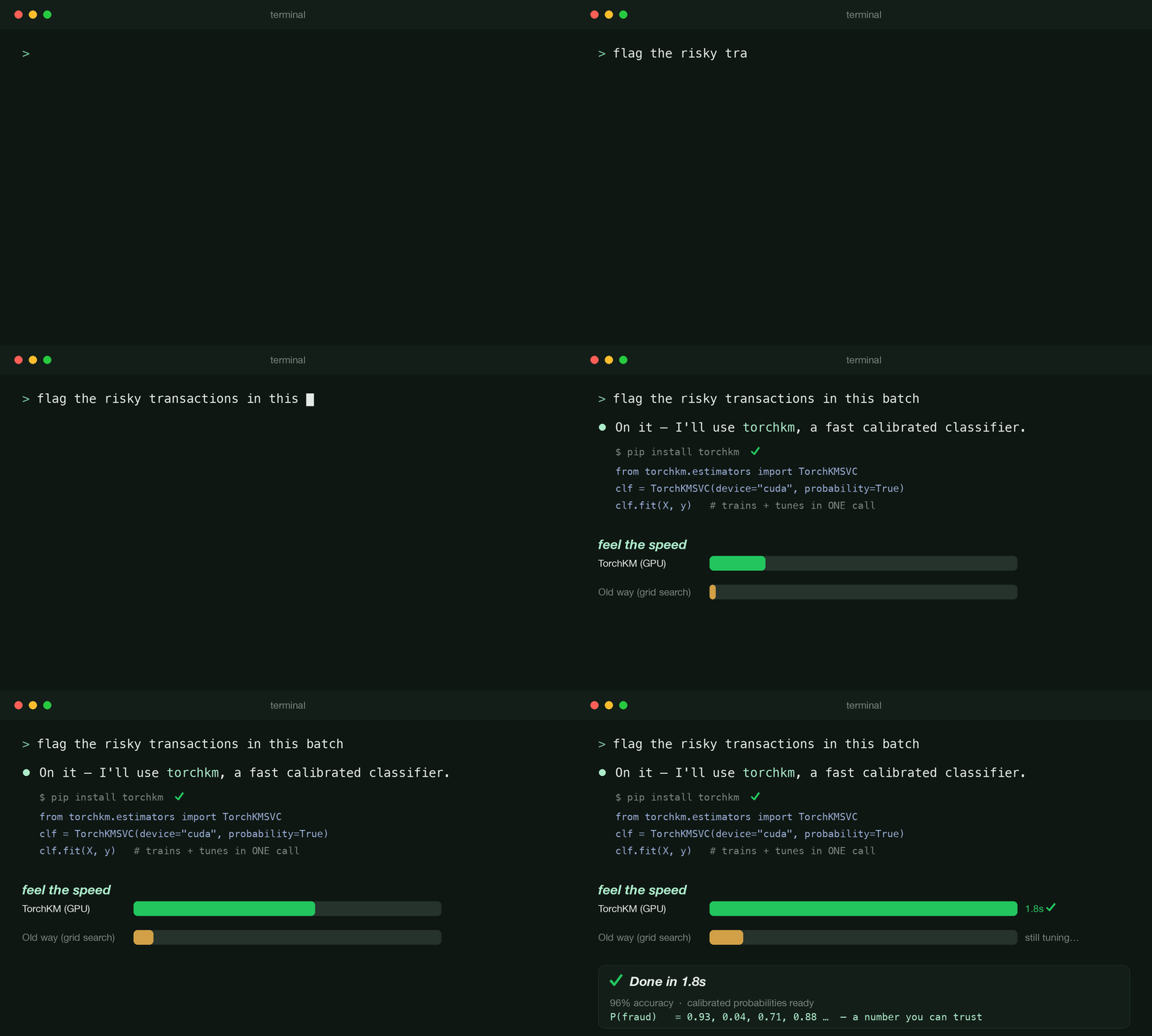
predict_proba(Platt scaling) gives a genuine confidence in[0, 1], not a raw score — so you can set thresholds, abstain when unsure, or route low-confidence cases to a human. - Fast enough to call in a loop. Full train + tune in tens of seconds on one GPU, where standard tools take minutes to hours (see chart above).
- GPU-native and light. Pure PyTorch/CUDA, a handful of dependencies, with a safe CPU fallback. No CUDA build steps, no C++ toolchain.
Why use TorchKM instead of what you have?
| You're using… | The pain | What TorchKM does |
|---|---|---|
scikit-learn SVM |
Tuning means an outer GridSearchCV loop that refits from scratch for every setting — minutes to hours. |
Folds tuning into the algorithm and reuses matrix work across folds and settings. Often 100×+ faster end-to-end. |
| ThunderSVM | Fast SVM fitting, but you still bolt on your own CV loop, and it's SVM-only. | One call trains and tunes; also does DWD, logistic, and quantile regression. |
| A neural net for small tabular data | Overkill, finicky to train, poorly calibrated, no guarantees. | A convex model with a single global optimum, calibrated out of the box, strong on small/mid data. |
| Raw scores / uncalibrated models | Your agent or rule engine can't reason about "how sure." | Calibrated probabilities you can threshold and trust. |
On small-to-mid tabular datasets (roughly hundreds to a few hundred thousand rows), well-tuned kernel methods are still some of the most accurate models there are, and they come with a calibrated probability and a convex, reproducible solution. TorchKM makes the tuning, usually the slow part, very efficient.
Where people use it
Click to expand: example application areas across domains
Anywhere you have a table of rows and want an accurate, calibrated yes/no (or a conditional quantile), especially when the dataset is small-to-mid sized and you care that the model is well-tuned and trustworthy:
Healthcare & life sciences
- Disease / readmission / adverse-event risk from clinical and lab features, where a calibrated probability matters more than a raw score.
- Bioinformatics classification (gene expression, omics, sequence-derived features): a classic stronghold of kernel methods on wide, small-sample data.
- Drug-response and compound-activity (active/inactive) screening.
Finance & risk
- Credit default, fraud, and churn scoring where you need a probability to set a decision threshold or expected-loss cutoff.
- Quantile regression for value-at-risk and prediction intervals (
TorchKMKQR).
Industry & operations
- Predictive maintenance: pass/fail and time-to-failure from sensor features.
- Manufacturing QC and anomaly flagging on tabular process data.
- Demand or load quantile forecasting for capacity planning.
Security & trust
- Spam, phishing, malware, and intrusion detection on engineered features.
- Bot / abuse classification where calibrated confidence drives auto-block vs. review.
Marketing & product
- Lead scoring, propensity-to-buy, conversion and retention prediction.
- A/B segment classification on behavioral features.
Science & engineering
- Materials and chemistry property classification on small experimental datasets.
- Remote-sensing / geospatial pixel classification on tabular feature vectors.
- Any lab setting where you have a few hundred to a few thousand measurements and want the most accurate model you can defend.
AI agents & tooling
- A callable classification tool for LLM agents: hand the agent a fast, calibrated classifier so it stops guessing on structured data and starts deciding on a real probability.
- A confidence gate in automated pipelines: act when
predict_probais high, escalate to a human when it isn't. - A cheap, reproducible second opinion to cross-check an LLM's structured-data judgments.
Scope note: TorchKM does binary classification (SVM, DWD, logistic) and kernel quantile regression today. For multiclass, wrap it one-vs-rest (a good first contribution — see below). It shines on small-to-mid tabular data; for millions of rows, use the built-in Nyström mode (
low_rank=True).
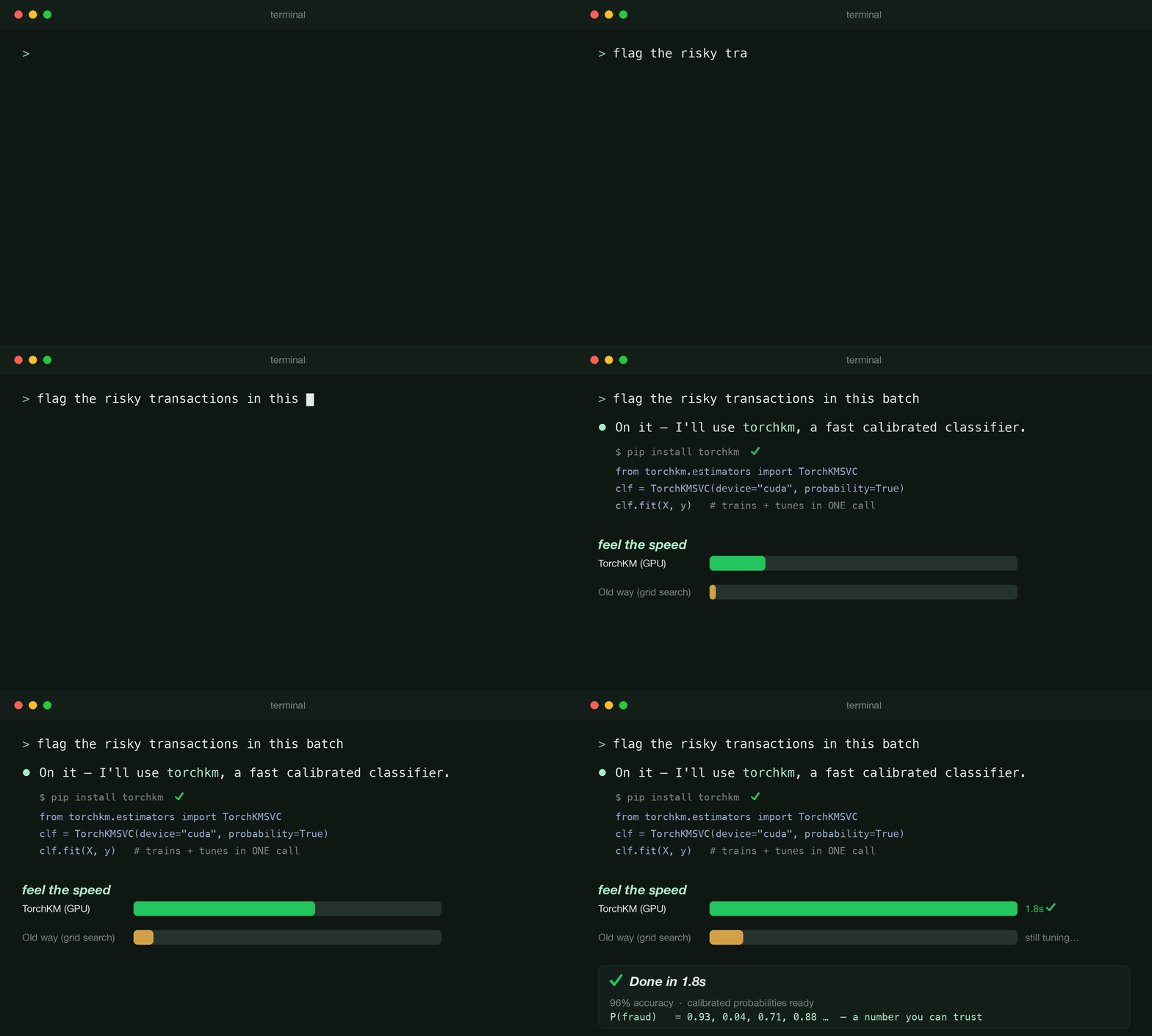
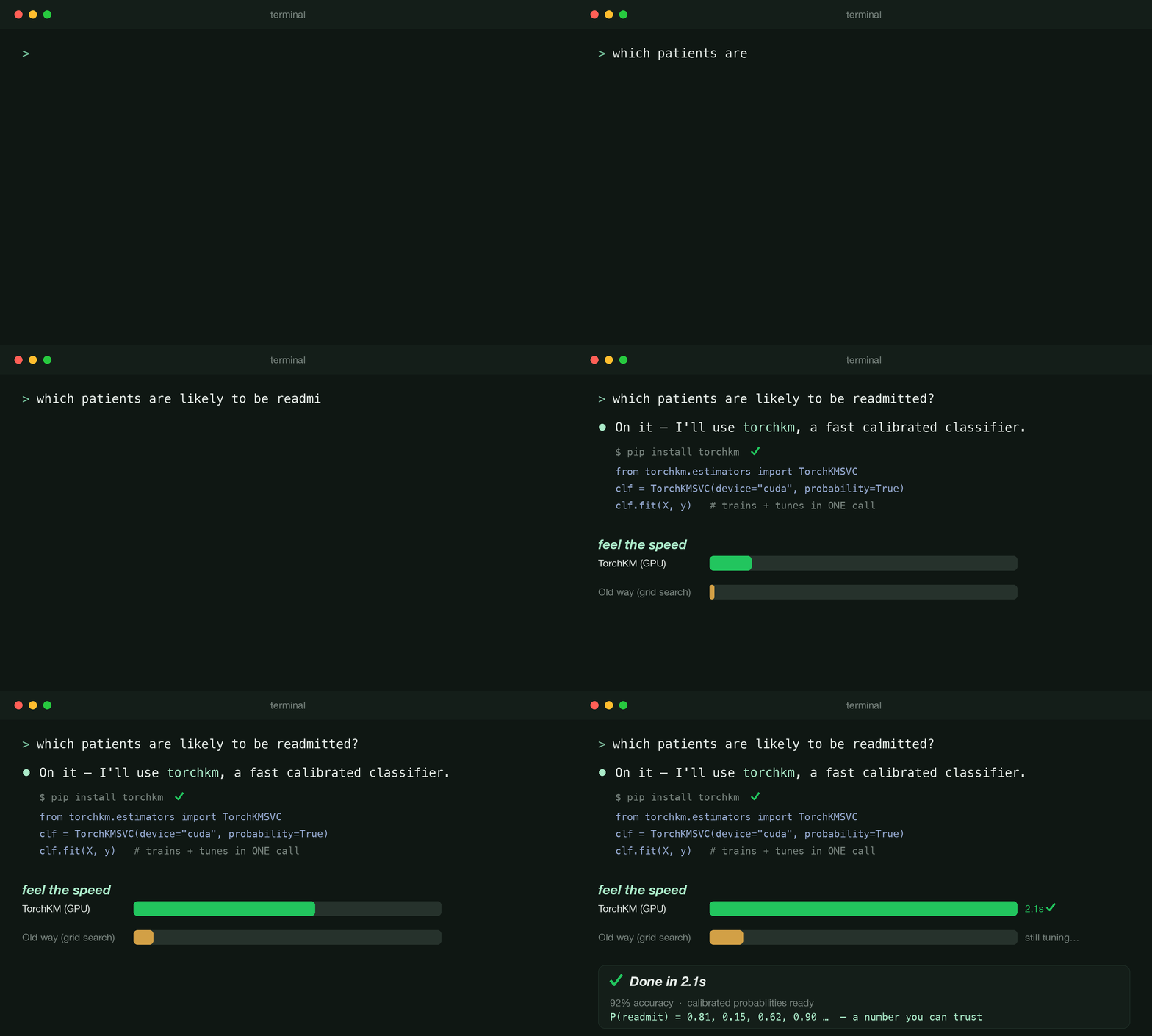
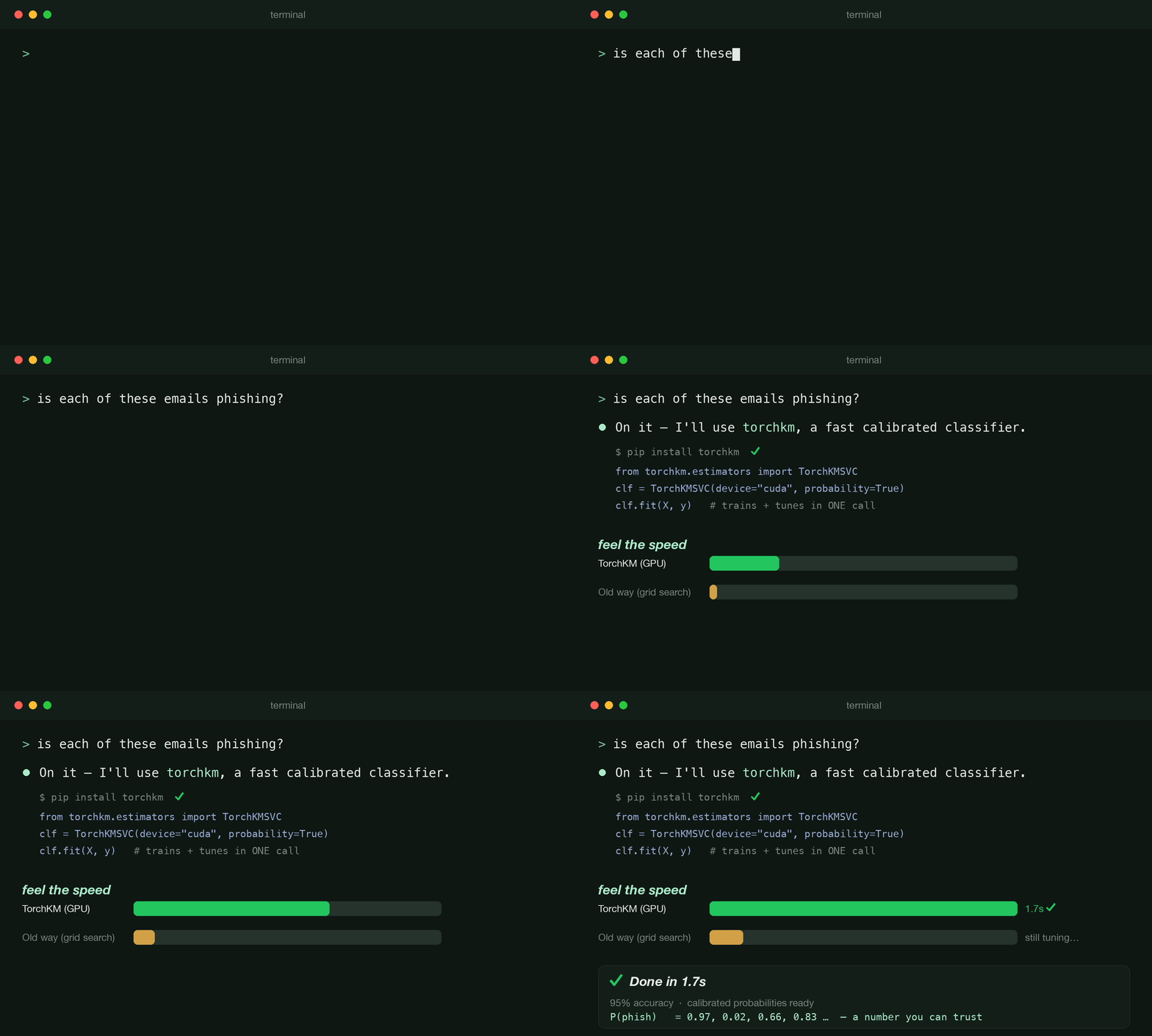
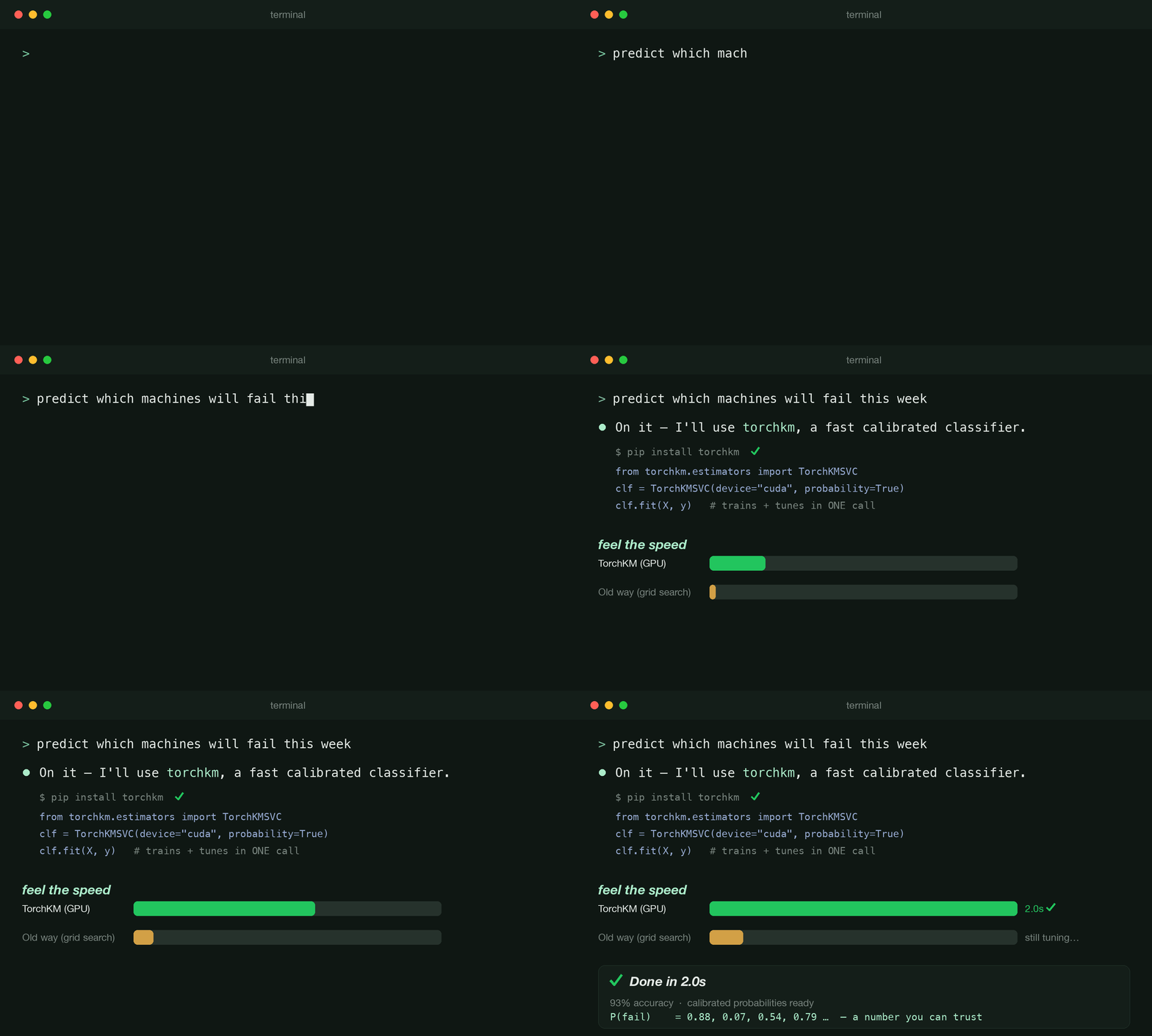
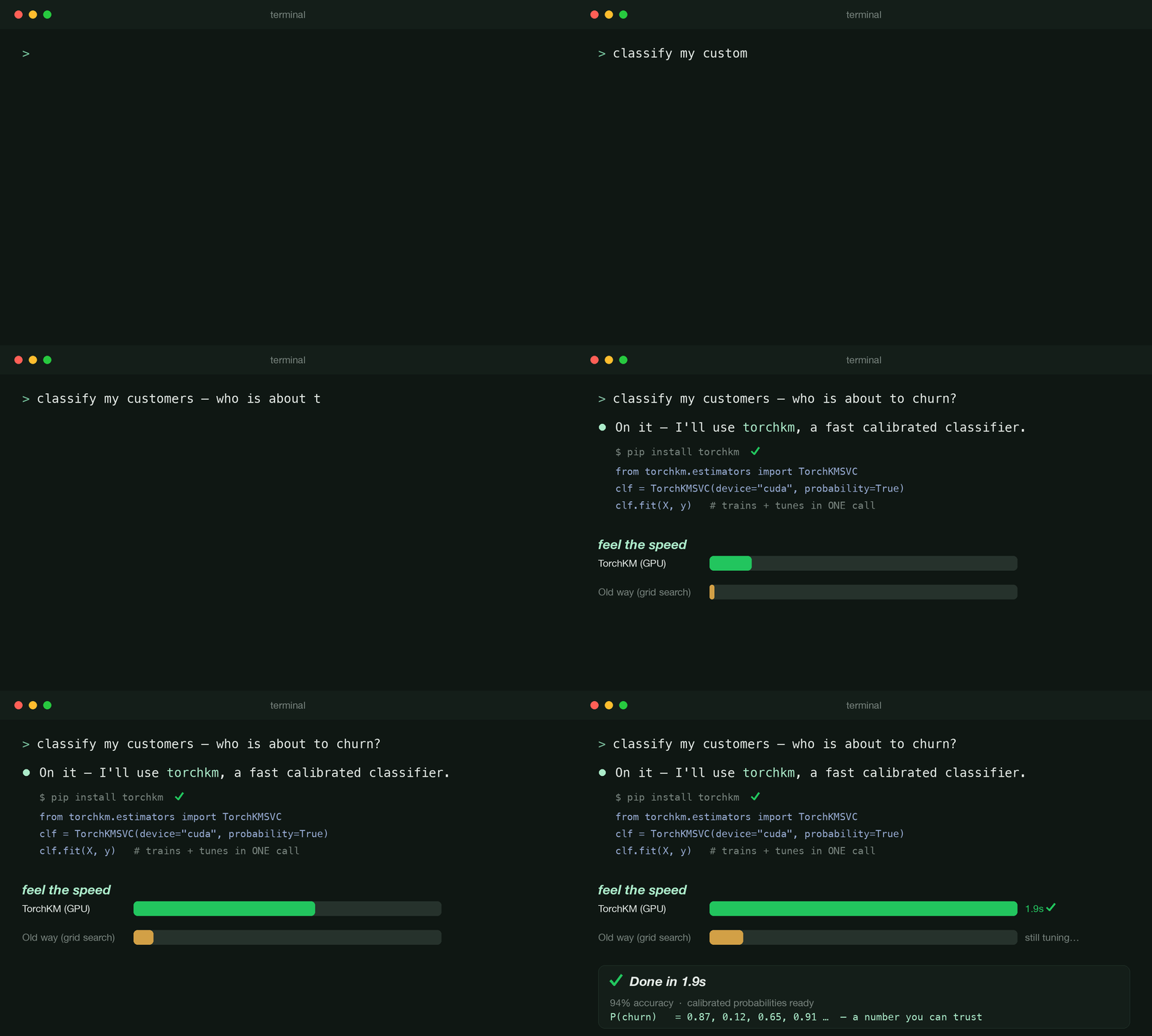
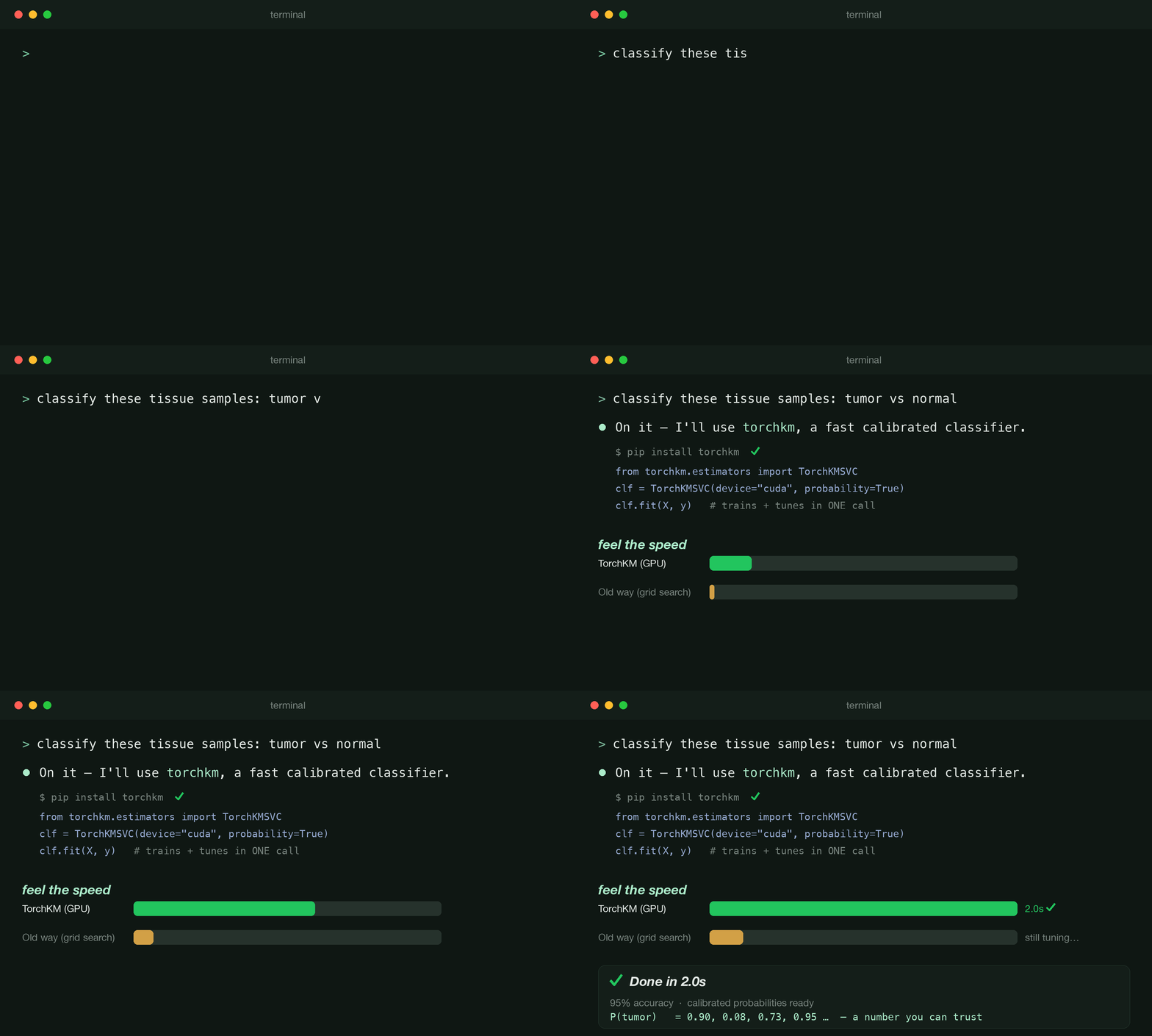
The same three lines, on different jobs. Ask in plain language, get a fast calibrated probability back:
| Finance — fraud | Healthcare — readmission |
|---|---|
 |
 |
| Security — phishing | Industry — predictive maintenance |
 |
 |
| Marketing — churn | Life sciences — tumor vs normal |
 |
 |
What's inside
scikit-learn-style estimators: same fit / predict / predict_proba interface across all of them:
| Estimator | Task |
|---|---|
TorchKMSVC |
kernel SVM classifier |
TorchKMDWD |
kernel distance-weighted discrimination classifier |
TorchKMLogit |
kernel logistic regression |
TorchKMKQR |
kernel quantile regression |
Common methods: fit(X, y), predict(X), decision_function(X), predict_proba(X) (when probability=True), platt_plot(X, y).
Kernels: rbf (default) and poly. Utilities: rbf_kernel, kernelMult, sigest, standardize, data_gen.
Key benefits, in one place:
- Integrated train + tune — pathwise solutions over a grid of regularization values (
Cs) with cross-validation built in, not bolted on. - Exact cross-validation for kernel machines (including exact LOOCV for kernel SVM).
- GPU acceleration via PyTorch/CUDA, with safe CPU fallback.
- Nyström low-rank mode (
low_rank=True) for large datasets. - Calibrated probabilities via Platt scaling.
How it's so fast
In a normal workflow the slow part isn't fitting one model. It's refitting the model for every cross-validation fold and every tuning value. TorchKM avoids that: it reuses one kernel computation across all folds and settings (an exact cross-validation formula plus a single eigendecomposition reused along the regularization path). You still get the exact solution, without paying for it 500 times.
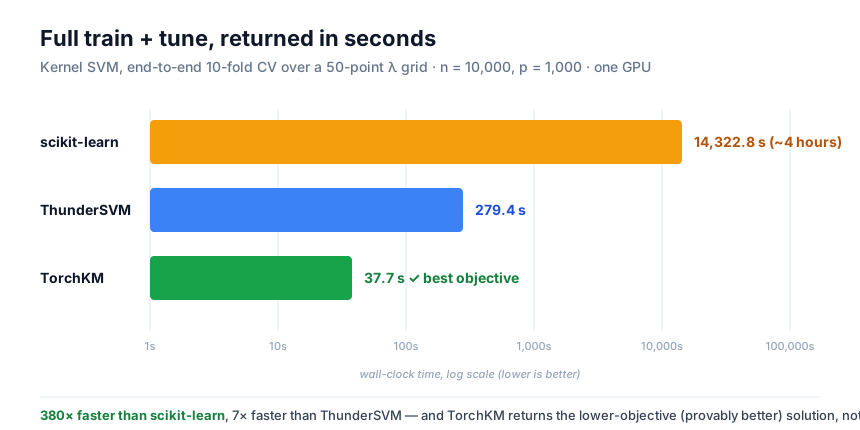
The result, from the paper's benchmarks (one GPU, full train + tune, 10-fold CV over 50 settings):
| Dataset | scikit-learn | ThunderSVM | TorchKM |
|---|---|---|---|
| n=10,000, p=1,000 | 14,322.8 s (~4 h) | 279.4 s | 37.7 s |
| n=20,000, p=1,000 | did not finish in 8 h | 580.8 s | 129.3 s |
In every case TorchKM also reached the best (lowest) objective, i.e. a provably better solution, not just a faster one.
More examples
Larger datasets — Nyström low-rank mode
clf = TorchKMSVC(
    kernel="rbf",
    low_rank=True, num_landmarks=40, nys_k=20,
    cv=5, device="cuda", probability=True,
)
clf.fit(X_train, y_train)
You can also enable it at fit time: clf.fit(X, y, low_rank=True, num_landmarks=40, nys_k=20).
Kernel quantile regression
from torchkm.estimators import TorchKMKQR

qr = TorchKMKQR(kernel="rbf", cv=3, tau=0.5, device="cuda")  # tau = the quantile
qr.fit(X_train, y_train)
qr.predict(X_new)
Use TorchKMKQR(low_rank=True) for the Nyström approximation on large data. (There is no separate TorchKMNysKQR class.)
Probabilities
Set probability=True to enable Platt scaling and predict_proba. platt_plot(X, y) visualizes the calibration.
Device
import torch
device = "cuda" if torch.cuda.is_available() else "cpu"
TorchKM runs on GPU when CUDA is available and falls back safely to CPU otherwise.
Documentation
Full docs, API reference, tutorials, and benchmark-reproduction notes: https://yikaizhang95.github.io/torchkm/
Development install
git clone https://github.com/YikaiZhang95/torchkm.git
cd torchkm
pip install -e ".[dev,examples,viz]"
python -m pytest -q
Testing and coverage
python -m pytest -q
CI runs the CPU-safe suite across Python 3.10, 3.11, and 3.12, and enforces a minimum 90% coverage on 3.11. The most recent CUDA validation reports 214 tests passed and 98% coverage on an NVIDIA L40S. CUDA smoke tests (pytest.mark.cuda) skip automatically when CUDA is unavailable; run them with python -m pytest -q -m cuda.
Contributing
Issues, bug reports, benchmarks, docs, and pull requests are welcome — see CONTRIBUTING.md.
Good first contributions:
- additional kernels
- a multiclass (one-vs-rest) wrapper
- more benchmark scripts
- expanded examples and tutorials
Citation
If you use TorchKM in academic work, please cite:
@article{zhang2026torchkm,
  title   = {TorchKM: A GPU-Oriented Library for Kernel Learning and Model Selection},
  author  = {Zhang, Yikai and Jia, Gaoxiang and Ding, Jie and Wang, Boxiang},
  year    = {2026},
  url    = {https://arxiv.org/pdf/2606.06742}
}
License
MIT License. See LICENSE.
Contact
Yikai Zhang — [email protected]
Ähnliche Projekte entdecken
tensorflow/tensorflow
Ein Open-Source-Framework für maschinelles Lernen für alle
201,584 Sternehuggingface/transformers
🤗 Transformers: das Framework zur Modelldefinition für State-of-the-Art-Modelle des maschinellen Lernens in Text, Vision, Audio und multimodal, für Inferenz und Training.
168,917 SterneAUTOMATIC1111/stable-diffusion-webui
Web-UI für Stable Diffusion
165,300 SterneComfy-Org/ComfyUI
Die leistungsstärkste und modularste GUI, API und das Backend für Diffusionsmodelle mit einer Oberfläche aus Graphen und Knoten. Die schnellste lokale Inferenz-Engine der Welt.
146,472 Sterne