
WarBean/tps_stn_pytorch
WarBean/tps_stn_pytorch has 956 GitHub stars and 154 forks. Star changes are not measured yet. Last checked 2026-11-14 13:22 UTC. Last push 2021-07-15.
Gemessener Sternzuwachs
- in 24h
- Verlauf wird gesammelt
- in 7 days
- Verlauf wird gesammelt
- in 15 days
- Verlauf wird gesammelt
- in 1 month
- Verlauf wird gesammelt
Nettoänderungen in überlappenden Zeiträumen, keine Tagessummen. Fehlende Messwerte bleiben leer. Sterne zeigen Interesse, nicht Qualität.
Über uns
PyTorch implementation of Spatial Transformer Network (STN) with Thin Plate Spline (TPS)
Maschinelles LernenREADME.md
Originaltps_stn_pytorch
PyTorch implementation of Spatial Transformer Network (STN) with Thin Plate Spline (TPS).

Introduction
STN is a powerful neural network architecture proposed by DeepMind in [1]. STN achieves real spatial invariance by automatically rectify input images before they are feeded into a normal classification network. The most amazing part of STN is that it is end-to-end differential and can be directly plugged into existing network architectures (AlexNet, Resnet, etc), without any extra supervision.
Original STN paper [1] experiments on three specific transformation forms: Affine Transformation, Projective Transformation and Thin Plate Spline Transformation (TPS). Among them I think TPS is the most powerful translation because it can warp a image in arbitrary way. As shown below, I can warp my Avatar

into

TPS-STN has been used in OCR application [2]. In this paper TPS-STN is to automatically rectify distorted text images, before they are feeded into a normal OCR text recognition model:

Dependencies
- Python3
- PyTorch
- Torchvision
- Numpy
- Matplotlib
- Pillow / PIL
- imageio
I use imageio to create GIF visualization. Simply install it by pip install imageio.
Run
python mnist_train.py --model unbounded_stn --angle 90 --grid_size 4
python mnist_visualize.py --model unbounded_stn --angle 90 --grid_size 4
python mnist_make_gif.py --model unbounded_stn --angle 90 --grid_size 4
Then PNG and GIF resutls will be saved in ./image/unbounded_stn_angle60_grid4/ and ./gif/unbounded_stn_angle60_grid4/.
You can try other combinations of model architecture, mnist random rotation angle and TPS grid size. Details below.
Arguments
There are three controllable arguments: --model, --angle, --grid_size.
--model: str, required
- With
no_stn, STN module is discarded and only a single CNN classifier remains. - With
bounded_stn, the output of localization network is squeezed to [-1, 1] byF.tanh, as was done in [2] - With
unbounded_stn, the output of locolizaition network is not squeezed
--angle: int, default = 60
- Samples in MNIST dataset will be rotated by random angles within
[-angle, angle]
--grid_size: int, default = 4
- Use
(grid_size x grid_size)control points to define Thin Plate Spline transformation
Test Accuracy Curves

Visualize TPS-STN
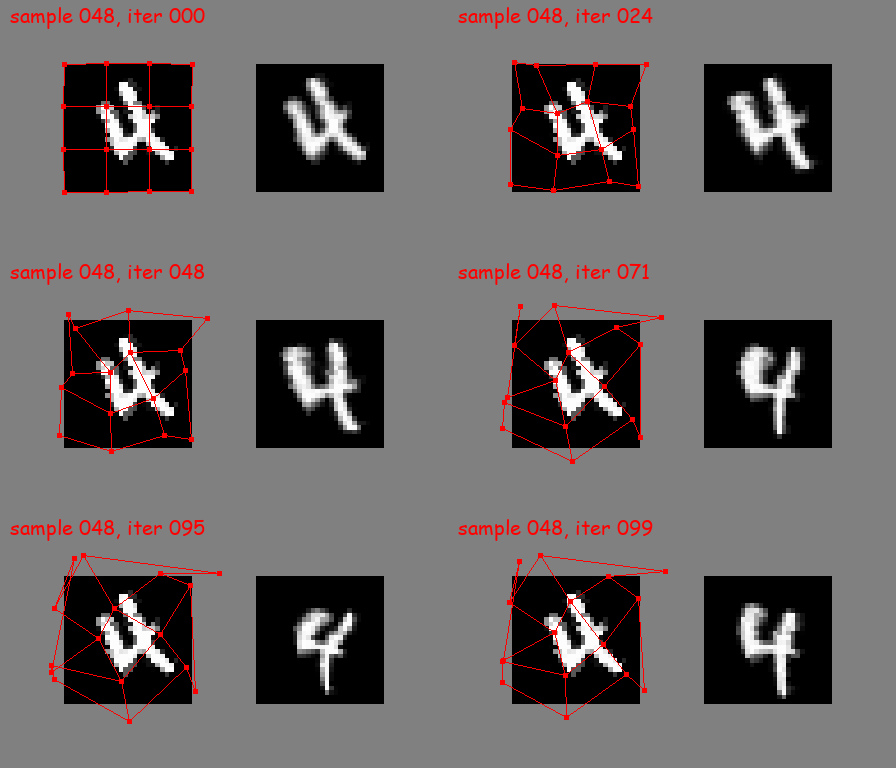
Results with angle = 90 are generally bad:


Results with bounded_stn are bad if grid_size <= 3:


But ok if grid_size >= 4:


Results with unbounded_stn are ok:


Of course there are always bad cases in each combination. You can download all my GIFs from Baidu Netdisk (file size 2G).
Reference
[1] Spatial Transformer Networks
[2] Robust Scene Text Recognition with Automatic Rectification