
Shark-NLP/OpenICL
Shark-NLP/OpenICL has 588 GitHub stars and 32 forks. GitHot measured 0 stars in 24 hours, 0 in 7 days, and 0 in 15 days. Last checked 2026-11-12 12:37 UTC. Last push 2023-10-03.
So werden diese Zahlen gemessen
OpenICL is an open-source framework to facilitate research, development, and prototyping of in-context learning.
Gemessener Sternzuwachs
- in 24h
- 0
- in 7 days
- 0
- in 15 days
- 0
- in 1 month
- Aktualisierung verzögert
Nettoänderungen in überlappenden Zeiträumen, keine Tagessummen. Fehlende Messwerte bleiben leer. Sterne zeigen Interesse, nicht Qualität.
README.md
Original
Overview • Installation • Paper • Examples • Docs • Citation

Overview
OpenICL provides an easy interface for in-context learning, with many state-of-the-art retrieval and inference methods built in to facilitate systematic comparison of LMs and fast research prototyping. Users can easily incorporate different retrieval and inference methods, as well as different prompt instructions into their workflow.
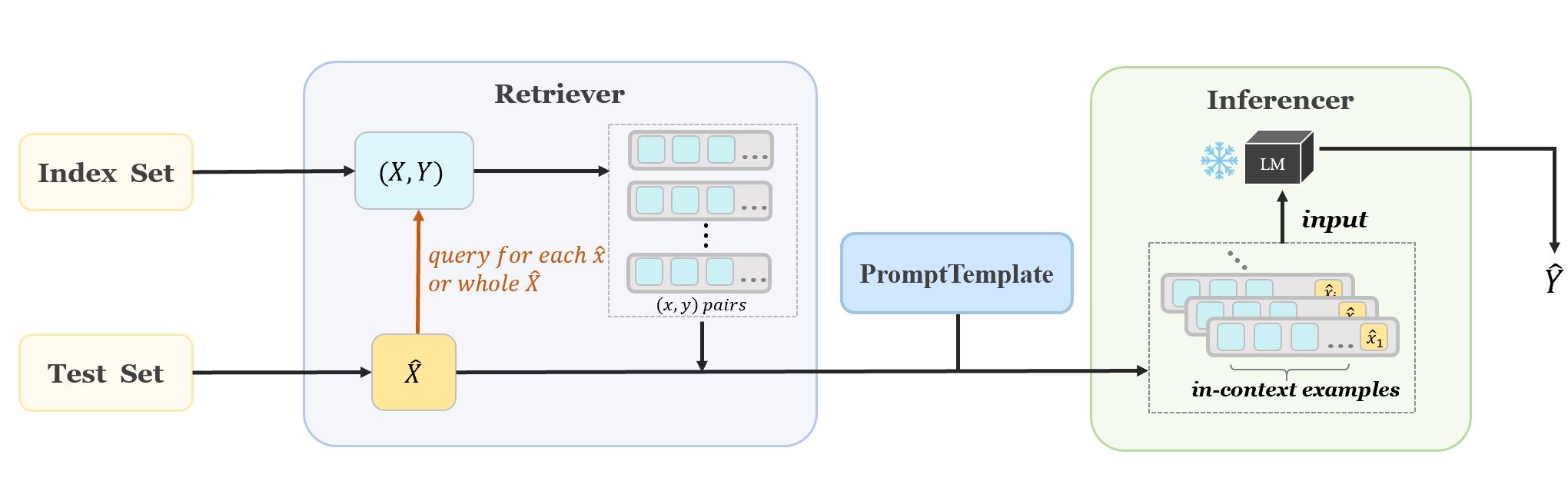
What's News
- v0.1.8 Support LLaMA and self-consistency
Installation
Note: OpenICL requires Python 3.8+
Using Pip
pip install openicl
Installation for local development:
git clone https://github.com/Shark-NLP/OpenICL
cd OpenICL
pip install -e .
Quick Start
Following example shows you how to perform ICL on sentiment classification dataset. More examples and tutorials can be found at examples
Step 1: Load and prepare data
from datasets import load_dataset
from openicl import DatasetReader

# Loading dataset from huggingface
dataset = load_dataset('gpt3mix/sst2')

# Define a DatasetReader, with specified column names where input and output are stored.
data = DatasetReader(dataset, input_columns=['text'], output_column='label')
Step 2: Define the prompt template (Optional)
from openicl import PromptTemplate
tp_dict = {
    0: "</E>Positive Movie Review: </text>",
    1: "</E>Negative Movie Review: </text>"
}

template = PromptTemplate(tp_dict, {'text': '</text>'}, ice_token='</E>')
The placeholder </E> and </text> will be replaced by in-context examples and testing input, respectively. For more detailed information about PromptTemplate (such as string-type template) , please see tutorial1.
Step 3: Initialize the Retriever
from openicl import TopkRetriever
# Define a retriever using the previous `DataLoader`.
# `ice_num` stands for the number of data in in-context examples.
retriever = TopkRetriever(data, ice_num=8)
Here we use the popular TopK method to build the retriever.
Step 4: Initialize the Inferencer
from openicl import PPLInferencer
inferencer = PPLInferencer(model_name='distilgpt2')
Step 5: Inference and scoring
from openicl import AccEvaluator
# the inferencer requires retriever to collect in-context examples, as well as a template to wrap up these examples.
predictions = inferencer.inference(retriever, ice_template=template)
# compute accuracy for the prediction
score = AccEvaluator().score(predictions=predictions, references=data.references)
print(score)
Docs
(updating...)
Citation
If you find this repository helpful, feel free to cite our paper:
@article{wu2023openicl,
  title={OpenICL: An Open-Source Framework for In-context Learning},
  author={Zhenyu Wu, Yaoxiang Wang, Jiacheng Ye, Jiangtao Feng, Jingjing Xu, Yu Qiao, Zhiyong Wu},
  journal={arXiv preprint arXiv:2303.02913},
  year={2023}
}
Ähnliche Projekte entdecken
sindresorhus/awesome
😎 Awesome-Listen zu allen möglichen interessanten Themen [HINWEIS: Pull Requests sind vorübergehend deaktiviert, bis ich dazu komme, die vorhandenen abzuarbeiten]
535,958 SterneEbookFoundation/free-programming-books
:books: Frei verfügbare Programmierbücher
401,496 Sternenilbuild/developer-roadmap
Interaktive Roadmaps, Leitfäden und weitere Bildungsinhalte, die Entwicklern helfen, in ihrer Karriere zu wachsen.
371,915 Sternevinta/awesome-python
Die maßgebliche Liste, die die Frage beantwortet: „Ich möchte X in Python machen – welches Tool soll ich verwenden?“
334,331 Sterne