
NX-AI/KronLSTM
NX-AI/KronLSTM has 64 GitHub stars and 8 forks. GitHot measured 0 stars in 24 hours. Last checked 2026-11-14 21:51 UTC. Last push 2026-10-20.
Gemessener Sternzuwachs
- in 24h
- 0
- in 7 days
- Verlauf wird gesammelt
- in 15 days
- Verlauf wird gesammelt
- in 1 month
- Verlauf wird gesammelt
Nettoänderungen in überlappenden Zeiträumen, keine Tagessummen. Fehlende Messwerte bleiben leer. Sterne zeigen Interesse, nicht Qualität.
Über uns
Flash-linear-attention compatible KronLSTM model and kernels by NXAI.
Maschinelles LernenREADME.md
OriginalKronLSTM


Triton kernels and a PyTorch layer for KronLSTM, from the paper Kronecker Delta Rule for Long Context Linear Attention (arXiv:2610.26834).
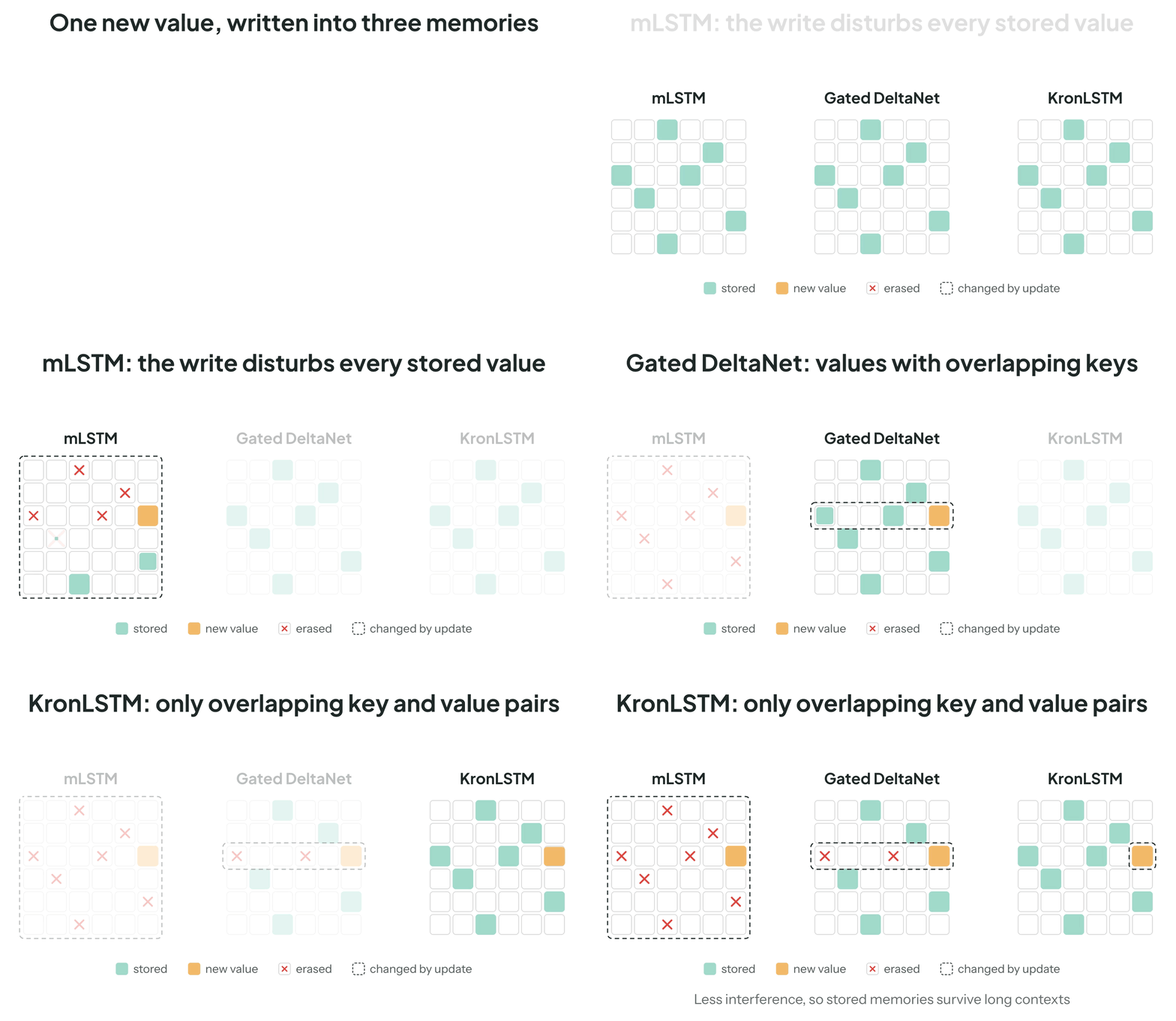
KronLSTM is a linear-attention recurrence whose matrix state $\mathbf{S}\in\mathbb{R}^{K\times V}$ is written along one rank-one Kronecker key $\mathbf{k}_t\mathbf{v}_t^\top$ per step. A scalar write strength closes the residual between what the state already stores for the pair and a target:
\begin{aligned}
y_t &= \mathbf{k}_t^\top \mathbf{D}_t\mathbf{S}_{t-1}\mathbf{v}_t, & \mathbf{D}_t &= \mathrm{Diag}(e^{\mathbf{g}_t}) \\
u_t &= \beta^*_t\,(c_t\lVert\mathbf{v}_t\rVert^2 - y_t), & \beta^*_t &= s\,\beta_t/\lVert\mathbf{v}_t\rVert^2 \\
\mathbf{S}_t &= \mathbf{D}_t\mathbf{S}_{t-1} + u_t\,\mathbf{k}_t\mathbf{v}_t^\top, & \mathbf{o}_t &= \text{scale}\cdot\mathbf{q}_t^\top\mathbf{S}_t
\end{aligned}
with a unit-norm key and query, an erase gate $\beta_t\in[0,1]$, a write (target) gate $c_t\in[0,1]$, $s=2$ under allow_neg_eigval and $s=1$ otherwise, and a decay $\mathbf{g}_t\le 0$ per key dimension or per head. On $\mathrm{vec}(\mathbf{S})$ this is the gated delta rule with key $\mathrm{vec}(\mathbf{k}_t\mathbf{v}_t^\top)$, so training uses the chunkwise WY/UT form of GDN-2 and KDA without ever forming the $KV$-dimensional keys. decouple_erase, on by default in the layer, takes $\beta_t$ off the write so that it gates the erase only; the kernel README contains this and the other variants, the chunkwise derivation, the kernel list and the numerics.
Contents
This repository is a snapshot of FLA at 78a39922 with KronLSTM added in FLA's layout. Everything else is FLA as of that commit. KronLSTM is intended to be integrated to FLA in the future.
| Path | Contents |
|---|---|
fla/ops/kronlstm/ |
chunk_kronlstm (training: chunkwise forward and backward), fused_recurrent_kronlstm (inference: token-by-token forward), and the naive PyTorch references |
fla/layers/kronlstm.py |
the KronLSTM token-mixing layer |
fla/models/kronlstm/ |
KronLSTMConfig, KronLSTMModel and KronLSTMForCausalLM: the paper's language model, optionally with sliding-window attention layers |
tests/ops/test_kronlstm.py, tests/layers/test_kronlstm_layer.py, tests/models/test_modeling_kronlstm.py |
tests of the kernels against the references, of the layer, and of the model |
benchmarks/ops/registry.py |
chunk_kronlstm and fused_recurrent_kronlstm in FLA's benchmark runner |
Pretrained models
The paper's language models, each trained on 100B tokens with the Llama-2 tokenizer, are on the Hugging Face Hub:
| Model | Layers | Context |
|---|---|---|
| KronLSTM-1.5B-100B | 24 KronLSTM | 8K |
| KronLSTM-1.5B-100B-32k | 24 KronLSTM | 32K |
| KronLSTM-SWA-1.5B-100B | 20 KronLSTM + 4 sliding-window attention (window 2048, no positional encoding) | 8K |
| KronLSTM-SWA-1.5B-100B-32k | 20 KronLSTM + 4 sliding-window attention (window 2048, no positional encoding) | 32K |
The 8K models are trained on FineWeb-Edu. The 32K models branch from the 8K runs after 75B tokens and train the remaining 25B at 32K context on a long-document mixture from ProLong-64k.
Installation
git clone https://github.com/NX-AI/KronLSTM.git
cd KronLSTM
pip install -e ".[cuda]"
The package keeps FLA's distribution name, flash-linear-attention, and its import name, fla, so it replaces any FLA installed in the same environment. INSTALL.md covers FLA's other install routes.
Models with attention layers, such as the hybrid pretrained models, also need FlashAttention, which FLA's attention layer runs on:
pip install flash-attn --no-build-isolation
KronLSTM was developed and tested on NVIDIA Hopper (H100) and Ampere (A100) GPUs with PyTorch 2.13 and Triton 3.7.1 (the CUDA 13.0 build of PyTorch on H100, the CUDA 12.6 build on A100). Other GPUs and backends are untested.
Usage
A pretrained model, through transformers' Auto classes, which import fla registers KronLSTM with:
import torch
from transformers import AutoModelForCausalLM, AutoTokenizer

import fla  # noqa: F401

tokenizer = AutoTokenizer.from_pretrained('NX-AI/KronLSTM-1.5B-100B')
model = AutoModelForCausalLM.from_pretrained('NX-AI/KronLSTM-1.5B-100B', dtype=torch.bfloat16).cuda().eval()
A new model: KronLSTMConfig() is the paper's 1.5B configuration (24 layers, hidden size 2048, 16 heads of dimension 128), and KronLSTMForCausalLM(config) initialises it as the paper's models were initialised. attn places softmax attention at chosen layers, as in FLA's other hybrid models; the paper's hybrids use
from fla.models import KronLSTMConfig, KronLSTMForCausalLM

config = KronLSTMConfig(attn={'layers': [5, 11, 17, 23], 'num_heads': 16, 'window_size': 2049, 'use_rope': False})
model = KronLSTMForCausalLM(config)
use_rope=False is KronLSTM's addition to FLA's attention specification: attention without positional encoding. window_size counts the attending token itself, so 2049 attends to the token and the 2048 before it.
The layer:
import torch
from fla.layers import KronLSTM

layer = KronLSTM(hidden_size=1024, k_head_dim=128, v_head_dim=128, num_k_heads=8, num_v_heads=8)
layer = layer.to(device='cuda', dtype=torch.bfloat16)
x = torch.randn(2, 2048, 1024, device='cuda', dtype=torch.bfloat16, requires_grad=True)
o, _, _ = layer(x)
o.sum().backward()
The projections keep nn.Linear's default init. A framework that applies its own init should call layer.reset_gate_parameters() afterwards: it re-initialises the parameters whose init is the layer's own (the decay's A_log and dt_bias, and the output gate's bias and weights). A_log, dt_bias, every bias and the norm weights are marked _no_weight_decay. The layer also takes a [B, T] padding attention_mask, packed cu_seqlens, and FLA's cache for decoding; see its docstring.
The op:
import torch
import torch.nn.functional as F
from fla.ops.kronlstm import chunk_kronlstm

B, T, H, K, V = 2, 2048, 8, 128, 128
q = F.normalize(torch.randn(B, T, H, K, device='cuda'), dim=-1).to(torch.bfloat16)
k = F.normalize(torch.randn(B, T, H, K, device='cuda'), dim=-1).to(torch.bfloat16)
v = F.normalize(torch.randn(B, T, H, V, device='cuda'), dim=-1).to(torch.bfloat16)
beta = torch.rand(B, T, H, device='cuda', dtype=torch.bfloat16)
g = F.logsigmoid(torch.randn(B, T, H, K, device='cuda'))
o, final_state = chunk_kronlstm(q, k, v, g, beta, output_final_state=True, decouple_erase=False)
fused_recurrent_kronlstm takes the same arguments and runs the forward only, for decoding. Both ops take variable-length inputs packed along T with batch size 1 and cu_seqlens, as the other FLA ops do.
Tests and benchmarks
pytest tests/ops/test_kronlstm.py tests/layers/test_kronlstm_layer.py tests/models/test_modeling_kronlstm.py
python -m benchmarks.ops.run --op chunk_kronlstm chunk_kda chunk_gdn2
Each test shape compiles every autotuning config of the kernels, so the first run with an empty Triton cache takes about an hour on one H100. Later runs reuse the cache.
Limitations
chunk_kronlstmneeds head dims $K, V$ in $[16, 256]$, and runs at a fixed chunk length of 64;fused_recurrent_kronlstmneeds $K, V\le 256$.- With fp32 inputs,
chunk_kronlstmneeds $K\le 128$ or $V\le 128$. The layer passes q, k and v in its projections' dtype, so under bf16 autocast it runs the bf16 kernels at any supported head dims. - No context parallelism and no grouped value attention (
num_v_headsmust equalnum_k_heads).
Citation
If you use KronLSTM, please cite the paper, and FLA, which the kernels are built on:
@article{hartl2026kronlstm,
  title   = {Kronecker Delta Rule for Long Context Linear Attention},
  author  = {Hartl, Anamaria-Roberta and Z{\'o}lyomi, Levente and List, Michael and Klambauer, G{\"u}nter and B{\"o}ck, Sebastian and Hochreiter, Sepp},
  journal = {arXiv preprint arXiv:2610.26834},
  year    = {2026}
}

@software{yang2024fla,
  title  = {FLA: A Triton-Based Library for Hardware-Efficient Implementations of Linear Attention Mechanism},
  author = {Yang, Songlin and Zhang, Yu},
  url    = {https://github.com/fla-org/flash-linear-attention},
  month  = jan,
  year   = {2024}
}
License
MIT, as FLA; see LICENSE.