
LFDT-ProofOfControl/ov-poc-standard
LFDT-ProofOfControl/ov-poc-standard has 30 GitHub stars and 35 forks. GitHot measured 0 stars in 24 hours. Last checked 2026-11-13 04:33 UTC. Last push 2026-10-31.
Gemessener Sternzuwachs
- in 24h
- 0
- in 7 days
- Aktualisierung verzögert
- in 15 days
- Aktualisierung verzögert
- in 1 month
- Aktualisierung verzögert
Nettoänderungen in überlappenden Zeiträumen, keine Tagessummen. Fehlende Messwerte bleiben leer. Sterne zeigen Interesse, nicht Qualität.
Über uns
The Proof-of-Control Standard (PoC) is a catalogue of verifiable requirements for AI agent systems.
SicherheitREADME.md
Original





Working Draft v0.1, open for public comment until October 30, 2026 — comment on the Google Doc Only the comments in the Google Doc will be addressed for the next Release. To avoid confusion, the Google Doc is the single source of truth. You can use GitHub for Discussion, but the final comments must be added to the Google Doc. You can also use Google Doc for discussion, which is preferable for this standard process.
📄 The research paper: the experiments behind the standard, measured on real confidential-computing hardware — download the PDF or read what we tested and how to contribute.
Get involved: Proof-of-Control is developed in the open and stewarded by the Advanced AI Society. Join a working group, comment on the draft, or become a member — sign up at advancedaisociety.org.
What is Proof-of-Control?
The Proof-of-Control Standard is a catalogue of verifiable requirements for AI agent systems: open, tamper-evident evidence of what an agent actually did — the data it touched, the authority it exercised, the tools it invoked — in a form anyone can verify without trusting the operator. Every requirement follows the same philosophy as OWASP AISVS/ASVS: verifiable, testable, and implementable.
A system has Proof-of-Control when, and only when, its evidence reaches Tier 3 or Tier 4 of the Verifiability Tiers — a binary threshold that makes the category procurable: "Does your AI have Proof-of-Control?" is a yes-or-no question.
New to the standard? Start with the one-pager: The Smart Leash — the whole standard in one analogy: from "trust me" to "trust my auditor" to "trust the math" to the leash locks itself.
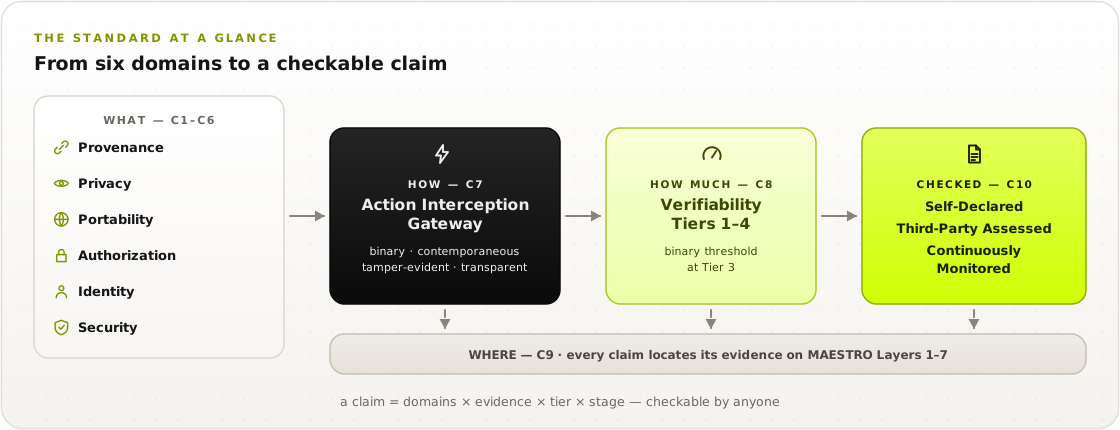
The Standard at a Glance
The Binary Threshold
Evidence is graded by who you must trust to believe it. Cryptography alone does not raise the tier — removing the trusted party does.
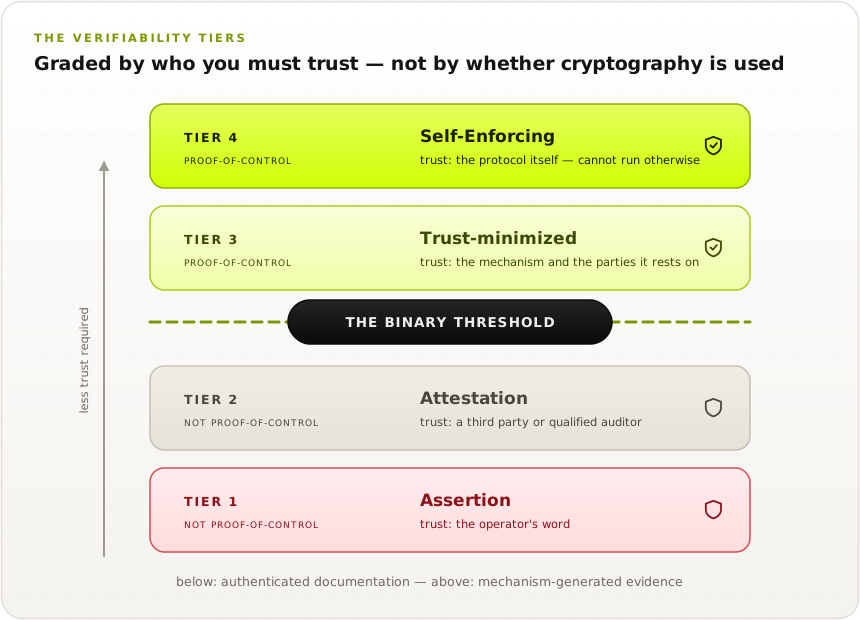
| Tier | Name | Who you must trust | Proof-of-Control? |
|---|---|---|---|
| 4 | Self-Enforcing | The protocol itself: continuous constraints, anchored in external hardware roots of trust | Yes |
| 3 | Trust-minimized | The mechanism's soundness, and the parties it depends on, as disclosed | Yes |
| 2 | Attestation | A third party or qualified auditor | No |
| 1 | Assertion | The operator | No |
Requirement Chapters
Chapters C1–C6 are the six domains of verification — what must be verified. Chapters C7–C10 are cross-cutting — what the evidence must be, how it is graded, where it applies, and how claims are checked.
| Chapter | Verifiable facts / scope |
|---|---|
| C1: Provenance | Which model ran; lineage, artifact and supply-chain origin |
| C2: Privacy | What data was read and written — evidenced without re-leaking it |
| C3: Portability | Boundary crossings: organizational, jurisdictional, compute |
| C4: Authorization | Authority granted, decisions within or against it, delegation validity |
| C5: Identity | Which agent and which principal ran |
| C6: Security | Execution-environment integrity; controls held; tools invoked; key lifecycle |
| C7: Evidence Generation & Properties | Interception gateways; the four properties; determinism boundary; custody & resilience |
| C8: Verifiability Tiers & Binary Threshold | Tier placement, mechanism fit, chain integrity |
| C9: System Surface (MAESTRO) | Locating evidence on the 7-layer agent stack |
| C10: Conformance & Disclosure | Stages, scope declaration, trust-assumption disclosure |
Appendices
| Appendix | Contents |
|---|---|
| A: Glossary | Normative terms and the Tier/Stage/Layer/Phase naming discipline |
| B: Proof-Mechanism & Controls Inventory | The 9-mechanism taxonomy and all seven MAESTRO layer control tables |
| C: Threat Model | 32 threats: coverage grades and out-of-scope boundaries |
| D: Open Working-Group Issues | Every [WG-INPUT NEEDED] decision, collected |
| E: Audit Checklist | All 127 requirements as tickable task lists, with the coverage matrix — generated, never stale |
Reference Implementation
A working implementation of the evidence pipeline — interception, path-aware policy, signed hash
chain, capability-bound dispatch, anchoring, gossip, and open verification — with an
attack harness and benchmarks: impl/.
cd impl
python3 tests/test_core.py        # 22 correctness tests, mapped to requirement IDs
python3 attacks/run_attacks.py    # 11 attacks, run with and without each requirement
python3 bench/bench.py            # latency, scaling, verification, utility
python3 bench/bench_pq.py         # post-quantum signature comparison
python3 bench/bench_frontier.py   # the declassification frontier
python3 bench/bench_ops.py        # scaling, anchoring interval, batching, retention
python3 bench/bench_merkle.py     # inclusion and consistency proofs vs chain replay

cd ..
python3 schema/validate.py --vectors   # the published evidence test vectors
python3 schema/cbor_profile.py         # JSON <-> CBOR rendering equivalence
Now measured on real Intel TDX hardware (impl/tdx/): running inside a trust
domain costs 6.2% (9.45 us/step), but a single hardware quote costs 39.5 ms - 2.6x the
entire 15 ms per-action budget, so per-action attestation is impossible and every deployment
must amortize. That amortization is a new exposure window, now requirement C7.2.3. The
evidence key is cryptographically bound into the quote's REPORTDATA (C7.2.4).
Headline results (Apple M2 Max, single core; except where noted the TEE is modelled in-process, so enclave transitions are excluded and latencies are a lower bound): 201 µs per intercepted step (p99 255 µs) — 1.3% of the 15 ms design budget · path-aware evaluation flat at 0.21 µs from 10 to 50,000 steps, versus linear growth for naive re-evaluation · 11/11 attacks succeed without the derived requirements and are refused or detected with them · a Merkle inclusion proof checks one record in a 100,000-record log with 544 bytes instead of replaying 123 MB · path-aware authorization falsely rejects 42% of benign workflows without a declassification point — and the fix is not more coverage but verifiable declassification, which takes false rejections to 0% while raising detection to 100%.
Several requirements in this standard exist because building or reviewing the implementation found defects the prose missed — C7.3.5 (an anchor's root must be compared, not only its step count) and the two found by the round-3 cross-model review: a binding check that failed open when unconfigured, and a capability that was never cross-bound to its evidence record. See attacks A9–A11.
The evidence claim set, in machine-readable form
Prose and a field table are not enough to make two implementations agree. Two implementations
that serialize the same action differently produce different digests for it — every signature
still verifies, so nothing looks broken, and the binding property that Theorem 1 depends on
fails silently. schema/ closes that: CDDL for the CWT/CBOR rendering,
JSON Schema for the JWT rendering, a canonicalization specification stating exactly which bytes
a signature covers, and 16 signed test vectors — four positive, ten negative, two
canonical-form. The reference implementation's own output is validated against the schema in its
test suite, so the two cannot drift apart silently.
Running an audit
The whole standard is available as a working checklist, in whichever form your audit runs on:
| Representation | Where | Use it for |
|---|---|---|
| Tickable task lists | Appendix E | Working an audit directly on GitHub, or copying into issues/tickets |
| Coverage matrix | Appendix E | Scoping: chapters × levels at a glance |
| CSV export | checklist/poc-checklist.csv |
Spreadsheet-driven audits — includes empty status and auditor_notes columns |
| JSON export | checklist/poc-checklist.json |
GRC tooling and automation |
| Auditor evidence notes | Every chapter section | What to collect and what to test, per requirement ID |
All of these are generated from the chapters by tools/generate_checklist.py, so they cannot drift from the normative text.
Requirement Levels
Each requirement carries a level (1–4), aligned one-to-one with the Verifiability Tiers: meeting the Level-N requirements is what makes evidence gradable at Tier N. Levels are cumulative, and every section ends with "Auditor evidence" guidance — what to collect and what to test, per requirement ID — so a compliance lead can scope an audit directly from the chapters.
| Level | Name | Aligned Tier | What it means |
|---|---|---|---|
| 1 | Recorded | Tier 1 | The control operates and its evidence is captured in queryable records — the on-ramp |
| 2 | Attested | Tier 2 | Evidence is signed, hash-chained, or attested; an assessor can confirm it unaltered |
| 3 | Trust-minimized | Tier 3 | Mechanism-generated evidence, verifiable by outsiders with published tooling — the binary threshold; minimum for a Proof-of-Control claim |
| 4 | Self-Enforcing / Continuous | Tier 4 | Verification gates operation: full coverage, fail-closed, Continuously Monitored |
How a Claim Gets Checked
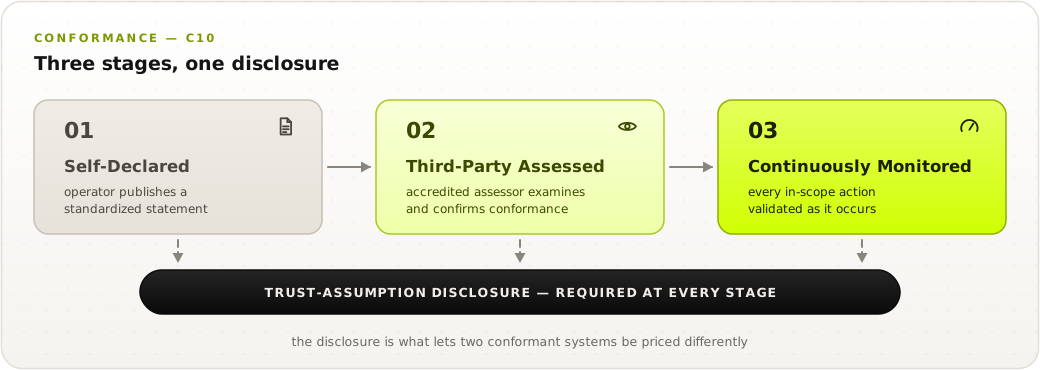
What a claim is worth comes from the domains claimed (C1–C6), the Tier of each claim (C8), the conformance stage (C10), and the trust-assumption disclosure — the part that lets two conformant systems be priced differently.
Project Leadership
The standard is led by co-chairs Ken Huang and Tricia Wang, produced by the Proof-of-Control Initiative's working groups, reviewed by a Distinguished Review Board, and stewarded by the Advanced AI Society as a public good (Governance). The Proof-of-Control Lab is being established as a community lab at Linux Foundation Decentralized Trust.
What Proof-of-Control is NOT
- Not validation. Proof-of-Control shows an agent stayed inside the control boundaries that were set; whether those boundaries — or the outputs — were right stays a human judgment (C7.5).
- Not a governance or risk framework. NIST AI RMF, ISO/IEC 42001, and the EU AI Act govern; Proof-of-Control produces the evidence that makes their requirements verifiable.
- Not runtime enforcement. Enforcement (what an agent may do) is CSA AARM's half; Proof-of-Control is the evidence half (what it did, verifiable by others).
- Not tied to any technology or vendor. The standard defines what the evidence must be, not which mechanism produces it.
Regulatory Coverage
How much of Proof-of-Control each external framework already addresses — (Exact + Partial
matches) / 127 requirements, coded per the mapping rubric and reproducible
with python3 mappings/compute_coverage.py:
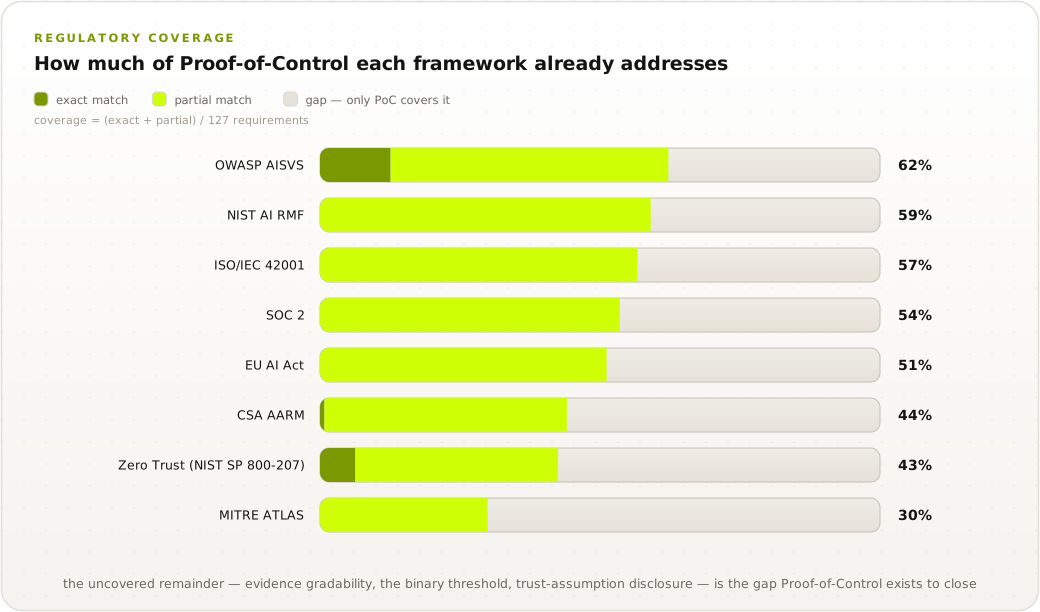
Read the caveat first. These are single-coder seed estimates with a known upward bias. An independent review of all 1,016 coded rows challenged every Exact rating and found 96 citations that name a chapter rather than a checkable clause. Treat the direction as informative and the values as provisional.
Coverage = (EM + PM) / 127 requirements. Only exact and partial matches count; the NM column is the gap only Proof-of-Control fills.
| Framework | Exact (EM) | Partial (PM) | None (NM) | Coverage |
|---|---|---|---|---|
| OWASP AISVS | 16 | 63 | 48 | 62% |
| NIST AI RMF | 0 | 75 | 52 | 59% |
| ISO/IEC 42001 | 0 | 72 | 55 | 57% |
| SOC 2 | 0 | 68 | 59 | 54% |
| EU AI Act | 0 | 65 | 62 | 51% |
| CSA AARM | 1 | 55 | 71 | 44% |
| Zero Trust (NIST SP 800-207) | 8 | 46 | 73 | 43% |
| MITRE ATLAS | 0 | 38 | 89 | 30% |
The uncovered remainder — evidence gradability, the binary threshold, trust-assumption
disclosure, self-enforcing execution — is the gap Proof-of-Control exists to close. Full
EM/PM/NM breakdown, row-level coding sheet, and corpus provenance
in mappings/. (Draft seed coding, pending working-group validation.)
How Proof-of-Control Complements Other Standards
| Standard | Focus | Proof-of-Control relationship |
|---|---|---|
| CSA MAESTRO | Agent threat modeling (7-layer stack) | Adopted as Proof-of-Control's System surface (C9) |
| CSA AARM | Runtime enforcement at the action boundary | Complementary halves: AARM enforces, Proof-of-Control evidences |
| OWASP Top 10s / AIVSS / AISVS | Agent & LLM threats; AI security controls | Threat source for Proof-of-Control's threat model; Proof-of-Control adds open evidence that the controls held |
| MITRE ATLAS | Adversarial AI threat catalog | Threat source (Appendix C) |
| NIST AI RMF | AI risk governance | Proof-of-Control supplies the runtime evidence RMF controls are checked against |
| ISO/IEC 42001 | AI management systems | Proof-of-Control evidences that declared controls held at execution |
| SOC 2 | Organizational attestation | Proof-of-Control is SOC-2-grade in role, with a cryptographic stage SOC 2 never had |
| EU AI Act | Regulation | Proof-of-Control evidence lets rules be enforced against evidence, not filings |
| Zero Trust · Confidential Computing · AIUC-1 | Architecture / mechanism / audit | See all crosswalks in mappings/ |
Repository Layout & Versioning
/
├── 0.1/en/     <- the standard: chapters C1–C10 + appendices A–E  (Working Draft v0.1)
├── schema/     <- the evidence claim set: CDDL, JSON Schema, canonical form, test vectors
├── impl/       <- reference implementation, attack harness, benchmarks
├── checklist/  <- the audit checklist as CSV and JSON (generated)
├── mappings/   <- framework crosswalks (MAESTRO, OWASP, NIST, SOC 2, EU AI Act, …)
├── paper/      <- the arXiv preprint (LaTeX source and figures)
├── tools/      <- generators: checklist, diagrams, charts, crosswalks, test vectors
├── docs/       <- companion documents: the case for the standard, reviews
├── images/     <- banner, artwork, and generated diagrams
Proof-of-Control uses v<MAJOR>.<MINOR> versioning; released folders are locked, mirroring OWASP ASVS/AISVS (RELEASE.md). Version 1.0 is targeted for February 1, 2027 (roadmap).
Referencing requirements: C<chapter>.<section>.<requirement>, version-qualified as v0.1-C4.1.4:
Verify that the evaluated payload parameters of each tool invocation matched the exact structural schema authorized at execution time.
Companion Documents
The case for the standard — informative, no requirements:
Introduction & design principles · Why verification matters · Standards landscape · Use cases · The Smart Leash one-pager · arXiv preprint draft · Roadmap · Governance · Research basis · CISO review · Security peer review · Round 2 · Round 3 (cross-model) · Mapping review
Contributing
The repository is public and anyone may propose a change — you do not need to be a member or a working-group participant to open a pull request. What contribution looks like, and the change process behind it, is in CONTRIBUTING.md. The open decisions that most need input are collected in Appendix D. Weaknesses in the standard itself belong in a public issue — adversarial review of the binary threshold is explicitly welcome — but a finding whose disclosure would itself create risk goes privately to the working group instead (Security Policy).
Open an issue before a large pull request. The standard moves by working-group consensus, so a substantive change — a new requirement, a retired one, a changed level or tier — is best started as an issue where it can be discussed before anyone writes it. Typos, broken links, clarified wording, and crosswalk rows can go straight to a pull request.
Propose a change with a fork and a pull request
Fork this repository on GitHub, then clone your fork and add this repository as
upstreamso you can keep it current:git clone https://github.com/<your-username>/ov-poc-standard.git cd ov-poc-standard git remote add upstream https://github.com/LFDT-ProofOfControl/ov-poc-standard.gitBranch off an up-to-date
master. Name the branch for the change, not for yourself:git fetch upstream git checkout -b c4-delegation-depth upstream/masterMake the change. Requirements language follows RFC 2119/8174, and the naming discipline (Tier / Level / Stage / Layer / Phase) is normative — both are in CONTRIBUTING.md. Every requirement must name a verifiable artifact or testable behavior, and its section's Auditor evidence note must say what to collect and what to test.
Regenerate what is generated. The checklist, crosswalks, and diagrams are built from the chapters so they cannot drift from the normative text. If you touched a requirement table or a diagram, regenerate and commit the output alongside your change:
python3 tools/generate_checklist.py     # Appendix E + checklist/ exports
python3 tools/generate_crosswalks.py    # mappings/ crosswalk tables
python3 tools/generate_diagrams.py      # images/diagrams/ SVGs
On Windows, a stock python.org install registers
python.exeand thepylauncher, notpython3.exe— ifpython3isn't found, usepythonorpy -3instead.Run the checks that cover what you touched. There is no CI on pull requests yet, so run them locally and say in the PR what you ran. Both need Python 3.11+ and their dependencies — install those first, or
validate.pywill report every negative vector as failing for the wrong reason rather than telling you a module is missing:pip install cryptography jsonschema python3 schema/validate.py --vectors # if you changed schema/ or the claim set cd impl && python3 tests/test_core.py # if you changed the reference implementationExpect
17 passed, 0 failedand22 passed, 0 failed.Commit and push to your fork, then open a pull request against
master:git commit -am "Bound delegation depth in C4.3" git push -u origin c4-delegation-depthExplain in the description what changes and why it is verifiable — for a normative change, which requirement, which level, and what an auditor would collect. Link the issue if there is one.
Review. A maintainer responds on the pull request. Normative changes go to the relevant domain working group for consensus and to the Distinguished Review Board for final sign-off (Governance), so a specification change can sit longer than an editorial one. Comments filed during the public-comment period (open until October 30, 2026) get a published disposition: accepted, rejected with rationale, or deferred.
By opening a pull request you agree your contribution is licensed under the Apache License 2.0, matching the specification. Contributors are credited, with their consent, in the Acknowledgments.
Membership is open to any organization — sign up at advancedaisociety.org.
License
The specification is licensed under the Apache License 2.0. The certification mark ("Proof-of-Control Certified") is protected as a trademark so that only systems assessed as conformant may claim it.
Proof-of-Control is stewarded by the Advanced AI Society.
Help build the evidence layer for AI governance — join at advancedaisociety.org.
Ähnliche Projekte entdecken
trimstray/the-book-of-secret-knowledge
Eine Sammlung inspirierender Listen, Handbücher, Spickzettel, Blogs, Tricks, Einzeiler, CLI- und Web-Tools und mehr.
258,205 SterneHack-with-Github/Awesome-Hacking
Eine Sammlung verschiedener Awesome-Listen für Hacker, Pentester und Sicherheitsforscher.
125,431 Sterneswisskyrepo/PayloadsAllTheThings
Eine Liste nützlicher Payloads und Bypass-Methoden für die Sicherheit von Webanwendungen sowie für Pentests/CTF.
82,654 Sternecaddyserver/caddy
Schneller, erweiterbarer und plattformübergreifender HTTP/1-2-3-Webserver mit automatischem HTTPS
79,021 Sterne