
KnowingNothing/MatmulTutorial
KnowingNothing/MatmulTutorial has 460 GitHub stars and 55 forks. GitHot measured 0 stars in 24 hours. Last checked 2026-11-19 06:13 UTC. Last push 2026-03-05.
Gemessener Sternzuwachs
- in 24h
- 0
- in 7 days
- Verlauf wird gesammelt
- in 15 days
- Verlauf wird gesammelt
- in 1 month
- Verlauf wird gesammelt
Nettoänderungen in überlappenden Zeiträumen, keine Tagessummen. Fehlende Messwerte bleiben leer. Sterne zeigen Interesse, nicht Qualität.
Über uns
A Easy-to-understand TensorOp Matmul Tutorial
LernenREADME.md
OriginalTensorOp Matmul Tutorial
This is an example repo for CUDA MatMul implementation. The aim of this repo is to provide some insights in high-performance kernel design for CUDA beginners. Currently, I only provide some implementation examples in
examples/matmul/this. Contributions for more kernels and other MatMul implementations are highly welcomed.
About
There is a detailed explanation about the different versions of MatMul kernels in examples/matmul/this.
Contents
examples:matmul: The MatMul implementationsthis-sm90: The Hopper version Matmulthis-sm80: The MatMul implemented by this repocublas: Call CuBLAS for performance testcutlass: Call CUTLASS for performance testmlir-gen: The cuda code generated by MLIRtriton: Call Triton for performance testtvm: Call Relay+CUTLASS/CuBLAS or TensorIR for performance test
atom: The usage of single intrinsic/instructionsreduction: Some reduction kernels for epilogue
Performance Results
Performance on H800 GPU
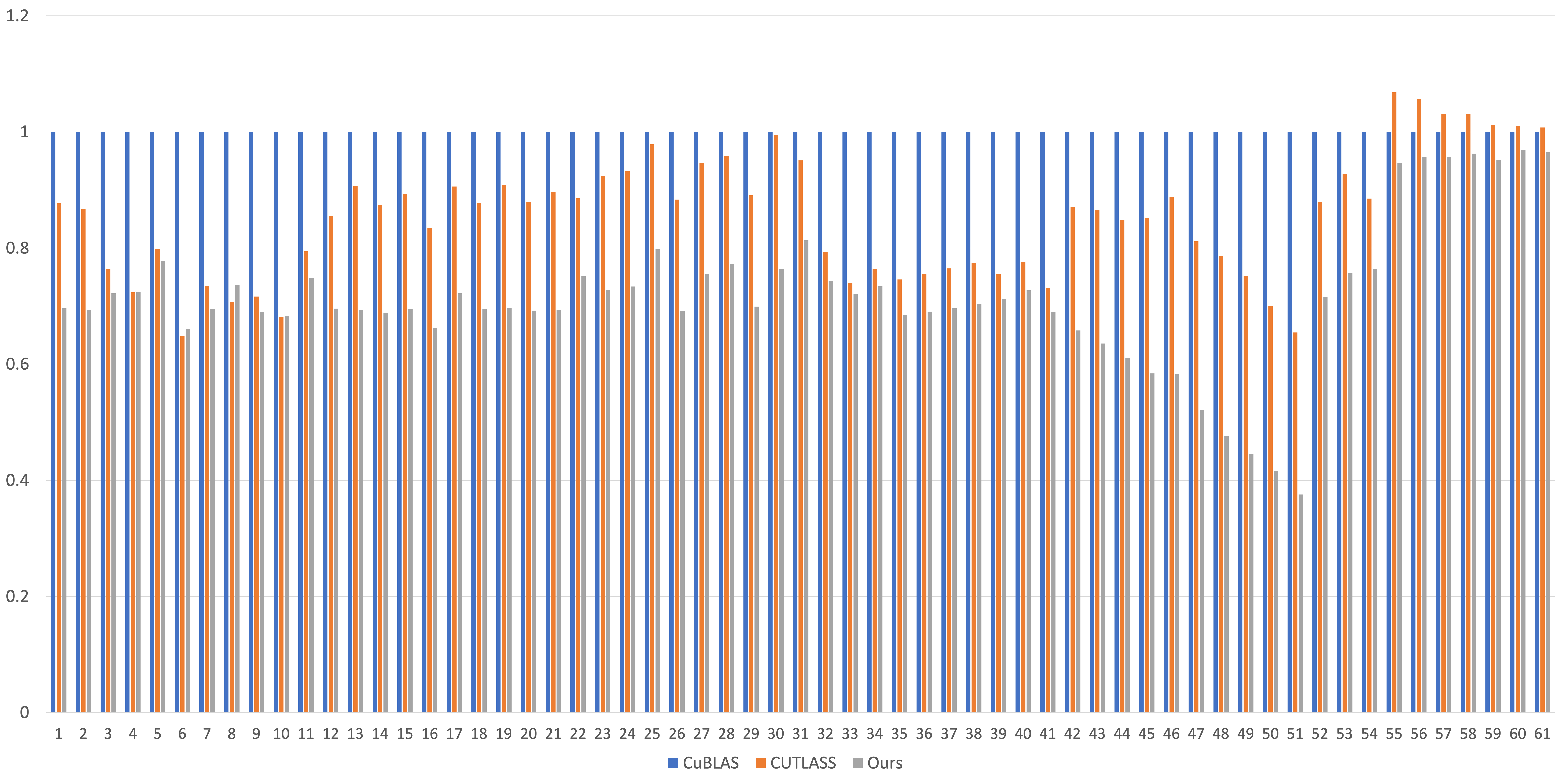 The current version only achieves on average 70% performance of CuBLAS. I am still working on improving the performance.
Performance on A100 GPU
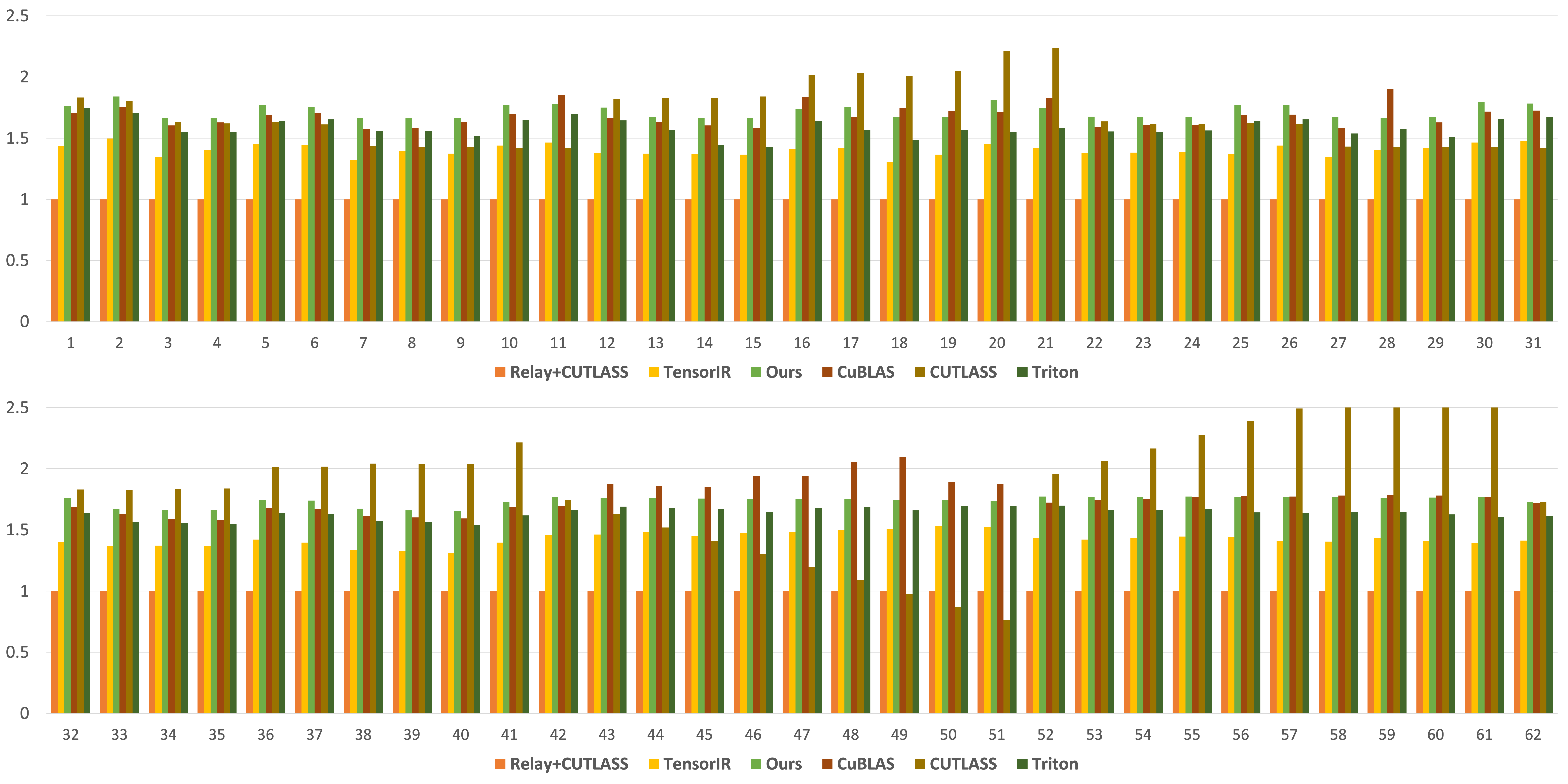 The overall performance comparison among Relay, CuBLAS, CUTLASS, TensorIR, Triton, and our implementations. The y-axis is speedup to Relay+CUTLASS.
Overall, the geometric mean speedup to Relay+CUTLASS is 1.73x, to TensorIR (1000 tuning trials using MetaSchedule per case) is 1.22x, to CuBLAS is 1.00x, to CUTLASS is 0.999x, to Triton is 1.07x. The 61 shapes are:
| No. | M | N | K |
|---|---|---|---|
| 1 | 5376 | 5376 | 2048 |
| 2 | 5376-128 | 5376 | 2048 |
| 3 | 5376-2*128 | 5376 | 2048 |
| ... | ... | ... | ... |
| 11 | 5376-10*128 | 5376 | 2048 |
| 12 | 5376+128 | 5376 | 2048 |
| 13 | 5376+2*128 | 5376 | 2048 |
| ... | ... | ... | ... |
| 21 | 5376+10*128 | 5376 | 2048 |
| 22 | 5376 | 5376-128 | 2048 |
| 23 | 5376 | 5376-2*128 | 2048 |
| ... | ... | ... | ... |
| 31 | 5376 | 5376-10*128 | 2048 |
| 32 | 5376 | 5376+128 | 2048 |
| 33 | 5376 | 5376+2*128 | 2048 |
| ... | ... | ... | ... |
| 41 | 5376 | 5376+10*128 | 2048 |
| 42 | 5376 | 5376 | 2048-128 |
| 43 | 5376 | 5376 | 2048-2*128 |
| ... | ... | ... | ... |
| 51 | 5376 | 5376 | 2048-10*128 |
| 52 | 5376 | 5376 | 2048+128 |
| 53 | 5376 | 5376 | 2048+2*128 |
| ... | ... | ... | ... |
| 61 | 5376 | 5376 | 2048+10*128 |
MLIR Generated CUDA kernels
I also use MLIR to generate MatMul kernels. The generated ones are in examples/matmul/mlir-gen. The performance to handwritten ones (examples/matmul/this) is shown as belows. As MLIR generated ones only implement part of the optimizations used by handwritten ones, we call the MLIR generated ones partial and the handwritten ones full.
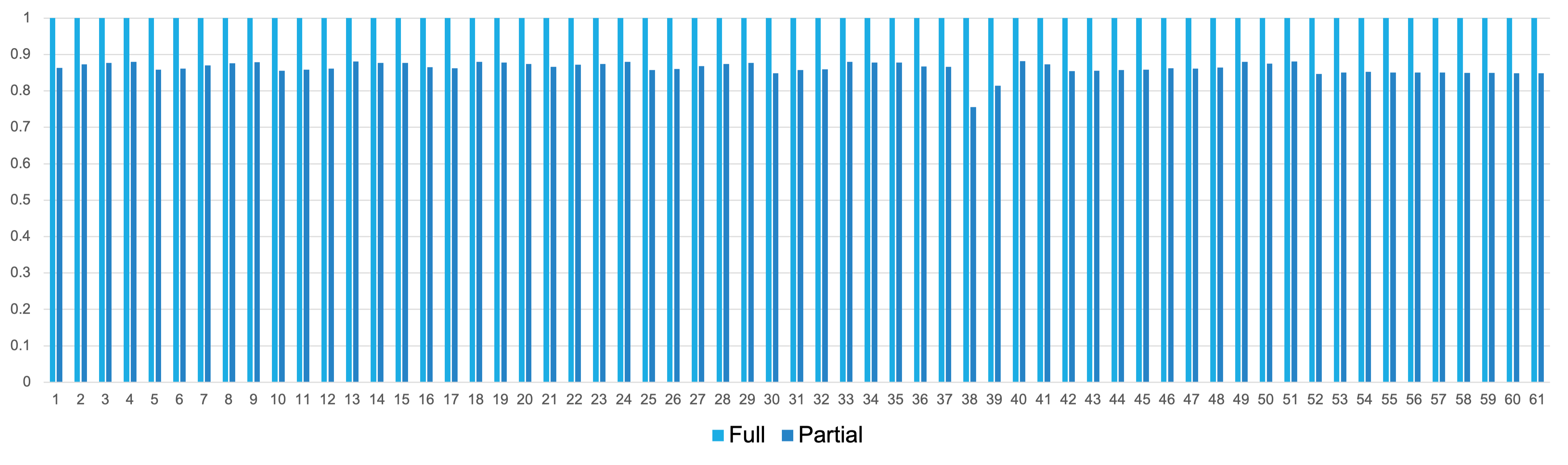 Overall, MLIR generated versions achieve 86% the performance of handwritten kernels.
Plan
More kernels
I plan to implement kernels for other operators such as softmax in future.
Use CUTLASS in implementation
There is a plan to use the CuTe interface of CUTLASS to implement high-performance kernels.