
ForeverBlue816/PhysioWave
ForeverBlue816/PhysioWave has 247 GitHub stars and 26 forks. GitHot measured +19 stars in 24 hours. Last checked 2026-11-11 14:49 UTC. Last push 2026-11-06.
So werden diese Zahlen gemessen
[NeurIPS 2025] PhysioWave & PhysioWave-T: tokeneffiziente, auf Wavelets basierende Foundation-Modelle für EEG, ECG und sEMG mit zuverlässigkeitsbewusster multimodaler Fusion
What you can do
- One EEG foundation model across montages. A 30 M-parameter encoder pretrained on over 15 M four-second windows from 19 to 128 channels at 256 and 512 Hz, with no common montage forced on the data.
- 4.0–7.2× faster, 6.8–12.7× less memory. Folding cuts Transformer latency and peak memory by these factors over scale expansion, with no loss of accuracy. On 128-channel EEG, per-batch memory drops from about 32 GB to 2.5 GB.
- State of the art on EEG, ECG and sEMG. The EEG encoder leads eight of nine metrics against BENDR, BIOT, LaBraM and EEGPT. The ECG encoder has the highest macro-F1 on PTB-XL Super and Chapman–Shaoxing. The sEMG encoder sets new accuracies on EPN-612 and GRABMyo.
- Wearable seizure detection. On two behind-the-ear EEG channels the encoder reaches 61.4 % sensitivity at ≤ 11 false alarms per hour, ahead of LUNA-L with 25.4 M against 40.4 M parameters. Adding ECG and EMG raises this to 74.4 % with RALF and 78.9 % with weighted-logit fusion. RALF lifts window-level AUPRC from 0.321 to 0.399.
Gemessener Sternzuwachs
- in 24h
- +19
- in 7 days
- Verlauf wird gesammelt
- in 15 days
- Verlauf wird gesammelt
- in 1 month
- Verlauf wird gesammelt
Nettoänderungen in überlappenden Zeiträumen, keine Tagessummen. Fehlende Messwerte bleiben leer. Sterne zeigen Interesse, nicht Qualität.
README.md
Original
PhysioWave-T: Token-Efficient Wavelet Foundation Models for Biosignals





Pretrained EEG, ECG and sEMG encoders that take any channel count and sampling rate, and a reliability-aware fusion model that combines them.
PhysioWave-T extends PhysioWave (NeurIPS 2025) from ECG and sEMG to EEG, and from one fixed input layout per encoder to many. The extension rests on three ideas:
- Dynamic scale folding. The wavelet subbands are recombined before tokenization. The sequence shrinks from $(J{+}1)CS$ to $CS$ tokens for $J$ levels, $C$ channels and $S$ patches.
- Routes. Each acquisition setup, defined by its channel count and sampling rate, gets its own wavelet front end. One Transformer and one channel-name vocabulary are shared by every route of a modality.
- RALF. Reliability-aware latent fusion combines the independently pretrained encoders with a per-sample reliability for each modality.
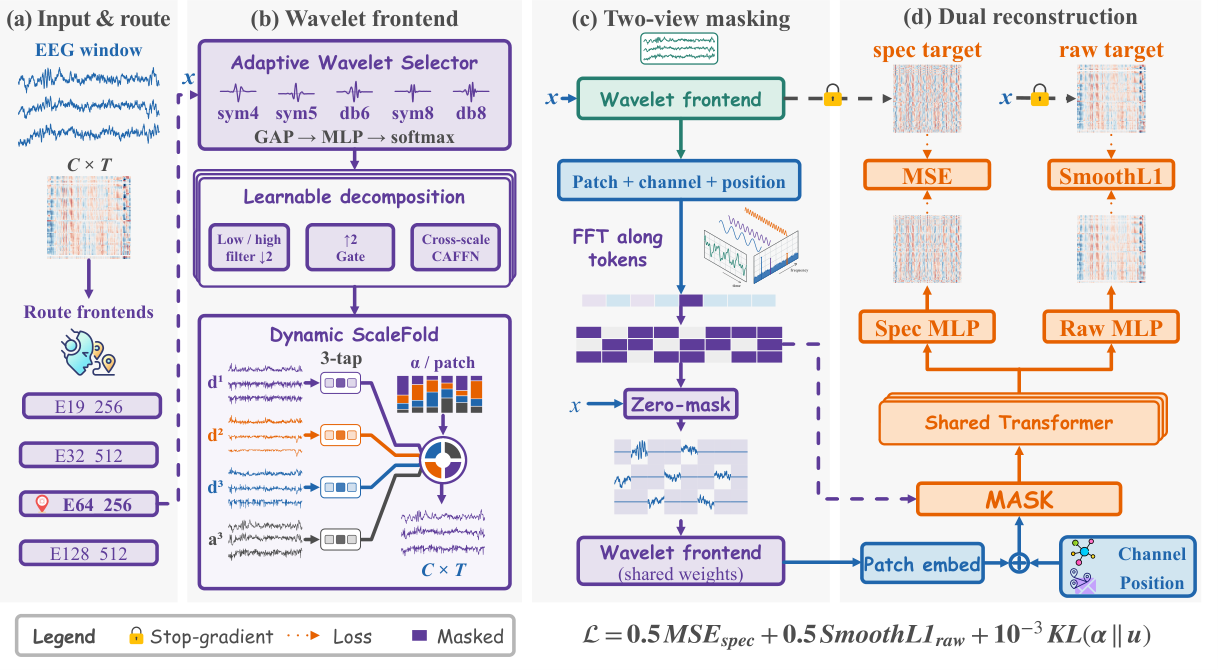
Overview, shown for EEG: route front ends, learnable wavelet analysis with dynamic ScaleFold, two-view masking and dual reconstruction.
Highlights
- One EEG foundation model across montages. A 30 M-parameter encoder pretrained on over 15 M four-second windows from 19 to 128 channels at 256 and 512 Hz, with no common montage forced on the data.
- 4.0–7.2× faster, 6.8–12.7× less memory. Folding cuts Transformer latency and peak memory by these factors over scale expansion, with no loss of accuracy. On 128-channel EEG, per-batch memory drops from about 32 GB to 2.5 GB.
- State of the art on EEG, ECG and sEMG. The EEG encoder leads eight of nine metrics against BENDR, BIOT, LaBraM and EEGPT. The ECG encoder has the highest macro-F1 on PTB-XL Super and Chapman–Shaoxing. The sEMG encoder sets new accuracies on EPN-612 and GRABMyo.
- Wearable seizure detection. On two behind-the-ear EEG channels the encoder reaches 61.4 % sensitivity at ≤ 11 false alarms per hour, ahead of LUNA-L with 25.4 M against 40.4 M parameters. Adding ECG and EMG raises this to 74.4 % with RALF and 78.9 % with weighted-logit fusion. RALF lifts window-level AUPRC from 0.321 to 0.399.
- Representations that recover physiology. Channel embeddings learned from electrode names recover scalp topography, and the slowest wavelet scale gains weight from wakefulness to deep sleep in 13 of 13 subjects.
Pretrained models
All weights are on the Hugging Face Hub, gathered in the PhysioWave-T collection. Each model card lists the files, the validation metrics and a loading example.
| Model | Repository | Parameters | Routes (channels × rate) | Pretraining data |
|---|---|---|---|---|
| EEG encoder | ForeverBlue/EEG | 30.3 M | 19 × 256, 32 × 512, 64 × 256, 128 × 512 | 7 corpora, 15.4 M windows of 4 s |
| ECG encoder | ForeverBlue/ECG | 30.1 M | 12 × 500, 1 × 250 | 7 corpora, 7.6 M windows of 10 s |
| sEMG encoder | ForeverBlue/EMG | 12.1 M | 16 × 2000, 24 × 2000, 64 × 2000 | 6 corpora, 5.1 M windows of 1 s |
| RALF seizure detector | ForeverBlue/RALF-SeizeIT2 | three encoders + fusion | bte-EEG + ECG + EMG, 4 s | SeizeIT2, official split |
Every encoder repository has two kinds of file:
<modality>_c1_encoder.pthholds the channel embedding and the shared Transformer. It loads onto any montage, and is the file to fine-tune from.pretrain_<modality>_c1_moe_*.pthis the complete pretraining model: every route front end and both decoders. Use it to continue pretraining, or to fine-tune on a montage that is one of the routes.
Pretraining corpora (processed training windows per corpus)
| Modality | Corpus | Route (channels, Hz) | Windows |
|---|---|---|---|
| EEG | TUEG | 19, 256 | 13,710,516 |
| EEG | HBN | 128, 512 | 1,352,818 |
| EEG | FACED | 32, 512 | 129,268 |
| EEG | TDBRAIN | 32, 512 | 86,991 |
| EEG | M3CV | 64, 256 | 81,895 |
| EEG | PhysioNet MI | 64, 256 | 36,933 |
| EEG | HGD | 128, 512 | 23,074 |
| ECG | PulseDB | 1, 250 | 4,992,774 |
| ECG | Icentia11k | 1, 250 | 1,650,343 |
| ECG | MIMIC-IV-ECG | 12, 500 | 748,592 |
| ECG | CODE-15% | 12, 500 | 123,202 |
| ECG | SPH | 12, 500 | 24,856 |
| ECG | MedalCare-XL | 12, 500 | 15,446 |
| ECG | Georgia | 12, 500 | 9,750 |
| sEMG | emg2qwerty | 16, 2000 | 2,359,161 |
| sEMG | emg2pose | 16, 2000 | 1,203,781 |
| sEMG | CEMHSEY 8×8 | 64, 2000 | 662,710 |
| sEMG | CEMHSEY 5×13 | 64, 2000 | 453,239 |
| sEMG | Hyser | 64, 2000 | 274,188 |
| sEMG | putEMG | 24, 2000 | 153,124 |
Windows are 4 s (EEG), 10 s (ECG) and 1 s (sEMG). Each corpus keeps its own license; none is redistributed here.
Method
 |
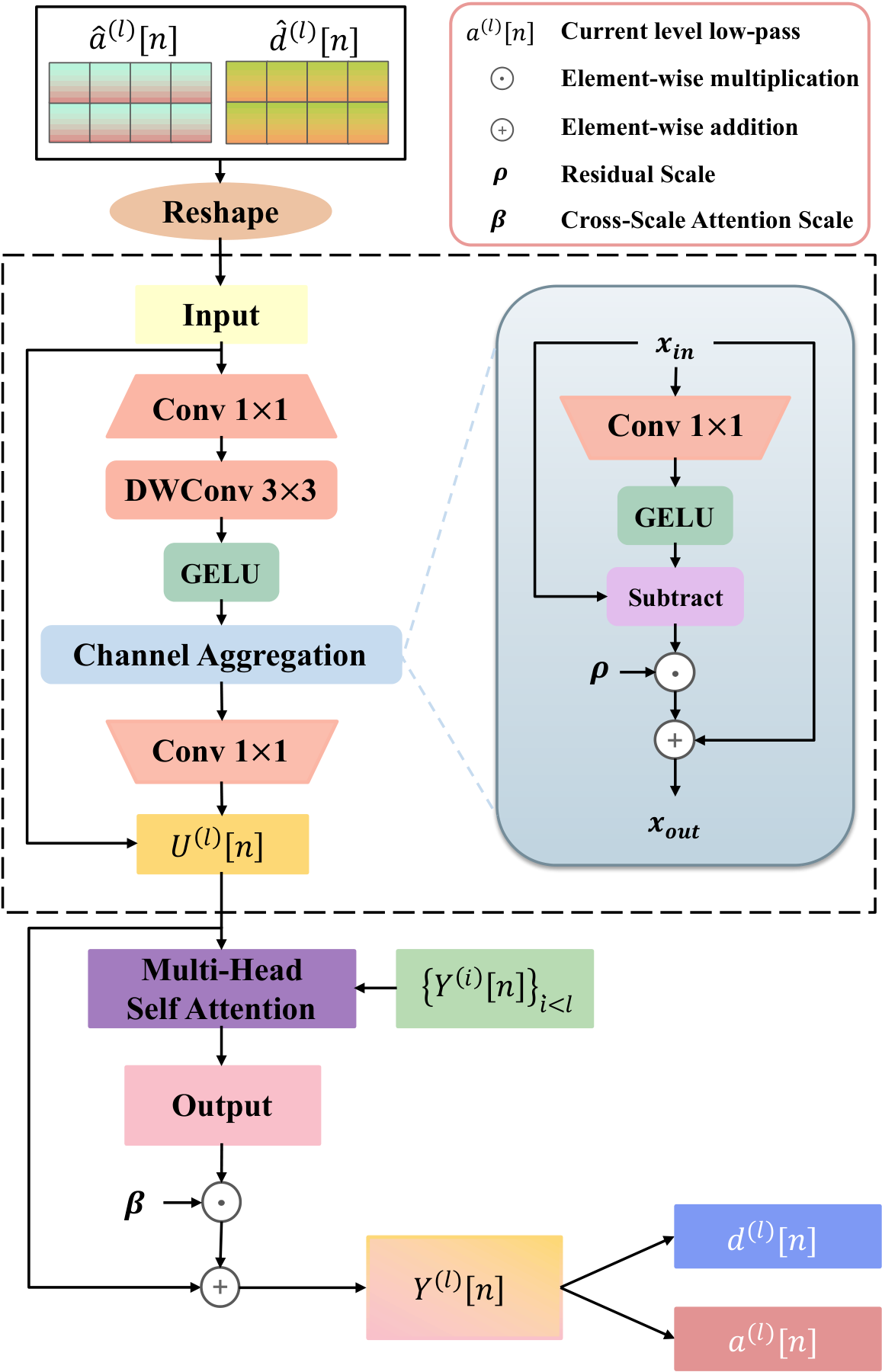 |
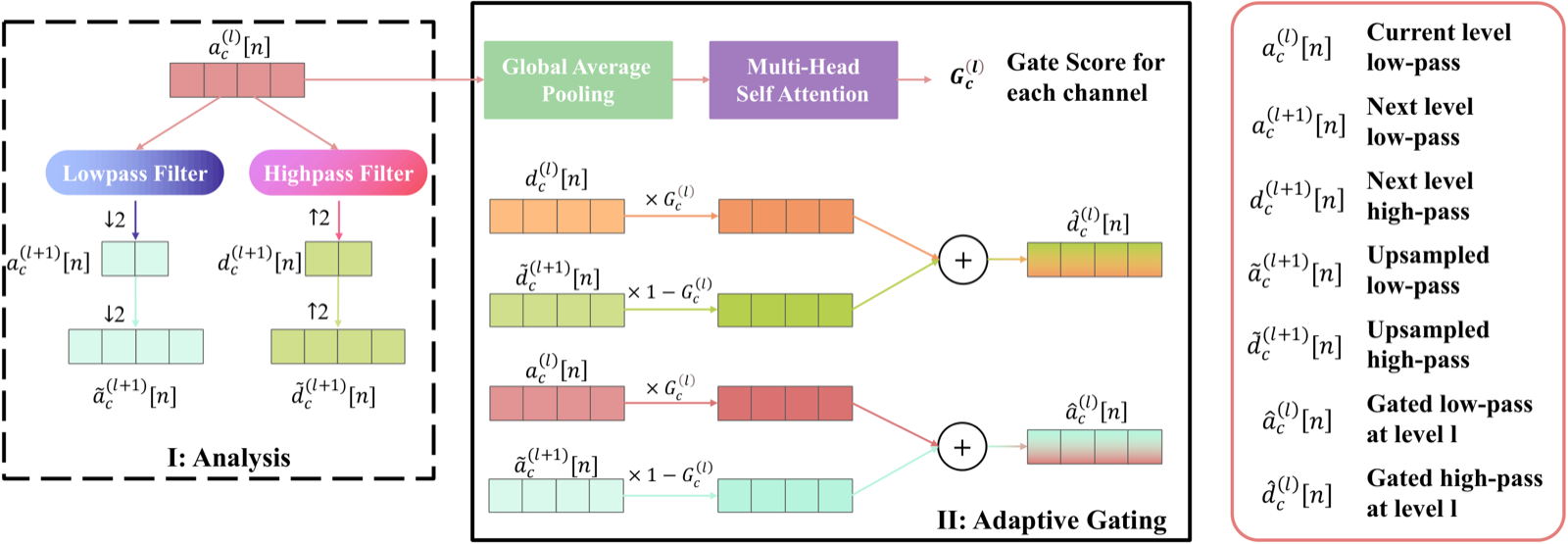
| Soft-gated wavelet analysis. Five learnable wavelet filter pairs per channel are mixed by a selector. Channel-specific gates blend the upsampled subbands with the running approximation and detail states. | Cross-scale channel-aggregation FFN (CAFFN). The current approximation–detail pair is refined by convolution and channel aggregation. |
Dynamic ScaleFold. Per channel and per patch, a small network predicts weights over the $J{+}1$ subbands from their local statistics. The subbands are then summed into one row, refined by a 3-tap synthesis filter. The Transformer therefore sees $C \times S$ tokens however deep the decomposition is. Folding has no channel-specific parameters, so it transfers unchanged to new montages.
Pretraining. The masked windows go through the front end, and the Transformer reconstructs them through two heads: the folded wavelet patch (MSE) and the preprocessed waveform (SmoothL1). Masking is frequency-guided at a 70 % ratio and applied before the front end.
Adaptation to unseen setups. A downstream montage that matches no route gets a fresh front end, seeded from the same wavelet families. The pretrained Transformer and channel embedding are reused, and new sensor names get new embedding rows.
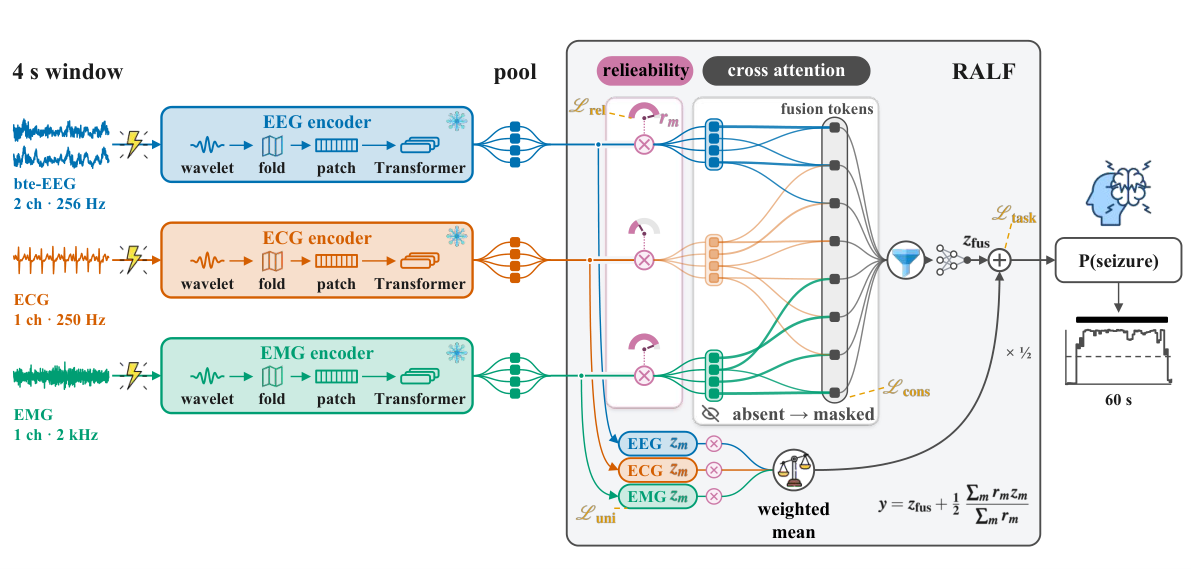
Reliability-aware latent fusion (RALF). Each encoder contributes four summary tokens. A per-sample reliability gates each modality's tokens in the cross-attention and weights its unimodal prediction. Missing modalities are masked out.
Results
EEG
Balanced accuracy (BAC), Cohen's kappa, weighted F1 and AUROC. Our values are means over three seeds.
| Method | Params | Sleep-EDFx BAC | Kappa | W-F1 | P300 BAC | Kappa | AUROC | KaggleERN BAC | Kappa | AUROC |
|---|---|---|---|---|---|---|---|---|---|---|
| BENDR | 157M | 0.6655 | 0.6659 | 0.7507 | 0.6114 | 0.2227 | 0.6588 | 0.5672 | 0.1461 | 0.6030 |
| BIOT | 3.2M | 0.6622 | 0.6461 | 0.7415 | 0.5485 | 0.0968 | 0.5308 | 0.5118 | 0.0297 | 0.5495 |
| LaBraM | 5.8M | 0.6771 | 0.6710 | 0.7592 | 0.6477 | 0.2935 | 0.7068 | 0.5439 | 0.0944 | 0.5693 |
| EEGPT | 25M | 0.6917 | 0.6857 | 0.7654 | 0.6502 | 0.2999 | 0.7168 | 0.5837 | 0.1882 | 0.6621 |
| PhysioWave-T (fine-tune) | 30M | 0.7060 | 0.7365 | 0.8092 | 0.6706 | 0.2975 | 0.7370 | 0.6171 | 0.2059 | 0.6632 |
Sleep-EDFx's 100 Hz derivations are not among the pretraining routes, so the encoder runs on a new front end.
ECG
Macro-F1 and macro-AUROC in %.
| Method | Params | PTB-XL Super F1 | AUC | CPSC 2018 F1 | AUC | Chapman F1 | AUC |
|---|---|---|---|---|---|---|---|
| MERL | 11M | 48.1 | 91.9 | 72.8 | 92.6 | — | 87.9 |
| OpenECG-MAE | 11M | 48.1 | 90.9 | 74.5 | 93.2 | 50.8 | 94.2 |
| PhysioWave-L | 37M | 66.7 | 94.6 | 73.1 | 96.1 | 54.8 | 98.3 |
| PhysioWave-T (fine-tune) | 30M | 70.9 | 90.3 | 73.1 | 94.2 | 56.7 | 99.4 |
sEMG
Gesture recognition accuracy and macro-F1 in %.
| Method | Params | EPN-612 Acc. | F1 | GRABMyo Acc. | F1 |
|---|---|---|---|---|---|
| MOMENT | 385M | 90.87 | 90.16 | 82.67 | 82.19 |
| OTiS | 45M | 87.55 | 88.03 | 79.38 | 78.80 |
| PhysioWave-L | 37M | 94.50 | 94.56 | 88.53 | 88.37 |
| PhysioWave-T (fine-tune) | 12M | 94.80 | 94.79 | 89.78 | 89.74 |
The paper's tables also list the from-scratch and linear-probe rows and every baseline.
Multimodal seizure detection (SeizeIT2)
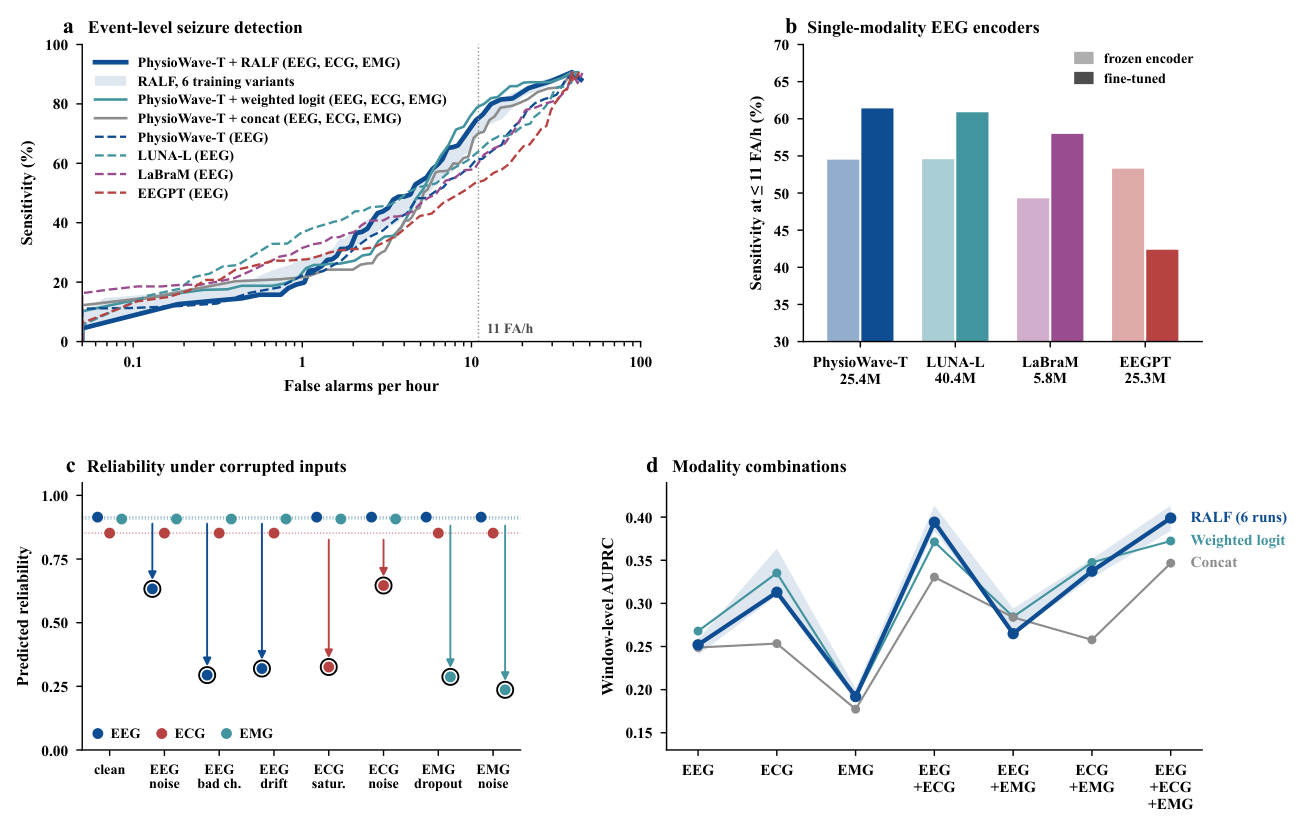
The panels show the official split: 29 test patients, 2,912 h and 181 seizures.
- (a) Event-level detection. Fusing EEG, ECG and EMG beats every EEG-only foundation model at the clinical operating points: at 11 false alarms per hour sensitivity rises from 61.4 % to 74.4 % with RALF and 78.9 % with weighted-logit fusion.
- (b) EEG-only encoders. Fine-tuned, PhysioWave-T is the most sensitive of the four EEG encoders, with 25.4 M parameters against LUNA-L's 40.4 M.
- (c) Reliability. Corrupting one modality lowers only that modality's reliability.
- (d) Fusion rules. All six RALF training variants exceed weighted-logit and concatenation fusion in AUPRC whenever EEG and ECG are present together.
Efficiency
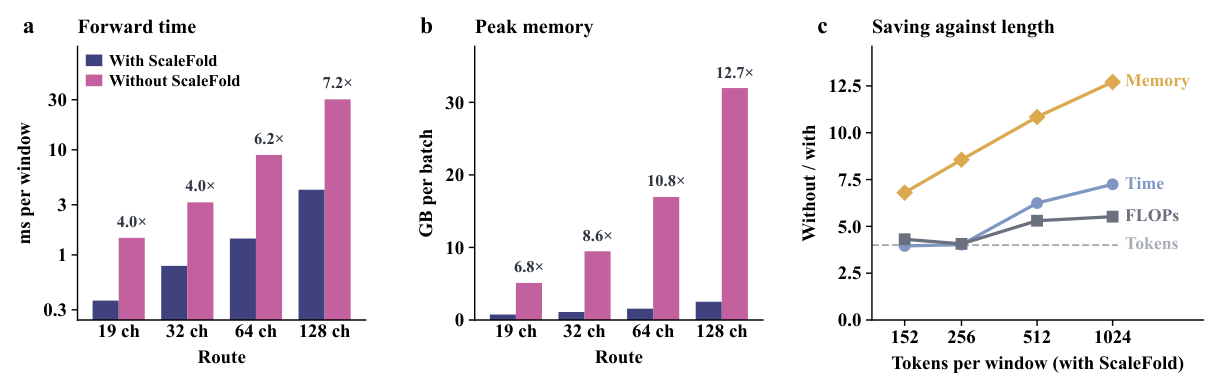
These are EEG encoder measurements on a single GPU in bf16, at the training batch sizes. Folding cuts latency by 4.0–7.2× and peak memory by 6.8–12.7×, while the dynamic fold itself costs 1.5–2.6 % of the forward pass. The saving grows with channel count.
What the encoders learned
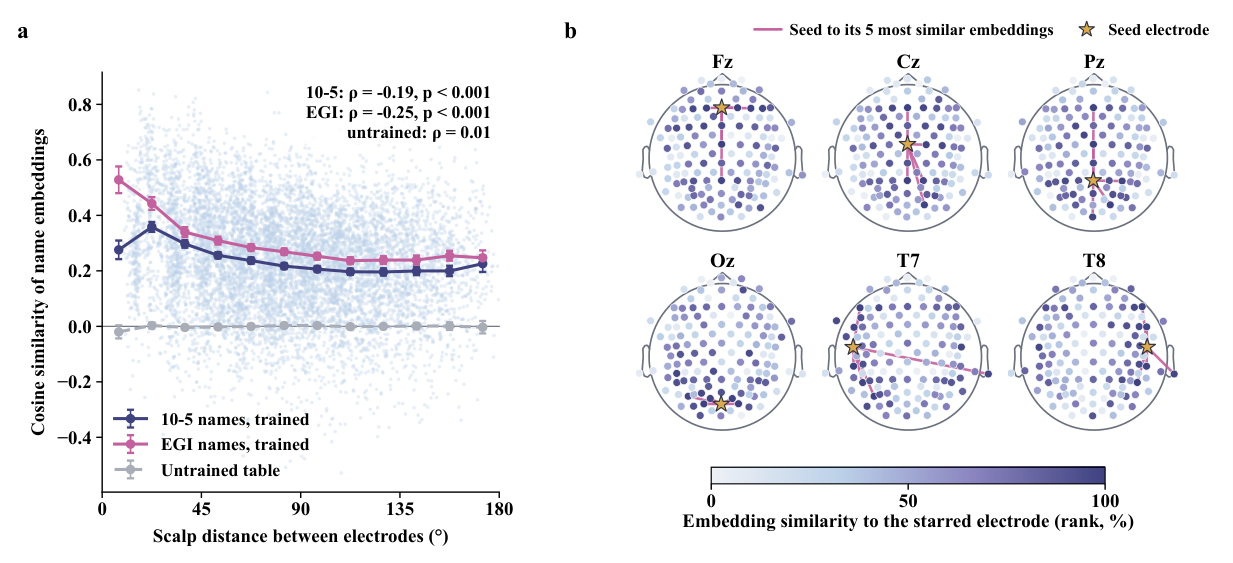
Scalp topology from names alone. Embedding similarity falls with geodesic scalp distance, both in the 10-5 system and on the 128-electrode EGI net (Spearman ρ = −0.19 and −0.25, p < 0.001). An electrode's five nearest neighbours in embedding space lie 44–56° apart on the scalp, against 84–88° when shuffled. The model never saw coordinates.
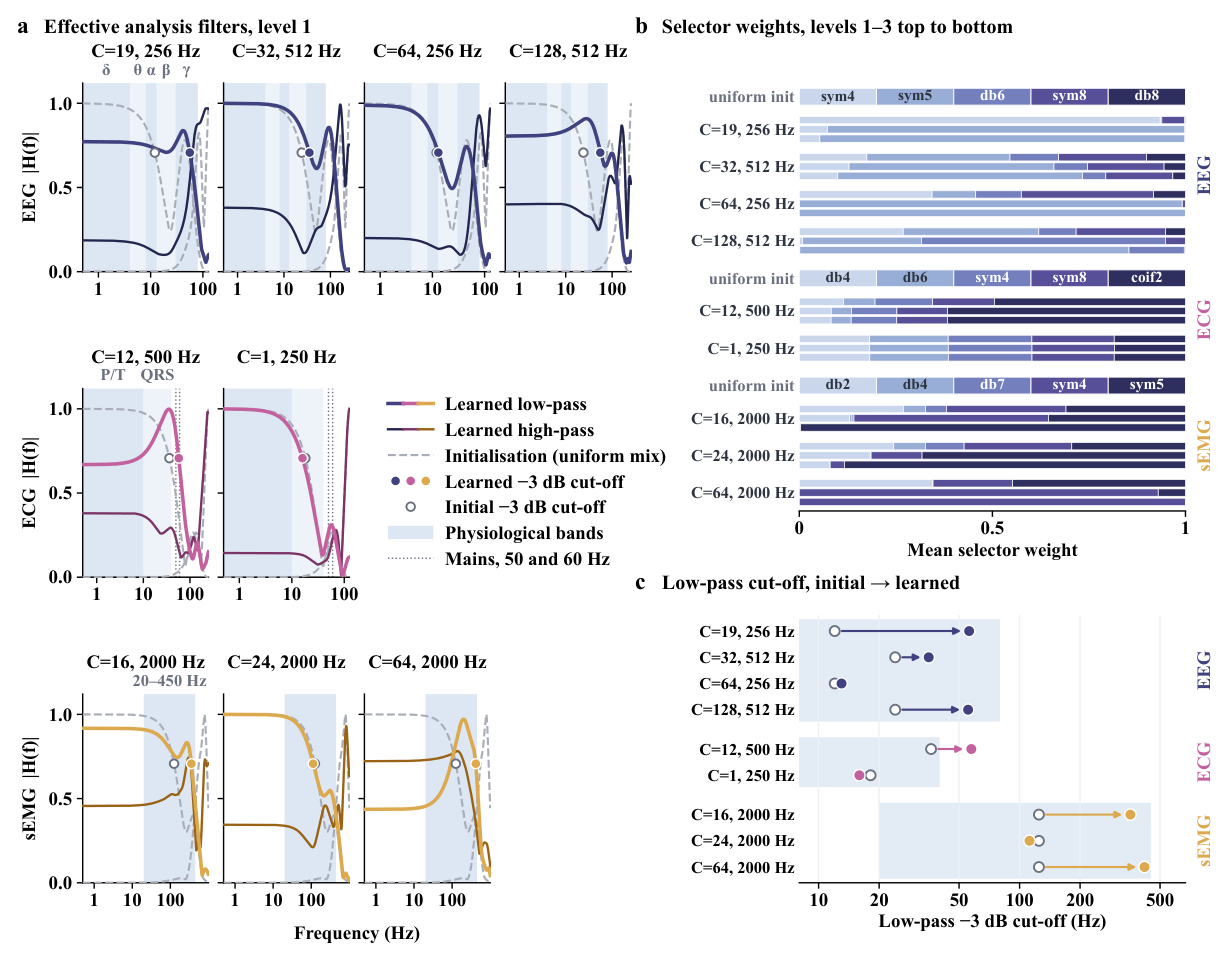
Spectral adaptation per modality. Pretraining moves each front end's pass-band onto its modality's informative range. On 19-channel EEG the low-pass widens from 12 Hz to 56 Hz, covering the γ band. On high-density sEMG it rises from 125 Hz to 356–418 Hz, the upper edge of the EMG band. On most routes, the deeper decomposition levels specialise to a single wavelet.
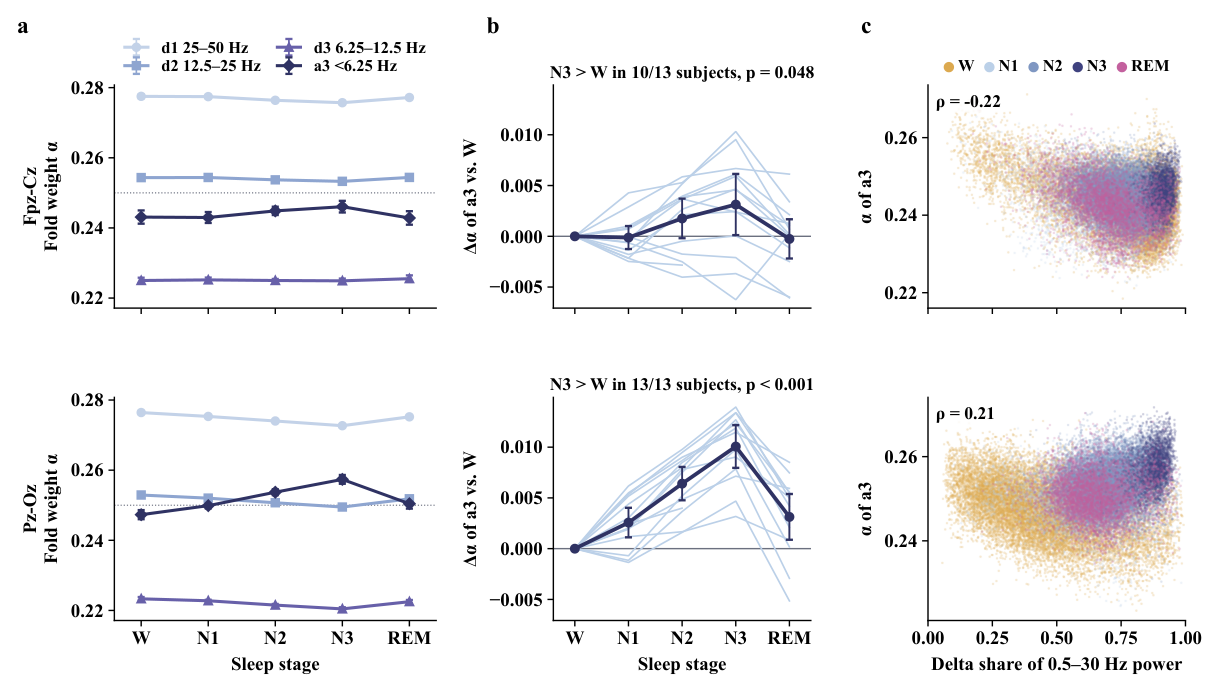
Scale allocation follows sleep. After fine-tuning for staging, ScaleFold gives more weight to the slowest scale from wakefulness to N3. On Pz-Oz this holds in 13 of 13 test subjects (Wilcoxon p = 2.4 × 10⁻⁴). The fold was never shown a stage label.
Masked reconstruction examples
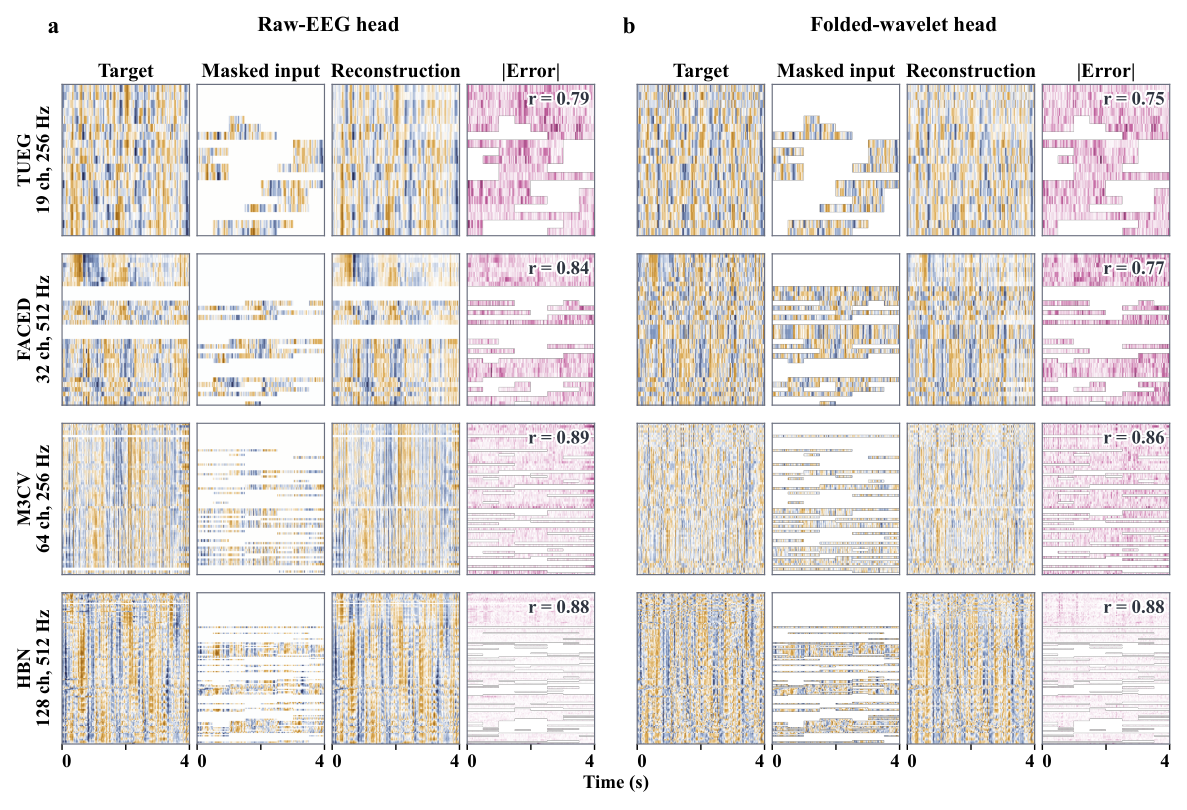
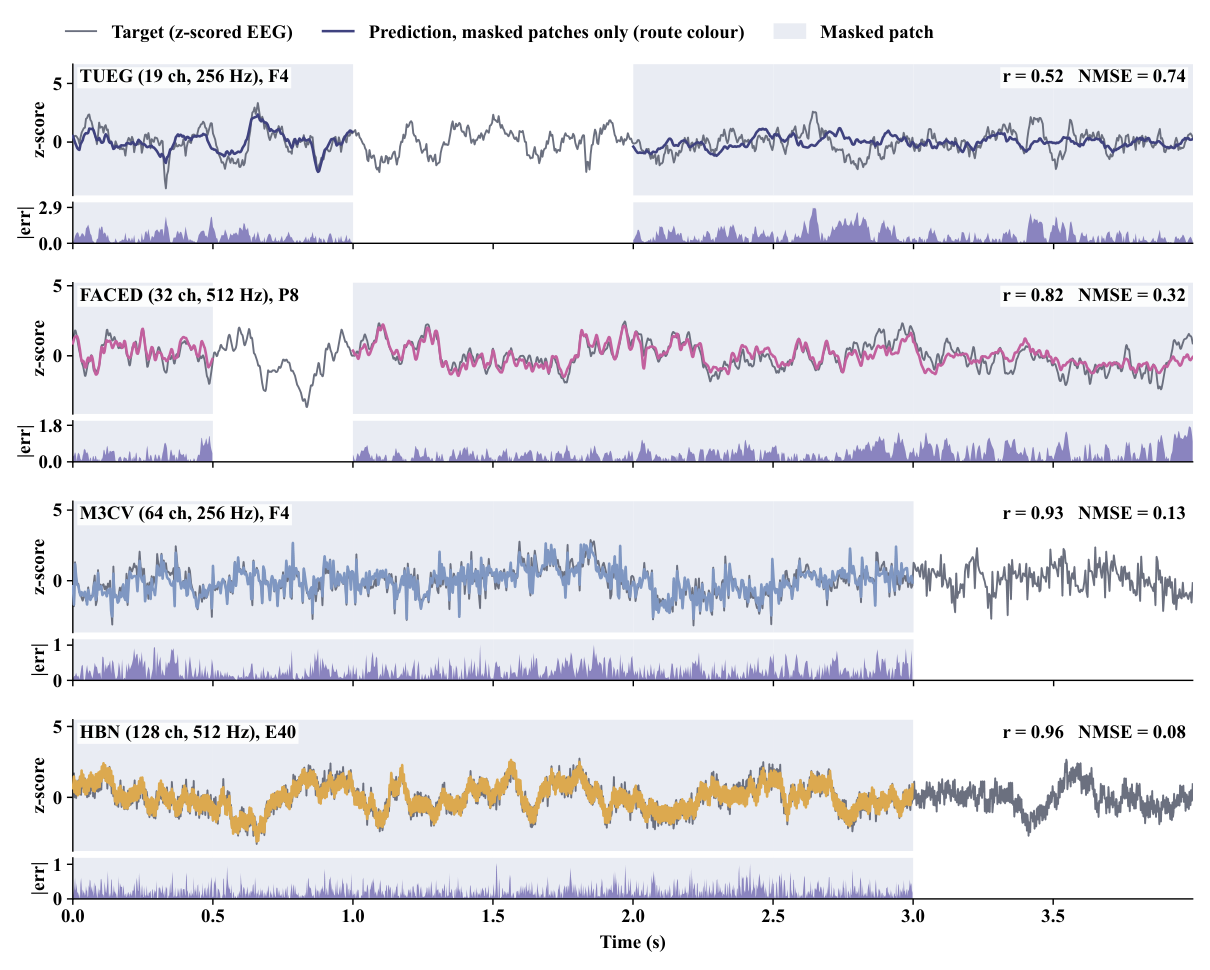
The examples come from four EEG routes spanning 19–128 channels, with 70 % of patches masked. Each route shows its median-NMSE validation window, not its best.
Installation
git clone https://github.com/ForeverBlue816/PhysioWave.git
cd PhysioWave
conda create -n physiowave python=3.11 -y && conda activate physiowave
pip install torch --index-url https://download.pytorch.org/whl/cu121   # PyTorch >= 2.2, your CUDA
pip install -e ".[hub]"              # the package + huggingface_hub; add ",data" for mne/wfdb
The package needs only NumPy, SciPy, h5py, PyWavelets, scikit-learn and a few small utilities. Reading raw archives (EDF, PhysioNet) needs mne and wfdb, which training never imports.
Quick start: fine-tune a pretrained encoder
The encoder file loads onto any montage. Your montage supplies the front end and the patch embedding, and the checkpoint supplies the rest.
import torch
from huggingface_hub import hf_hub_download
from physiowave.eeg_c1.downstream import EEGC1Downstream

ENC = hf_hub_download("ForeverBlue/EEG", "eeg_c1_encoder.pth")
ck = torch.load(ENC, map_location="cpu", weights_only=False)
mc = ck["model_config"]
CH = ["Fz", "Cz", "Pz", "Oz", "C3", "C4", "P3", "P4"]          # your electrodes, by name

model = EEGC1Downstream(
    in_channels=len(CH), window_samples=1024, sampling_rate=256.0,
    patch_samples=128, num_classes=2, channel_names=CH,
    embed_dim=mc["embed_dim"], depth=mc["depth"], num_heads=mc["num_heads"],
    channel_embed_dim=mc.get("channel_embed_dim", 64),
    channel_vocab_size=ck["channel_vocab_size"])
print(model.describe_transfer(model.load_pretrained(ENC)))
# loaded: transformer N, channel encoder N, gate yes, frontend 0, patcher 0

class Meta:
    channel_names = CH
    channel_mask = None

logits = model(torch.randn(2, len(CH), 1024), Meta())["logits"]     # [2, 2]
For ECG and sEMG, swap in physiowave.ecg_c1.downstream.ECGC1Downstream with ForeverBlue/ECG, or physiowave.emg_c1.downstream.EMGC1Downstream with ForeverBlue/EMG. Pass real channel names, because the checkpoint's vocabulary hash is checked on load. Names the vocabulary does not know get a fresh embedding row each, trained as a montage adapter.
The loading report is the contract: frontend 0, patcher 0 is the expected line for a montage that is not one of the pretraining routes. To fine-tune on a route with its pretrained front end, take it out of the complete checkpoint:
python scripts/export_eeg_pretrained_encoder.py \
    --checkpoint pretrain_eeg_c1_moe_best.pth --route E64_256 --output encoder_E64_256.pth
Reproducing the paper
All runs were trained on the CINECA Leonardo cluster; docs/cineca_setup.md has the environment and Slurm jobs.
The corpora are public but each has its own access terms, so they are not redistributed here. The download and preprocessing scripts under scripts/ and EEG/, ECG/, EMG/ say where each one comes from and turn it into the HDF5 windows the trainers read.
# Pretraining, one modality each (multi-GPU; see the script headers for the corpora)
bash EEG/pretrain_eeg_c1_moe.sh
bash ECG/pretrain_ecg_c1_moe.sh
bash EMG/pretrain_emg_c1_moe.sh

# Downstream: MODE = ft | probe | scratch, PRETRAINED = an encoder file from the Hub
TASK=sleep_edf    MODE=ft PRETRAINED=eeg_c1_encoder.pth bash EEG/finetune_eeg_c1.sh    # also physio_p300
TASK=kaggleern    MODE=ft PRETRAINED=eeg_c1_encoder.pth bash EEG/finetune_eegpt_bench.sh # also bcic2a, bcic2b
TASK=ptbxl_super  MODE=ft PRETRAINED=ecg_c1_encoder.pth bash ECG/finetune_ecg_c1.sh    # also ptbxl, cpsc2018, chapman
TASK=epn612       MODE=ft PRETRAINED=emg_c1_encoder.pth bash EMG/finetune_emg_c1.sh    # also grabmyo, ninapro_db5, ...

# Multimodal fusion on SeizeIT2: windows, training, then event-level scoring on the full recordings
python Fusion/seizeit2_prep.py --raw-dir <SeizeIT2 BIDS root> --out-dir data/seizeit2
python -m physiowave.fusion.train --config fusion/c1_ralf --output-dir runs/ralf_frozen \
    --set data.tasks.seizeit2.dir=data/seizeit2 \
          encoders.eeg=pretrain_eeg_c1_moe_best.pth encoders.ecg=pretrain_ecg_c1_moe_best.pth \
          encoders.emg=pretrain_emg_c1_moe_epoch38.pth
python Fusion/seizeit2_events.py --run-dir runs/ralf_frozen --raw-dir <SeizeIT2 BIDS root>
| Topic | Document |
|---|---|
| Architecture, routes, corpora, training budgets | docs/c1_pretraining_architecture.md |
| EEG downstream: Sleep-EDFx, P300, KaggleERN | docs/eeg_downstream.md, docs/eegpt_benchmarks.md |
| ECG downstream | docs/ecg_downstream.md |
| sEMG downstream | docs/emg_downstream.md |
| Multimodal fusion and the SeizeIT2 evaluation | docs/fusion.md |
| Per-run metrics and figures | docs/runs/ |
| Releasing weights to the Hub | scripts/prepare_hf_release.py, scripts/prepare_hf_fusion_release.py |
Repository layout
physiowave/
  eeg_c1/  ecg_c1/  emg_c1/   PhysioWave-T encoders: routes, model, pretraining, downstream
  fusion/                     RALF and the baselines, SeizeIT2 / MPDB data, event scoring
  wavelet/  train/  pretrain/ shared wavelet modules, training loops, corruption
EEG/  ECG/  EMG/  Fusion/     entry scripts and dataset preparation
configs/                      pretraining, fine-tuning and fusion configs
scripts/                      figures, benchmarks, Slurm jobs, Hub releases
docs/                         methods, protocols, run records
model.py  pretrain.py  finetune.py   the original PhysioWave (NeurIPS 2025), unchanged
PhysioWave (NeurIPS 2025)
The original ECG and sEMG model, with its training and fine-tuning guide, is still in this repository: docs/physiowave_v1.md.
Citation
If you use this code or the released models, please cite PhysioWave:
@inproceedings{chen2025physiowave,
  title     = {PhysioWave: A Multi-Scale Wavelet-Transformer for Physiological Signal Representation},
  author    = {Chen, Yanlong and Orlandi, Mattia and Rapa, Pierangelo Maria and Benatti, Simone and Benini, Luca and Li, Yawei},
  booktitle = {Advances in Neural Information Processing Systems (NeurIPS)},
  year      = {2025}
}
License and contact
The code is released under the MIT License. The pretraining corpora keep their own licenses and data-use agreements. Questions and issues: GitHub issues or [email protected].
Ähnliche Projekte entdecken
tensorflow/tensorflow
Ein Open-Source-Framework für maschinelles Lernen für alle
201,505 Sternehuggingface/transformers
🤗 Transformers: das Framework zur Modelldefinition für State-of-the-Art-Modelle des maschinellen Lernens in Text, Vision, Audio und multimodal, für Inferenz und Training.
168,815 SterneAUTOMATIC1111/stable-diffusion-webui
Web-UI für Stable Diffusion
165,289 SterneComfy-Org/ComfyUI
Die leistungsstärkste und modularste GUI, API und das Backend für Diffusionsmodelle mit einer Oberfläche aus Graphen und Knoten. Die schnellste lokale Inferenz-Engine der Welt.
146,271 Sterne