
Balanov/equal has 28 GitHub stars and 3 forks. GitHot measured 0 stars in 24 hours and -28 in 7 days. Last checked 2026-11-24 08:09 UTC. Last push 2026-11-15.
Gemessener Sternzuwachs
- in 24h
- 0
- in 7 days
- -28
- in 15 days
- Verlauf wird gesammelt
- in 1 month
- Verlauf wird gesammelt
Nettoänderungen in überlappenden Zeiträumen, keine Tagessummen. Fehlende Messwerte bleiben leer. Sterne zeigen Interesse, nicht Qualität.
Über uns
Turn real API traffic into a local sandbox and OpenAPI. Tiny static Go binary, any HTTP SDK, offline development, MIT.
EntwicklerwerkzeugeREADME.md
Original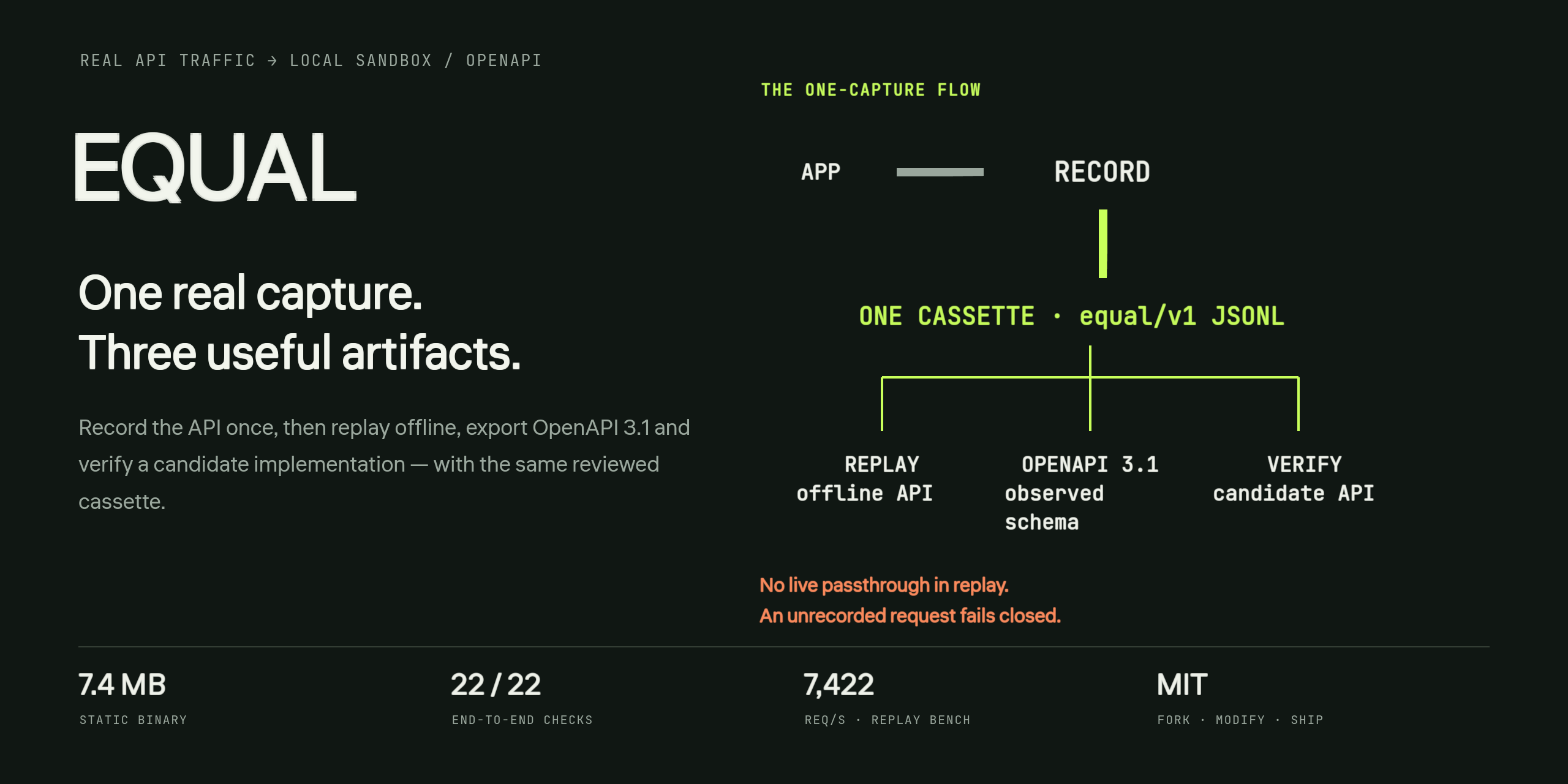
Turn real API traffic into a local sandbox and OpenAPI.
One 7.4 MB static binary. Any HTTP SDK. No runtime or account.
Linux · macOS · Windows · amd64 + arm64 · MIT
Install · 90-second start · Proof · Benchmarks · Website · Русский


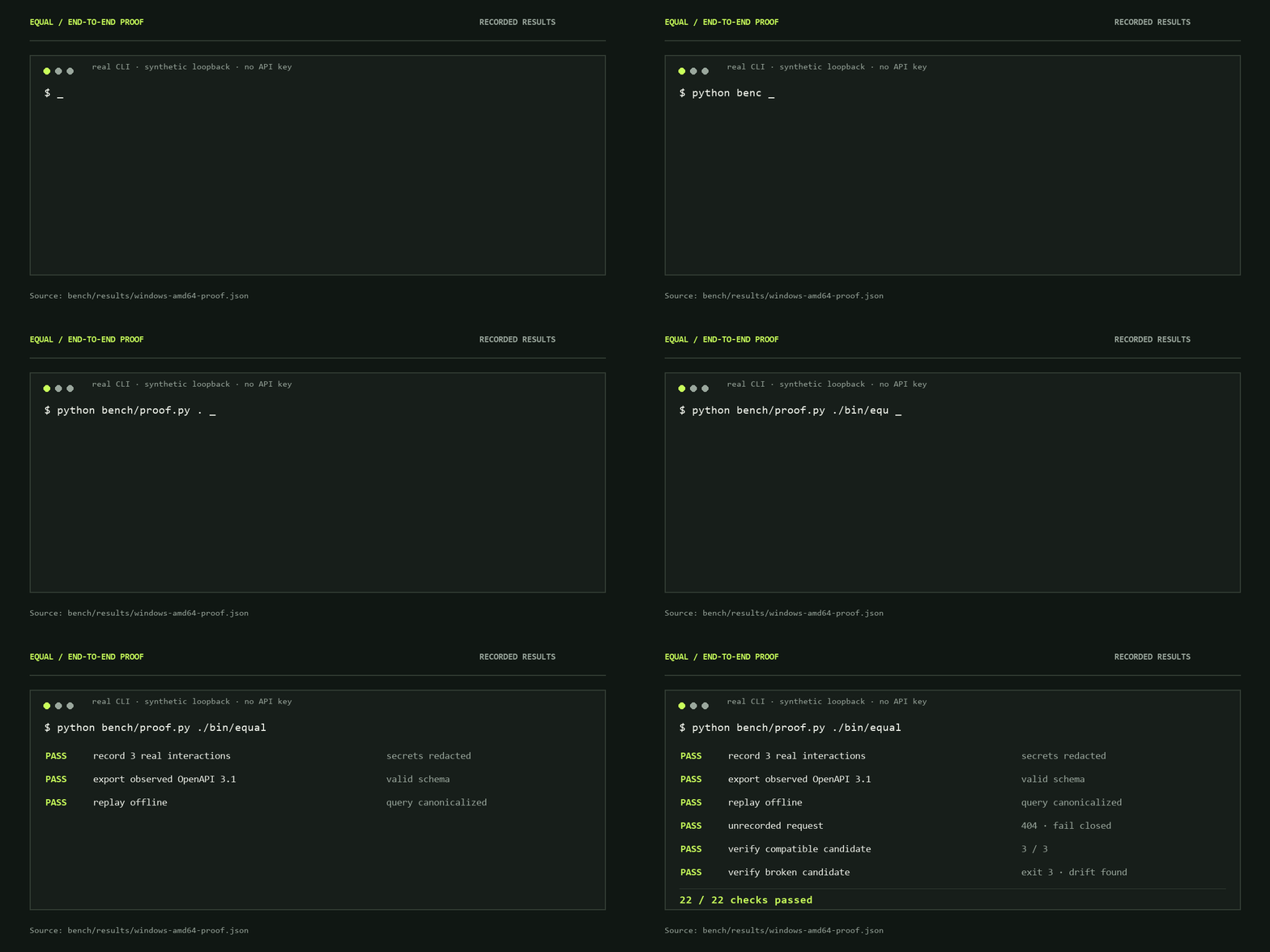
Recorded end-to-end proof: 22 checks passed · Run the proof yourself.
EQUAL lets you keep building when an API is unavailable, rate-limited, paid per call, or unsafe to trigger from CI.
Point your application at the local recorder and run its normal workflow once. EQUAL turns the observed requests and responses into three useful artifacts:
- A local API server that returns the recorded responses without contacting the provider.
- A portable JSONL cassette that you can review, edit, share, and version in Git.
- An OpenAPI 3.1 document for Postman, Prism, documentation tools, and SDK generators.
Your application only needs a configurable HTTP base URL. There is no language plugin, control plane, database, account, telemetry, or connector catalogue.
What this is useful for
- Offline development. Keep working on a plane, in a restricted network, or while the provider is down.
- Deterministic CI. Stop depending on sandbox availability, rate limits, and changing third-party data.
- Fewer live credentials. Record with a test credential, then run the local sandbox without the real secret.
- One fixture across stacks. Share the same cassette between Python, Node, Go, mobile, and CI jobs instead of maintaining a recorder per language.
- API documentation from reality. Export the observed endpoints and examples instead of writing the first OpenAPI draft by hand.
- Replacements and migrations. Optionally replay recorded requests against another implementation and inspect field-level differences.
EQUAL is a development and testing tool, not a production proxy. It proves only the traffic it recorded.
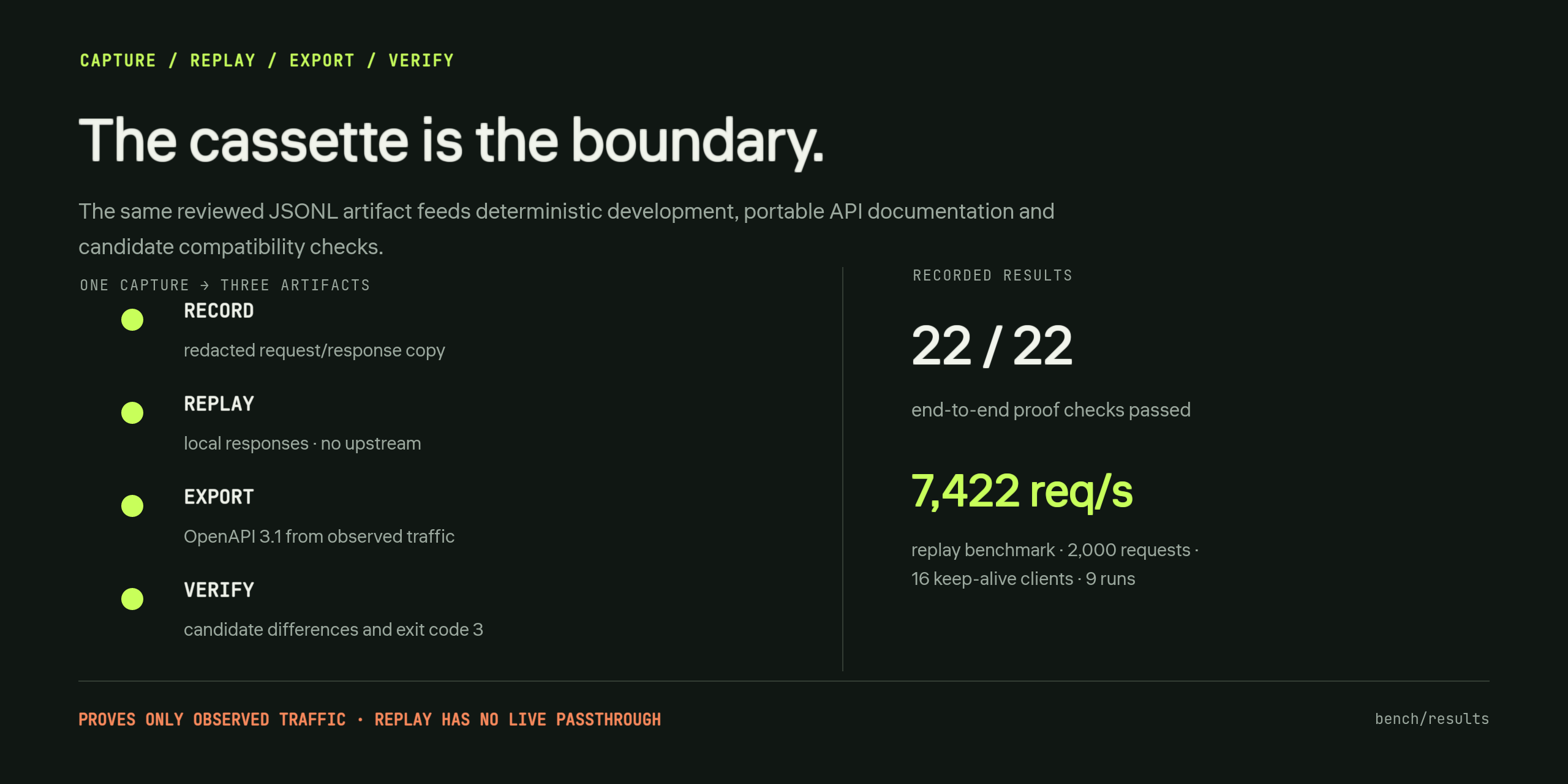
Replay has no upstream option or live passthrough. An unrecorded request fails closed. Architecture and invariants.
Install
Unix
curl -fsSL https://raw.githubusercontent.com/Balanov/equal/main/install.sh | sh
equal --version
Set EQUAL_VERSION=0.2.0 to pin a version and EQUAL_INSTALL_DIR to change $HOME/.local/bin.
Windows PowerShell
irm https://raw.githubusercontent.com/Balanov/equal/main/install.ps1 | iex
equal --version
Set $env:EQUAL_VERSION = "0.2.0" to pin a version and $env:EQUAL_INSTALL_DIR to change the install directory.
Go
With Go 1.26+:
go install github.com/Balanov/equal/cmd/equal@latest
Or build a checkout:
git clone https://github.com/Balanov/equal.git
cd equal
go build -trimpath -ldflags="-s -w" -o bin/equal ./cmd/equal
On Windows, use bin/equal.exe. Every release includes SHA-256 checksums. The binaries are not code-signed yet.
Start in 90 seconds
1. Record your application's real traffic
equal record \
  --target https://api.example.com \
  --cassette account.jsonl
The recorder listens on 127.0.0.1:8080. Set your application's existing API base URL to http://127.0.0.1:8080 and use it normally. For example:
curl http://127.0.0.1:8080/v1/account \
  -H "Authorization: Bearer $TEST_TOKEN"
Stop the recorder with Ctrl+C and review the cassette for sensitive data:
equal inspect --cassette account.jsonl
2. Run the local copy without the provider
equal replay --cassette account.jsonl
Run the same application against the same local base URL. The recorded responses come back without contacting the original provider. An unrecorded request returns an explicit 404 instead of silently reaching the network.
3. Export OpenAPI
equal export \
  --cassette account.jsonl \
  --out openapi.json \
  --title 'Account API'
Import openapi.json into your existing API tools. See the complete synthetic cassette and its generated OpenAPI document. The generated example was independently validated against the OpenAPI 3.1 schema.
Compare another implementation
This is an additional workflow for clean-room replacements, migrations, and rewrites:
equal verify \
  --target http://127.0.0.1:9000 \
  --cassette account.jsonl \
  --ignore-json '/request_id' \
  --ignore-json '/users/*/created_at' \
  --header 'Authorization: Bearer candidate-test-token' \
  --json compatibility-report.json
EQUAL sends the recorded requests to the candidate and compares status, Content-Type, Location, semantic JSON, and binary bodies. Exit code 0 means every observed interaction matched under your rules; exit code 3 identifies incompatibility. Use disposable test tenants because verification can trigger real side effects.
Commands
record
equal record --target URL --cassette FILE [options]
| Flag | Default | Meaning |
|---|---|---|
--listen ADDR |
127.0.0.1:8080 |
Local reverse-proxy listener |
--redact NAME |
built-in list | Additional header, query, or JSON field name; repeatable |
--no-redact |
false | Disable built-in redaction for controlled local fixtures |
--overwrite |
false | Replace an existing cassette |
--fsync |
false | fsync every recorded interaction |
--max-body BYTES |
16777216 |
Per-message body limit |
--timeout DURATION |
30s |
Upstream request timeout |
The live caller receives the original response; only the stored copy is redacted. Existing cassettes require explicit --overwrite.
replay
equal replay --cassette FILE [--strict] [--match-header NAME]
Matching uses method, escaped path, canonical query parameters, and the request body. JSON object key order and whitespace are normalized; array order remains significant. Repeated identical requests consume responses in capture order. --strict enforces the global interaction sequence.
Replay has no upstream option and no live passthrough mode.
export
equal export --cassette FILE [--out openapi.json] [--title NAME] [--api-version VERSION]
Without --out, the OpenAPI JSON is written to stdout. Output files are created without overwriting an existing file.
The document includes observed paths, methods, query parameters, JSON request bodies, response statuses, schemas, examples, binary content encodings, and interaction IDs. Numeric and UUID path segments become documented inferred parameters. Alternative responses are retained in a provenance extension.
This is an example-driven, incomplete specification, not the provider's authoritative schema. Unobserved endpoints and fields are absent. JSON array item schemas currently follow the first observed item; non-JSON request bodies are not described. Redacted examples remain redacted.
verify
equal verify --target URL --cassette FILE [options]
| Flag | Meaning |
|---|---|
--ignore-json POINTER |
Ignore a response JSON Pointer; * matches one segment; repeatable |
--compare-header NAME |
Replace the default compared response headers; repeatable |
--header 'Name: value' |
Inject candidate credentials or request headers; repeatable |
--json FILE |
Write a machine-readable report |
--max-body BYTES |
Per-message body limit |
--timeout DURATION |
Candidate request timeout |
inspect
equal inspect --cassette FILE [--json]
Print capture provenance, interaction count, redaction settings, methods, URIs, and statuses without network access.
Cassette format
The first line is an equal/v1 header. Every following line is one interaction:
{"format":"equal/v1","created_at":"2026-11-04T12:00:00Z","target":"https://api.example.com","redactions":["authorization","password"]}
{"id":1,"request":{"method":"GET","uri":"/v1/account","headers":{"Authorization":["[REDACTED]"]}},"response":{"status":200,"headers":{"Content-Type":["application/json"]},"body":"{\"plan\":\"free\"}","body_encoding":"utf8"}}
UTF-8 remains readable; non-UTF-8 payloads use base64. See architecture and invariants and SECURITY.md. Built-in redaction is a safeguard, not a privacy guarantee: inspect every cassette before sharing it.
Measured locally
Windows 11 AMD64, Go 1.27.3, EQUAL 0.2.0 and Hoverfly 1.12.17:
| Observation | EQUAL | Hoverfly | Scenario |
|---|---|---|---|
| Median process launch | 9.050 ms | 39.984 ms | 100 version launches, warm cache |
| Executable | 7,776,768 bytes | 22,234,112 bytes | Complete standalone binaries |
| Median replay batch | 269.472 ms | 551.879 ms | 2,000 unique GETs, 16 keep-alive clients |
| Median requests/s | 7,422 | 3,624 | Same replay scenario |
| Median working set | 14.57 MiB | 31.98 MiB | 2,000 loaded interactions |
The replay ratio is 2.05× in this exact scenario, not a universal performance ranking. Hoverfly provides a broader simulation and matching feature set. Startup/import was excluded; fresh server state was used for every batch. Raw samples and reproduction commands are in BENCHMARKS.md and bench/.
End-to-end proof
go build -o bin/equal.exe ./cmd/equal
python bench/proof.py ./bin/equal.exe
The proof drives the real executable through record → OpenAPI export → upstream shutdown → offline replay → compatible verification → intentional incompatibility. The recorded Windows run passed 22 checks, including OpenAPI generation, secret redaction, binary fidelity, fail-closed misses, reports, and exit code 3 on drift. It uses synthetic loopback services and needs no credentials or third-party Python packages.
Develop
gofmt -w cmd internal
go test -count=1 ./...
go test -race -count=1 ./...
go vet ./...
See CONTRIBUTING.md and docs/RESEARCH.md. Portable cassette tooling, public-SDK fixtures, precise bug reports, and performance reproductions are welcome.
The bilingual landing source lives in site/:
python bench/render_site.py
cd site
npm install
npm run dev
npm run build
The production site is static output in site/dist/; asset URLs work under /equal/.
Citation
@misc{balanov2026equal,
  title        = {EQUAL: Turn Real API Traffic into a Local Sandbox and OpenAPI},
  author       = {Balanov, Anton},
  year         = {2026},
  howpublished = {\url{https://github.com/Balanov/equal}},
  url          = {https://balanov.pro/equal/}
}
Related projects
- uncut — the lossless, headless coding-agent harness.
- shim — a local-first harness for any model, MCP servers and Agent Skills.
- latch — one tiny HTTPS contract between any agent and any service.
- verdict — a local semantic verifier for agent tool calls.
License
MIT. Fork it, modify it, ship it. See LICENSE.
Ähnliche Projekte entdecken
Wird geladen…